[First posted in AWOL 23 March 2021, updated 18 April 2024]
ISSN: 2700-3590

Teiresias Supplements Online is an open access venue for the publication of high-end research in Classical Studies. Supplementing the journal Teiresias Online Review and Bibliography of Boiotian Studies,
the mission of the series is to foster research on Central Greece and
its core region Boiotia. At the same time, the supplements have a wider
geographical range, branching out into the history and culture of the
Greek mainland and the Peloponnese, from the Bronze Age to Late
Antiquity. Read more.
Teiresias Supplements Online is a publication out of
Westfälische Wilhelms-Universität Münster, Germany. It offers a swift
two-step reviewing process. A detailed proposal is first examined by the
advisory board, and, if successful, the editors will forward the
submitted manuscript for peer review.
All inquiries and submissions should be directed to the series editors Fabienne Marchand and Hans Beck.
Chandra Giroux (ed): Plutarch: Cultural Practice in a Connected World. TSO Vol. 3, 2022.
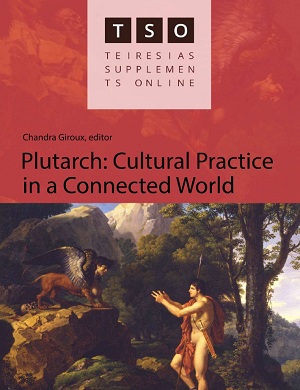
Plutarch and Chaironeia: the two are often synonymous, but Plutarch
was not confined to what might be considered a parochial experience.
Although Plutarch spent most of his life in his hometown, he travelled
extensively and developed friendships and ties to people throughout the
Roman Empire. In this way, his view of the world expanded from his local
environment to its regional affiliate, and ultimately, to what we may
consider the ‘global’ sphere. These three domains – local, regional, and
global –, often associated with particular forms of discourse, give
meaning to each other and orient Plutarch and his writings in their
world writ-large. Plutarch: Cultural Practice in a Connected World seeks
to understand how Plutarch engaged with cultural practices in the past
and present, and through the landscapes of his local, regional, and
global worlds. In this volume, contributors explore topics from dance to
athletics, groups of people (‘barbaroi’ and Romans), and places (Sparta
and Boiotia). The contributions, on their own and as a whole, shed new
light on our understanding of how Plutarch conceived of his
interconnected world.
Forthcoming Volume
Sebastian Scharff (ed): Beyond the Big Four. Local Games in Ancient Greek Athletic Culture. TSO Vol. 4, 2023.
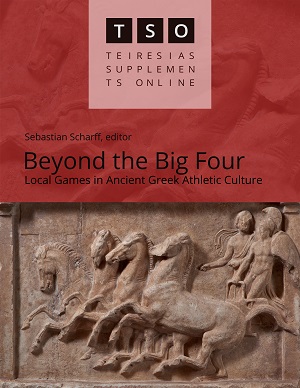 In the course of the sixth century BCE, the festivals of Olympia,
Delphi, Isthmia, and Nemea canonically emerged as the four most
important Greek athletic contests. Beyond these games, which are
comparatively well studied, there was a very large number of local
contests that shaped the agonistic world of Greek city-states. Focusing
on local, small-scale contests and the significance these festivals had
for their organizing communities, this volume explores the aspect of
competitions in the shadow of the Big Four. Most eminently, the book
explains how the contests served as occasions on which a local identity
was articulated; in this vein of inquiry, the assembled papers intersect
with recent research on localism in ancient Greece. The authors shed
light on all aspects of local athletic festivals, including the analysis
of local disciplines, prizes, and rules. They also consider local
catchment areas and ask what the games meant for each community: why and
when the games were founded, how many athletes participated, and what
role local sports heroes played in the political communities that put on
the show.
Back Volume
Salvatore Tufano: Boiotia from Within. The Beginnings of Boiotian Historiography. TSO Vol. 2, 2019.
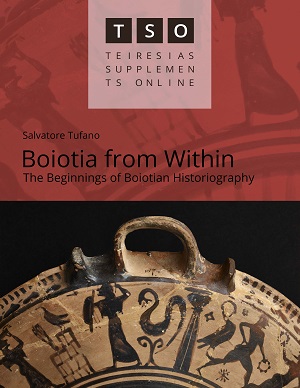 Boiotians
are not known as the most cultivated people. In Greek antiquity, they
were widely viewed as backward. The legacy continues: in several modern
languages, the term ‘Boiotian’ may be used as a synonym for ‘boorish' or
'rude.’ This volume challenges this reading through the study of a
specific cultural output: historiography. Not only, in fact, did Boiotia
give birth to memorable authors such as Pindar and Plutarch, but there
was also a lively historiographical scene. Between the end of the fifth
century BCE and the years of the Theban Hegemony (371-362 BCE), this
literary genre developed gradually in the region, speaking to a series
of critical societal themes: who are the Boiotians? What do they
believe? Why do the fighting roosters of Tanagra wear iron sticks?
Through a detailed commentary on the fragments of the first
historiographers of Boiotia (Hellanikos, Armenidas, Aristophanes, and
Daimachos), the author brings to life the local history of the region.
The volume unlocks a body of evidence, local historiography, which is of
pivotal importance for a multi-facetted approach to ancient Boiotia -
from within.
Back Volume
Hans Beck and Philip J. Smith (eds): Megarian Moments. The Local World of an Ancient Greek City-State. TSO Vol. 1, 2018.
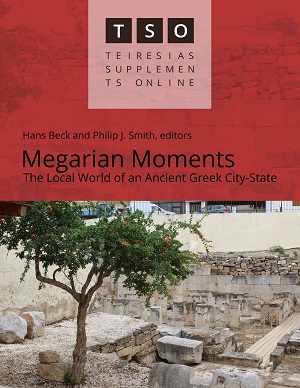 Situated
near the main traffic artery in Central Greece and surrounded by poleis
that were more powerful, the city-state of Megara was often a punching
bag of others. In neighbouring Athens in particular, the Megarians were
subject to all sorts of slander. The people of Megara, by default, had
their own assessment of the world and their role in it. A highway to
others, the Megarid, was a rich source of meaning and orientation to its
inhabitants. This local backdrop, often misunderstood as petty or
irrelevant, constituted a unique local discourse environment. Rather
than telling a narrative history of Megara – unravelling its local
history, as it were –, this volume delves into the local discourse of
this ancient city. The various contributions all shed light on the
prevailing identity of place, on what it meant to be from Megara. In
doing so, the book unpacks the vibrant local life in a Greek city-state.
In their endeavour to break the code of a local discourse and recreate
its environment, the editors and authors also invite readers to rethink
approximations toward the pluriverse of poleis in Greek Antiquity.




 Posts


 Stumble It!


