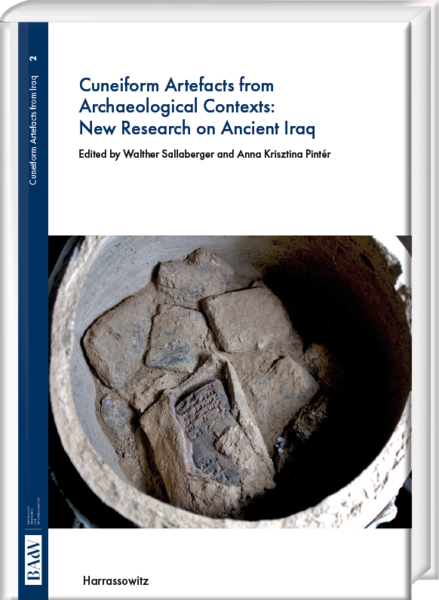
Sallaberger, Walther / Pintér, Anna Krisztina (eds.)
The resumption of systematic excavations in Iraq draws attention to
basic questions in the study of the Ancient Near East. How do
archaeological contexts contribute to the interpretation of clay tablets
and other cuneiform artefacts, as well as to the analysis of ancient
architectural remains? To what extent can assemblages of inscribed
objects provide evidence of ancient collections, archives, or libraries?
In which way do records from earlier excavations depend on their
respective research strategies?
CAI 2 brings together fifteen
contributions from experts in Cuneiform Philology (Assyriology) and
Ancient Near Eastern Archaeology. The articles pertain to different
sites in Iraq, including Kemune, Nineveh, Nimrud, Assur in Assyria, and
Sippar, Babylon, Nippur, Isin, Umma, Girsu, Uruk, and Ur in Babylonia.
The authors present results from ongoing research projects and address
methodological issues, terminologies, and material aspects regarding the
production, use, and preservation of cuneiform artefacts. The case
studies presented in this volume open new perspectives on the
methodology in interpreting both texts and buildings.
|
|
| series: |
|
| volume: | 2 |
| pages/dimensions: | VIII, 306 pages, 59 Abb., 24 Tabellen |
| language: | English |
| binding: | Book (Hardback) |
| dimensions: | 21.00 × 29.70 cm |
| weight: | 1117g |
| publishing date: | 26.08.2026 |
| prices: | 78,00 Eur[D] / 80,20 Eur[A] |
| ISBN: | 978-3-447-12587-1 |
| DOI: | 10.13173/9783447125871 |





 Posts
Posts


 Stumble It!

