La genèse des premières écritures suscite toujours beaucoup d’intérêt et
reste souvent mal comprise. Ce colloque a eu pour ambition de faire se
rencontrer des spécialistes qui travaillent sur différents systèmes
graphiques attestés au IVe millénaire en Égypte. Ils ont
examinés différents supports d’image à cette période, en Égypte et avec
des comparatifs en Mésopotomie, avant de s’interroger aussi sur le lien
entre l’écrit et l’image, la pratique graphique impliquée et le contexte
socio-culturel dans lequel cette transformation s’est produite et le
statut du signe. Il semble en effet que la relation entre le signe et le
support puisse être une clef de compréhension. Des pistes très
prometteuses et novatrices sont ouvertes par la prise en compte des
techniques de mémorisation de performances orales liées à la pratique
rituelle.
C’est au printemps 1929 que commencèrent les
fouilles régulières de la mission alors dirigée par Claude Schaeffer,
avec la collaboration de Georges Chenet, au mois d’avril à Minet
el-Beida, puis, dès le 9 mai, dans la région la plus élevée du tell de
Ras Shamra, où les fouilleurs découvrirent les vestiges de l’antique
Ougarit et de son port principal.
La même année, la revue Syria publiait les contributions des acteurs de ces premières découvertes.
Nous devons à Léon Albanèse, un collaborateur de Charles Virolleaud qui
dirigeait le Service des Antiquités en Syrie et au Liban, la première
description du site portuaire de Minet el-Beida :
« Cette anse a suffisamment d’eau pour
abriter les bateaux d’un certain tonnage et possède en outre une plage
de sable fin permettant de tirer au rivage des embarcations légères. Un
ruisseau d’eau douce, le Nahr el-Fidd se jette à la mer au sud de la
crique. Il est évident que ces lieux, favorisés par la nature, ont dû
être fréquentés par les marins dès les âges les plus reculés. D’abord
simple point de relâche avec aiguade, un comptoir d’échange s’y éleva
par la suite, précurseur lui-même d’établissements plus considérables »
(L. Albanèse 1929)
.
et à Claude Schaeffer, l’arrivée sur place :
« nous nous rendions à Minet-el-Beida,
le 30 mars 1929, avec une caravane de 7 chameaux portant nos bagages,
les routes et pistes étant à ce moment impraticables à l’auto. Nous
profitions des journées de Pâques pour installer notre camp et pour
prospecter le site, où nous avions bientôt recueilli sur un rayon de
plusieurs kilomètres des traces d’occupation depuis l’âge néolithique
(…) jusqu’à l’époque romaine ».
et la découverte des premières tablettes en écriture cunéiforme alphabétique, inconnue alors :
« Il s’agit d’une vingtaine de
tablettes environ, dont la plus petite mesure 3 x 4, la plus grande 16 x
21 cm., taille exceptionnelle. Suivant M. Charles Virolleaud à qui je
les ai soumises, la plupart de ces tablettes présentent un type
d’écriture nouveau et sont pour l’instant indéchiffrables. »
et déchiffrée dès l’année suivante.
Fouilles sur le tell de Ras Shamra (Mission de Ras Shamra, fonds Schaeffer, Collège de France).
Tablette RS 12.063 : abécédaire en ougaritique (Musée national de Damas)
À
l’issue de la première campagne, René Dussaud, conservateur au Louvre,
concluait déjà, en se fondant sur l’analyse de la documentation
archéologique, sur :
« la diversité des populations qu’on
rencontrait à Ras Shamra au cours de la seconde moitié du deuxième
millénaire » avant notre ère.
L’année 2019 a été l’occasion de dresser un
bilan de la longue tradition d’études pluridisciplinaires portant sur la
documentation issue de l’exploration du site de Ras Shamra depuis neuf
décennies et de souligner le dynamisme de la recherche par l’étendue des
enquêtes à mener, des voies à explorer, des approches à développer.
En 2022
La réalisation de nouvelles vidéos
La mise en ligne de dossiers thématiques : Le Palais royal d’Ougarit, L’eau à Ougarit
Un volume collectif dans la série RSO
« Le
caveau était rempli de terre jusqu’à la voûte… Elle avait pénétré dans
le caveau par un trou pratiqué dans la voûte par des violateurs qui
avaient visité et pillé la tombe très anciennement… Mais dans la hâte
avec laquelle ils semblent avoir opéré, ils n’avaient pas bien exploré
les coins du caveau où nous trouvions… une pyxide ovale en ivoire dont
le couvercle porte une fort belle sculpture. Elle représente une déesse
assise sur un autel, le torse nu, vêtue d’une ample jupe, tenant dans
les mains des épis et flanquée de deux boucs dressés sur leurs jambes
postérieures… Je ne puis ici entrer dans la discussion de cette curieuse
représentation de la potnia thérôn qui trahit nettement le style
mycénien et qui est comparable à l’ivoire, incomplet celui-ci, du Musée
d’Athènes, trouvé par Tsuntas à Mycènes même. »
L’ouvrage
Ougarit, un anniversaire, bilans et recherches en cours (Ras Shamra –
Ougarit XXVIII), édité grâce au soutien du Ministère de l’Europe et des
Affaires étrangères, de l’Académie des Inscriptions et Belles-Lettres et
de la Fondation Hugot du Collège de France, rassemble vingt-cinq
contributions.
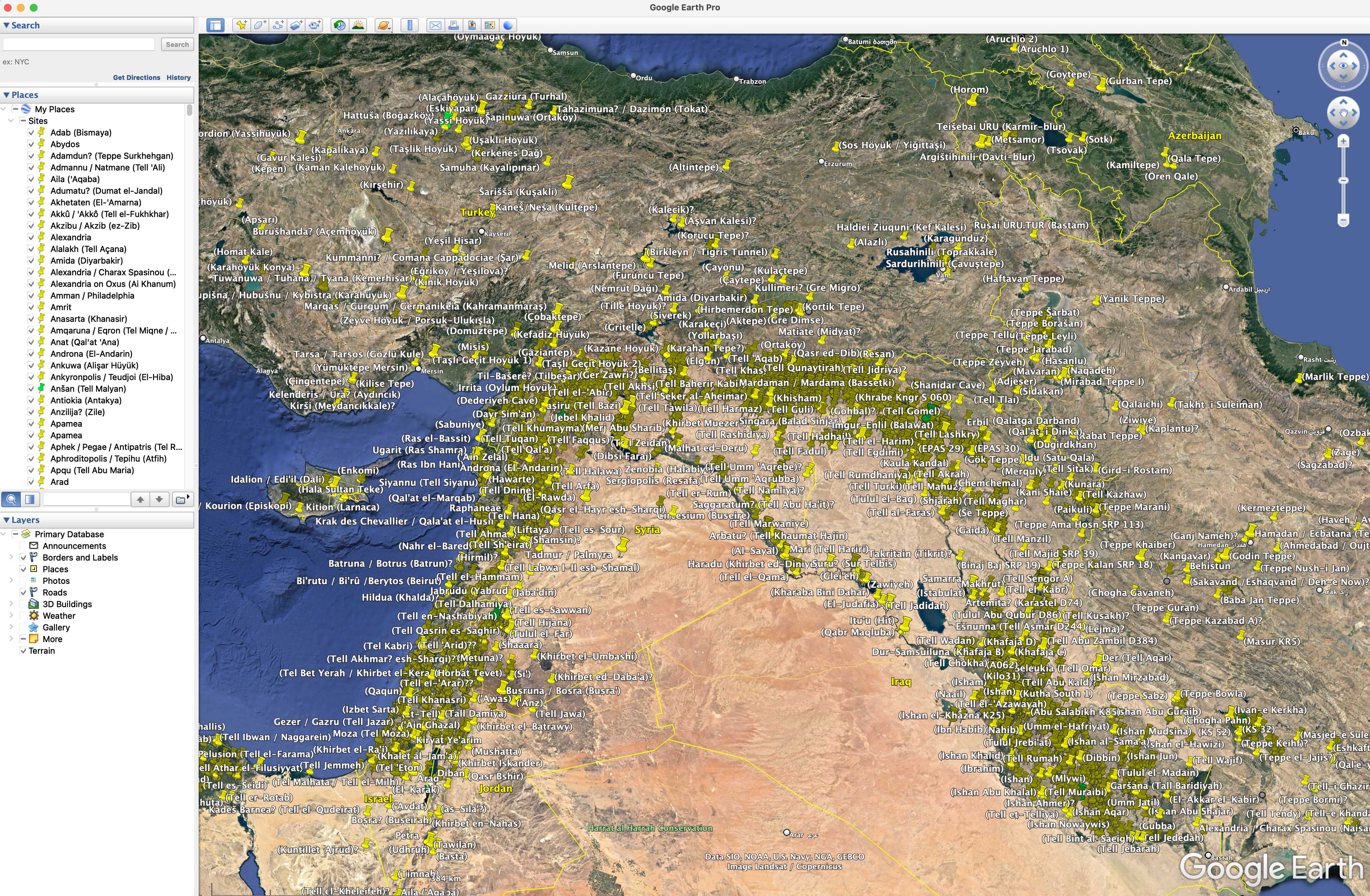
ANE.kmz is a set of site
placemarks for Google Earth of a selection of the most important
archaeological sites in the Ancient Near East. ANE.kmz works with Google
Earth Pro, which first has to be downloaded for free. When opened
inside Google Earth Pro, ANE.kmz gives, to the left, an alphabetic list
of ancient sites and, to the right, on the satellite images the same
sites marked. For the moment, there are some 2500 sites with modern
names; among them some 400 have ancient names. Additions of more sites
are planned. Ancient names are written without parenthesis. Modern names
are within parenthesis. Most sites have been identified on the
satellite images.
ANE Waters.kmz is an experimental set of provisional water placemarks for Google Earth covering Mesopotamia up to modern time.
ANE Picture.jpg is just illustrating the appearence of ANE.kmz before zooming in and is not for use.
The development started in 2007 with support from Uppsala
University, the Urban Mind Project at Mistra, and the Excellence Cluster
Topoi at Freie Universität Berlin. Early versions were hosted by
Uppsala University servers.
JEMAHS10.1, edited by Ann E. Killebrew and Sandra Scham, has been published on the Scholarly Publishing Collective (https://scholarlypublishingcollective.org/psup/jemahs/issue/10/1), and readers can access all content free of charge until April 1, 2022. In addition, all previously published JEMAHSvolumes
will be open access until April 1. After that date, one article of the
current issue will continue to be open access until June 30, 2022:
The Destruction of Cultural Heritage in Syria: The Case of Shash Hamdan Tomb 1 in the Upper Euphrates, 1995–2020
by Adnan Almohamad
A second article will be permanent open access:
Harald
Ingholt’s Twentieth-Century Archive of Palmyrene Sculptures: Unleashing
“Archived”: Archaeological Material in Modern Conflict Zones
Gregory Crane Tufts University March 25 Gregory.Crane@tufts.edu
Tufts University will offer two different sections of introductory
Ancient Greek in fall 2022, each of which takes a complementary
approach. Both sections of the class have been designed to exploit
increasingly powerful digital tools for understanding Ancient Greek and
other languages — the skills that you learn will also help you exploit,
and go far beyond, what you can do with translation, whether those are
literary translations by human beings or the product of systems such as Google Translate or DeepL.
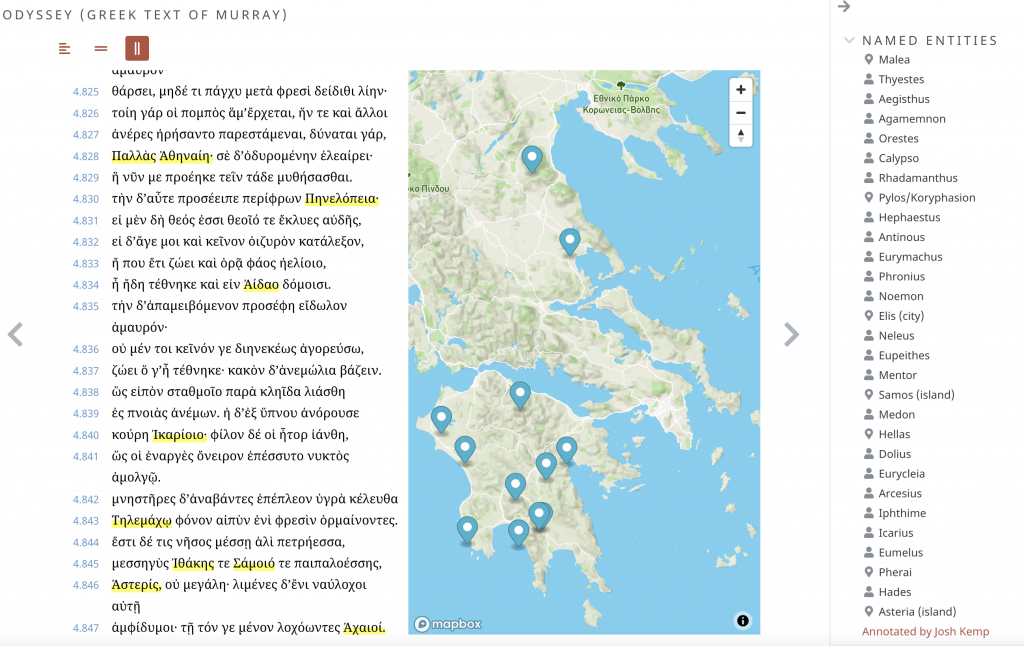
Both sections build directly on an emerging new version of the Perseus
Digital Library. Neither section has any prerequisites.
The first section will follow a textbook and will teach you to
produce, as well as to understand, ancient Greek. It will, however, also
give students far more exposure to ancient Greek source texts from the
opening weeks of the semester. The second section, which will be online
at a time to be determined, will focus on exploiting increasingly
sophisticated digital tools to analyze ancient Greek sources.
Figure
1: the first line of the Iliad with exhaustive annotation in a new
reading environment being developed for the Perseus Digital Library,
with translations and glosses into English and Persian. More than 1
million words of Greek has this level of linguistic annotation.
The first section follows a traditional textbook but exploits a range
of digital methods to enhance the experience of learning Ancient Greek,
providing substantial immediate feedback as you practice traditional
exercises. Instead of translating Greek into English or English into
Greek and then waiting days for correction, you will be able to receive
substantial feedback. We will also spend as much time possible seeing
how the vocabulary and grammar are used in actual Greek sources and
minimize use of artificial textbook Greek. The goal is to give you
active as well as passive command of the Greek. This section is better
suited to your needs if you feel you may wish to go beyond first year
Greek. It will meet Mondays and Wednesdays 3:00-4:15 PM local time.
This section will be primarily in person but will be open to those
who wish to participate remotely. If you are at an institution where you
can cross-register with Tufts (such as Boston College or Brandeis), you
would not have to travel across town — scheduling may prevent you from
taking your local introduction to Greek or you may wish to participate
in this novel approach. Those seeking credit should be able do so
through Tufts’ University College.
Figure
2: A translation of Iliad 1 by Amelia Parrish (Tufts ’21) designed to
be aligned at the word and phrase level with the Greek original to
expose the working of the source language.
The second section will meet online at a time to be determined. It
will focus entirely on reading and is designed for those who may have
only one year — or even one semester — to study Ancient Greek. This
second section represents a more radical departure from traditional
approaches as it focuses on annotated texts themselves and could be
applied to any corpus with sufficient annotation. After one semester,
practice with digitally enabled tools will allow you to compare a
translation of Homeric epic to the original Greek, to explore what the
words really mean in Homeric Greek (end not just how they are
translated), and to engage with the epics on your own. In the second
semester, you will be able to move on to more syntactically complex
sources such as Plato.
If space allows, we would particularly encourage participation in
this online section by students from outside of Tufts. We want to
understand how to apply this more radical departure from traditional
pedagogy. We are building on work done by Farnoosh Shamsian, Phd student
at the University of Leipzig and participants in this class will be
contributing not only to her research but to an ongoing reimagining of
how we work with historical languages.
Figure
3: Metrical analysis for the Iliad and Odyssey (and much else)
published by David Camberlain, with a recording of Camberlain reading
those lines: see the original with recording at Hypotactic.com.
We are aware of no modern language programs that will provide such
transferable skills. You will not only learn how to work with sources in
Ancient Greek but will have tools to analyze Latin as well as modern
languages such as French, German, and Italian but also Croatian and
Latvian, Arabic and Mandarin. Our goal is not to help you check into a
hotel or order dinner. Our goal is to allow you to work directly and
quickly with not only Ancient Greek primary sources but with scholarship
about these sources in a variety of modern languages. Our goal is to
transform who can participate in traditional scholarship about the
Greco-Roman world and then to enable new forms of scholarship and new
intellectual communities that were never possible in print culture.
Description of this version of Greek 1 as it appears in the course book for the Department of Classical Studies at Tufts University.
Greek 1: Fall 2022 Introduction to Ancient Greek Section 1: Monday/Wednesday 1:30-2:45 Section 2: To be scheduled. Gregory Crane, Professor of Classical Studies, Editor-in-Chief, Perseus Digital Library Christopher Petrik, Tufts ’24 Farnoosh Shamsian, Phd Candidate, Leipzig University
The
rise of digital methods and, increasingly, of machine learning has
begun to enable a transformation in the study of Ancient Greek. What you
can learn in an introduction to Ancient Greek can be far greater now
than was ever possible before. At the same time, what you can do with
what you learn will take you much farther now than was possible before.
Tufts University has been at the forefront of this transformation. In
taking Ancient Greek, you not only can benefit from this work but will
have an opportunity to contribute yourself, creating during the course
of first year Greek materials that will serve other language learners
and advanced researchers alike.
You will have more exposure to
authentic Greek in this introductory class than has ever been.
Exhaustive annotation exists explaining the function of more than a
million words of Ancient Greek while a new generation of translations,
designed to clarify the working of Greek for those who do not know the
language makes it possible to see how grammar and vocabulary actually
work in some of the most famous works of Greek literature, from the time
you learn your first words. The very same methods that you learn to
begin working with Ancient Greek have been applied to dozens of other
languages
A major barrier to learning historical languages has
been the slow pace and limited reach of the feedback that you receive.
You do an assignment one day, hand it in the next, and then see how you
did in the next class, two days or more later. When you practice what
you have learned, you will often be able to get immediate feedback and
then be able to practice what you have learned until you have mastered
it.
We offer two different sections, each with a
complementary approach aimed to serve different audiences. The first
section builds off of a traditional textbook, offering all exercises
online with immediate feedback. Class time will be devoted to questions
that you cannot resolve on your own and to seeing how what we have
learned in class helps us begin to understand real texts. Students will
also begin working with short passages from the Iliad and Odyssey,
Sophocles, Thucydides, Plato, and the New Testament. The second section
is designed to support those who may be able to devote only a year or
even a semester to the study of Ancient Greek. You will learn enough of
the grammar to understand the basic working of highly inflected
languages such as Ancient Greek (and Latin and Russian and many other
languages) but you will spend most of your time learning how to apply
the rich set of tools available to help you read Ancient Greek – and
many other languages. If you do choose to continue your study beyond the
first year, we will provide you with a framework by which you can do
that.
Videos from Youtube struggle to get hits. Many creators are placing
great work on Youtube, in the hope that their work will be noticed.
These videos are struggling to get seen; yet the same content on
Wikipedia is getting thousands to hundreds of thousands of video views.
A few caveats: Wikipedia statisitics don’t tell us much about the
interaction of users with video, such as the length of a ‘view’; and
they probably include people whose attempt to watch a video did not
work, because Wikipedia’s purist open standards “Web Matroska” videos
don’t play on iPhones and iPads.
Nevertheless, here are some of the statistics for the first brave
adventurers who were kind enough to take the plunge and release their
videos under a Creative Commons licence, so they could be added to
Wikipedia. These are total views; currently Latin videos are being seen
around 300,000 times a month on Wikipedia, and over 10,000 times a month
on Vicipaedia.
The lesson seems to be that if you want people to see your videos,
then Wikipedia is a much better bet than Youtube, if it is the right
topic. Videos of Roman roads, Cicero, Jerusalem and Catullus are getting
a lot of views on Wikipedia, as they are on very popular pages, and are
seen by a large, English speaking audience. That audience is clearly
interested and curious to listen to the Latin they find.
Vicipaedia now also has a Pellicula Mensis, hosted on their front page,
which is getting around 10,000 views a month. While other videos on
other pages may get less views, they are of course reaching a
Latin-using audience who can see and hear first hand from other people
speaking Latin.
This raises two obvious questions: why then, are so few people
contributing video to Wikipedia; and what do people need to do to get
more, very popular Latin language content onto Wikipedia?
On the first, people do not think about Wikipedia for video; or at
least have not. I think this will change over time. However there is a
different mindset required for Wikipedia; care and attention is needed
to ensure you do not violate copyright, are truthful and accurate, and
so on.
Use of Unsplash images or royalty free music is not compatible
with Wikipedia’s fully open CC-By-SA licence; you can’t just use what
you find on Google image search. Try WordPress Openverse search instead
Material needs to be factual, accurate and generally about something
Think about what people want to learn about on Wikipedia
There are also, to be frank, issues of technical barriers that get in
the way. Open Latin project will help with this, if you would like.
Wherever the videos, and whether they are watched by people who are
interested or skilled in Latin, Wikipedia offers a stronger and more persistent audience than Youtube for most creators, as relevant videos can stay in prominent locations for a long time.
Most of us will find it takes years of effort to get tens of
thousands of Youtube views, with a small number of Yotube stars
dominating what Youtube shows their audience; the model is based on
familiarity with personality of presenters and the channel rather than
content as such. Content is valued if it appears exciting (“engaging”),
rather than if it is useful or informative per se.
However, the first person to record a video and place it on Wikipedia
of any of the following is pretty much guaranteed a mass audience, as
the reverse is true of Wikipedia; the topic is everything:
Wikipedia page
Video reading
Page views per month
Julius Caesar
Gallic war
200,000
Cicero
Speeches
90,000
Aeneid
Exerpt
40,000
Erasmus
Stultitiae Laus
10,000
Isaac Newton
Principia
220,000
Thomas More
Utopia
70,000
Potential video audience on Wikipedia
You get the idea. There are many very famous Latin texts that are
well known, culturally important, and will be listened to by audiences
on Wikipedia and Wicipaedia. Many already exist on Youtube, and could
easily be relicenced by their authors and added. If you are a creator,
why not give it a go?
The AWOL Index: The bibliographic data presented herein has been programmatically extracted from the content of AWOL - The Ancient World Online (ISSN 2156-2253) and formatted in accordance with a structured data model.
AWOL is a project of Charles E. Jones, Tombros Librarian for Classics and Humanities at the Pattee Library, Penn State University
AWOL began with a series of entries under the heading AWOL on the Ancient World Bloggers Group Blog. I moved it to its own space here beginning in 2009.
The primary focus of the project is notice and comment on open access material relating to the ancient world, but I will also include other kinds of networked information as it comes available.
The ancient world is conceived here as it is at the Institute for the Study of the Ancient World at New York University, my academic home at the time AWOL was launched. That is, from the Pillars of Hercules to the Pacific, from the beginnings of human habitation to the late antique / early Islamic period.
AWOL is the successor to Abzu, a guide to networked open access data relevant to the study and public presentation of the Ancient Near East and the Ancient Mediterranean world, founded at the Oriental Institute, University of Chicago in 1994. Together they represent the longest sustained effort to map the development of open digital scholarship in any discipline.


 Parutions
 Colloques & conférences
 Parutions






 Posts


 Stumble It!