It has been a busy year for the Coptic Magical Formularies project. We have been working hard towards the publication of the second volume of Papyri Copticae Magicae. We estimate that this will be about four hundred pages long, and consist of three major archives – the British Library Portfolio, the Michigan Coptic ‘Wizard’s Hoard’, and the Collège de France Coptic magical archive. These archives give us an excellent range of perspectives on what different types of magical handbooks looked like, and the ways in which their copyists and users produced and interacted with them. We hope that the full draft of the volume will be finished in 2027, with publication following shortly thereafter.
As part of our work on these exceptional manuscripts, we decided for the first time in July of this year to publish our drafts of unpublished texts online in our database, Kyprianos. The full details can be found in our update notes, but this increased the number of texts in the database by over a third, to 355. We will continue to improve the text and notes of these editions, but we hope that in the meantime it will be useful to colleagues and others interested in Coptic magic to have access to these previously untranslated texts.
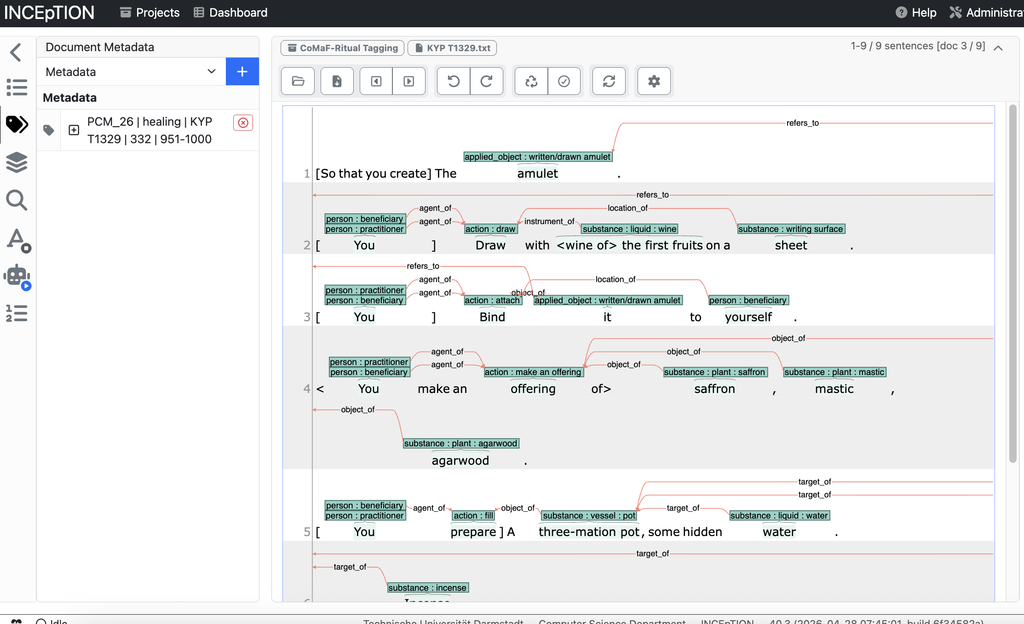
The team has also been working on a new ritual tagging system using the INCEpTION platform. The aim of the tagging is to identify ritual patterns in relation to ritual elements. In practice, when enough texts are tagged, we hope to trace patterns across rituals, such as these: Which types of rituals used wine? In which rituals was it required to draw an angelic figure? Is there a particular relationship between, e.g., the use of oil and favour spells? Electronic tagging of ritual elements might help us identify connections which we would otherwise miss.
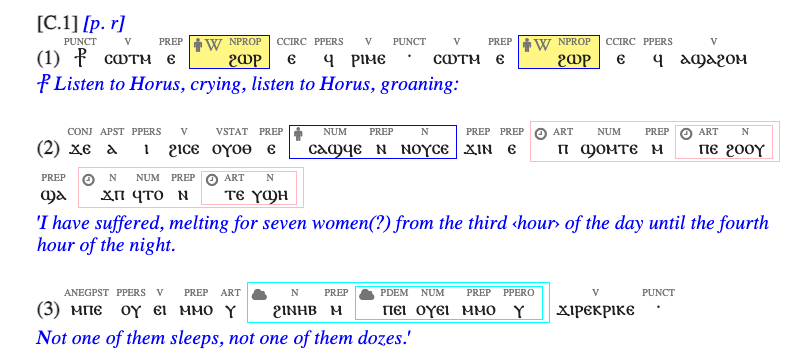
An example of Analytic Visualisation of a Coptic Magical text in Coptic Scriptorium
We have also been working with the fantastic Coptic Scriptorium project to make magical texts available through their platform in a lemmatised format. This work is particularly valuable, since it makes them searchable through ANNIS, linked to the Coptic Dictionary Online, so that research on Coptic grammar and lexicography using these resources will be able to take into account magical material alongside literary texts.
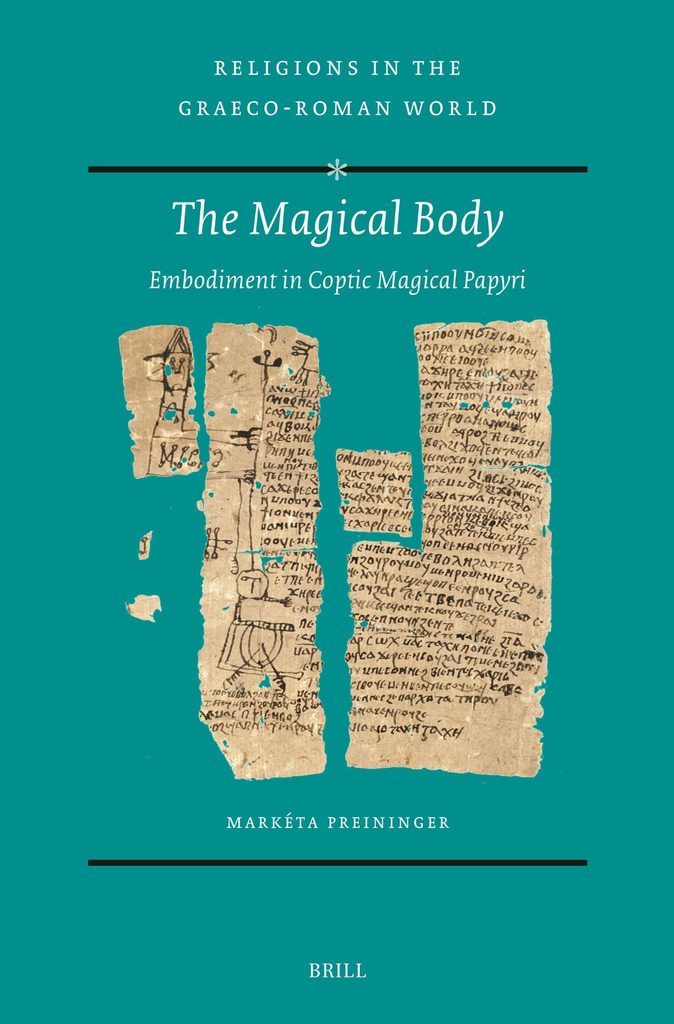
Markéta Preininger, The Magical Body: Embodiment in the Coptic Magical Papyri. Religions in the Greco-Roman World 202, Leiden (Boston: Brill, 2026). The lived experience of individuals from Late Antique and Early Islamic Egypt is the subject of this study. By focusing on Christian ritual texts for private use written in Coptic, this book gives voice to those whose lives the ancient manuscripts reflect, revealing how they used ritual practices and amulets to navigate fear, health, and social conflicts. Reconstructing various “bodies”—from the social, female to the divine—the book explores the intersection of ritual action and bodily metaphor. This volume offers a unique, intimate glimpse into the lived religion and private lives of a long-lost world.
Korshi Dosoo, ‘Medea, the Magi, and the Memorandum of Aeëtes: Notes on the Mithras Liturgy’, in From PGM IV to GEMF 57: New Approaches to the Great Paris Magical Codex, edited by Christopher Faraone and Sofía Torallas Tovar. Berlin: De Gruyter, 2026, 233–273. Since it was given its name by Albrecht Dieterich in 1903, the so-called “Mithras Liturgy” of the Great Magical Papyrus of Paris has become the most famous of the texts of the Greek magical papyri, re-edited and translated numerous times. Much of the discussion surrounding it has focused on its cultural background – is it, as Dieterich suggested, an adaptation of a liturgical text produced by a Mithraic cultic group, or should it be understood rather an initiatory text produced by Egyptian priests in Alexandria, or is the apparently Mithraic and Egyptian content merely a frame for a primarily Stoic, Neoplatonic, or Pythagorean worldview? This article approaches the question from a different angle, beginning with new readings produced in the course of the Greek and Egyptian Magical Formularies project. The new edition suggests that the Mithras Liturgy is a letter from Aeëtes, legendary king of Colchis, to his daughter Medea, situating it in the tradition of pseudonymous treatises written by legendary figures of the past to their children, produced in late Hellenistic and Roman Egypt. This new framework helps us to understand both minor details of the text as well as its overall structure and content.
Korshi Dosoo, ‘Magic as Cultural Crossroads’, in A Cultural History of Magic. Vol. 1. Antiquity, edited by Esther Eidinow and Richard Gordon (London: Bloomsbury, 2025, 49-69). From their discovery in the 19th century, the Graeco-Egyptian and Coptic magical manuscripts have been understood as a complex melange of Greek, Egyptian, Jewish, Christian, “Gnostic”, and Mesopotamian elements, though at different times, and in the work of different scholars, some of these elements have be stressed, leading to others being downplayed or even denied. This takes these questions, and the similar problems surrounding the later Greek and Coptic material from Christian Egypt, by first providing an overview of the evidence for different cultural influences in the corpus of magical texts from Roman Egypt in Demotic, Greek, and Coptic from the 1st century BC to the 7th century AD.
Markéta Preininger, “Transforming Words into Efficacious Objects: The Case of the Bleeding Woman,” Quotidiana 1 (2025): 29–54. The miraculous healing of the bleeding woman, Haemorrhoissa, as known from Mt 9:20‑22, Mk 5:25‑34, and Lk 8:43‑48, has been reinterpreted and inscribed onto several ‘magical’ objects to help women recover from gynecological hemorrhage in Egypt (and elsewhere) during the sixth or seventh century. The retelling of the story and the mechanics of healing through these efficacious objects are the focus of this article.
As always, if you would like to read an article produced by a team member, but don’t have access to it, please feel free to contact us to receive an offprint. In the meantime, thanks to everyone who has reached out to us, read our work, and supported us over the last year!
The AWOL Index: The bibliographic data presented herein has been programmatically extracted from the content of AWOL - The Ancient World Online (ISSN 2156-2253) and formatted in accordance with a structured data model.
AWOL is a project of Charles E. Jones, Tombros Librarian for Classics and Humanities at the Pattee Library, Penn State University
AWOL began with a series of entries under the heading AWOL on the Ancient World Bloggers Group Blog. I moved it to its own space here beginning in 2009.
The primary focus of the project is notice and comment on open access material relating to the ancient world, but I will also include other kinds of networked information as it comes available.
The ancient world is conceived here as it is at the Institute for the Study of the Ancient World at New York University, my academic home at the time AWOL was launched. That is, from the Pillars of Hercules to the Pacific, from the beginnings of human habitation to the late antique / early Islamic period.
AWOL is the successor to Abzu, a guide to networked open access data relevant to the study and public presentation of the Ancient Near East and the Ancient Mediterranean world, founded at the Oriental Institute, University of Chicago in 1994. Together they represent the longest sustained effort to map the development of open digital scholarship in any discipline.


 Posts


 Stumble It!


No comments:
Post a Comment