Doctor of Philosophy, The Ohio State University, 2021, History
Less Committee: Greg Anderson (Advisor); Kristina Sessa (Committee Member); Anthony Kaldellis (Committee Member)
Doctor of Philosophy, The Ohio State University, 2021, History
Less Committee: Greg Anderson (Advisor); Kristina Sessa (Committee Member); Anthony Kaldellis (Committee Member)
Doctor of Philosophy, The Ohio State University, 2024, Anthropology
Less Committee: Debbie Guatelli-Steinberg (Advisor); Douglas Crews (Committee Member); Mark Hubbe (Committee Member); Clark Larsen (Advisor)
Doctor of Philosophy, The Ohio State University, 2024, Greek and Latin
Less Committee: Sarah Johnston (Advisor); Harriet Fertik (Committee Member); Tom Hawkins (Committee Member); Fritz Graf (Committee Member)
Editorial project
Archaeology in Greece Online combines the Chronique published annually in the BCH by the French School at Athens, and Archaeology in Greece published as part of the annual Archaeological Reports by the Society for the Promotion of Hellenic Studies and the British School at Athens (which continues to appear in print in a new review format).
The project is managed jointly by the French School at Athens and the British School at Athens: data processing is divided by region and reflects the traditions, history and research foci of the two schools. Texts are thus either in English or in French, but the search engine draws on the entire database regardless of language.
Collaborators
The Chronique team of the French School at Athens consists in 2026 of Véronique Chankowski (School Director), Guillaume Biard (Director of Studies in Antiquity and Byzantine Studies), Catherine Bouras (editorial secretary), and Louis Mulot (Developments). Entries on Cyprus are written by Sabine Fourrier (CNRS). The drafting of entries is regularly entrusted to scientific members of the School. For the British School at Athens, the team consists of Rebecca Sweetman (School Director), Georgios Mouratidis (Assistant Director), and Kostis Christakis (Knossos Curator).
Past collaborators : Laurianne Sève, Amélie Perrier, Julien Fournier, Arthur Muller, Directors of Studies in Antiquity and Byzantine Studies, Alexandre Farnoux, Dominique Mulliez (Directors) , Catherine Aubert, Publications assistant, Catherine Morgan, John Bennet, Directors, Robert Pitt, Chryssanthi Papdopoulou, Michaeol Loy, assistant directors.General Information
The inclusion of material in Archaeology in Greece Online does not constitute its formal publication.
The EfA and the BSA cannot supply copies of illustrations here reproduced to which they do not hold copyright.
Website
This website has been entirely redeveloped during the year 2018 at the EfA by Louis Mulot (Software engineer) and G. Bejjaji (trainee in the IT department).
The site has been tested with different browsers (for computers, phones and tablets) in their most recent versions, supporting actual HTML standards. It is strongly recommended that you update your browser to avoid problems with display, animation, content management, and security.
Refer to the official site of your web browser for more information.
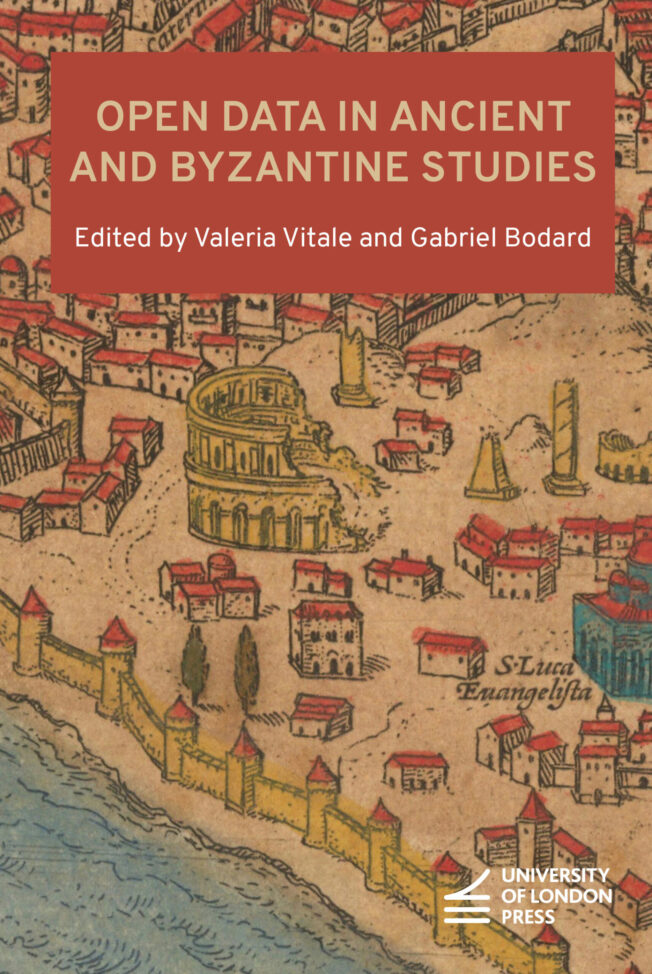
This volume presents case studies in classical and Byzantine research that exemplify practices, structures and standards in open data which transform and subvert historical scholarship. It leverages new data publication methods and embeds them as part of its argument, exploring the potential of non-linear discourse, multimedia content and data visualisation. Individual chapters illustrate how open scholarship enables a shift from authority-based interpretative frameworks to transparent, collaborative approaches, and combining datasets allows for analysis and comparisons at unprecedented scales, empowers researchers and elicits creative and original responses to old and new research questions.
Collaborative practices and data models lead historians to reflect rigorously and openly on assumptions, definitions and biases, encouraging more diverse approaches to interpretation of ancient sources. The different perspectives, methodologies, disciplines and research questions showcased in this book highlight the role of open data and code in the pursuit of historical research questions and the creation of new knowledge. It demonstrates that methods like linked open data, open licensing, documentation of standards and the publication of code influence the development of open data, tools and workflows, and are in turn nourished by a rich, sustainable classical open data ecosystem.
Published in association with: Institute of Classical Studies
Creative Commons Attribution-NonCommercial-NoDerivatives 4.0 International License
Introduction
Valeria Vitale and Gabriel Bodard1 Historical authority and the prosopography of the Byzantine world: from factoids to assertions
Tara Andrews2 Connecting late antiquities: challenges and opportunities for prosopographical data
Charlotte Tupman & Richard Flower3 Venetian officals in sixteenth-century Cyprus: An online database and a pilgrimage account
Tassos Papacostas4 Connections through collections: linking archaeological and epigraphic archives through places and people
Alessandra Giovenco & Nurdan Atalan Çayırezmez5 Engraving the soil: the challenges of defining spatial footprints in Cypriot cultural heritage
Stuart Dunn6 You can’t step into the same dataset twice: iterative improvement through reuse of open Libyan place data
Valeria Vitale7 The makeup of Ajax: reconstructing networks of interpretation through the commentary tradition
Charles Pletcher & Matteo Romanello8 Traces of lost libraries in the works of Alexandrian and Byzantine scholars: bibliographic open data from antiquity to Wikimedia
Monica Berti9 Digital epigraphy at Dura-Europos: toward a FAIR-er inscriptional corpus
Anne Hunnell Chen, Carl R. Rice, Ilaria Bucci & Jennifer A. Baird10 Reception of Sapphic language in Hadrianic verse epigraphy: building on open philological data
Marja Vierros & Gabriel Bodard11 The next decade of Byzantine sigillography: the impact of open data as collaboration
Martina Filosa, Jonathan Shea & Alessio Sopracasa
Doctor of Philosophy, The Ohio State University, 2024, Greek and Latin
Less Committee: Fritz Graf (Advisor); K.A. Rask (Committee Member); Gaia Gianni (Committee Member)
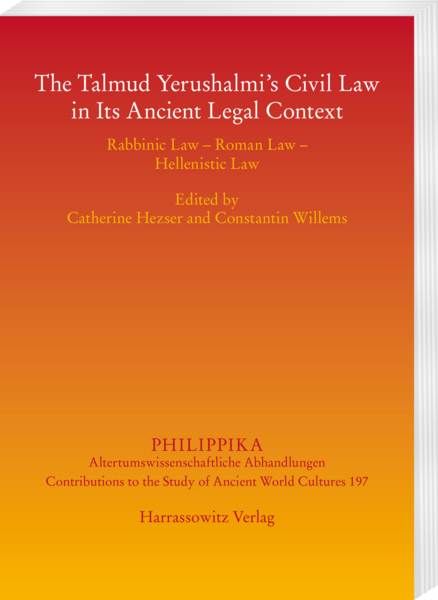
The Talmud Yerushalmi’s Civil Law in Its Ancient Legal Context provides a historical and comparative examination of legal issues that were shared by both rabbis and jurists during the Roman-Byzantine period. The topics covered concern slaves and manumission, women and property, house building and ownership rights, the treatment of laborers, liability for wild animals, and the broader issue of surveillance and accountability of citizens in the Roman world.
The chapters are written by historians of Roman law as well as scholars of rabbinic literature and ancient Judaism. They reveal the shared interest of rabbis and jurists in specific legal issues, their attention to the same details, similarities in legal solutions, and interesting differences that point to social, cultural, and religious concerns. The interdisciplinary volume exemplifies how the inclusion of rabbinic legal traditions in the study of ancient legal systems enables a better understanding not only of Jewish law but also of Roman legal culture and social practice in late antiquity.
pages/dimensions: VIII, 178 pages language: English binding: Book (Paperback) dimensions: 17.00 × 24.00 cm weight: 307g publishing date: 14.10.2026 prices: 49,00 Eur[D] / 50,40 Eur[A] ISBN: 978-3-447-12607-6 DOI: 10.13173/9783447126076


 Posts
All Comments
Posts
All Comments






 Stumble It!