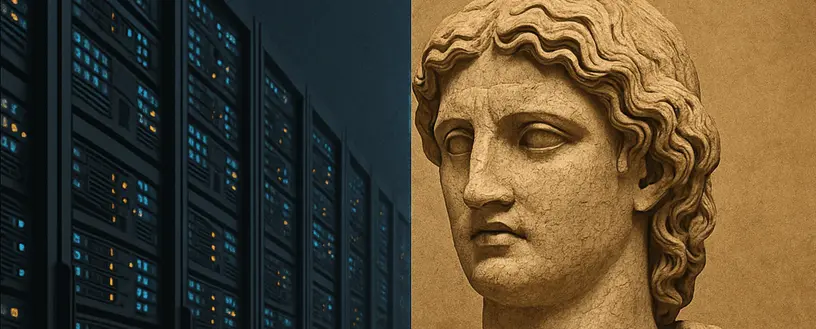
Founded in 2025, AI & Antiquity: Journal of Teaching and Technology in Ancient Studies (ISSN 3081-4553) was established on the conviction that Ancient Studies—encompassing history, archaeology, philology, and art history—urgently require a dedicated forum for critical reflection on pedagogy, teaching practices, and the transformative role of digital technologies in education. In a scholarly environment where research often takes precedence, this journal places teaching at the centre of attention: as a fundamental, creative, and intellectual dimension of professional practice in the study of the ancient world.
The journal’s mission is to foster dialogue among researchers, educators, and technologists committed to inclusive, active, and innovative pedagogies for engaging with the past. AI & Antiquity gives particular attention to perspectives historically overlooked in scholarship—especially those of women and other underrepresented groups—alongside the experiences of neurodivergent students and educators. As an online publication, it provides a dynamic platform for exchanging ideas and practices across disciplines and geographies. While artificial intelligence occupies a central place in this conversation, the journal also embraces a wide spectrum of digital tools—from immersive environments and data visualisation to collaborative platforms and gamified learning strategies—with the aim of reshaping how Antiquity is taught and learned in the 21st century.
AI & Antiquity is published under the umbrella of the Center for Innovation in Ancient Worlds (CIAW), a non-profit academic framework designed to sustain the journal and to foster new initiatives at the intersection of Ancient Studies, pedagogy, and digital innovation. Through CIAW, the journal benefits from a stable institutional base while remaining an independent academic initiative. It also counts on the support of the Area of Ancient History, Department of Sciences of Antiquity and the Middle Ages, Universitat Autònoma de Barcelona.
Drawing on the expertise of a distinguished editorial team and an international advisory board, AI & Antiquity ensures academic excellence, fosters interdisciplinary innovation, and seeks global relevance in every contribution it publishes.
Volume 2, Issue 2 (2026) of AI & Antiquity, devoted to “Neurodiversity and Antiquity,” explores how Ancient Studies can move from a model centred primarily on individual accommodation towards more inclusive forms of educational design. Its contributions examine the intellectual strengths associated with neurodivergence, the experiences of neurodivergent educators, the reduction of barriers in tutorials and online learning environments, and alternative ways of structuring assessment without lowering academic standards. A central argument running through the issue is that inclusion does not mean making learning easier, but distinguishing more carefully between the disciplinary competences that must remain constant and the pedagogical conventions that can legitimately vary. The issue is dedicated to all neurodivergent people, whose experiences and perspectives enrich how we teach and understand the world.
The issue also connects these questions with the critical use of digital technologies and artificial intelligence. Several contributions show how AI can become an object of historical and pedagogical analysis rather than simply a tool to be adopted or prohibited, and how meaningful AI literacy depends on foundational skills such as critical reading, source evaluation, error detection, and argumentation. The three book reviews extend these concerns to digital competence in higher education, student attendance and participation, and the educational effects of Discovery Tour: Ancient Greece, reinforcing a common principle: educational innovation has value when it demonstrably supports learning, accessibility, and critical judgement.
Full Issue available in PDF:
Download PDFTable of Contents
Editorial
Articles
Reviews
See AWOL's full List of Open Access Journals in Ancient Studies




 Posts
Posts


 Stumble It!


No comments:
Post a Comment