[First posted in AWOL 15 July 2019, updated 7 June 2026]
Showing posts with label South Arabia. Show all posts
Showing posts with label South Arabia. Show all posts
Sunday, June 7, 2026
Monday, May 30, 2022
DASI: Digital Archive for the Study of pre-Islamic Arabian Inscriptions
[First posted in AWOL 31 January 2013. Updated when the site relaunched 30 May 2022]
DASI: Digital Archive for the Study of pre-Islamic Arabian Inscriptions
DASI: Digital Archive for the Study of pre-Islamic Arabian Inscriptions

DASI seeks to gather all known pre-Islamic Arabian epigraphic material into a comprehensive online database, with the aim to make available to specialists and to the broader public a wide array of documents often underestimated because of their difficulty of access.
By means of a digitization process through a hybrid data entry/xml system, DASI gives access at present to more than 8,400 Ancient South Arabian inscriptions and 600 more anepigraphic objects, for the most part recorded by the University of Pisa team under the direction of Alessandra Avanzini. Thanks to the collaboration with other major European centres for the study of the Arabian Peninsula, also parts of the corpora of the Ancient North Arabian inscriptions (supervision by Mr. M.C.A. Macdonald, University of Oxford), Nabataean inscriptions (supervision by Dr. Laila Nehmé, UMR 8167, CNRS-Paris) and other Aramaic inscriptions (soon available, under the supervision by Dr. Maria Gorea, Université de Paris VIII) have been digitized.
DASI project was funded by the European Community within the Seventh Framework Programme “Ideas”, through an ERC – Advanced Grant awarded to Prof. Alessandra Avanzini at the University of Pisa (2011-2016). The Scuola Normale Superiore di Pisa, additional participant of the project, was responsible for the technical development of the archive, which is now maintained at the Consiglio Nazionale delle Ricerche, Rome.
Projects

Corpus of South Arabian Inscriptions
The ASA (Ancient South Arabian) corpus is one of the most interesting collections of epigraphic documents of the Semitic world, first and foremost for its vastness. With its over 15,000 inscriptions, it is the first-hand, written documentation of the culture that flourished in South Arabia from the late second millennium BC to the sixth century AD. At present, CSAI contains a collection of some 8,400 texts, for the most part digitized by the team of the University of Pisa under the direction of A. Avanzini.
Online Corpus of the Inscriptions of Ancient North Arabia
The Online Corpus of the Inscriptions of Ancient North Arabia (OCIANA) is a project of the Khalili Research Centre of the University of Oxford, directed by J. Johns and M.C.A. Macdonald. It aims to present an easily updatable, online edition of all known Ancient North Arabian inscriptions: Taymanitic, Dadanitic, Hasaitic, Safaitic, Hismaic and Thamudic.
Corpus of Aramaic Inscriptions
The Corpus of Aramaic inscriptions on DASI is composed of inscriptions found in Taymāʾ and its region and in the Gulf in the Achaemenid and post-Achaemenid periods. The corpus of Aramaic inscriptions is under the supervision of Maria Gorea (Université Paris VIII).
Corpus of Nabataean Inscriptions
The Corpus of Nabataean inscriptions on DASI has been accomplished thanks to the agreement with the CNRS laboratory UMR 8167 – Mondes Sémitiques, under the scientific supervision of L. Nehmé.
Saturday, January 16, 2021
The Glaser Collection :3D-Digitizing of Rare Ancient South Arabian Squeezes, 19th Century Glaser Collection
[First posted in AWOL 5 August 2017, updated 16 January 2021]

The collection of the Austrian scholar and explorer Eduard Glaser (1855-1908) was acquired in 1910 by the Academy of Sciences in Vienna. The epigrapher and specialist in the South-Arabian language brought back a huge amount of medieval Arabic manuscripts, and stone inscriptions, nowadays spread over Europe, as well as squeezes of the non-transportable ones, photographs, glass-negatives, diaries, and notes of historical importance. The Academy owns the latter precious documents of the 1880s and 1890s and within this project they are going to be digitally preserved and partly scientifically analyzed. Moreover, the international scholarly community – most of the researchers in this field are abroad – could participate and benefit from the digital items, either to download in high quality or to contribute their results of research. They will mark one further step towards the integration of the History and Culture of South Arabia within the field of ancient Near Eastern studies and will help to give a fuller historical background from the early first millennium BCE till the rise of Islam. This applies, above all, to the glass negatives and photographs with historical significance and the five unexplored diaries with their ethnological, historical and linguistic documentation. Another part will be the development of a linguistic text analyzing tool KALAM reloaded for the inscriptions written in closely related Semitic languages like Sabaic, Qatabānic, Minaic/Madhābian, and Ḥaḍramitic language that could help to better resolve illegible passages/letters, while giving the full grammatical information with translation. All these items, catalogued and searchable in a web-application, are going to be visualized in a geographical map-search.The Structured from Motion method (SfM) has been selected for the scans of both sides of the 2155 squeezes left from the first project “Pilot-3D-Digitizing of Rare Ancient South Arabian Squeezes, 19th Century Glaser Collection”. This technique has been chosen after evaluating other possibilities (pulse based laser scanner, structured light scanner, arm based 3D scanners and Reflectance Transformation Imaging (RTI)). Time, accuracy and project resources are among the important elements that make this technique the best for the two-year period of the project. SfM is well known for the accuracy and good quality of the textures that can be achieved.scannerThe Scanning Process (by Moises Hernandez-Cordero)
The workflow will use a photo tent for capturing of the data together with the markers for an accurate geometry. These elements will enhance accuracy, colour management and light parameters during the processing of the images. The Canon EOS5D Mark III with the Canon 50 mm lens is the camera used to capture the images. Agisoft Photoscan Pro 1.3.4 is the software selected to process the data and to create the 3D models with texture (obj format). Then, these will be exported on the 3D open source Meshlab 2016 to create an additional file (analyse file.png) with a filter (radiance scaling). At the end of the process, the files will have three important qualities of the squeezes collection, geometry, texture and an image file highlighting the most important features of the squeeze itself.

Saturday, March 28, 2020
CSAI: Corpus of South Arabian Inscriptions
[First posted in AWOL 4 October 2010, updated (new URLS) 28 March 20120]
CSAI: Corpus of South Arabian Inscriptions
CSAI: Corpus of South Arabian Inscriptions
The ASA (Ancient South Arabian) corpus is one of the most interesting collections of epigraphic documents of the Semitic world, first and foremost for its vastness. With its over 15,000 inscriptions, it is the first-hand, written documentation of the culture that flourished in South Arabia from the late second millennium BC to the sixth century AD. At present, CSAI contains a collection of some 8,150 texts digitized by the team of the University of Pisa under the direction of A. Avanzini.
CORPORA BY LANGUAGE\

Corpus of Ḥaḍramitic Inscriptions
The collection includes about 900 inscriptions which date from between the 7th century BC and the end of the 3rd century AD. After an early period of formation characterised by a strong Sabaean cultural and linguistic influence, around the 5th-4th century Ḥaḍramawt became a kingdom with its own political importance. Its main activity was trading in incense, which grew in various regions of the country.
Corpus of Minaic Inscriptions
The corpus of the Minaic inscriptions is composed by almost 1,400 texts, gathering all the epigraphic texts left in Minaic (elsewhere called Madhabaic) language. These come from the Jawf valley in northern Yemen (Corpus of Central Minaic inscriptions), but also from outside South Arabia, as the Minaean traders visited and settled in other regions and sites of the Arabian Peninsula and the Near East (Corpus of Marginal Minaic inscriptions).
Corpus of Qatabanic Inscriptions
The Corpus of Qatabanic inscriptions comprises in total more than 1,800 texts. It has been divided into three linguistic varieties: beside the inscriptions of the Central Qatabanic, the two small corpora of Marginal Qatabanic and Awsanite inscriptions has been created, because these documentations show several linguistic and cultural features that distinguish them from the Qatabanic language of the mainland.
Corpus of Sabaic Inscriptions (work in progress)
The Corpus of Sabaic inscriptions is the largest linguistic corpus of South Arabian texts. To date, of the approximately 5,000 Sabaic inscriptions, more than two thirds have been published in DASI. This corpus is divided into three major historical linguistic periods: early, middle and late. We have also identified a number of regional varieties such as the Corpus of Early Sabaic inscriptions from Ethiopia (that is being compiled) and - in the Middle phase - the Central, Northern and Southern Sabaic.
Corpus of Undefined Ancient South Arabian Language inscriptions (work in progress)
This corpus collects all the South Arabian texts which cannot be assigned to any specific language, because they convey no information about their linguistic provenance, nor on their geographic or chronological setting. The majority of them are fragmentary or simply onomastic texts.CORPORA BY SCRIPT TYPOLOGY

Corpus of Ancient South Arabian Minuscule texts (work in progress)
This is a small corpus, comprising some 40 texts, written in a new script and on a different support than the inscriptions in monumental writing engraved on stone, bronze or rocks. The first two wooden sticks texts were discovered at the beginning of the 1970's, during clandestine excavations in as-Sawdāʾ. The scholar Mahmoud al-Ghul was the first to partially decipher these new documents.COLLECTIONS BY DEPOSIT

Collection of the objects from the European museums
Since the beginning of the nineteenth century, the political presence and scientific expeditions of Europeans in the Arabian Peninsula inaugurated the establishment of European private and public collections of ancient South Arabian material, which constantly increased during the following decades.
Collection of the objects from the USA museums
The Collection of the objects from the USA museums in DASI gathers the South Arabian antiquities housed in USA museums and private collections.
Collection of the objects from the Yemeni museums
The digital cataloguing of the South Arabian inscriptions and artefacts housed in the Yemeni museums is one of the activities of the project CASIS, funded by the Italian Ministry for the University and Research for the years 2007-2010.
Tuesday, March 20, 2018
News: Open access for fascinating South-Arabian ‘squeezes’ from the Glaser Collection
Copies of several hundred open access South-Arabian stone inscriptions have been made available in Europeana Collections via Kulturpool by the Austrian Academy of Sciences.
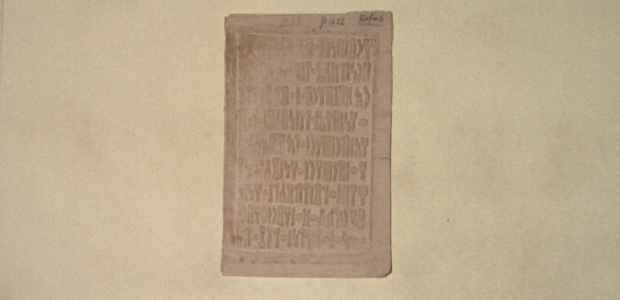
Guest blog by Petra Aigner, leader of a project titled 'Pilot-3D-Digitizing of Rare Ancient South Arabian Squeezes, 19th Century Glaser Collection'.
The collection of the Austrian scholar and explorer Eduard Glaser (1855-1908) was acquired for a large sum of money in 1910 by the Academy of Sciences in Vienna. The epigrapher and specialist in the South-Arabian languages collected a huge amount of medieval Arabic manuscripts and stone inscriptions that are now spread all over Europe. He also collected ‘squeezes’ (a kind of copy on paper) of the non-transportable ones, as well as photographs, glass-negatives, diaries, and notes of historical importance. The Academy owns the latter precious documents of the 1880s and 1890s and through two projects is digitally preserving and scientifically analysing them. This is another step towards the integration of the history and culture of South Arabia within the field of ancient Near Eastern studies and will help to give a fuller historical background of the early first millennium BCE till the rise of Islam.
Eduard Glaser collected these inscriptions during four expeditions (1882-1884, 1885-1886, 1887-1888, 1892-1894) to South Arabia - now largely the Republic of Yemen. Most of the squeezes are currently in a very poor state, while the original inscriptions are in many cases damaged and are (given Yemen’s political instability) inaccessible anyway. The preservation of this valuable epigraphic corpus will amount to the preservation of a significant part of ancient Yemen’s history and culture and, more broadly speaking, the preservation of an often overlooked part of the Semitic-speaking Near East. The inscriptions are written in Ḥaḍramitic, Quatabānic, Minaic, and Sabaic languages of Ancient South Arabia. The time range is from 800 BCE-600 CE.
Almost 500 items from the Glaser Collection were transferred to Europeana Collections by the Austrian Academy of Sciences, Library, Archive & Collections (BAS:IS). The scans are available for use under an open licence.
George Hatke (Austrian Academy of Sciences, University of Vienna) is responsible for all transcriptions of the texts preserved in the squeezes, together with the translations and commentary. These remain intellectual property of the author. Please contact George.hatke@univie.ac.at
Thursday, November 2, 2017
Open Access Journal: Arabian Humanities. International Journal of Archaeology and Social Sciences in the Arabian Peninsula
[First posted in AWOL 17 August 2013, updates 2 November 2017]
Arabian Humanities. International Journal of Archaeology and Social Sciences in the Arabian Peninsula
ISSN électronique: 2308-6122
Arabian Humanities. International Journal of Archaeology and Social Sciences in the Arabian Peninsula
ISSN électronique: 2308-6122
Arabian Humanities s’inscrit dans la continuité des Chroniques yéménites, revue de valorisation des travaux menés au Centre Français d’Archéologie et de Sciences sociales de Sanaa (CEFAS) entre 1993 et 2013. Tout en garantissant l’accès aux numéros des Chroniques yéménites, elle en élargit le champ de compétence à l’ensemble de la péninsule Arabique, et se tourne résolument vers l’international.
Arabian Humanities est une revue à comité de lecture, multilingue (articles édités et publiés en français, anglais et arabe), qui couvre, à un rythme biannuel, l’ensemble des domaines des sciences humaines allant de la préhistoire jusqu’aux sociétés actuelles.
Construit autour d’un dossier thématique, chaque numéro comprend également des varia et des comptes rendus de lecture sur les publications les plus récentes portant sur la péninsule Arabique et paraissant en langues européennes et arabe.
Arabian Humanities is the continuation of the earlier Chroniques yéménites journal, published by the French Center for Archaeology and Social Sciences in Sanaa (CEFAS) from 1993. It broadens its scope to the entire Arabian Peninsula, and is now resolutely oriented towards international research networks.
Arabian Humanities is a peer-reviewed journal. It is multilingual (articles published in French, English or Arabic, with abstracts in the two other languages), and freely available on internet.
Arabian Humanities intends, through biennial issues, to cover all areas of the humanities from prehistory to contemporary societies in the Arabian Peninsula. Constructed around a specific theme, each issue will also include independent articles and book reviews on the latest publications on the Arabian Peninsula appearing in European languages and Arabic.
See the full List of Open Access Journals in Ancient Studies
Tuesday, October 24, 2017
Open Access Book: Art rupestre et peuplements préhistoriques au Yémen
Art rupestre et peuplements préhistoriques au Yémen
…Art rupestre et peuplements historiques au Yémen fait le point sur l'état actuel des connaissances en ce domaine.
À l'inventaire iconographique de l'art rupestre préhistorique des régions de Saada et de Radā‘, établi par Madiha Rachad, s'est établie une nouvelle découverte dans la région d'al-Dalī‘, relevée par une équipe dirigée par Frank Braemer. Ainsi cet ouvrage révèle-t-il un remarquable ensemble gravé et peint de représentations d'animaux, ainsi que des figurations humaines et de...
Lire la suite
Catalogue
La région de Saada
Subscribe to:
Posts (Atom)




 Posts
Posts


 Stumble It!

