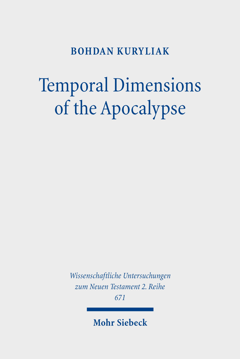
Bohdan Kuryliak examines the book of Revelation through four interpretive approaches: preterism, idealism, historicism, and futurism. Drawing on a synthesis of close biblical exegesis and early Christian reception history (second to seventh centuries), he analyzes key temporal markers and disputed passages, ranging from the vision of the seals to the millennium. The author challenges the tendency to confine the text's symbolic richness to a single framework, showing that early Christian interpreters often blended these perspectives by combining past, present, and future dimensions. By grounding this synthesis in the text itself, he proposes historicism as an integrative model that incorporates the temporal insights of the other three approaches. The author thus offers a renewed hermeneutical pathway for navigating Revelation's complex temporal landscape.
Table of contents:1. Introduction
2. Interpretive Issues in the Book of Revelation: The Temporal Dimensions
2.1. Temporal Markers of the Apocalypse
2.2. Seven Seals (Revelation 6:1-8:1)
2.3. Seven Trumpets (Revelation 8:7-11:19)
2.4. Dragon and the Beasts (Revelation 12-13)
2.5. Babylon the Whore (Revelation 17)
2.6. Millennial Kingdom (Revelation 20)
2.7. Conclusions
3. Temporal Dimensions in the Reception of the Book of Revelation (ca. 2nd-7th Centuries)
3.1. Early Revelation's Reception (ca. 2nd-3rd Centuries)
3.2. Later Revelation's Reception (ca. 4th-7th Centuries)
3.3. Conclusions
4. The Panorama of Hermeneutical Approaches
4.1. Temporal Markers of the Apocalypse
4.2. Preterist Approach
4.3. Idealist Approach
4.4. Historicist Approach
4.5. Futurist Approach
4.6. Conclusions
5. Conclusions
Tuesday, September 29, 2026
Temporal Dimensions of the Apocalypse: Ancient Christian Reception and Contemporary Hermeneutical Reflections
Bohdan Kuryliak
Subscribe to:
Post Comments (Atom)




 Posts
Posts


 Stumble It!


No comments:
Post a Comment