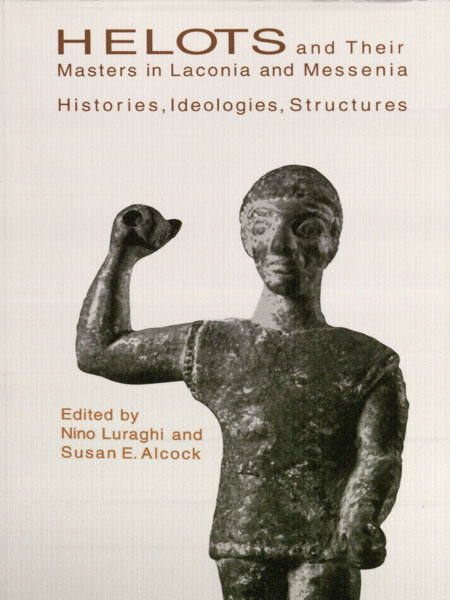
The name “Helots” evokes one of the most famous peculiarities of ancient Sparta, the system of dependent labor that guaranteed the livelihood of the free citizens. The Helots fulfilled all the functions that slaves carried out elsewhere in the Greek world, allowing their masters the leisure to be full-time warriors. Yet, despite their crucial role, Helots remain essentially invisible in our ancient sources and peripheral and enigmatic in modern scholarship.
This book is devoted to a much-needed reassessment of Helotry and of its place in the history and sociology of unfree labor. The essays deal with the origins and historical development of Helotry, with its sociological, economic, and demographic aspects, with its ideological construction and negotiation
Available for purchase in print via Harvard University Press.
Luraghi, Nino, and Susan E. Alcock, eds. 2003. Helots and Their Masters in Laconia and Messenia: Histories, Ideologies, Structures. Hellenic Studies Series 4. Washington, DC: Center for Hellenic Studies. http://nrs.harvard.edu/urn-3:hul.ebook:CHS_LuraghiN_AlcockS_eds.Helots_and_Their_Masters.2003.
This work is licensed under a Creative Commons 3.0 License.
Tuesday, March 10, 2026
Helots and The Masters in Laconia and Messenia: Histories, Ideologies, Structures
Subscribe to:
Post Comments (Atom)




 Posts
Posts


 Stumble It!


No comments:
Post a Comment