|
|

|
|

|

|
|
|

|
|

|
|
|
|

|
|

|
|

|
|

|
|
|
|
|

|
|

|
|

|
|

|
|
|
|

|
|
|
|
|

|
|
|
|
|
|
|
|
|
|
|
|
|
|
|
|
|
|
|
|
|
|
|
|
|
|
|
|
|
|
|
|
|
|
|
|
|
|
|
|
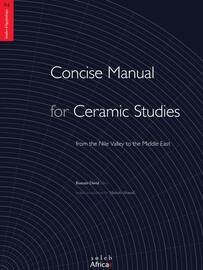
This manual is intended to accompany the training of future ceramic specialists in the Arab world. Resulting from the collaboration of four major institutions of French archaeology abroad: the Section française de la direction des Antiquités du Soudan (Sfdas), the Institut français d’Archéologie orientale (Ifao), the Institut français du Proche-Orient (Ifpo) and the Centre français de recherche de la péninsule arabique (Cefrepa), it draws on the recent work of specialists from the Nile Valley, the Near East and the Arabian Peninsula to shed light on the theoretical reflections that have enriched ceramic studies in recent decades. Providing a genuine field tool, this volume is nonetheless a skilfully illustrated collection of the contribution of ceramic studies to the understanding of human history.
This is the English version of the manual. The bilingual version (English / Arabic) is available here: https://page.hn/yq8gch.
- Éditeur : Africae, Soleb
- Collection : Africae Studies
- Lieu d’édition : Paris, Khartoum, Nairobi
- Année d’édition : 2022
- Publication sur OpenEdition Books : 03 juillet 2023
- Nombre de pages : 167 p.
I. The First Steps on the Field
II. Ceramic Classification
III. Documentation of the Assemblages
IV. Computerisation of the Documentation
V. Various Approaches of the Ceramic Documentation
VI. Ceramic Studies in French Institutes Abroad
Commemorating Classical Battles: A Landscape Biography Approach to Marathon, Leuktra, and ChaironeiaBraun, Brandon
This project is a study of the commemoration of Classical Greek battles from a landscape biography perspective, approaching monuments and other practices as vital elements in the creation and curation of memories. It analyzes the diachronic development of battlefield, sanctuary, and city spaces, as evidenced by archaeological remains, ancient literary sources, and inscriptions. In addition, it explores the experience of the commemorative spaces through the application of theories of space, phenomenology, and social memory. Following a biographical approach, the commemoration of each battle is separated into stages of initial commemoration, official monumentalization, memory curation, memory lapse, and recovery and reception. The battles fought at Marathon, Leuktra, and Chaironeia are chosen as case studies for three reasons. First, Marathon (490 BCE) and Chaironeia (338 BCE) effectively span the period of Classical Greece. Secondly, these battles have different participants: Athenians over Persians at Marathon, Thebans over Spartans at Leuktra, and Macedonians over Thebans at Chaironeia. By focusing on these battles, this project looks at a diverse range of participants, both victorious and defeated. Lastly, these were battles that had lasting impacts in the material and literary record. Archaeologically, there are numerous monuments on each battlefield, as well as many that were dedicated in sanctuaries and in individual cities. Literary records indicate the Athenians repeatedly celebrated their victory at Marathon, whether to bolster their esteem among Greek states or to encourage their own citizenry in their undertaking of empire in the subsequent centuries. Similarly, the victory at Leuktra inspired the Thebans while simultaneously provoking the Spartans and other Greek cities. The project has several conclusions. The commemoration of each battle can be divided into stages, but that the stages are not always discrete. There is variation in the types of commemorations within the stages, dependent on both time and surrounding space. Single commemorations can resonate differently with multiple audiences. The processes within the stage of memory curation lead to the subsequent lapse. The final stage of commemoration for each battle begins with the rediscovery of ancient monuments and continues to this day.
Mimesis as Metamorphosis in Classical Greek LiteratureBorst, Zachary
The aim of my dissertation is to trace an intellectual and theoretical trend in classical Greek literature and philosophy that ironizes and theorizes dramatic mimesis as transformative. The texts I will examine in my dissertation are loci classici for thinking about ancient literary criticism (e.g. Aristophanes’ Frogs) as well as mimesis (Plato’s Republic), and the originality of my project lies in bringing these texts together in order to think through a cluster of related concepts: mimesis, the body, and being and becoming. I will show show that the literary texts of Aristophanes and Euripides, in particular, shed light on dramatists’ views of mimesis, and I argue that they offer an alternative to the view of mimesis in Republic Book 10 as an image impoverished of being and knowledge. In Aristophanes and Euripides putting on a costume can change one’s bodily comportment and ultimately one’s character and behavior.
By sketching a history of mimesis that precedes the work of Plato and Aristotle, my project brings out an alternative view of mimesis. I read the language surrounding mimesis in Aristophanes, Euripides, and Plato closely in order to show how mimesis is put into conversation with important thematic binaries such as being/becoming and seeming/being. Mimesis is often depicted not merely as a disguise or copy, but as a transformational force that affecting poets, actors, and audiences. By unpacking the depth and diversity of the discourses surrounding mimesis, we can see that it is connected to other topics in the intellectual revolution of the 5th c. BCE, such as nomos and physis and the development and profusion of rhetoric. In the dissertation I use the term “mimetic metamorphosis” to convey this notion of mimesis as metamorphosis. “Mimetic metamorphosis” is a helpful term because it covers both the scenes that depict poets or characters becoming or representing different people (such as Dicaeopolis becoming Telephus in Aristophanes’ Acharnians) and the theoretical discourse surrounding these scenes. In order for authors of literary works to theorize mimesis as transformational, the scenes in which these transformations are depicted are often highly metatheatrical. This allows for commentary on the nature of mimesis. Thus, “mimetic metamorphosis” applies both to the metamorphoses that are represented through the enactment of dramatic mimesis and to the metatheatrical, often ironic, commentary surrounding mimesis as a transformative force. Characters draw attention to the costumes, gestures, and language they put on to appear like another, and the language surrounding these scenes reveals a concerted interest in recurrent themes of being and becoming, often with reference to the words εἰμί (“be”) and γίγνομαι (“become”).
Ultimately, my aim with this project and the term mimetic metamorphosis is to revise the view of mimesis as a mere imitation or copy that is inherited from Book 10 of Plato’s Republic. I trace these alternative views of mimesis in order to show that there is a rich conception of mimesis prior to Plato and that this discussion has an undercurrent in Plato’s poetics. My project offers new insights into the texts in question as well as ancient literary criticism and mimesis. By placing these texts in conversation with each other, I argue that Aristophanes, Euripides, and Plato theorize that mimetic poetry is a medium affecting authors, performers, and audiences in a similar way. By imitating a character and taking on that character’s defining traits, one differs from the person one was before. This kind of transformation and self-likening to another also allows for one to empathize with a fictional character. By reading for the literary representation and theorization of mimesis, or “mimetic metamorphosis,” I argue that classical Greek literature views poetry as an affective, transformational force that challenges being and notions of the self.


 Posts
All Comments
Posts
All Comments





 Stumble It!