Monday, July 3, 2023

Partially Open Access Journal: Atti del... Convegno di studi sulla Magna Grecia

Dal 1961 l’ ISAMG, accanto a quelle di ricerca scientifica, svolge attività editoriali, tra le quali spiccano le pubblicazioni relative agli Atti dei Convegni sulla Magna Grecia che organizza annualmente.

È, inoltre, disponibile un ricco catalogo di titoli a carattere scientifico.

 
XVIa
XVIb
XVIc
1976Locri Epizefiri
XVIIa
XVIIb
XVIIc
1977Magna Grecia bizantina e tradizione classica
XVIIIa
XVIIIb
XVIIIc
1978Gli Eubei d’Occidente
XIXa
XIXb
1979L’Epos greco in Occidente
XXa
XXb
1980Siris e l’influenza ionica in Occidente
XXIa
XXIb
1981Megale Hellas, nome e immagine
XXIIa
XXIIb
XXIIc
XXIId
XXIIe
1982Magna Grecia e mondo miceneo: Catalogo


Catalogo della mostra
  Atti del convegno
XXIIIa
XXIIIb
XXIIIc
1983Crotone
XXIVa
XXIVb
XXIVc
1984Magna Grecia, Epiro e Macedonia
XXVa
XXVb
XXVc
1985Neapolis
XXVIa
XXVIb
XXVIc
1986Lo stretto, crocevia di culture
XXVIIa
XXVIIb
XXVIIc
XXVIId
1987Poseidonia-Paestum
XXVIIIa
XXVIIIb
XXVIIIc
1988Un secolo di ricerche in Magna Grecia
XXIXa
XXIXb
XXIXc
1989La Magna Grecia e il lontano Occidente
XXXa
XXXb
XXXc
1990I Messapi
XXXIa
XXXIb
1991La Magna Grecia e i grandi santuari della madrepatria
XXXIIa
XXXIIb
XXXIIc
1992Sibari e la Sibaritide
XXXIIIa
XXXIIIb
XXXIIIc
1993Magna Grecia, Etruschi, Fenici
XXXIVa
XXXIVb
XXXIVc
1994Corinto e l’Occidente
XXXVa
XXXVb
XXXVc
1995Eredita’ della Magna Grecia
I -XXXVIndici (1961-1995)
XXXVIa
XXXVIb
1996Mito e storia in Magna Grecia
XXXVIIa
XXXVIIb
XXXVIIc
1997Confini e frontiera nella grecita’ d’Occidente
XXXVIIIa
XXXVIIIb
XXXVIIIc
1998L’Italia meridionale nell’eta’ tardo-antica
XXXIXa
XXXIXb
XXXIXc
1999Magna Grecia e Oriente mediterraneo prima dell’eta’ ellenistica
XLa
XLb
XLc
2000Problemi della chora coloniale dall’Occidente al Mar Nero

See AWOL's full List of Open Access Journals in Ancient Studies


Sunday, July 2, 2023

Transformations of Animal Materials in Early Greece

Transformations of Animal Materials in Early GreeceDiBattista, Adam

From the earliest periods of Greek history, bone, antler, ivory, and other materials were consistently created into objects for use within social practices, and archaeological evidence suggests that these objects took on new forms and functions during the Early Iron Age and early Archaic period (ca. 1100–600 BCE). Between the 11th and 8th centuries BCE, worked animal objects were sporadically used as grave goods, while by the 7th century, hundreds of such objects were dedicated at major sanctuaries across the Greek world, including at Sparta, Ephesus, and Thasos. In this dissertation, I ask how worked animal objects were created and understood during a period of great social change in the Greek world. Using perspectives from the environmental humanities, aimed at de-centering the human, as well as problematizing the nature-culture divide, I posit that worked animal objects acquired values rooted in their organic histories.

Within my dissertation, I examine how the larger patterns of ivory production in the Iron Age Mediterranean, as well as the exploitation of elephant populations in the Near East, impacted the development of ivory carving in the Greek world. The creation of these objects coincided with a return to long-distance trade after a period of disruption brought on by the instability at the end of the Bronze Age. While the Mycenaeans used foreign trade connections to maintain a tradition of ivory carving, archaeological evidence suggests that the availability of the material was limited between the start of the Early Iron Age (ca. 1100 BCE) and the 9th century BCE. With the increase of other worked animal object dedications in the 7th century, ivory objects took on a variety of new forms in Greek sanctuaries. By the end of the century, craftspeople were using ivory to create larger, more complex works (e.g., the chryselephantine statues at Delphi).

This dissertation also considers how worked animal objects were employed within Greek social contexts. By comparing finds from funerary and dedicatory contexts, I demonstrate that specific types of worked animal objects (e.g., ivory carvings of recumbent animals, circular seals, miniature double axes) were reserved for use in sanctuaries and employed across the Greek world. However, certain sanctuaries also show evidence for unique forms of worked animal object dedications which were not found at other sites (e.g., worked long bone shafts at the sanctuary of Artemis Orthia at Sparta, decorated bone shafts at the Kamiros well on Rhodes). I conclude that, within the venue of dedication, worked animal objects had a specific value rooted in the organic origins of the material.

Finally, using the site of ancient Methone as a case study, I examine the production practices used to create worked animal objects. Methone shows evidence for the production of worked animal materials (including ivory) dating to between the end of the 8th century/start of the 7th century and the 6th century, a period concurrent with the increase of dedications of such objects across the Greek world. I interpret these technical acts as a form of human-animal relationship, in which craftspeople are interacting with the organic qualities of the materials. Worked animal materials from Methone demonstrate that craftspeople used a diversity of wild and domesticated species to make a variety of objects.


Climate Change and the Social History of Food in Ancient Egypt: Between Humanities and Life Sciences

Climate Change and the Social History of Food in Ancient Egypt: Between Humanities and Life SciencesShahat, Amr khalaf

The effect of climate change on food and water sustainability is an alarming issue worldwide. Food remains found in ancient settlements and mortuary contexts as is the case in ancient Egypt not only embody a list of plant taxa that shaped the people’s diet and cultural foodways but also encode the social and climatic history of Egypt and the Nile River, which is relevant to current issues relating to the anthropogenic impact of climate change and the impact of the damming of rivers on social structure and food and water supply. Food is more than a biological need that sustains our body; it is an active agent in the creation of social structure, economy, personal identity, and cross-cultural relationships. Contextualized analysis of food remains from the archaeological record has served as a powerful lens for archaeologists, anthropologists, and social historians to understand social relations, cultural interactions, and the engendered experiences of individuals in the past. The archaeological record from ancient Egypt has yielded an exceptionally rich array of organic food remains. Indeed, it was the study of botanical materials from Egypt that spearheaded the field of archaeobotany and allowed Willard Libby to invent carbon dating, using seeds from Djeser’s pyramid housed in the Field Museum of Natural History in Chicago, eventually winning him the Nobel Prize for his contribution in archaeology, geology and other branches of science. In this dissertation, I continue this interdisciplinary cross-link between life sciences and the humanities by proposing interdisciplinary analyses to study ancient foodways, and ultimately demonstrate the various ways in which ancient botanical remains can expand our knowledge of ancient Egyptian society in terms of social structure, temporal and regional cultural variation, cross-regional interactions, and cultural relationships, especially in non-elite contexts. The interpretations of the results are carried out within the theoretical frameworks of postcolonial and indigenous archaeologies to transcend, and push the field of Egyptology beyond colonial and oriental origins. Scientific analysis including stable isotope biogeochemistry and ecology applications on well-dated plant-food remains from the archaeological record serve as a scientific tool to record changes in climate, soil fertility, water cycle, and environmental conditions and how they are influenced by different water and agricultural management systems, providing invaluable deep-time data on the anthropogenic impact of climate change on social structure and foodways. First, I present the analysis of unpublished and reanalyzed botanical remains excavated by Reisner and Lythgoe in the early 1900s at the sites of Nag ed-Deir and Deir el-Ballas that are now housed at the Phoebe Hearst Museum at the University of California, Berkeley. This study presents the results of archaeobotanical and molecular isotopic analyses on plant remains from these sites. A nano-archaeological method was also developed as a non-destructive way to identify the ingredients of a beer mash, which was found to have rich fiber content in addition to residue of wild fruits, used as a natural sweetener. This finding is a region-specific recipe, which demonstrates that there was regional cultural variation in ancient Egyptian cuisine, and a difference in nutritional values of food between the past and present foodways in the Egyptian society. This research also presents the result of a long stable isotope experiment, building a baseline for the Nile River, and introduces a new isotopic method using non-exchangeable oxygen isotopes in fruits to identify the source region of plant-food remains, and the environmental and water conditions in which they grew. Such an approach enables us to reconstruct the elements of a social history of food, regional identities, and cross-cultural interactions, ultimately challenging the simplistic assumption that the ancient Egyptian diet was homogenous and predominantly composed of “bread and beer made of wheat and barley”. This is also the first stable isotopic study on archaeobotanical remains from Egypt corroborated with AMS carbon dating. This new combination of methods opens a new direction of research into the history of cultural interactions, providing critical implications for historians, bioarchaeologists, hydrologists, and climate change scientists. This research demonstrates that the analysis of plant food remains through interdisciplinary theories and methods not only contributes to social sciences but is also significant in capturing the environmental history of climatic changes in the past and of important relevance to life sciences as well. Contextualized comparison of these changes by contrasting ancient and modern plant species biodiversity and their isotopic composition can be a significant contribution to the next generation of scientists interested in reversing the impact of climate change on social structure and food and water sustainability.


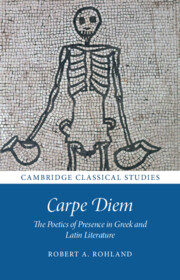
Carpe Diem: The Poetics of Presence in Greek and Latin Literature

 Carpe diem – 'eat, drink and be merry, for tomorrow we die!' – is a prominent motif throughout ancient literature and beyond. This is the first book-length examination of its significance and demonstrates that close analysis can make a key contribution to a question that is central to literary studies in and beyond Classics: how can poetry give us the almost magical impression that something is happening here and now? In attempting an answer, Robert Rohland gives equal attention to Greek and Latin texts, as he offers new interpretations of well-known poems from Horace and tackles understudied epigrams. Pairing close readings of ancient texts along with interpretations of other forms of cultural production such as gems, cups, calendars, monuments, and Roman wine labels, this interdisciplinary study transforms our understanding of the motif of carpe diem.


Sensing the Fundamentals: An Examination of Scent as Integral to Ancient Egyptian Society

Despite the senses being foundational to how we interact with our environments, archaeologists rarely consider the significance of the senses to past lives. Thus, I examine in this dissertation the extent to which a culture’s understanding of the human body experience (i.e., the senses) affects their society. I argue that sensory experience permeates every aspect of our lives (i.e., the ideological, the social, the economic, and the political), and, by focusing on sensory experience in humanistic studies, we might eliminate false dichotomies (e.g., religious/secular) and discrete categories (e.g., economic/political).

Ancient Egypt serves as a case study for how the senses are central to the ways we organize our lives. Specifically, I investigate the values attributed scent and smelling in New Kingdom Egypt (1550 BCE–1050 BCE)—considering how scented products figured in economic negotiations and across socio-political and religious spheres. After examining the visual, written, and material evidence of scent from New Kingdom Egypt, I argue that the ancient Egyptians employed scent as an organizing feature in their society, from dictating proper etiquette for celebrating holidays and expressing endearment, to praising the gods, healing bodies, and purifying spaces. Pleasant fragrances communicated one’s identity and presence, and also functioned as the manifestation of life itself. To smell was more than a physiological reaction to environmental stimuli but was a physical presence that exerted influence over individuals.

This study, furthermore, demonstrates the dangers of ignoring the senses in humanistic studies. Sensory experiences can be manipulated to control and order populations. In the ancient Egyptian context, the high ideological and social values attributed pleasant scents resulted in a foundational need among the populace for access to sweet-smelling air. In valuing the experience of pleasant scents across social contexts, the demand for these products increased beyond their earlier limited uses. High prices and an emphasis on foreign scents, however, restricted general access to the most desirable aromas. Ultimately, social hierarchies were established and maintained based on access to these products and an industry was developed to support these relationships.


Saturday, July 1, 2023

Victorian Alchemy: Science, magic and ancient Egypt

Eleanor Dobson
 Cover of Victorian Alchemy: Science, magic and ancient Egypt
Copyright Date: 2022
Published by: UCL Press
https://doi.org/10.2307/j.ctv2qnx59x
Pages: 279
https://www.jstor.org/stable/j.ctv2qnx59x

The Alexandria Archive Institute Digital Data Stories Series

 [First posted in AWOL 6 Octobere 2022, updated 1 July 2023]
 

Welcome to the Digital Data Stories (DDS) Project from the Alexandria Archive Institute! We’re happy to provide these educational resources, which can be used for personal practice or integrated into a course.

The DDS Project promotes a focus in archaeological education on digital data literacy. These exercises, guides, and tutorials teach principles of digital data literacy alongside methods in archaeological analysis and combine different ways of learning and literacy components to illustrate the confluence of science and humanities-based investigations in data collected about the past.

This approach promotes multiple levels of engagement through reading, working with, analyzing, arguing, and communicating with archaeological data to ethically explore the data we have about the past. In these resources, users will utilize a variety of data, from published open-access data sets to popular books to their own belongings to cultivate and practice archaeological data literacy. 

We’re happy to provide you with these educational resources, which can be used for personal practice or integrated into a course.

  • The Fall 2022 Data Stories Table of Contents!
    We’re happy to announce the Data Literacy Program’s (DLP’s) first Table of Contents (TOC). The TOC is a preview of our existing and future Data Stories. And we designed this handy resource to outline data stories you can incorporate in classes now or in the future.
  • Gabbing about Gabii: Going from Notes to Data to Narrative
    This exercise is best suited to those with an interest in ceramics, the Roman Republic, or the archaeology of the Italian Peninsula. Users should have a basic understanding of archaeological data types, but little previous experience is required.
  • Cow-culating your data with spreadsheets and R
    This exercise is best suited to those with an interest in zooarchaeology, the Neolithic, or Central European archaeology. Users should have a basic understanding of what a spreadsheet is, but little previous experience is required.
