Showing posts with label Archeology. Show all posts

Saturday, March 16, 2019

Open Access Journal: NGSBA Archaeology (The Nelson Glueck School of Biblical Archaeology)

 [First posted in AWOL 13 January 2914, updated 16 March 2019 [lnew URLs)]


NGSBA Archaeology (The Nelson Glueck School of Biblical Archaeology)
ISSN 2227-9008
NGSBA Archaeology is our platform for presenting the results of our fieldwork. The contents consist mainly of reports on salvage archaeology projects conducted by Y.G. Archaeology under NGSBA oversight. But from time to time reports of our community archaeology and research projects will also be published. We will also accept field reports of projects executed by other organizations. The journal is peer reviewed, edited by David Ilan, the director of the NGSBA, and is overseen by a board of editors. It will appear more or less annually—depending on the quantity of material available for publication—in print and digital form. The digital version can be downloaded from our website for free. 

Volume 4 (2017)


Volume 3 (2015)


Volume 2 (2013)


Volume 1 (2012)


Thursday, November 15, 2018

5000 Fonds Louis Robert photographs Online

5000 Fonds Louis Robert photographs Online
You are invited to offer identifications and comments on the more than 5000 photographs that are held in the Fonds Louis Robert of the Académie des Inscriptions et Belles-Lettres at the Institut de France in Paris. These photos have been digitized from glass plates, negatives, and prints through the initiative of Thibaut Boulay and Anne-Valérie Pont with funding from the Institut Universitaire de France. They are displayed all together in Photostream and also in two separate albums according to whether they are on glass plates or on prints and negatives.
 
These images are, like other material in the Fonds Louis Robert (squeezes, carnets, and correspondence) the joint responsibility of Jean-Louis Ferrary, membre de l’Institut, and Glen Bowersock, associé étranger de l’Académie. The presentation of these images through Flickr has been made possible by Jonathan Peele of the Institute for Advanced Study in Princeton, New Jersey, USA.
 
Interested viewers are urged to sign up with Flickr at no cost. This will facilitate providing comments, which will be available to Professors Ferrary and Bowersock.
 
Unpublished inscriptions that may be found among the photographs in this archive are now in the public domain, and they may be published with acknowledgment of the Fonds Louis Robert at the Académie des Inscriptions et Belles-Lettres.

Thursday, July 12, 2018

Portal to the Past: Digital Archive of Archaeological Projects and Research Canadian Institute in Greece

[First Posted in AWOL  16 November 2013, updated 12 July 2018]

Portal to the Past: Digital Archive of Archaeological Projects and Research Canadian Institute in Greece
http://www.portal.cig-icg.gr/sites/default/files/cig-icg%20logo-1.png
A generous grant from Thracean Gold Mining, S.A., a subsidiary of the Eldorado Gold Corporation (Vancouver), has enabled the Institute to undertake the creation of an interactive website, “Portal to the Past” (or Portal) that highlights the archaeological work of the Canadian Institute in Greece (CIG) since 1980. The Ambassador of Canada to the Hellenic Republic, Robert W. Peck, was instrumental in creating this opportunity for CIG. This new website is designed to provide a wide audience in Canada and beyond with access to the fieldwork, the finds and the results of the archaeological and scientific research carried out under the auspices of the Canadian Institute in Greece with permits from the Hellenic Ministry of Culture. Cultural organizations around the world for the past decade or so have created similar online portals to make their collections accessible to the public.
Each CIG's 18 archaeological projects since 1980 have a representative sample of the imagery and information related to its research in the Portal. The information and imagery in the website is fully searchable, by project, site, find, image, institution, researcher, research expertise and other criteria. In making this available online, both the projects and the Institute will receive a broader recognition of the significant work that they have carried out in the past four decades throughout Greece in elucidating the rich cultural heritage of the country. These discoveries span from the Mesolithic period (ca 9th millennium BCE) to the 20th century CE. One can search each component for specific information.
After each field season the current project’s entries and image collection in the Portal will be updated. New projects will be added as they are approved and conduct their field work. Additional materials will be added to older projects as they become available.
In addition to the archaeological projects the Portal includes imagery and information related to the Frederick E. Winter B/W Negative Collection. The late Professor Winter (University of Toronto) donated to the Archives of the Institute his collection of B/W negatives with contact sheets that he took during a long career focused on the study of Greek and Roman defensive architecture and Hellenistic buildings. This imagery covers Greece, Turkey and Italy from 1956 to 1986.
The CIG Portal to the Past is one component of the Institute’s ongoing efforts to preserve, to organize, to store properly and to make accessible the archives of the Institute as an institution and of the archives of the archaeological projects which have held permits under the aegis of the Institute.


Friday, June 30, 2017

Open Access Monograph Series: Abusir

The Abusir Series
Abusir_I
Miroslav Verner
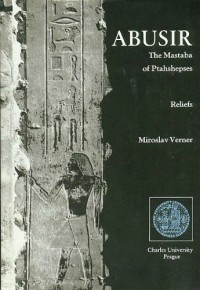
Abusir I. The Mastaba of Ptahshepses: Reliefs, vol. I-II
Charles University, Prague 1982
This two-volume work is dedicated to the analysis and publication of the reliefs preserved in situ in the area of the mastaba of Ptahshepses. The first volume contains the text, the second consists of the drawings of the individual reliefs.
Abusir_II Miroslav Verner
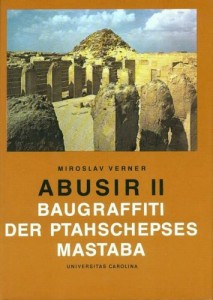
Abusir II. Baugraffiti der Ptahschepses Mastaba
Czech Institute of Egyptology, Prague 1992
The publication of building graffiti found on the walls of the Mastaba of Ptahshepses. Building graffiti represent an important source of information about the organization of ancient Egyptian construction works, their creation and the people who had built them.
  download
Abusir_III Miroslav Verner
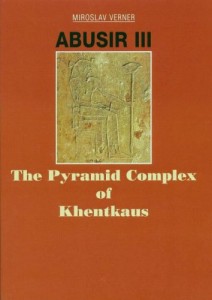
Abusir III. The Pyramid Complex of Khentkaus
Charles University in Prague and Academia, Prague 1995
The unique pyramid complex of Khentkaus (the ‘mother of two kings’ who lived around 2500 BC) was discovered by the Czech Institute of Egyptology in 1976. This volume provides the final report on the excavation as well as specialist reports on the masons’ marks, the fragments of papyri and reliefs, and the sealings. It also contains an evaluation of the architectural remains and some conclusions about what this find tells us about Egyptian history at the beginning of the 5th Dynasty.
Abusir_IV Ladislav Bareš
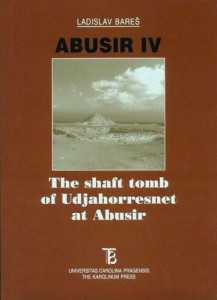
Abusir IV. The Shaft Tomb of Udjahorresnet
Charles University in Prague, Prague 1999
This report describes work in the 1980s and 1990s on the tomb of Udjahorresnet, a prominent official who participated in the Persian occupation of Egypt around 525 BC and may even have been one of their main collaborators. As well as chapters on the results of excavations, on the development of the Saite-Persian shaft tomb tradition, and the finds, this book presents a full review of what we know about this colourful 1st Millennium BC figure.
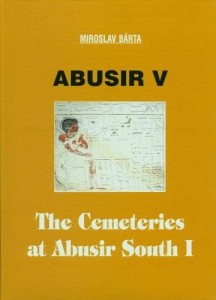
Abusir_V Miroslav Bárta
Abusir V. The Cemeteries at Abusir South I
Set Out and the Czech Institute of Egyptology, Prague 2001
This report describes work carried out between 1991 and 1993 on a number of Old Kingdom tombs, mostly of lesser officials. Each tomb is given a full treatment with archaeology, architecture, decoration, epigraphic descriptions and a catalogue of significant finds, with the exception of pottery, which will be published separately. The volume is illustrated with line drawings. Contents: The tomb of Ity; the Lake of Abusir tombs; the tomb of Fetekty and adjacent tomb complexes; the tomb of Kaaper; some taphonomic, demographic and pathologic aspects of the skeletons from mastaba tombs at Abusir South; Palaeographic table; Indexes: Royal names, non-royal names, titles and epithets, gods, tombs.
  download
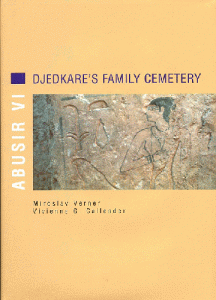
Abusir_VI Miroslav Verner – Vivienne G. Callender
Abusir VI. Djedkare’s Family Cemetery
Czech Institute of Egyptology and Set Out, Prague 2002
This volume contains the results of excavations at the Djedkare’s family cemetery at Abusir, arranged by individual tomb. Verner and Callender describe the structure and archaeology of the tomb including plans of the rooms, its owner, wall paintings and finds from the tomb. These chapters are succeeded by a discussion of the chronology of the tombs, a typology and details on the skeletal remains. Appendices look at the role of female members of the Djedkare family in the old Kingdom.

Friday, July 15, 2016

Herculaneum Conservation Project

[First posted in AWOL 14 April 2011.  Updated 25 July 2016]

Herculaneum Conservation Project
home
 L' Herculaneum Conservation Project è stato fondato da David W. Packard, Presidente del Packard Humanities Institute, fondazione filantropica, con lo scopo di sostenere lo Stato Italiano, attraverso la Soprintendenza Speciale per i Beni Archeologici di Napoli e Pompei, nella sua azione di salvaguardia di questo fragile sito archeologico, dal valore inestimabile.

Ercolano fu sepolta dalla stessa eruzione vulcanica che seppellì Pompei ed altri centri siti ai piedi del Vesuvio, nel 79 dC. L'esplorazione della città antica cominciò con Borbone nel 1738, più tardi lo scavo a cielo aperto fu condotto a più riprese fino alla fine del ventesimo secolo. Molto più piccola di Pompei, ai giorni nostri Ercolano non è altrettanto conosciuta … ma forse dovrebbe esserlo; le particolari dinamiche di seppellimento della città hanno fatto in modo che oggi il passato riviva molto più vividamente qui che non a Pompei. Mentre quest'ultima fu ricoperta da una coltre di cenere e lapilli alta meno di 10 metri, Ercolano fu sommersa da ondate fluide di materiale vulcanico, che raffreddandosi diventò roccia tufacea, e raggiunse in alcuni punti i 25 metri di spessore. Per questo motivo, a differenza della grande maggioranza dei siti archeologici nel mondo, qui molti reperti organici, incluse travi lignee e arredi, si sono conservati, e molti edifici presentano due o più piani in altezza. Allostesso tempo, queste caratteristiche costituiscono altrettanti punti di debolezza, e questo sito unico nel suo genere è costantemente a rischio di collasso se non si mettono in gioco azioni continuative e incessanti per la sua conservazione.

Dal 2001 l'Herculaneum Conservation Project, una collaborazione tra il Packard Humanities Institute e la Soprintendenza Speciale per i Beni Archeologici di Napoli e Pompei, con il supporto della British School at Rome, si è impegnato a contrastare le minacce più immediate per la sopravvivenza del sito. Sono stati affrontati per primi i problemi infrastrutturali – le coperture e i sistemi di raccolta delle acque. Sono state inoltre condotte indagini scientifiche per analizzare i fattori di rischio critici per la conservazione e per mettere a punto gli approcci migliori per eliminarli o mitigarli. E' stata ribadita l'importanza di una manutenzione costante del sito tramite lo sviluppo di programmi sostenibili in futuro. Durante i lavori, sono state fatte nuove scoperte archeologiche, e nuova luce è stata gettata sulla storia del sito. Si cerca di coinvolgere la comunità locale nello svolgimento delle attività, sono stati avviati progetti congiunti con il Comune di Ercolano, ed è stato fondato il Centro Herculaneum.

L'Herculaneum Conservation Project è composto da un team ampio e interdisciplinare di specialisti, molti dei quali italiani. Lavora sotto la supervisione di un Comitato Scientifico, che comprende esperti italiani e internazionali nel campo dell'archeologia e della conservazione. E' diretto da Andrew Wallace-Hadrill, prima direttore della British School at Rome, e attualmente Rettore del Sidney Sussex College, Cambridge. Le attività sul sito sono coordinate dal Project Manager, Jane Thompson e dalla Direttrice del Sito, Maria Paola Guidobaldi.

Monday, April 23, 2012

Gnomon is now available in English as well as German

Gnomon Bibliographische Datenbank

The Gnomon Online database provides access to the complete journal "Gnomon" (since 1928) and the quarterly bibliographic appendix to "Gnomon" from 1990 onwards. The collection is augmented by the inclusion of the holdings of the Library of Eichstätt University in Classics, and, in addition, holdings of the Bayerische Staatsbibliothek in Munich with its unique collection of books published in Classical Studies ("Sondersammelgebiet 6, 12"). Further, the inclusion of some works of reference may be mentioned. 

From now on, the Gnomon Bibliographic Database is also available in an
English version (http://www.englisch.gnomon-online.de/), including a
comprehensive English thesaurus. The database contains around 500000
entries with monthly updates comprising the latest reviews, monograph
studies, anthologies, and articles in periodicals.