The main purpose of Integrated Biblical and Theological Studies
(IBTS) is to revitalise and enhance the study of the biblical text
through a comprehensive and holistic approach. It aims to bridge the gap
between intra-disciplinary and inter/multidisciplinary approaches,
fostering discussions that integrate various disciplines involved in the
study of the Bible and its theological impact. It seeks to engage with
both academia and the public, while promoting critical thinking within
and beyond scholarly circles. IBTS revolves around the exploration of
inter-/intra-disciplinarity in the study of the Bible. IBTS emphasises
the importance of both inter- and intra-disciplinary approaches to
comprehensively understand and engage with the Bible’s theological
significance.
Aspects of Judean Life focuses on Elephantine during the fifth century BCE, developing
a comprehensive model of Achaemenid Persian imperial governance in
Egypt and situating the Judean colony within that framework. It
reconsiders the colony at Elephantine not as a band of foreign
mercenaries living private lives but as colonial state dependents
embedded within Achaemenid systems of land-for-service taxation and
imperial administration. Far from isolated, the Judeans emerge as active
participants in—and beneficiaries of—the structures of empire.
Part
1 offers a cultural history of Imperial Aramaic scribal practice in the
Persian period, drawing on Egyptian and Babylonian evidence alongside
Phoenician scribal culture. Part 2 reinterprets the Elephantine Papyri
through close philological and historical analysis, resolving
long-standing problems concerning ethnic designation, administrative
purpose, and community sociology. Part 3 reconstructs the professional
networks of Judean temple administrators through analysis of Aramaic
ostraca and examines the community’s role in systems of production,
rationing, and taxation.
By placing Elephantine in dialogue with
evidence from the Nile Delta, Babylonia, and other imperial settlements,
this study offers a nuanced account of how Persian policies were
locally implemented. It will be an indispensable resource for scholars
of the ancient Near East, biblical studies, and imperial history.
P6, MVP, and Beta Perseus oh my, or Keeping the Flame of P4 Alive
Background
For almost a year now the Perseus development team has been hard at work on Minimum Viable Perseus (which we redundantly call Perseus MVP), now viewable at: https://beta.perseus.tufts.edu.
Perseus MVP builds upon decades of work by Lisa Cerrato, Alison Babeu
and others, creating and curating structured data that can be then
recast into different formats. David A. Smith built the first web-based
version of the Perseus Digital Library in 1995. In 2003, David Mimno
created the Perseus “Hopper,” the system which has, in various forms,
served audiences for decades – the Hopper is older than many (if not
most) current undergraduates. Developers such as Gabe Weaver, Adrian
Packel, Rashmi Singhal and Bridget Almas maintained and enhanced the
Hopper for a decade.
Further, years of research and development
on the Scaife Viewer by Jake Wegner and James Tauber have provided the
foundation for Perseus MVP. Clifford Wulfman took the lead in designing a
Minimum Viable Perseus. Crucially, Charles Pletcher with his pioneering
work on the Ajax Multicommentary
and the New Alexandria Commentary Platform, demonstrated that it was
actually possible to build a complex philological system on a
conservative, serverless architecture. Charles has been responsible for
implementing Perseus MVP, drawing upon Cliff’s outline and his own
experiences.
MVP has been greatly inspired by years of
requests from dedicated users whose devotion to the current version of
the Perseus Digital Library (P4) is matched only by the volume of email
we receive to Perseus webmaster whenever P4 goes down. For over 20
years, P4 has served as the flagship digital library for Perseus’s
various collections. For a number of years now it has not been possible
to update anything on the P4 site due to aging infrastructure and
complex software dependencies. In addition, age made it vulnerable to
scraping by LLMs (Large Language Models), which has led to numerous
outages and the dreaded “Error 503 Backend fetch failed.” While we have
made various efforts to mitigate this vulnerability it has become
increasingly clear it is not possible to easily maintain a robust P4,
especially in the face of aggressive and what increasingly feels like
nonstop LLM scraping.
The Design and Logic Behind Perseus MVP
Development on P6 has come in fits and
starts depending on project funding and staffing (for more on the
history of Perseus and its different instances, please see our recent
article here).
MVP provides a structurally conservative foundation to which we can add
new services (such as support for treebanks and translation
alignments). We had planned to use the Scaife Viewer as the foundation
for Perseus 6 and were able to create a working prototype for next
generation Perseus features such as treebanks, alignments and bilingual
searching. But the Scaife Viewer was developed almost ten years ago and
included versions of older JavaScript libraries that could not be
trivially replaced. Its architecture also depended upon the host
institution running a database. While computation has become less
expensive and the per-cycle cost of managing server side databases is
certainly much lower than it was when David A. Smith created the first
web version of Perseus in 1995, swarming bots in the age of LLMs can,
unchecked, swamp any normal system and mitigating their impact requires
ongoing adjustments.
Perseus MVP does not depend on the host
managing a database. Instead, Perseus MVP compiles the TEI corpora
maintained by Perseus into static HTML pages that are delivered to users
from a file system via a simple static web server. All computation
takes place in the reader’s browser. In addition to providing a
functional replacement for P4, MVP has been designed to not impose
technical burdens on maintainers and future developers. This design also
seeks to establish a foundation to which treebanks, translation
alignments and other new features developed for the Scaife Viewer and Beyond Translation may be included.
The first version of Perseus MVP aims to
provide core features familiar from P4. One advantage of Perseus MVP is
that the data is new and, in most cases, more extensive than that
available in P4. There are still texts that need to be updated but LLMs
have made it easier to update the format and metadata for XML (with a
human in the loop) and we hope to have straggler texts updated as work
continues. Readers will see a growing body of new content. And, of
course, where P4 has been a frozen library, Perseus MVP will include the
latest updates and corrections.
Perseus MVP does not (yet) support all
features familiar from P4 (i.e., that’s the “minimum viable” part).
Features not yet implemented include:
Site search, i.e., look for all documents in Perseus that contain the word “Thucydides.”
Greek and Latin word searching: for now, we recommend that users take advantage of Perseus under Philologic.
This version of Perseus is not quite the same as what we have (though
it is close) but it does an excellent job of providing classic search
services.
Cross-references: This needs to wait until we have
more of the various reference works from P4. Our initial focus is
including source texts, translations and core dictionaries.
URL mapping from P4 and the Scaife Viewer: Before
we retire P4 and the Scaife Viewer, we will produce a system that
converts URLs to P4 and Scaife into URLs that point to the appropriate
pages in Perseus MVP. The goal is to maintain, insofar as possible,
backward compatibility with the vast body of links into Perseus that
have evolved over decades.
New Classes of Content Found in Perseus MVP
Perseus MVP, however, also contains a
growing body of content that is available neither in P4 nor in Scaife.
Optical Character Recognition (OCR) and LLMs have allowed us to create
draft versions of complex documents such as critical editions,
commentaries and dictionaries. Going forward there will be three core
classes of content.
Curated Digital Resources-A core of digital
resources that we have been able to review and curate. Given the need to
make substantial amounts of data available, our goal is to bring these
resources to a reasonable level and then augment them as members of the
community identify issues and/or offer corrections and enhancements.
OCR Drafts-A larger body of documents with rich TEI
XML markup that we have produced, with minimal manual intervention by
using LLMs to add TEI XML. We offer these on an as-is basis with the
label “OCR draft.” Over time, some of these will be curated by Perseus
staff or by members of the community, but we make them available now for
those who wish to use them. We are very much in the process of
understanding how to use rapidly improving systems to create these
documents but we feel that they have reached a point where we find them
useful and hope that others will as well.
For examples of “OCR draft” resources, look at the contents for
Homer, Aeschylus, Sophocles. To filter out these resources, you can
click on a search filter “Status” on the Collections/Texts screen and select “Curated” vs. “Experimental”.
Raw textual data/Massive corpora-We now have access
to six hundred million words of Classical Greek and billions of words
of Classical Latin. Powerful as new systems are, we simply do not have
the computational resources to apply LLMs to textual data at this scale –
the LLMs are too slow or (if we were to work with scalable commercial
enterprises) too expensive to apply. We need to develop ways to make
this content visible and accessible. The traditional method is to search
and analyze the uncorrected, automatically produced text and then to
display the pages (image front processing) and this will probably be our
approach for the foreseeable future.
And introducing Perseus MVP/Beta Perseus!
Home Page
The design has been heavily influenced by
P4 and seeks to ultimately create a feature for feature duplication of
the P4 reading experience. The Home page still includes
the familiar navigation bar above, news and updates (found on this
trusty blog), and links to Art & Archaeology images at their new
online home.
Figure 1: Homepage for Beta Perseus
Collections/Texts Page
The Collections/Texts
page below does not include links to all of the collections currently
found in P4. Beta Perseus does contain links to all the public domain
works in P4 Greek, the Open Greek and Latin (OGL) First Thousand Years of Greek collection, Latin from both P4 and OGL, and initial Hebrew and Italian collections. The default Collections/Texts page view opens with all Collections and authors fully expanded, with the Greek
collection at the top (illustrated below). The user can then scroll
down through a fully expanded author list for each collection. Clicking
on the downward facing arrow to the left of a Collection (Greek) or
an author name (e.g. Achilles Tatius) will minimize the collection or a
given author. The Italian, Hebrew and Latin collections can be found
by scrolling down (not illustrated).
There are also two search boxes on the
left. The top level search box allows the user to search for a specific
title, author or editor and produces a drop down list under the box. The
second search box is an Author filter search that will produce a
filtered list of search results on the right based on the author search.
The current Collections/Texts page is very much a work
in progress and the current visual below could change in the near
future. Due to the addition of a large number of “OCR draft” resources, Perseus and First1KGreek editions are labeled to assist the user in selecting a text.
Figure 2: Current Collections Page in Beta Perseus
Reading Texts in Beta Perseus
The reading interface in Beta Perseus
offers an experience similar to P4, although some features are still
under development. As illustrated below, the Table of Contents
navigation can be found on the left, the selected study text in the
center, and related texts and tools on the right (e.g. notes and
commentaries will appear here in the future). Currently, the user can
expand the Translations tab on the right to choose the available translation for Herodotus Histories. Clicking on the translation name in the panel loads the related passage from the translation and clicking on focus (not illustrated) will load the entire translation in the central reading panel.
Figure 3: Initial reading environment for Beta Perseus-Greek text of Herodotus Histories
As noted above, while some texts will have
commentaries and notes available, not all texts have all of their
related reference works from P4 available yet, but work to add them is
ongoing.
Looking up Words and the Word Study Tool in Beta Perseus
One key feature in Beta Perseus is the ability to look up a word from within a text by clicking on it. The Word Study Tool has been updated with new data first published in the Scaife Viewer.
For example, clicking on ἱστορίης
(first image below, selected word in text is underlined) launches a
search with the result illustrated in the second image below.
Figure 4: Clicking on a word in Beta Perseus
Figure 5: Entry page for ἱστορίης in Beta Perseuswith LSJ and Middle Liddell entries expanded.
The entry page for this word includes
short definitions provided courtesy of Logeion and entries from relevant
lexicons (LSJ and Middle Lidell for Greek and Lewis & Short for
Latin). While the citation abbreviations are not yet linked to their
instances in other texts as in P4, this feature will become available as
work progresses.
Let us know what you think!
We would like to ask all those who love P4
to help us make Beta Perseus better, please use it, test it, and most
importantly tell us about your experiences with it! Email us at perseus_webmaster@tufts.edu
Aside from the features, mentioned above, that we have not yet implemented, known issues include:
The majority of reference works and commentaries found in P4 are not
yet available in Beta Perseus and linked to their source texts-but work
on this is progressing.
Broken links and non-existent pages. Many content pages such as Research/About/Help and other pages have yet to be written.
This is still very much a work in progress,
we wanted to let our dedicated user community know that we hear their
frustration with how this new age of AI is impacting the ability to use
P4 and we are exploring solutions such as Beta Perseus to try and find a
sustainable way forward.
The earliest documented instances of extractive metallurgy date around 5000 BC
in both Southwestern Asia and Southeastern Europe. Current evidence from Iran,
Anatolia, as well as from the Western Black Sea Coast and across the Balkan Mountains,
indicates that by this time metallurgical production was carried out only in a small
number of settlement sites and that these centres were separated by long distances.
Accordingly, these early adopters seem to have been extremely diverse in terms of their
social organization and cultural values. In this study, I am particularly interested in
examining the social context of metallurgy during its formative stage between 5000 BC
and 3500 BC and taking into consideration how cultural attitudes and responses might
have been influential factors in shaping the development of metallurgy.
The battle is about to begin. The commander takes their place in
front of their troops and surveys the opposing horde. The odds seem
stacked against them. Fear strikes the hearts of the soldiers. There is
only one thing to be done: to fight by sheer force of will. This is the
moment in which a rousing exhortation can secure victory. In the face of
overwhelming odds, a heroic speaker calls upon their audience not to
fear but to take courage. In warfare, commanders incite combatants to
violence by centring the oppositional identity of their enemies, the
historic value of their fight, and the divine support for their cause.
These incitements were often delivered in the immediate moments before
combat - in other words, as a pre-battle speech. Joseph Scales collects
and analyses every known pre-battle exhortation in Second Temple Jewish
sources and earlier. These literary examples can shed light on aspects
of identity creation for in-text audiences and their enemies. Their
narrative arcs reveal and promote the deeply held convictions of the
author channeled into a context of urgency and heightened emotion,
making them all the more impactful. For this reason, these texts
continue to provide a framework for self-understanding and perception of
one's enemies, motivating violence throughout history.
Table of contents:
Chapter 1: »Fighting Talk« - Introduction A. Pre-battle speeches between oration and narrative B. Jewish sources as narratives C. Criteria for selection in this study D. Success criteria E. Pre-battle speech corpus overview F. Chapter layout Chapter 2: »Listen to me« - Who gives a Jewish pre-battle speech? A. Speeches in character B. The principal speech-givers C. Who gives a pre-battle speech? Chapter 3: »Do not fear, but take courage« - Assuring the audience A. Injunctions against fear B. Injunctions towards courage C. Fear amongst the enemies D. The role of fear and courage in assuring the audience Chapter 4: »For they are...« - Creating an enemy A. Enemy characterisation B. Creating an other C. Out-group conceptions D. Recollection and »memory« deployment Chapter 5: »For we are...« - Binding an audience A. Audience characterisation B. Means of cohesion C. In-group framing and conceptions D. Us and them Chapter 6: »If we fail... if we succeed« - Outlining consequences A. Reasons for battle and results from violence B. The consequences of failure C. The rewards of success D. Realisation Chapter 7: Conclusions A. Summary of the above findings B. Points of contact and a varied development C. Effects upon readers and hearers D. Legitimate applications of violence E. What is an ancient Jewish pre-battle speech?
Roxanne Bélanger Sarrazin examines a group of Coptic prayer texts known
in modern scholarship as »magical liturgies«, preserved in manuscripts,
mostly from Egypt, dating from the 5th to 13th centuries. Drawing on the
sociological concept of »multiple identities«, she explores how these
prayers can, from an etic perspective, be described as »apocryphal«,
»magical«, and »liturgical«. Her approach involves a rigorous
comparative analysis and employs several scholarly categories as lenses
for evaluating the sources. It sheds light on how these prayers might
have been conceptualized and used by people in Late Antique and early
Islamic Egypt, and on the roles they played in the formation of
Christian identities. In addition, the book draws on concepts from
Material Philology. It pays particular attention to the material and
paratextual features of the manuscripts containing these prayers, and
assesses what these features can tell us about the contexts in which the
manuscripts were produced and used. By analyzing the textual, material,
and paratextual aspects together, the study reveals that the »magical
liturgies« were most probably composed in monastic and ecclesiastic
contexts. The Coptic manuscripts transmitting them, too, were produced
and used in such settings in Late Antique and early Islamic Egypt.
Table of contents:
Introduction: Some Thoughts on Categories and Boundaries Establishing Categories: »Apocrypha« Establishing Categories: »Magic« Establishing Categories: »Liturgy« At the Intersection of Apocrypha, Magic, and Liturgy - On Multiple Identities Chapter 1 - The Prayer of Mary at Bartos The Work - Origin and Developments The Manuscripts - Material and Paratextual Features The Texts - Structure and Variants Chapter 2 - The Praise of the Archangel Michael Introduction: The Work, its Manuscript Attestations, and its Title The Texts - Structure and Variants Drawings, Instructions, and the Contexts of Production and Use Chapter 3 -The other »Magical Liturgies« Rossi's Tractate Cairo JdE 49547 Berlin P. 11347 The Baktiotha Prayer The Magical Liturgies: Elaboration and Spheres of Influence Chapter 4 - Liturgical Prayers and Magical Liturgies: Structures Compared Liturgical Prayers, Anaphoras, and their Structure Structures in Comparison What is »Liturgical« in the »Magical Liturgies«? Concluding Remarks - On Multiple Identities and Monastic Contexts
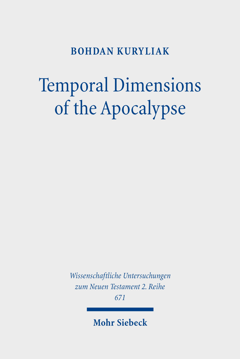
Bohdan Kuryliak examines the book of Revelation through four
interpretive approaches: preterism, idealism, historicism, and futurism.
Drawing on a synthesis of close biblical exegesis and early Christian
reception history (second to seventh centuries), he analyzes key
temporal markers and disputed passages, ranging from the vision of the
seals to the millennium. The author challenges the tendency to confine
the text's symbolic richness to a single framework, showing that early
Christian interpreters often blended these perspectives by combining
past, present, and future dimensions. By grounding this synthesis in the
text itself, he proposes historicism as an integrative model that
incorporates the temporal insights of the other three approaches. The
author thus offers a renewed hermeneutical pathway for navigating
Revelation's complex temporal landscape.
Table of contents:
1. Introduction 2. Interpretive Issues in the Book of Revelation: The Temporal Dimensions 2.1. Temporal Markers of the Apocalypse 2.2. Seven Seals (Revelation 6:1-8:1) 2.3. Seven Trumpets (Revelation 8:7-11:19) 2.4. Dragon and the Beasts (Revelation 12-13) 2.5. Babylon the Whore (Revelation 17) 2.6. Millennial Kingdom (Revelation 20) 2.7. Conclusions 3. Temporal Dimensions in the Reception of the Book of Revelation (ca. 2nd-7th Centuries) 3.1. Early Revelation's Reception (ca. 2nd-3rd Centuries) 3.2. Later Revelation's Reception (ca. 4th-7th Centuries) 3.3. Conclusions 4. The Panorama of Hermeneutical Approaches 4.1. Temporal Markers of the Apocalypse 4.2. Preterist Approach 4.3. Idealist Approach 4.4. Historicist Approach 4.5. Futurist Approach 4.6. Conclusions 5. Conclusions
The importance of studying the political situation in Egypt during the 13th Dynasty
stems from the fact that it remains an obscure period in ancient Egyptian history. The
13th Dynasty still raises debatable issues regarding its nature, including its formation,
the location of its power centre, the mechanisms through which its rulers legitimized
and maintained power, and its place within the conventional framework of ancient
Egyptian history. The only available and indispensable source of information about the
rulers of the 13th Dynasty is the Ramesside manuscript known as the Turin King-list.
Unfortunately, the King-list suffers from numerous deficiencies and is largely
inconsistent with the contemporary archaeological evidence of these rulers. Therefore,
the main question of the current study deals with questions regarding the nature of the
13th Dynasty and examines the extent to which it formed a cohesive political regime in
the literal sense of the dynastic system of ancient Egyptian history.
The present work studies the historical contexts of the Bactrian
inscriptions of the Kušān period and attempts to extract the historical
information of this epigraphic corpus by contextualising it with related
sources. Following an introduction on the historical backgrounds and
the problem of Kušān chronology, four main topics are studied: (1) The
linguistic and literary contextualisation of the texts, (2) the
titulature of the Kušān emperors in the inscriptions, (3) the religious
aspects of the inscriptions and their contexts and (4) the information
on the expansion and administration of the Kušān Empire which are
described here as the “Imperial Strategy”.
(1) shows that Bactrian was reduced to writing in the early Kušān period
to facilitate its use as an imperial means of communication. This
process involved individuals who spoke Greek and probably identified
themselves as such. This becomes apparent from various attempts to solve
problems arising from writing Bactrian in Greek script, which is
phonetically unsuited for this language. An epigraphical analysis of the
corpus of inscriptions further shows that by the time of Huviška, the
Kušān attempted to standardise and simplify Bactrian orthography at the
cost of grammatical complexity. The inscriptions contain only little
material for literary analysis, but a sense of style is apparent from
several passages that can be related to the inscriptions of the
Achaemenid, Arsakid and Sāsānian periods. This proves that the Bactrian
inscriptions of the Kušān are part of the literary history of Iran.
(2) shows that the Kušān had already established a canon of imperial
titles under their founder Kujula Kadphises that was only subject to
marginal change afterwards. The titles are largely taken from the
Bactrian tradition and originate in the Hellenistic period. The Bactrian
titles were mostly translated from Greek forms current in Bactria for
several centuries. A few Kušān novelties in the repository of titles are
probably attributable to Chinese and Roman influence.
(3) adds a study of the deities appearing on Kušān coins to explain the
religious information from the inscriptions. It becomes clear that the
Kušān religion appearing in epigraphic, numismatic and archaeological
sources is influenced by various religious ideas in the empire, but
contrary to long-standing opinions by researchers, it did not intend to
portray the religious diversity of the empire. Rather, the Kušān
emperors Kaniška I and Huviška assembled various groups of deities for
political ideas. The Rabatak Inscription shows that such groups were
also the subject of collective cults. The only known parallel to this
practice in the Iranian world is possibly the cult of the Commagenean
king Antiochos I. This also includes the deification of the living
emperor and his predecessors, for which the epigraphic and iconographic
material provides indicators that can no longer be doubted. The present
work cannot, however, trace the origins of this practice.
(4) first examines the expansion of the Kušān Empire from the literary
and archaeological sources. An excursus of sorts then examines the
long-standing claim that Kušān expansion was primarily motivated by the
interest of gaining control of long-distance trade routes. Further, the
related idea of a Roman influence exerted mainly through trade on the
foundations of the Kušān Empire is evaluated critically. The result is
that these elements have been strongly overrated by researchers and the
strategy of the Kušān does not display any sort of predominant
commercial interests. Roman influence on the Kušān which is mostly
observable in the material culture, also seems to have only been
superficial.
Following these investigations, the second part of (4) is concerned with
the inner structure of the Kušān Empire and its administration. The
main group of sources are administrative titles from Kušān inscriptions.
Titles in Bactrian inscriptions and Iranian titles in Indian
inscriptions show that, apart from the top layer of the imperial court,
it is hard to argue for a centralised imperial administration of the
empire. It would have been expected in such a case that Bactrian
administrative titles would have been spread throughout the empire
during its expansion. However, the Iranian titles in Indian inscription
rather seem to be part of the Achaemenid legacy there, as they can best
be etymologised as Old Persian.
In place of a summary, a new narrative of Kušān history has been
proposed. The dissertation also includes an appendix with a catalogue of
the Bactrian inscriptions of the Kušān and a glossary of these
inscriptions.
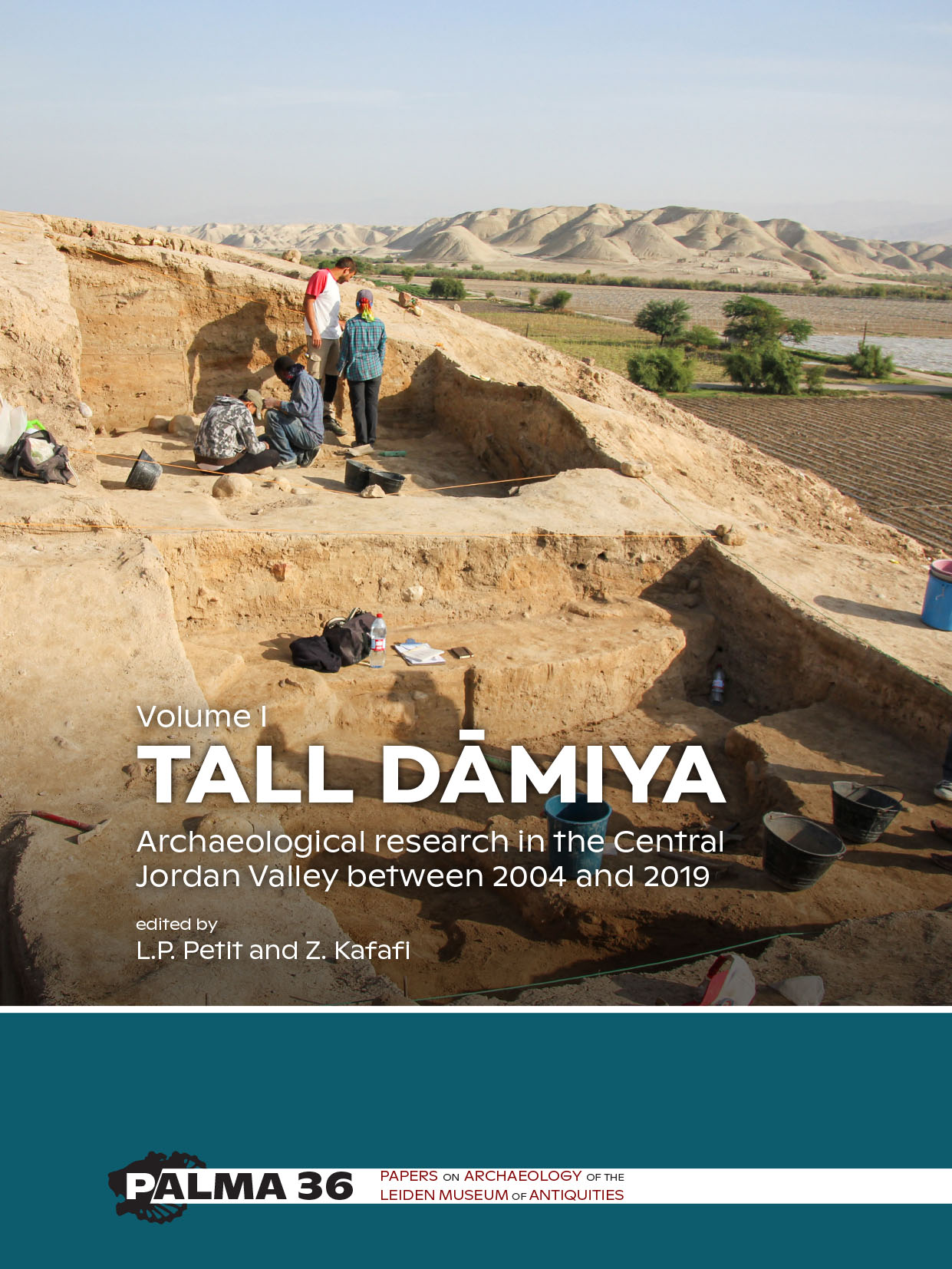
This monograph presents the results of nine seasons of archaeological
excavations (2004–2019) at Tall Dāmiya, a key site in the Central
Jordan Valley. Situated just south of the confluence of the Az-Zarqa and
Jordan rivers, near one of the region’s few natural river fords, the
settlement mound has long served a vital crossroads of cultures.
Founded in the Late Bronze Age, Tall Dāmiya developed into a
prominent cultic centre in the Iron Age. In the second half of the first
millennium BCE, it was repurposed as a
storage site for mobile pastoralists, later serving as a graveyard in
the Byzantine and Ottoman periods – before becoming a battleground in
the twentieth century.
Presented in three volumes, this joint Jordanian–Dutch project
explores how people lived in and moved through the arid Jordan Valley
over time, offering a comprehensive reconstruction of Tall Dāmiya’s
settlement history and shedding new light on its long and varied
afterlives.
Paperback ISBN: 9789464264661 |
Hardback ISBN: 9789464264678 |
Imprint: Sidestone Press
| Format: 210x280mm
| 252 pp.
| Papers on Archaeology of the Leiden Museum of Antiquities 36
|
Series: PALMA
| Language: English
| 350 illus. (bw)
| 263 illus. (fc)
| Keywords: settlement archaeology; Jordan; Iron Age; cult; Jordan Valley; ancient West Asia; ancient Near East
| download cover
| DOI: 10.59641/o7r3l4m5n6
| CC-license: CC BY-NC-ND 4.0
Contents Volume I:
Preface
PART I – INTRODUCTION
1. Introduction Lucas P. Petit and Zeidan Kafafi
2. Jordanian-Dutch cooperation in the Central Jordan Valley Zeidan Kafafi
3. Early records and history of study Zeidan Kafafi and Lucas P. Petit
4. Modern habitation history of Tall Dāmiya Zeidan Kafafi
PART II – REGIONALSTUDIES
5. Archaeological surface survey around Tall Dāmiya Eva Kaptijn
6. The historiography of the Dāmiya bridges Lucas P. Petit
7. Iron Age occupation – Strata XVIII-IV Lucas P. Petit and Zeidan Kafafi
8. Persian and Hellenistic remains – Stratum III Lucas P. Petit and Zeidan Kafafi
9. The burials – Strata II-I Jeroen Rensen
10. Contemporary occupation remains – Stratum 0 Lucas P. Petit
PART IV – THELOWERMOUND: STRATIGRAPHYANDARCHITECTURE
11. Area B Lucas P. Petit and Zeidan Kafafi, with contribution by Jeroen Rensen
Contents Volume II:
PART V – FINDSANDSPECIALISEDSTUDIES
12. Pottery
12a. Pottery repertoire and statistics Lucas P. Petit and Zeidan Kafafi
12b. Pottery catalogue Lucas P. Petit and Zeidan Kafafi
13. Finds catalogue Lucas P. Petit and Zeidan Kafafi
14. Seals, scarabs, and scaraboids Alexander Ahrens
15. Figurines and anthropomorphic statues Zeidan Kafafi and Lucas P. Petit
16. The inscriptions Omar al-Ghul
17. Textile production Jeanette Boertien
18. Archaeobotanical remains
18a. Archaeobotanical remains from the excavation seasons 2012, 2013, and 2014 Yotti Van Deun
18b. Archaeobotanical investigation of two storage rooms in Stratum VII Bert Verleijsdonk, with a contribution by Corrie Bakels
18c. The botanical content of three Persian-Hellenistic pits Corrie Bakels
19. Archaeozoological remains
19a. Faunal remains Maaike Groot, Anna Hofmann, and Jana Eger
19b. Analyses and identification of serpent bones Lucas P. Petit
20. Compositional analysis of soil, ceramics, and small finds
at Tall Dāmiya using non-destructive X-ray fluorescence spectroscopy Dennis Braekmans
Contents Volume III:
PART VI – THEORETICALCONSIDERATIONS, DISCUSSIONS, ANDCONCLUSIONS
21. Worshippers, travellers, and trade: the Tall Dāmiya ‘sanctuary’ in its context Diederik J.H. Halbertsma
22. A holistic view of cultic practices at Tall Dāmiya and a potential dual sanctuary Michel de Vreeze
23. Conclusions Lucas P. Petit and Zeidan Kafafi
References
Appendix A – Index of field loci
Appendix B – Index of bucket numbers
Appendix C – Profile drawings
The concept of style has been central to art history and archaeology for
most of their disciplinary history but has faced serious critique,
especially since the 1960s. While some scholars argue for moving beyond
style, others maintain its heuristic value. In the context of ancient
Near Eastern archaeology and related disciplines, stylistic analysis has
always played a vital role, while still oscillating between promise and
challenge. Stylistic analysis has been crucial for questions of
attribution, i. e. of origins, workshops, craftspeople, dates, contacts,
and more. Recent scholarly perspectives have proposed alternative
frameworks, such as understanding stylistic similarities as products of
historically contingent communities of shared practices. The intertwined
relationship between medium, style and meaning has also become an
increasingly vital topic. This volume and the 2021 virtual conference on
which it is based aimed to explore these developments and encourage
discussion of style beyond (mere) attribution. The assembled papers
concentrate on the highly interconnected visual cultures of the Late
Bronze and Iron Age Near East, but also include a perspective from
prehistoric European archaeology. Common themes of power dynamics in the
production and consumption of style, rhetorical uses of style for
ideological, aesthetic, or programmatic ends, and the embodiment of
stylistic production emerge from these contributions. The final chapters
take a historiographic view, assessing how far the connoisseurial
approaches of the past have taken us and where the future of visual
inquiry will lead.
This cumulative thesis is a landscape archaeological study with the
aim of identifying and interpreting the interdependencies between the
ancient city of Pergamon on the western coast of Asia Minor (present-day
Türkiye), urban and rural settlements, and the landscape within its
micro-region from the Hellenistic to the Roman Imperial period (3rd
century BCE – 3rd century CE). To this end, a research approach based on
the category of the micro-region as a spatial and conceptual framework,
digital landscape-based analyses, and archaeological surveys was
adopted. By means of three case studies on specific aspects of the
micro-region and their synthesis, it is thus possible to significantly
modify the previous understanding of rural space and its significance
for the history of the city of Pergamon.
This thesis is able to demonstrate that the settlement structure of the
Pergamon Micro-Region underwent a transformation during the period under
study, while the city of Pergamon experienced a fundamental urban
transformation and changes in its political and social framework. It
shows that this transformation was an expression of the dynamically
changing needs that emanated from the rulers, the city, and its
inhabitants, and that it was promoted by the heterogeneous landscape and
Pergamon’s location within it. Thus, previous assumptions about a
potential transformation of the rural settlement structure can be put on
a much more solid data basis and completely re-evaluated, and the close
interdependencies between Pergamon and its micro-region can be
revealed.
This thesis provides an essential contribution to the ongoing project of
the study of Pergamon and the micro-region in which it is embedded.
Moreover, it vividly demonstrates how a strongly landscape-based and
interdisciplinary approach can be used to arrive at meaningful
interpretations that go beyond an individual city and the boundaries
artificially drawn by purely geographical or historical-archaeological
considerations.
With the consistent use of open-source software and the transparent
presentation of all analyses, this thesis also guarantees connectivity
for further discussions and research on Pergamon and should at the same
time offer motivation to apply the approach presented here to the
micro-regions of other ancient cities in Asia Minor and beyond in order
to arrive at comparative studies and common answers and insights in the
future.
Bei der vorliegenden
kumulativen Dissertation handelt es sich um eine
landschaftsarchäologische Studie mit dem Ziel die Interdependenzen
zwischen der antiken Stadt Pergamon an der kleinasiatischen Westküste
(heutige Türkei), städtischen und ländlichen Siedlungen und der
Landschaft innerhalb ihrer Mikroregion vom Hellenismus bis zur römischen
Kaiserzeit (3. Jh. v. Chr. – 3. Jh. n. Chr.) zu identifizieren und zu
interpretieren. Zu diesem Zweck wurde ein Forschungsansatz gewählt, der
auf der Kategorie der Mikroregion als räumlichem und konzeptionellem
Rahmen, digitalen landschaftsbasierten Analysen und archäologischen
Surveys basiert. Anhand von drei Fallstudien zu spezifischen Aspekten
der Mikroregion und deren Synthese kann somit das bisherige Verständnis
des ländlichen Raumes und seiner Bedeutung für die Geschichte der Stadt
Pergamon deutlich modifiziert werden.
Diese Dissertation kann nachweisen, dass die Siedlungsstruktur der
Mikroregion Pergamon im Untersuchungszeitraum einer Transformation
unterlag, während die Stadt Pergamon einen grundlegenden urbanen Wandel
und Veränderungen der politischen und sozialen Rahmenbedingungen
erlebte. Sie zeigt, dass diese Transformation ein Ausdruck der sich
dynamisch verändernden Bedürfnisse war, die von den Herrschern und der
Stadt und ihren Bewohnern ausging, und dass sie durch die heterogene
Landschaft und die Lage Pergamons darin befördert wurde. Somit können
nicht nur bisherige Annahmen zu einer potentiellen Transformation der
ländlichen Siedlungsstruktur auf eine deutlich solidere Datengrundlage
gestellt und völlig neu bewertet werden, sondern auch die engen
Interdependenzen zwischen Pergamon und seiner Mikroregion aufgedeckt
werden.
Diese Dissertation liefert damit einen wesentlichen Beitrag für das
derzeit laufende Projekt zur Erforschung Pergamons und seiner
Mikroregion, in das sie eingebettet ist. Darüber hinaus demonstriert sie
anschaulich, wie man mit einem stark auf die Landschaft ausgerichteten
und interdisziplinären Ansatz zu aussagekräftigen Interpretationen
gelangen kann, die über eine individuelle Stadt und die durch rein
geografische oder historisch-archäologische Überlegungen künstlich
gezogen Grenzen hinaus gehen.
Mit der konsequenten Anwendung von open-source Software und der
transparenten Darstellung aller Analysen garantiert die vorliegende
Dissertation außerdem die Anschlussfähigkeit für weiterführende
Diskussionen und Forschungen in Pergamon und soll gleichzeitig
motivieren, den hier präsentierten Ansatz auf die Mikroregionen anderer
antiker Städte in Kleinasien und darüber hinaus anzuwenden um so
zukünftig zu vergleichenden Studien und übergreifenden Antworten und
Erkenntnissen zu gelangen.
The dissertation was funded by the German Research Foundation (DFG,
grant number 419349690) and supported by the Pergamon Excavation Project
of the Istanbul Department of the German Archaeological Institute
(DAI).
The use of writing in the development of Greek law was unique. In this
comparative study Professor Gagarin shows the reader how Greek law
developed and explains why it became so different from the legal systems
with which most legal historians are familiar. While other early
communities wrote codes of law for academic or propaganda purposes, the
Greeks used writing extensively to make their laws available to a
relatively large segment of the community. On the other hand, the Greeks
made little use of writing in litigation whereas other cultures used it
extensively in this area, often putting written documents at the heart
of the judicial process. Greek law thereby avoided becoming excessively
technical and never saw the development of a specialised legal
profession. This book will be of interest to those with an interest in
the history of law, as well as ancient historians. This title is also
available as open access on Cambridge Core.
The Greek romance was for the Roman period what epic was for the Archaic
period or drama for the Classical: the central literary vehicle for
articulating ideas about the relationship between self and community.
This book offers a reading of the romance both as a distinctive
narrative form (using a range of narrative theories) and as a
paradigmatic expression of identity (social, sexual and cultural). At
the same time it emphasises the elasticity of romance narrative and its
ability to accommodate both conservative and transformative models of
identity. This elasticity manifests itself partly in the variation in
practice between different romancers, some of whom are traditionally
Hellenocentric while others are more challenging. Ultimately, however,
it is argued that it reflects a tension in all romance narrative, which
characteristically balances centrifugal against centripetal dynamics.
This book will interest classicists, historians of the novel and
students of narrative theory. This title is also available as open
access on Cambridge Core.
The Charmides is a difficult and enigmatic dialogue traditionally
considered one of Plato's Socratic dialogues. This book provides a close
text commentary on the dialogue which tracks particular motifs
throughout. These notably include the characterization of Critias,
Charmides, and Socrates; the historical context and subtext, literary
features such as irony and foreshadowing; the philosophical context and
especially how the dialogue looks back to more traditional Socratic
dialogues and forward to dialogues traditionally placed in Plato's
middle and late period; and most importantly the philosophical and
logical details of the arguments and their dialectical function. A new
translation of the dialogue is included in an appendix. This will be
essential reading for all scholars and students of Plato and of ancient
philosophy. This title is also available as Open Access on Cambridge
Core.
Carpe diem – 'eat, drink and be merry, for tomorrow we die!' – is a
prominent motif throughout ancient literature and beyond. This is the
first book-length examination of its significance and demonstrates that
close analysis can make a key contribution to a question that is central
to literary studies in and beyond Classics: how can poetry give us the
almost magical impression that something is happening here and now? In
attempting an answer, Robert Rohland gives equal attention to Greek and
Latin texts, as he offers new interpretations of well-known poems from
Horace and tackles understudied epigrams. Pairing close readings of
ancient texts along with interpretations of other forms of cultural
production such as gems, cups, calendars, monuments, and Roman wine
labels, this interdisciplinary study transforms our understanding of the
motif of carpe diem.
The AWOL Index: The bibliographic data presented herein has been programmatically extracted from the content of AWOL - The Ancient World Online (ISSN 2156-2253) and formatted in accordance with a structured data model.
AWOL is a project of Charles E. Jones, Tombros Librarian for Classics and Humanities at the Pattee Library, Penn State University
AWOL began with a series of entries under the heading AWOL on the Ancient World Bloggers Group Blog. I moved it to its own space here beginning in 2009.
The primary focus of the project is notice and comment on open access material relating to the ancient world, but I will also include other kinds of networked information as it comes available.
The ancient world is conceived here as it is at the Institute for the Study of the Ancient World at New York University, my academic home at the time AWOL was launched. That is, from the Pillars of Hercules to the Pacific, from the beginnings of human habitation to the late antique / early Islamic period.
AWOL is the successor to Abzu, a guide to networked open access data relevant to the study and public presentation of the Ancient Near East and the Ancient Mediterranean world, founded at the Oriental Institute, University of Chicago in 1994. Together they represent the longest sustained effort to map the development of open digital scholarship in any discipline.









 Posts
Posts


 Stumble It!