The Biblical Toolkit is my classified collection of links to useful digital resources relevant to Biblical and Jewish Studies, Ancient Near Eastern, and Eastern Mediterranean studies, aimed at a range of academic and research levels. It developed out of my own bookmarks, which I wanted to offload from my browser to reduce digital clutter. I have put these links together in one place online, mainly for my own use in research, but also in the hopes that it might declutter others’ digital work and expand existing interests.
Click any of the individual areas to begin exploring.
Last updated June 2024.
Creator: Dr Lindsey A. Davidson (née Askin), Lecturer in Jewish Studies, University of Bristol, Department of Religion and Theology, UK
University of Bristol staff profile page: link
Saturday, November 30, 2024
The Biblical Toolkit: Collecting Resources for Biblical, Classical, and Near Eastern Studies
Friday, November 29, 2024
CARMEN Newsletter November 2024
The CARMEN project (Communal Art – Reconceptualising Metrical Epigraphy Network), a Horizon 2020 International Training Network, that has delivered several major workshops and seven successful PhD theses, have shared a newsletter with updates on their final year.
The CARMEN project is nearing its conclusion. It has provided a valuable opportunity for experienced colleagues, the supervisors, and the Early-Stage Researchers (ESRs) to engage in professional networking. The majority of participants were able to adhere to the guidelines set forth by the European funder, providing support for the project at the conclusion of the three-year contract period. This posed a significant challenge, as the majority of participants had no prior experience working on the Carmina Latina Epigraphica. Through the training programmes, they were able to gain expertise in non-book epigraphy, which involved fieldwork, contextualising the texts within their original discovery and installation contexts.
Full newsletter at <https://carmen-itn.eu/wp-content/uploads/2024/11/JGU_Carmen_News_5.pdf>
CDLI Newsletter 2024/2: September 2024
- Recent contributions
- Updated bibliography
- New images and licensing information
- Linked Open Data features
- API improvements
- Current catalogue statistics
- New publications and papers
- Visitor statistics
The Cuneiform Digital Library Initiative is pleased to provide an update on recent additions to our collections. We are grateful to see colleagues making such extensive use of the new features to expand the catalogue, furthering the availability of more and better open research to a global user community. With considerable delay, we also take this chance to thank everyone who found the room in their busy schedules to drop by the CDLI and ORACC drop-in session at the 69th Rencontre Assyriologique Internationale (RAI) in Helsinki in July - and to the conference organisers and staff for making the entire conference such a wonderful experience!
Recent contributions
During the third quarter of 2024, around 4,300 submissions and additions to artifact transliterations, translations, imagery, metadata, and related entities have been received and accepted for publication. A full listing of all update events since 1 July 2024, as well as their contributors and authors, can be found here: https://cdli.mpiwg-berlin.mpg.de/update-events?created_after=2024-06-30&created_before=2024-10-01
Here, the editors would like to express their particular gratitude to Tohru Ozaki for his immense contributions to the catalogue. For several years now, Tohru Ozaki has been systematically re-reading the old transcriptions of the mass of Ur III texts available on the CDLI. Several thousand Ur III texts have already been corrected in this way, and work continues with the CDLI staff to constantly improve the transcriptions available. On his CDLI author page, you can find the flow of curated editions from Ozaki’s suggestions uploaded and with further careful curation by Bertrand Lafont https://cdli.mpiwg-berlin.mpg.de/authors/1050 (see list of contributions at the bottom of the page).
Updated bibliography
For this edition of our newsletter, we would also like to highlight recent efforts to update and clean the bibliography of the CDLI. Since January 2024, Richard Firth has worked tirelessly to clean and merge incomplete and duplicate records, which has reduced our publications table from more than 100,000 records to less than 18,000 records. During the summer of 2024, uploads of the project bibliography of the Geomapping Landscapes of Writing (GLoW) of Uppsala University has been completed, adding another ca. 2,000 records to the bibliography database. A growing number of these records also include DOI identifiers and, where available, links to free online versions of the pertinent publication.
Publications can be searched here: https://cdli.mpiwg-berlin.mpg.de/publications, but are also accessible for consultation and download on the main search and on an artifact’s page. The full bibliography can also be retrieved through the CDLI API, through our API client (https://github.com/cdli-gh/framework-api-client).
New images and licensing information
Thanks to support from the Getty Director’s fund, Joseph Barber, Christie Carr, and Gustavo Fernandes Pedroso have assembled more than 1750 fatcrosses of unpublished images of Louvre artifacts, totaling 48 GB of archival composite images under the management of Jacob Dahl at the University of Oxford. Those images are now online for everyone’s perusal. They include photos of texts that many of us have only been able to study through the published lineart in the past. The original images were produced during the ”Creating a Sustainable Cuneiform Digital Library” (2011-2015) project funded by the Mellon Foundation and expertly captured by Klaus Wagensonner.
We also have uploaded the remaining images of seals from Oxford’s Ashmolean Museum, images of more than 1100 seals from the British Museum, and additional images of the Kassite seals from the Yale Babylonian collection, captured by Oxford DPhil student Lara Bampfield, in the course of her research on Old Babylonian and Kassite period seals. These seals were captured using line scan technologies and the images are offered double the usual density of pixels so anyone can examine minute details from the surface of the seals. Many of these photos will showcase annotations. See, for example, https://cdli.mpiwg-berlin.mpg.de/artifacts/473134/reader/238411 (zoom in for extra detail and click on “Show annotations” to see annotations). Lara’s work on cylinder seals was also supported by the Getty Director’s Fund.
We would also like to thank Joe Barber and Lara Bampfield for preparing images-related guides: “Generating a fatcross in Adobe Photoshop” for the manual processing of tablet scans at https://cdli.mpiwg-berlin.mpg.de/docs/images-acquisition-and-processing#content-generating-a-fatcross-in-adobe-photoshop and “Files renaming” for batch renaming files useful in image work: https://cdli.mpiwg-berlin.mpg.de/docs/images-acquisition-and-processing#content-files-renaming.
Additionally, thanks to lead programmer Lars Willighagen, it is now possible to see owner and license information close to digital assets on the site. A feature for providing credits for individuals participating in the digitisation process, and linking lineart (and photos) to their publication, will also be added soon. In the coming months, we will be working hard in publishing this information granularly based on the different agreements and licenses used by image owners, which at this time generally displays based on the default that photos belong to collections and original line art to the publication author or publisher it was published in.
Linked Open Data features
Lars Willighagen has recently deployed the beta CDLI SPARQL endpoint with a snapshot of the CDLI data from October 15. At this time, URIs are not stable (we will announce an official release when they are stable), and the structure of the graph might evolve. Interested users can use our new lightweight custom endpoint client made available on the CDLI site at https://cdli.mpiwg-berlin.mpg.de/resources/sparql. Interface documentation is available at https://cdli.mpiwg-berlin.mpg.de/docs/sparql-interface (see the test queries!). We welcome any comments and suggestions regarding the cdli graph. Data consumers can reach the endpoint directly at https://cdli.utoronto.ca/sparql with renewed thanks to Professor Heather Baker and the Digital Research Alliance of Canada for their support with the resources necessary for this deployment.
API improvements
Finally, the API was improved under the hood to achieve faster downloads, and to improve the structure of the linked data. The API client (https://github.com/cdli-gh/framework-api-client/) was updated to be more resilient in case of intermittent failures and to provide more information during the download and when a lasting problem does occur. Users of the API client should make sure to update their local installation of the client to fully enjoy these benefits. Altogether, this means it is now possible to download the entire catalog as linked data or as a CSV file without too much trouble.
Current catalogue statistics
Below are current statistics for the main tables of the CDLI as of 30 September 2024:
- Artifacts (https://cdli.mpiwg-berlin.mpg.de/artifacts): 368,735 records
- Artifact records with images: 139,287
- Artifact records with lineart: 86,627
- Artifact records with transliterations: 151,024
- Artifact records with translations: 5,568
New publications and papers
Our publication series includes the Cuneiform Digital Library Journal, the Cuneiform Digital Library Bulletin, the Cuneiform Digital Library Notes, and the Cuneiform Digital Library Preprints. For new issues, please see the Publications tab on https://cdli.mpiwg-berlin.mpg.de.
- Parian, Saber Amir & Mahmoudi, Keyvan 2024. “A New Reading of the 70th Paragraph of the Behistun Inscription” Cuneiform Digital Library Bulletin 2024/3 https://cdli.mpiwg-berlin.mpg.de/articles/cdlb/2024-3
- Changyu, Liu 2024. “One Neo-Sumerian Tablet in a Chinese Private Collection” Cuneiform Digital Library Notes 2024/1 https://cdli.mpiwg-berlin.mpg.de/articles/cdln/2024-1
- Simkó, Krisztián 2024. “Catalogue of Campbell Thompson’s Assyrian Medical Texts (1923-2024)” Cuneiform Digital Library Preprints 26.0 https://cdli.mpiwg-berlin.mpg.de/articles/cdlp/26.0
Visitor statistics
In accordance with European Union and UK GDPR regulations, the CDLI does not track individual users of the platform. We do, however, monitor the number of unique visitors and page views and are happy to report that the CDLI is currently receiving an average of ca. 16.000 visits per month generating an average 157.000 page views.
As a resource dedicated to enabling full and open access to cuneiform sources for everyone across the globe, the Cuneiform Digital Library Initiative is dependent on feedback, contributions and corrections from users. Input from our user community continues to generate improvements to the CDLI framework and user interface. Anyone is welcome to create an account (https://cdli.mpiwg-berlin.mpg.de/register) and email us to request crowdsourcing privilege (mailto:cdli@ames.ox.ac.uk).
On behalf of the CDLI
Jacob Dahl, Bertrand Lafont, Émilie Pagé-Perron, and Rune RattenborgOctober 01, 2024
Posted by Rattenborg, Rune
This repository contains the largest multilayer corpus for Ancient Greek, Opera Graeca Adnotata (1,999 base texts/files and 40M+ tokens). The corpus can be queried by word form, lemma, author, work title, CTS URN, passage, work date, morphosyntax, and IPA transcription. For more information, read the README.md file accompanying the corpus.
Files
opera_graeca_adnotata_v0.2.0.zip
Files (8.6 GB)
Name Size md5:d4117ae52f1cc6319c6ba20af0c1cf3b
Dime im Fayum: Ein Tempel im Spannungsfeld von Tradition und Multikulturalität im hellenistisch-römischen Ägypten
For citations of this document, please do not use the address displayed in the URL prompt of the browser. Instead, please cite with one of the following:
Document type: Other Place of Publication: Heidelberg Date: 2024 Version: Primary publication Date Deposited: 25 Nov 2024 07:39 Faculties / Institutes: Research Project, Working Group > Individuals DDC-classification: Ägypten (Altertum) Subject (Propylaeum): Egyptology Controlled Keywords: Dimeh, Tempel Subject (classification): History of the ancient world to ca. 499 Countries/Regions: Egypt (Antiquity) Collection: Abschlussberichte zu geförderten Projekten der Deutschen Forschungsgemeinschaft
PDF, German
Download (5MB) | Lizenz: Rights reserved - Free Access

Thursday, November 28, 2024
l’Égypte dure longtemps regards croisés sur la réception en Occident de la civilisation phraonique
« Car chacun vaque à son destin / Petits ou grands / Comme durant des siècles égyptiens / Péniblement »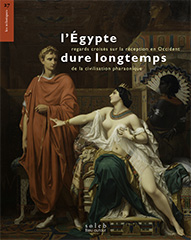
Alain Bashung, dans son ultime album, dit bien le temps long auquel l’Égypte antique nous renvoie inlassablement. Et, depuis plusieurs décennies, les histoires des beaux-arts, du cinéma, du vêtement, des arts décoratifs et de la littérature ont entrepris de prendre au sérieux les références et réappropriations de ce qu’on pourrait nommer le grand paradigme égyptien.
• Le présent volume ajoute à ces études un éclairage sur la construction de ce paradigme à partir du fonctionnement même de l’image égyptienne. Comment la spécificité du lien littéral entre image et sens, caractéristique de l’art pharaonique, influence-t-elle la réception de cet art par des civilisations éloignées, dans l’espace et le temps ? • • •
Human Societies Facing Climate Change: Volume 3: Determinisms in Prehistoric Societies: Climate Changes, Environments, Functional Constraints and Cultural Tradition

This volume contains the papers given at a symposium organized by the International Academy of Prehistory and Protohistory (AIPP) at the Institute of Human Paleontology in Paris, on June 3, 2023.
The chosen theme “Determinisms in prehistoric societies: climate change, environments, functional constraints and cultural traditions” is part of the project “Human societies in the face of climate change” supported by the International Academic Union (UAI).
H 245 x W 174 mm
306 pages
153 figures, 5 tables (colour throughout)
Published Nov 2024
ISBN
Paperback: 9781803278919
Digital: 9781803278926
Contents
Foreword
Avant-propos
Quantification of morphological variability expressed by a “log sem” statistic in the context of human evolution (Australopithecus, Paranthropus and early Homo) – Francis Thackeray
L’importance du déterminisme climatique dans l’évolution de l’Humanité – François Djindjian
Cultural evolution as the emperor’s new clothes – Martin Oliva
Le Mézinien : un exemple d’adaptation climatique et culturelle aux steppes froides d’Europe orientale: état actuel des recherches, des discussions et des interprétations – Lioudmila Iakovleva
The evidence for fishing in the Late Palaeolithic and Mesolithic of Northwestern Poland – Jacek Kabaciński
The turn to sedentary life at the edge of Southeast and Central Europe – Eszter Bánffy
Cultural changes consequential to the formation of Neolithic way of living: The Upper Euphrates – Upper Tigris Basin – Mehmet Özdoğan
The Rajajil Cultures. Socio-economic and cultural evolution interacting with climate oscillations in Northwestern Arabia (5th – early 4th millennium BCE) – Hans Georg K. Gebel
Leceia, Moita da Ladra and Outeiro Redondo: Similarities and differences between three walled sites of Portuguese Extremadura – João Luís Cardoso
The large stones of the Neolithic Age. Menhirs and stelae – Svend Hansen
犍陀罗美术与希腊—罗马世界:简明导论

In the early centuries AD, the small region of Gandhara (centred on what is now northern Pakistan) produced an extraordinary tradition of Buddhist art which eventually had an immense influence across Asia. Mainly produced to adorn monasteries and shrines, Gandharan sculptures celebrate the Buddha himself, the stories of his life and the many sacred characters of the Buddhist cosmos. Since this imagery was rediscovered in the nineteenth century, one of its most fascinating and puzzling aspects is the extent to which it draws on the conventions of Greek and Roman art, which originated thousands of kilometres to the west.
Inspired by the Gandhara Connections project at Oxford University’s Classical Art Research Centre, this book offers an introduction to Gandharan art and the mystery of its relationship with the Graeco-Roman world of the Mediterranean. It presents an accessible explanation of the ancient and modern contexts of Gandharan art, the state of scholarship on the subject, and guidance for further, in-depth study.
Chinese language edition.
H 245 x W 174 mm
96 pages
60 figures (colour throughout)
chi text
Published Nov 2024
ISBN
Paperback: 9781803278650
Digital: 9781803278667
Contents
序言
第一章 : 何谓犍陀罗美术
第二章 : 希腊、罗马与犍陀罗
第三章 : 犍陀罗美术在今天
延伸阅读与资源
参考文献
图注总录与图片来源
Islamic, Semitic, and Biblical Studies in Germany during the First Half of the Twentieth Century
Volume 1 (2024) / Issue 2 of Historical Interactions of Religious Cultures (HIReC)Editorial Introduction
Sabine Schmidtkepp. 171-176 (6)Articles
Sabine Schmidtkepp. 177-240 (64)Valentina Sagaria Rossipp. 241-364 (124)Francesca BellinoManuscripts and Research Materials on the Egyptian Shadow Play in the Paul E. Kahle Archive in Turinpp. 405-449 (45)
Wednesday, November 27, 2024
Camées et intailles. Tome II : Les portraits romains du Cabinet des médailles. Catalogue raisonné

Éditeur : Éditions de la Bibliothèque nationale de France
Lieu d’édition : Paris
Publication sur OpenEdition Books : 17 septembre 2018
ISBN numérique : 978-2-7177-2586-5
DOI : 10.4000/books.editionsbnf.327
Collection : Monnaies, Médailles et Antiques
Année d’édition : 2003
ISBN (Édition imprimée) : 978-2-7177-2217-8
Nombre de pages : 2 vol. Vol. I : 240 p. ; vol. II : 148
Le département des Monnaies, Médailles et Antiques de la Bibliothèque nationale de France conserve une des plus importantes et des plus anciennes collections de pierres gravées au monde (près de dix mille).
Dès le Moyen-Âge, certaines, d’une qualité exceptionnelle, exécutées pour des princes durant l’Antiquité, sont entrées dans les trésors des églises et des rois de France. Au début du XVIIIe siècle, le Cabinet du Roi en renferme déjà près de mille. Louis XIV, collectionneur passionné, fait orner les plus belles de montures d’or émaillées. Les confiscations révolutionnaires puis, aux XIXe et XXe siècles, les dons enrichissent considérablement le fonds. Les catalogues des pierres gravées grecques et romaines du département des Monnaies, Médailles et Antiques remontaient au XIXe siècle. C’est la plus éminente spécialiste de la glyptique antique, Marie-Louise Vollenweider, qui a relancé leur étude avec le catalogue raisonné des portraits antiques sur pierres dures.
Le premier tome, intitulé Camées et intailles. Les Portraits grecs du Cabinet des médailles, illustrait la naissance du portrait en Grèce, les effigies des princes hellénistiques et des philosophes. Pour ce deuxième tome, consacré aux portraits romains, plus de 250 camées et intailles ont été sélectionnés. La richesse de la collection permet de présenter un panorama quasiment complet de l’histoire du portrait romain des débuts de la République jusqu’au Bas-Empire. Loin d’être un simple inventaire, cet ouvrage est une étude très personnelle mais rigoureuse, à la fois iconographique, technique, historique, stylistique et psychologique. Elle est accompagnée de plus de 500 photographies exécutées par l’auteur, dont de nombreuses macrophotographies qui révèlent des traits invisibles à l’oeil nu. Dans ces pierres, parfois minuscules, aux tons chatoyants, les visages des souverains et de leur famille ont gardé intacte toute leur expressivité. La présentation en deux volumes permettra au lecteur de suivre les descriptions très minutieuses de l’auteur tout en ayant sous les yeux les portraits eux-mêmes. Une table des concordances et des index des provenances, des collections, des artistes, des sujets et des matériaux complètent l’ouvrage.
Le texte seul est utilisable sous licence Licence OpenEdition Books
. Les autres éléments (illustrations, fichiers annexes importés) sont « Tous droits réservés », sauf mention contraire.
Cette publication numérique est issue d’un traitement automatique par reconnaissance optique de caractères.
Camées et intailles. Tome I: Les portraits grecs du Cabinet des médailles. Catalogue raisonné

Éditeur : Éditions de la Bibliothèque nationale de France
Lieu d’édition : Paris
Publication sur OpenEdition Books : 17 septembre 2018
ISBN numérique : 978-2-7177-2585-8
DOI : 10.4000/books.editionsbnf.550
Collection : Monnaies, Médailles et Antiques
Année d’édition : 1995
ISBN (Édition imprimée) : 978-2-7177-1915-4
Nombre de pages : 2 vol. : 264, 123-VIII
Le Cabinet des médailles de la Bibliothèque nationale de France compte parmi ses trésors la plus importante collection de pierres gravées au monde (près de dix mille). Nombre d’entre elles, d’une qualité exceptionnelle, gravées pour des princes durant l’Antiquité, nous ont été transmises par les rois de France qui les firent orner de montures d’or décorées de pierres précieuses et d’émaux.
C’est la plus éminente spécialiste de la glyptique antique, Marie-Louise Vollenweider, qui inaugure l’étude des pierres grecques et romaines avec le catalogue raisonné des portraits antiques, résultat de trente années de travail. Pour ce premier tome, consacré à la naissance du portrait et à son développement à l’époque hellénistique - qui sera suivi d’un second sur les portraits romains -, 283 camées et intailles ont été sélectionnés. D’une conception résolument nouvelle, ce catalogue ne se contente pas d’établir un classement des oeuvres, selon le style d’une époque et la manière d’un graveur, mais cherche à comprendre l’esprit du temps, le talent des graveurs et la psychologie des personnages représentés.
Ceux-ci, restés jusqu’ici anonymes, ont retrouvé leur identité de princes et de princesses hellénistiques – ptolémaïques, séleucides, pontiques, cappadociens –, d’artisans ou de philosophes, mais aussi une vie nouvelle. Car pour Marie-Louise Vollenweider, le visage parle et elle en comprend parfaitement le langage. Notons aussi certaines attributions inédites à des artistes, dont la plus novatrice est celle d’un camée d’Alexandre le Grand au plus célèbre graveur de l’Antiquité, Pyrgotélès, connu par le témoignage de Pline l’Ancien, mais dont aucune œuvre n’avait été jusqu’à présent identifiée. Ce serait là le seul portrait du grand souverain réalisé de son vivant.
Le texte seul est utilisable sous licence Licence OpenEdition Books
Volume I. Textes
Jean Favier
Avant-proposAlexandre le Grand
- 29 — ALEXANDRE LE GRAND
- Bibliographie
- 30 — ALEXANDRE LE GRAND
- Bibliographie
- 31 — ALEXANDRE LE GRAND
- Bibliographie
- 32 — ALEXANDRE LE GRAND
- Bibliographie
- 33 — ALEXANDRE Ier BALA
- Bibliographie
- 34 — JEUNE PRINCE ASSIMILÉ À ALEXANDRE LE GRAND
- 35 — PTOLÉMÉE XI ALEXANDRE II ASSIMILÉ À ALEXANDRE LE GRAND
- Bibliographie
- 36 — MARC ANTOINE SOUS LES TRAITS D’ALEXANDRE
- Bibliographie
- 37 — ALEXANDRE LE GRAND
- Bibliographie
- 38 — ALEXANDRE LE GRAND
- 39 — ALEXANDRE LE GRAND ASSIMILÉ À HÉLIOS-SOL
- 40 — ALEXANDRE LE GRAND ASSIMILÉ À HÉLIOS-SOL
- 41 — ALEXANDRE LE GRAND ASSIMILÉ À HÈLIOS-SOL
- Bibliographie
Jean-Baptiste Giard
IntroductionMathilde Avisseau-Broustet
Historique de la collectionI. Les premiers portraits
La naissance du portrait miniature en matière précieuse
- 1 — CACHET HITTITE EN FORME DE TÊTE
- 2 — TÊTE D’HOMME COIFFÉ D’UNE TIARE
- 3 — TÊTE D’HOMME PROCHE-ORIENTAL
- Bibliographie
- 4 — TÊTE DE NOIR
- Bibliographie
- 5 — TÊTE DE JEUNE HOMME
- Bibliographie
- 6 — TÊTE ÉTRUSQUE
- Bibliographie
- 7 — TÊTE ORPHIQUE
- Bibliographie
- 8 — TÊTE DE MINERVE-ROMA
- Bibliographie
- 9 — SCARABÉE À TÊTE DE JEUNE HOMME PROCHE-ORIENTAL
- Bibliographie
- 10 — TÊTE DE GUERRIER PHÉNICIEN
- Bibliographie
- 11 — GUERRIER GREC
- Bibliographie
- 12 — GUERRIER ITALIQUE
- Bibliographie
- 13 — APHRODITE OU KORÉ
- 14 — GUERRIER SYRIEN
- Bibliographie
- 15 — GUERRIER
- Bibliographie
- 16 — GUERRIER
- Bibliographie
- 17 — JEUNE HOMME JOUANT AVEC SON CHIEN
- Bibliographie
- 18 — GUERRIER
- Bibliographie
- 19 — HERMÈS
- 20 — GUERRIER
- Bibliographie
- 21 — ARCHER
- Bibliographie
- 22 — GUERRIER GREC
- L’artiste
- Bibliographie
- 23 — APHRODITE
- Bibliographie
- 24 — ARCHERS PERSES ACHÉMÉNIDES
- Bibliographie
- 25 — SOLDAT GREC
- Bibliographie
- 26 — DÉPART D’UN CAVALIER THRACE
- 27 — PORTRAIT D’UN PHILOSOPHE
- Bibliographie
- 28 — PORTRAIT D’UN CARTHAGINOIS
- Un maître graveur de la Grande Grèce
- Bibliographie
II. Les portraits hellénistiques
Alexandre le Grand
- 29 — ALEXANDRE LE GRAND
- Bibliographie
- 30 — ALEXANDRE LE GRAND
- Bibliographie
- 31 — ALEXANDRE LE GRAND
- Bibliographie
- 32 — ALEXANDRE LE GRAND
- Bibliographie
- 33 — ALEXANDRE Ier BALA
- Bibliographie
- 34 — JEUNE PRINCE ASSIMILÉ À ALEXANDRE LE GRAND
- 35 — PTOLÉMÉE XI ALEXANDRE II ASSIMILÉ À ALEXANDRE LE GRAND
- Bibliographie
- 36 — MARC ANTOINE SOUS LES TRAITS D’ALEXANDRE
- Bibliographie
- 37 — ALEXANDRE LE GRAND
- Bibliographie
- 38 — ALEXANDRE LE GRAND
- 39 — ALEXANDRE LE GRAND ASSIMILÉ À HÉLIOS-SOL
- 40 — ALEXANDRE LE GRAND ASSIMILÉ À HÉLIOS-SOL
- 41 — ALEXANDRE LE GRAND ASSIMILÉ À HÈLIOS-SOL
- Bibliographie
Les diadoques et les épigones
- 42 — DÉMÉTRIOS POLIORCÈTE ASSIMILÉ À DIONYSOS
- Bibliographie
- 43 — ALEXANDRE D’ÉPIRE
- Bibliographie
- 44 — COUPLE ROYAL ASSIMILÉ À ZEUS ET À HÉRA
- Bibliographie
- 45 — PHILA, FILLE D’ANTIPATER
- Bibliographie
- 46 — ARSINOÉ II, ASSIMILÉE À APHRODITE
- 47 — BÉRÉNICE I EN PSYCHÉ
- 48 — ARSINOÉ I
- Bibliographie
- 49 — ARSINOÉ II
- Bibliographie
- 50 — PRINCESSE PTOLÉMAÏQUE
- Bibliographie
- 51 — ARSINOÉ II ASSIMILÉ À HÉRA
- Bibliographie
- 52 — ARSINOÉ II
- Bibliographie
- 53 — PRINCESSE PTOLÉMAÏQUE
- Bibliographie
- 54 — PTOLÉMÉE II ET ARSINOÉ II ASSIMILÉS À DIONYSOS ET ARIANE
- Bibliographie
- 55 — PERSÉE
- Bibliographie
- 56 — PTOLÉMÉE III ASSIMILÉ À HERMÈS THOT
- Bibliographie
- 57 — PTOLÉMÉE II ASSIMILÉ À ALEXANDRE
- Bibliographie
- 58 — PTOLÉMÉE III ASSIMILÉ À HERMÈS
- 59 — PTOLÉMÉE II PHILADELPHE
- 60 — PRINCE ASSIMILÉ À HERMÈS
- Bibliographie
- 61 — PTOLÉMÉE III ASSIMILÉ À HERMÈS
La dynastie des Ptolémées
- 62 — PTOLÉMÉE III
- Bibliographie
- 63 — BÉRÉNICE II ASSIMILÉE À ATHÉNA PARTHÉNOS
- Bibliographie
- 64 — BÉRÉNICE II
- Bibliographie
- 65 — BÉRÉNICE II ASSIMILÉE À ATHÉNA
- Bibliographie
- 66 — PTOLÉMÉE IV ASSIMILÉ À DIONYSOS ENFANT
- Bibliographie
- 67 — PTOLÉMÉE IV PHILOPATOR ENFANT
- Bibliographie
- 68 — PTOLÉMÉE IV ASSIMILÉ À HARPOCRATE ENFANT
- Bibliographie
- 69 — PRINCESSE PTOLÉMAÏQUE SOUS LES TRAITS D’ÉROS
- Bibliographie
- 70 — PTOLÉMÉE IV ENFANT
- Bibliographie
- 71 — PTOLÉMÉE IV SOUS LES TRAITS DE L’ENFANT HORUS
- Bibliographie
- 72 — PTOLÉMÉE IV, PORTRAIT POSTHUME
- Bibliographie
- 73 — JEUNE PRINCE PTOLÉMAÏQUE EN ÉROS-HERAKLISKOS
- Bibliographie
- 74 — ARSINOÉ III
- Bibliographie
- 75 — SOSIBIOS, MINISTRE DE PTOLÉMÉE IV, EN HÉRACLÈS
- 76 — CHEF DE MERCENAIRES
- 77 — PRINCE DE LA FAMILLE DE PTOLÉMÉE ΙII ou IV EN HÉRAKLÈS
- Bibliographie
- 78 — CHEF DE MERCENAIRES EN HÉRAKLÈS
- 79 — PTOLÉMÉE VII PHILOPATOR (?) ASSIMILÉ À HÉRAKLÈS
- 80 — PTOLÉMÉE V ÉPIPHANE, ENFANT, ASSIMILÉ À HARPOCRATE
- Bibliographie
- 81 — ARSINOÉ ΙII ASSIMILÉE À UNE DÉESSE SYNCRÉTISTE
- Bibliographie
- 82 — ARSINOÉ III, COIFFÉE DE LA COURONNE ATEF
- Bibliographie
- 83 — CLÉOPÂTRE I COIFFÉE DE LA DÉPOUILLE D’ÉLÉPHANT
- 84 — PTOLÉMÉE V ÉPIPHANE ET CLÉOPÂTRE I, ASSIMILÉS À TRIPTOLÈME ET CÉRÊS
- Bibliographie
- 85 — PTOLÉMÉE VI PHILOMÉTOR ADOLESCENT, AVEC ÉROS ET CLÉOPÂTRE II
- Bibliographie
- 85bis — PTOLÉMÉE VI PHILOMÉTOR ET CLÉOPÂTRE II
- Bibliographie
- 86 — PTOLÉMÉE V ÉPIPHANE
- Bibliographie
- 87 — PTOLÉMÉE VI ENFANT
- 88 — PTOLÉMÉE VI ASSIMILÉ À HERMÈS
- Bibliographie
- 89 — CLÉOPÂTRE I ASSIMILÉE À ISIS
- Bibliographie
- 90 — CLÉOPÂTRE I ASSIMILÉE À TYCHÉ
- 91 — CLÉOPÂTRE I ASSIMILÉE À ISIS
- Bibliographie
- 92 — CLÉOPÂTRE I ASSIMILÉE À ISIS
- Bibliographie
- 93 — CLÉOPÂTRE I ASSIMILÉE À ISIS
- Bibliographie
- 94 — PRINCE PTOLÉMAÏQUE ASSIMILÉ À HORUS-HARPOCRATE
- 95 — ARSINOÉ III ASSIMILÉE À TYCHÉ
- 96 — CLÉOPÂTRE I ASSIMILÉE À ISIS
- 97 — CLÉOPÂTRE II ASSIMILÉE À ARTÉMIS
- Bibliographie
- 98 — PRINCESSE PTOLÉMAÏQUE ASSIMILÉE À ARTÉMIS
- Bibliographie
- 99 — PRINCESSE PTOLÉMAÏQUE ASSIMILÉE À ARTÉMIS
- Bibliographie
- 100 — JEUNE PRINCE, FILS DE PTOLÉMÉE VI ET CLÉOPÂTRE II
- Bibliographie
- 101 — PTOLÉMÉE VI PHILOMÉTOR
- 102 — PTOLÉMÉE VI PHILOMÉTOR
- Bibliographie
- 103 — PTOLÉMÉE VI PHILOMÉTOR
- Bibliographie
- 104 — PTOLÉMÉE VI PHILOMÉTOR REVERS : CLÉOPÂTRE II
- Bibliographie
- 105 — CLÉOPÂTRE II ASSIMILÉE À CÉRÈS
- Bibliographie
- 106 — CLÉOPÂTRE II ASSIMILÉE À HYGIE
- 107 — PRINCE PTOLÉMAÏQUE ASSIMILÉ À HERMÈS
- Bibliographie
- 108 — NIKÉ (CLÉOPÂTRE II ?)
- Bibliographie
- 109 — CLÉOPÂTRE II
- Bibliographie
- 110 — PTOLÉMÉE X ALEXANDRE I ASSIMILÉ À APOLLON
- Bibliographie
- 111 — PRINCESSE, FILLE DE PTOLÉMÉE VI ET DE CLÉOPÂTRE II
- Bibliographie
- 112 — CLÉOPÂTRE IIΙ, ADOLESCENTE, ASSIMILÉE À ARTÉMIS
- Bibliographie
- 113 — JEUNE PRINCE PTOLÉMAÏQUE (L’UN DES FILS DE PTOLÉMÉE VI)
- Bibliographie
- 114 — PTOLÉMÉE VIII
- Bibliographie
- 115 — VASE DES SAISONS
- Bibliographie
- 116 — CLÉOPÂTRE III PORTANT ÉROS
- Bibliographie
- 117 — CLÉOPÂTRE SÉLÉNÉ
- 118 — CLÉOPÂTRE III
- Bibliographie
- 119 — REINE PTOLÉMAÏQUE
- Bibliographie
- 120 — CLÉOPÂTRE II COIFFÉE DE LA DÉPOUILLE DE VAUTOUR
- Bibliographie
- 121 — PTOLÉMÉE X ALEXANDRE I
- Bibliographie
- 122 — PTOLÉMÉE X ALEXANDRE I ASSIMILÉ À ALEXANDRE LE GRAND
- 123 — JEUNE PRINCE PTOLÉMAÏQUE
- Bibliographie
- 124 — JEUNE PRINCE PTOLÉMAÏQUE, FILS DE PTOLÉMÉE VIII
- Bibliographie
- 125 — ENFANT, FILS DE PTOLÉMÉE VI, EN HÉRAKLISKOS
- Bibliographie
- 126 — JEUNE PRINCE, FILS DE PTOLÉMÉE VI, ASSIMILÉ À HERMÈS
- 127 — CLÉOPÂTRE IV (?) ASSIMILÉE À ISIS
- 128 — REINE PTOLÉMAÏQUE
- 129 — JEUNE PRINCE ASSIMILÉ À HERMÈS
- 130 — NIKÈ
- Bibliographie
- 131 — REINE ASSIMILÉE À ARTÉMIS
- Bibliographie
- 132 — PRINCESSE ASSIMILÉE À ISIS
- Bibliographie
- 133 — PRINCESSE ASSIMILÉE À ARTÉMIS
- 134 — PRINCESSE DE LA COUR DE CLÉOPÂTRE VII
- 135 — PSYCHÉ
- Bibliographie
- 136 — REINE TENANT UN SCEPTRE
- Bibliographie
- 137 — PRINCE PTOLÉMAÏQUE ASSIMILÉ À ALEXANDRE-HÉRACLÈS
- Bibliographie
- 138 — PRINCE PTOLÉMAÏQUE ASSIMILÉ À APOLLON OU HERMÈS MUSICIEN
- 139 — PRINCE PTOLÉMAÏQUE ASSIMILÉ À APOLLON OU HERMÈS MUSICIEN
- Bibliographie
- 140 — PRINCESSE PTOLÉMAÏQUE EN BACCHANTE
- 141 — JEUNE PRINCE (PTOLÉMÉE XI ?) ASSIMILÉ À UN SATYRE
- 142 — MÉNADE
- Bibliographie
- 143 — REINE COIFFÉE DE LA PERRUQUE ÉGYPTIENNE
- 144 — PRINCESSE PTOLÉMAÏQUE
- Bibliographie
- 145 — CLÉOPÂTRE V TRYPHAINA ASSIMILÉE À APHRODITE-NIKÈ
- 146 — PRINCESSE PTOLÉMAÏQUE ASSIMILÉE À NIKÈ
- Bibliographie
- 147 — CLÉOPÂTRE V TRYPHAINA ASSIMILÉE À L’AFRIQUE
- 148 — HÉRACLÈS
- Bibliographie
- 149 — JEUNE SOUVERAIN ASSIMILÉ À APOLLON
- Bibliographie
- 150 — JEUNE PRINCE COIFFÉ D’UN DIADÈME
- Bibliographie
- 151 — JEUNE PRINCE COIFFÉ D’UN DIADÈME
- Bibliographie
- 152 — BUSTE DE JEUNE HOMME
- 153 — JEUNE PRINCE ASSIMILÉ À HERMÈS
- Bibliographie
- 154 — BÉRÉNICE IV, ASSIMILÉE À APHRODITE
- Bibliographie
- 155 — PRINCESSE PTOLÉMAÏQUE, PEUT-ÊTRE BÉRÉNICE IV
- Bibliographie
- 156 — JEUNE PRINCE, PEUT-ÊTRE LE FRÈRE DE CLÉOPÂTRE VII
- Bibliographie
- 157 — PTOLÉMÉE XII AULÈTE OU L’UN DE SES FILS ASSIMILÉ À HERMÈS
- 158 — CLÉOPÂTRE VII
- Bibliographie
- 159 — ROI-ENFANT, CÉSARION
- Bibliographie
- 160 — BUSTE DE PRINCESSE PTOLÉMAÏQUE
- Bibliographie
- 161 — JEUNE PRINCE DRAPÉ DE LA CHLAMYDE
- 162 — PRINCESSE PTOLÉMAÏQUE
- 163 — JEUNE HOMME COIFFÉ DE LA BOUCLE D’ISIS
- 164 — TÊTE D’UN PETIT PRINCE PTOLÉMAÏQUE
- Bibliographie
- 165 — REINE PTOLÉMAÏQUE
- 166 — JEUNE FEMME, UN SERPENT ENROULÉ SUR LE BRAS
- 167 — PRINCESSE PTOLÉMAÏQUE
- Bibliographie
- 168 — JEUNE PRINCE PTOLÉMAÏQUE EN DIADUMÈNE
- 169 — JEUNE PRINCE EN DIADUMÈNE (FILS DE MARC ANTOINE ET CLÉOPÂTRE ?)
- 170 — JEUNE PRINCE EN HÉRAKLÈS (FILS DE MARC ANTOINE ?)
- Bibliographie
- 171 — JEUNE PRINCE EN HÉRAKLÈS (CÉSARION ?)
La dynastie des Séleucides et les usurpateurs
- 172 — ACHAIOS
- Bibliographie
- 173 — ANTIOCHOS HIÉRAX
- Bibliographie
- 174 — SÉLEUCOS IV
- 175 — DÉMÉTRIOS I
- 176 — JEUNE PRINCE SÉLEUCIDE
- 177 — DÉMÉTRIOS I ASSIMILÉ À APOLLON
- 178 — ANTIOCHOS V ENFANT
- Bibliographie
- 179 — DÉMÉTRIOS II NIKATOR ASSIMILÉ À DIONYSOS
- Bibliographie
- 180 — DIODOTE
- Bibliographie
- 181 — ALEXANDRE BALA ASSIMILÉ À HÉLIOS
- 182 — ALEXANDRE BALA ASSIMILÉ À ACHILLE
- 183 — ALEXANDRE I BALA ET DÉMÉTRIOS II NIKATOR
- 184 — ANTIOCHOS VII SIDETES
- Bibliographie
- 185 — PHILIPPE PHILADELPHE
- Bibliographie
- 186 — PRINCESSE PTOLÉMAÏQUE ASSIMILÉE À ARTÉMIS-SÉLÉNÉ
- 187 — JEUNE PRINCESSE SOUS LES TRAITS D’UNE BACCHANTE
- 188 — CLÉOPÂTRE SÉLÉNÉ
- 189 — SÉLÉNÉ ET HÉLIOS (CLÉOPÂTRE SÉLÉNÉ ET ANTIOCHOS IX ?)
- Bibliographie
- 190 — LES FILS DE CLÉOPÂTRE SÉLÉNÉ ASSIMILÉS AUX DIOSCURES
- 191 — DEUX JEUNES PRINCES, FILS DE CLÉOPÂTRE SÉLÉNÉ ?
- Bibliographie
- 192 — LES FILS DE CLÉOPÂTRE SÉLÉNÉ ASSIMILÉS AUX DIOSCURES
- Bibliographie
- 193 — JEUNE HOMME COIFFÉ DU BONNET PHRYGIEN
- Bibliographie
- 194 — JEUNE FEMME COIFFÉE DU BONNET PHRYGIEN
- 195 — PRINCE SÉLEUCIDE COIFFÉ DE LA DÉPOUILLE D’ÉLÉPHANT
- Bibliographie
- 196 — PRINCE HELLÉNISTIQUE ASSIMILÉ À SOL
- Bibliographie
- 197 — PRINCE HELLÉNISTIQUE ASSIMILÉ À APOLLON MEDICUS
- 198 — PRINCE SÉLEUCIDE ASSIMILÉ À HERMÈS
- Bibliographie
- 199 — JEUNE PRINCE DIADÉMÉ
- Bibliographie
- 200 — JEUNE PRINCE HELLÉNISTIQUE
- Bibliographie
La dynastie des rois du Pont
- 203 — DÉMÉTRIOS III EUCAERUS ET SA MÈRE
- Bibliographie
- 204 — COUPLE DE SOUVERAINS DE L’ASIE MINEURE OU DU BOSPHORE CIMMÉRIEN
- Bibliographie
- 205 — PRINCESSE DU PONT
- Bibliographie
- 206 — NYSA, ÉPOUSE DE PHARNACE
- Bibliographie
- 207 — MITHRIDATE VI
- Bibliographie
- 208 — MITHRIDATE VI ASSIMILÉ À DIONYSOS
- 209 — PRINCESSE DU PONT ASSIMILÉE À AMPHITRITE
- Bibliographie
- 210 — JEUNE PRINCE ASSIMILÉ À UN TRITON
- Bibliographie
- 211 — PRINCESSE ASSIMILÉE À UNE NÉRÉIDE
- 212 — REINE OU PRINCESSE ASSIMILÉE À ATHÉNA
- Bibliographie
- 213 — APOLLON ET MARSYAS
- Bibliographie
- 214 — MÉNADE EN EXTASE
- 215 — MITHRIDATE VI ÂGÉ
- 216 — MITHRIDATE VI ASSIMILÉ À APOLLON
- Bibliographie
- 217 — MITHRIDATE VI ASSIMILÉ À DIONYSOS
- 218 — MITHRIDATE VI ASSIMILÉ À ALEXANDRE LE GRAND
- 219 — MITHRIDATE VI EUPATOR
- 220 — JEUNE ROI, FILS DE MITHRIDATE VI
- Bibliographie
- 221 — MITHRIDATE ÂGÉ ASSIMILÉ À DIONYSOS
- Bibliographie
Philosophes et artisans
- 226 — SOCRATE
- L’iconographie de Socrate au Ier siècle av. J.-C.
- La gravure de cette cornaline
- Bibliographie
- 227 — SOCRATE ET DIOTIME
- Bibliographie
- 228 — SOCRATE
- Bibliographie
- 229 — SOCRATE OU CHRYSIPPE
- 230 — SOCRATE
- 231 — SOCRATE
- 232 — SOCRATE
- 233 — CHRYSIPPE
- 234 — SOCRATE
- 235 — SOCRATE
- 236 — SOCRATE
- 237 — SOCRATE
- 238 — SOCRATE
- Bibliographie
- 239 — SOCRATE
- Bibliographie
- 240 — SOCRATE
- Bibliographie
- 241 — SOCRATE
- 242 — SOCRATE
- 243 — SOCRATE À CORPS DE CHIEN
- 244 — SOCRATE-SILÈNE
- Bibliographie
- 245 — MASQUE DE SOCRATE-SILÈNE
- Bibliographie
- 246 — SOCRATE
- Bibliographie
- 247 — SOCRATE
- Bibliographie
- 248 — SOCRATE-SILÈNE
- Bibliographie
- 249 — SOCRATE-SILÈNE
- 250 — MASQUE DE SOCRATE-SILÈNE
- Bibliographie
- 251 — MASQUE DE SOCRATE-SILÈNE
- Bibliographie
- 252 — ÉPICURE
- Bibliographie
- 253 — ÉPICURE
- Bibliographie
- 254 — ÉPICURE
- Bibliographie
- 255 — PHILOSOPHE DE L’ÉPOQUE DE MITHRIDATE
- Bibliographie
- 256 — « PHILOSOPHE » ASSIMILÉ À DIONYSOS
- Bibliographie
- 257 — PHILOSOPHE OU POÈTE GREC
- Bibliographie
- 258 — DIOGÈNE
- 259 — PLATON
- 260 — SOCRATE
- 261 — ANTISTHÈNE (?)
- Bibliographie
- 262 — HOMÈRE
- Bibliographie
- 263 — PLAUTE (?)
- L’artiste
- Le portrait
- Bibliographie
- 264 — DÉMOSTHÈNE
- La gravure
- Bibliographie
- 265 — PHILOSOPHE LISANT
- Bibliographie
- 266 — PHILOSOPHE ET BERGER
- 267 — PHILOSOPHE ET ÉLÈVES
- Bibliographie
- 268 — PHILOSOPHE ET ACTEUR
- 269 — PHILOSOPHE ET « DIOGÈNE »
- 270 — TÊTE DE PENSEUR
- 271 — TÊTE DE PHILOSOPHE CHAUVE
- 272 — TÊTE DE PHILOSOPHE
- 273 — ADEPTE D’UN CULTE ORIENTAL
- 274 — PRÊTRE OU ADEPTE D’ISIS
- 275 — DÉDALE
- Bibliographie
- 276 — SCULPTEUR FAÇONNANT UNE STATUE
- Bibliographie
- 277 — DEUX ARTISANS FABRIQUANT UN BOUCLIER
- Bibliographie
- 278 — ARTISAN MARTELANT UN BOUCLIER
- 279 — ARTISANS CISELANT UNE AMPHORE
- Bibliographie
- 280 — PEINTRE ASSIS DEVANT SON CHEVALET
- Bibliographie
- 281 — POTIER FAÇONNANT UNE AMPHORE
- Bibliographie
- 282 — SCULPTEUR CISELANT UN CANTHARE
- Bibliographie
- 283 — SCULPTEUR
- Bibliographie
Volume II. Planches
Table des figures
- LES PREMIERS PORTRAITS
- PLANCHES EN COULEURS
- LES PORTRAITS HELLÉNISTIQUES
- I ALEXANDRE LE GRAND (nos 29 à 41) 27
- II LES DIADOQUES ET LES ÉPIGONES (nos 42 à 61) 33
- III LA DYNASTIE DES PTOLÉMÉES (nos 62 à 171) 43
- IV LA DYNASTIE DES SÉLEUCIDES ET LES USURPATEURS (nos 172 à 200) 80
- V PERSÉE DE MACÉDOINE ET ARIARATHE DE CAPPADOCE
- VI LA DYNASTIE DES ROIS DU PONT (nos 203 à 221) 95
- VII ROIS DE CAPPADOCE (nos 222 à 225) 104
I. Les premiers portraits
II. Les portraits hellénistiques
I. Alexandre le Grandnos 29 à 41
II. Les Diadoques et les Épigonesnos 42 à 61
III. La dynastie des Ptoléméesnos 62 à 171
IV. La dynastie des Séleucides et les usurpateursnos 172 à 200
V. Persée de Macédoine et Ariarathe de Cappadocenos 201 et 202
VI. La dynastie des rois du Pontnos 203 à 221
VII. Rois de Cappadocenos 222 à 225
VIII. Philosophes et artisansnos 226 à 283





 Posts
Posts


 Stumble It!

