Doctor of Philosophy, The Ohio State University, 2024, Greek and Latin
Less Committee: Thomas Hawkins (Advisor); Sarah Iles Johnston (Committee Co-Chair); Benjamin Folit-Weinberg (Committee Member); Hugh Urban (Committee Member)
Wednesday, October 14, 2026
The Homeric Psychology of Parmenidean Meditation
Eutrapelia: Humorous texts in Hellenistic poetry
Doctor of Philosophy, The Ohio State University, 2021, Greek and Latin
Less Committee: Benjamin Acosta-Hughes Ph.D. (Advisor); Tom Hawkins Ph.D. (Committee Member); Dana Munteanu Ph.D. (Committee Member)
Poetic Health: Literary and Medical Traditions in Apollonius' Argonautica
Doctor of Philosophy, The Ohio State University, 2024, Greek and Latin
Less Committee: Benjamin Acosta-Hughes (Advisor); Jackie Murray (Committee Member); Mark Fullerton (Committee Member); Dana Munteanu (Committee Member)
Sword Arm of the Demos: The Military Contributions of the Athenian Elite
Doctor of Philosophy, The Ohio State University, 2021, History
Less Committee: Greg Anderson (Advisor); Kristina Sessa (Committee Member); Anthony Kaldellis (Committee Member)
Tuesday, October 13, 2026
Infant Feeding Practices in Roman Italy: A Study of Weaning Variation and its Relationship to Physiological Stress During Infancy and Early Childhood
Doctor of Philosophy, The Ohio State University, 2024, Anthropology
Less Committee: Debbie Guatelli-Steinberg (Advisor); Douglas Crews (Committee Member); Mark Hubbe (Committee Member); Clark Larsen (Advisor)
Illuminating the Abyss: The Divine Underworld in the Homeric Hymn to Demeter
Doctor of Philosophy, The Ohio State University, 2024, Greek and Latin
Less Committee: Sarah Johnston (Advisor); Harriet Fertik (Committee Member); Tom Hawkins (Committee Member); Fritz Graf (Committee Member)
Archaeology in Greece Online / Chronique des fouilles en ligne
[First posted in AWOL 30 November 2009. Updated 13 October 2026]
Archaeology in Greece Online / Chronique des fouilles en ligne
Archaeology in Greece Online / Chronique des fouilles en ligne
Editorial project
Archaeology in Greece Online combines the Chronique published annually in the BCH by the French School at Athens, and Archaeology in Greece published as part of the annual Archaeological Reports by the Society for the Promotion of Hellenic Studies and the British School at Athens (which continues to appear in print in a new review format).
The project is managed jointly by the French School at Athens and the British School at Athens: data processing is divided by region and reflects the traditions, history and research foci of the two schools. Texts are thus either in English or in French, but the search engine draws on the entire database regardless of language.
Collaborators
The Chronique team of the French School at Athens consists in 2026 of Véronique Chankowski (School Director), Guillaume Biard (Director of Studies in Antiquity and Byzantine Studies), Catherine Bouras (editorial secretary), and Louis Mulot (Developments). Entries on Cyprus are written by Sabine Fourrier (CNRS). The drafting of entries is regularly entrusted to scientific members of the School. For the British School at Athens, the team consists of Rebecca Sweetman (School Director), Georgios Mouratidis (Assistant Director), and Kostis Christakis (Knossos Curator).
Past collaborators : Laurianne Sève, Amélie Perrier, Julien Fournier, Arthur Muller, Directors of Studies in Antiquity and Byzantine Studies, Alexandre Farnoux, Dominique Mulliez (Directors) , Catherine Aubert, Publications assistant, Catherine Morgan, John Bennet, Directors, Robert Pitt, Chryssanthi Papdopoulou, Michaeol Loy, assistant directors.General Information
The inclusion of material in Archaeology in Greece Online does not constitute its formal publication.
The EfA and the BSA cannot supply copies of illustrations here reproduced to which they do not hold copyright.
Website
This website has been entirely redeveloped during the year 2018 at the EfA by Louis Mulot (Software engineer) and G. Bejjaji (trainee in the IT department).
The site has been tested with different browsers (for computers, phones and tablets) in their most recent versions, supporting actual HTML standards. It is strongly recommended that you update your browser to avoid problems with display, animation, content management, and security.
Refer to the official site of your web browser for more information.

Open Data in Ancient and Byzantine Studies
Valeria Vitale (Editor),
Gabriel Bodard (Editor)
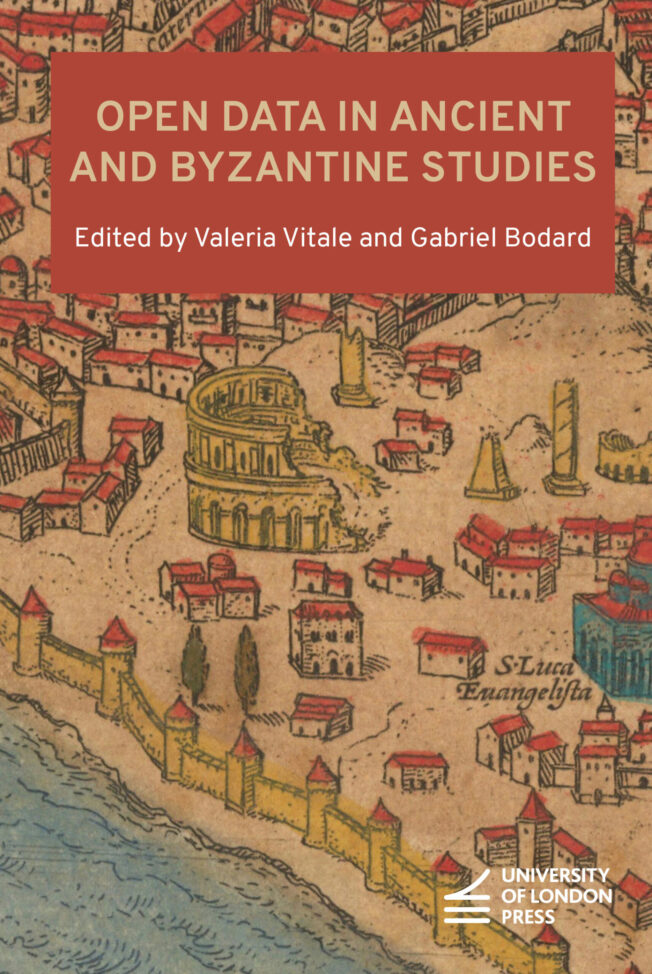
This volume presents case studies in classical and Byzantine research that exemplify practices, structures and standards in open data which transform and subvert historical scholarship. It leverages new data publication methods and embeds them as part of its argument, exploring the potential of non-linear discourse, multimedia content and data visualisation. Individual chapters illustrate how open scholarship enables a shift from authority-based interpretative frameworks to transparent, collaborative approaches, and combining datasets allows for analysis and comparisons at unprecedented scales, empowers researchers and elicits creative and original responses to old and new research questions.
Collaborative practices and data models lead historians to reflect rigorously and openly on assumptions, definitions and biases, encouraging more diverse approaches to interpretation of ancient sources. The different perspectives, methodologies, disciplines and research questions showcased in this book highlight the role of open data and code in the pursuit of historical research questions and the creation of new knowledge. It demonstrates that methods like linked open data, open licensing, documentation of standards and the publication of code influence the development of open data, tools and workflows, and are in turn nourished by a rich, sustainable classical open data ecosystem.
Published in association with: Institute of Classical Studies
Creative Commons Attribution-NonCommercial-NoDerivatives 4.0 International License
Introduction
Valeria Vitale and Gabriel Bodard1 Historical authority and the prosopography of the Byzantine world: from factoids to assertions
Tara Andrews2 Connecting late antiquities: challenges and opportunities for prosopographical data
Charlotte Tupman & Richard Flower3 Venetian officals in sixteenth-century Cyprus: An online database and a pilgrimage account
Tassos Papacostas4 Connections through collections: linking archaeological and epigraphic archives through places and people
Alessandra Giovenco & Nurdan Atalan Çayırezmez5 Engraving the soil: the challenges of defining spatial footprints in Cypriot cultural heritage
Stuart Dunn6 You can’t step into the same dataset twice: iterative improvement through reuse of open Libyan place data
Valeria Vitale7 The makeup of Ajax: reconstructing networks of interpretation through the commentary tradition
Charles Pletcher & Matteo Romanello8 Traces of lost libraries in the works of Alexandrian and Byzantine scholars: bibliographic open data from antiquity to Wikimedia
Monica Berti9 Digital epigraphy at Dura-Europos: toward a FAIR-er inscriptional corpus
Anne Hunnell Chen, Carl R. Rice, Ilaria Bucci & Jennifer A. Baird10 Reception of Sapphic language in Hadrianic verse epigraphy: building on open philological data
Marja Vierros & Gabriel Bodard11 The next decade of Byzantine sigillography: the impact of open data as collaboration
Martina Filosa, Jonathan Shea & Alessio Sopracasa
Monday, October 12, 2026
How to Build Belief with Blocks: The Religious Affordance of Greco-Roman Funerary Inscriptions
Doctor of Philosophy, The Ohio State University, 2024, Greek and Latin
Less Committee: Fritz Graf (Advisor); K.A. Rask (Committee Member); Gaia Gianni (Committee Member)
The Talmud Yerushalmi’s Civil Law in Its Ancient Legal Context: Rabbinic Law – Roman Law – Hellenistic Law
Hezser, Catherine / Willems, Constantin
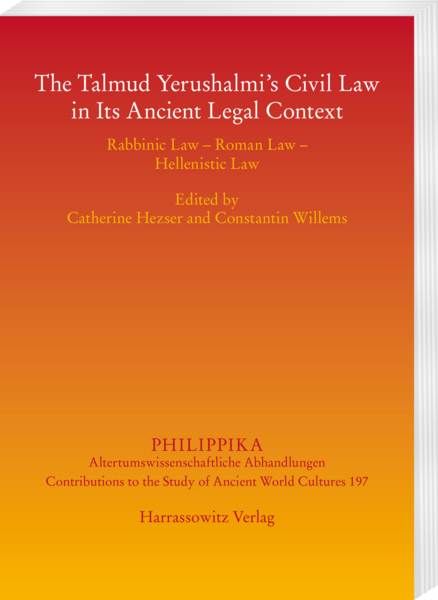
The Talmud Yerushalmi’s Civil Law in Its Ancient Legal Context provides a historical and comparative examination of legal issues that were shared by both rabbis and jurists during the Roman-Byzantine period. The topics covered concern slaves and manumission, women and property, house building and ownership rights, the treatment of laborers, liability for wild animals, and the broader issue of surveillance and accountability of citizens in the Roman world.
The chapters are written by historians of Roman law as well as scholars of rabbinic literature and ancient Judaism. They reveal the shared interest of rabbis and jurists in specific legal issues, their attention to the same details, similarities in legal solutions, and interesting differences that point to social, cultural, and religious concerns. The interdisciplinary volume exemplifies how the inclusion of rabbinic legal traditions in the study of ancient legal systems enables a better understanding not only of Jewish law but also of Roman legal culture and social practice in late antiquity.
pages/dimensions: VIII, 178 pages language: English binding: Book (Paperback) dimensions: 17.00 × 24.00 cm weight: 307g publishing date: 14.10.2026 prices: 49,00 Eur[D] / 50,40 Eur[A] ISBN: 978-3-447-12607-6 DOI: 10.13173/9783447126076
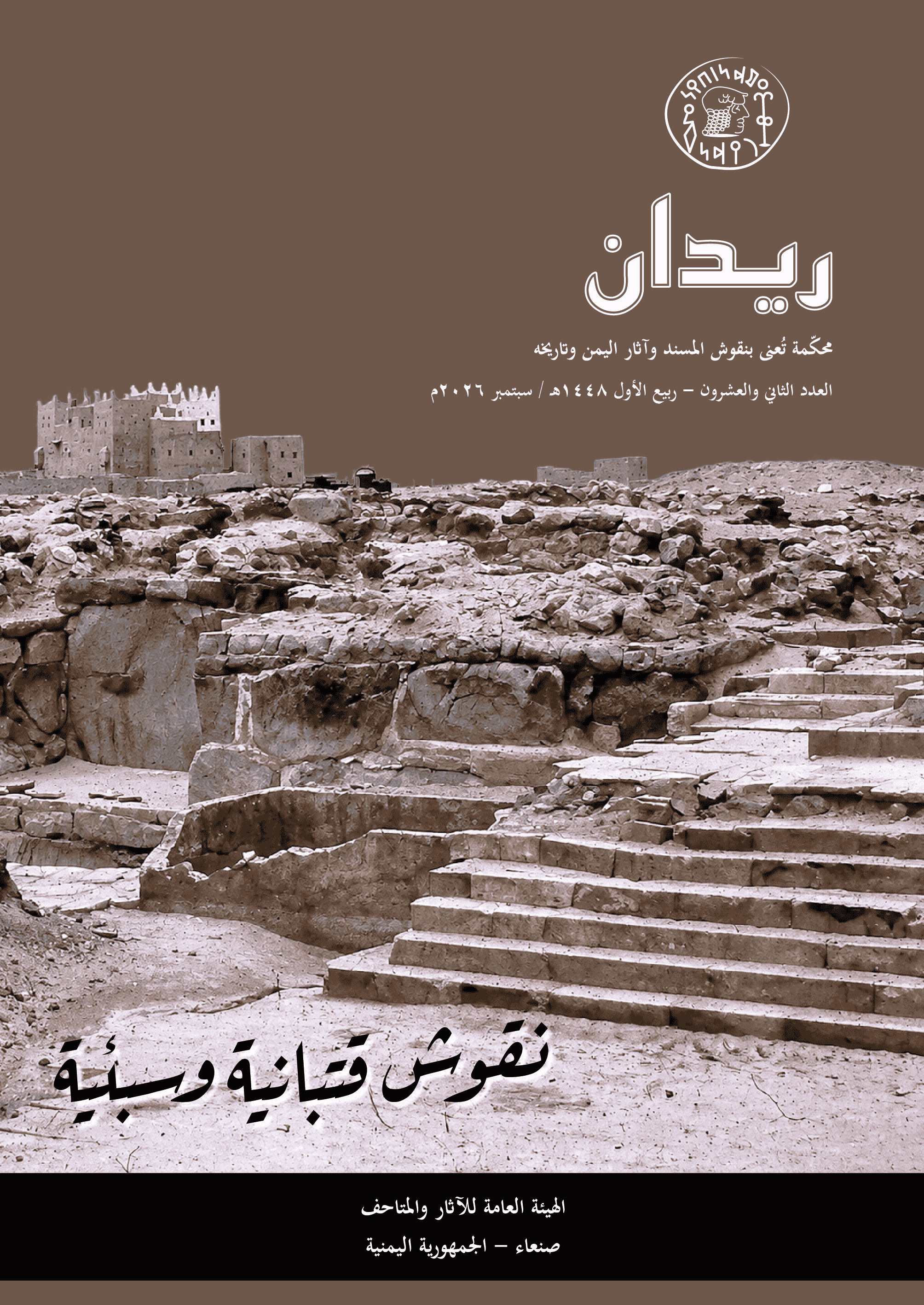
Open Access Journal: Raydān: journal of ancient Yemeni antiquities and epigraphy
[First Posted in AWOL 17 July 2013, updated (new URLs)12 October 2026]
Print ISSN: 1015-4523
Online ISSN: 3136-9367
Journal title: Raydān: Journal of Ancient Yemeni Antiquities and EpigraphyPublisher: General Organization of Antiquities and Museums (GOAM), YemenPrint ISSN: 1015-4523Online ISSN: 3136-9367Former website: https://goam.gov.ye/raydanCurrent official website: https://raydan.goam.gov.ye/index.php/raydan
Publication frequency: QuarterlyAccess: Open access, with articles freely available online.
RAYDÂN
Revue des antiquités et de l’épigraphie du Yémen antiqueJournal of Ancient Yemeni Antiquities and EpigraphyCurrent Issue
 Published:2026-09-10
See the full List of Open Access Journals in Ancient Studies
The Israelite Samaritan Torah
The Israelite Samaritan Torah

The Israelite Samaritan Torah
About this appThe Five Books of Moses as they have been kept by the Samaritan community, on Mount Gerizim and in Holon, for thousands of years. Read the Samaritan Pentateuch in the ancient Samaritan script or in Hebrew letters, divided into the Samaritan sections and chapters alongside the Jewish division.
What's inside
• Verse commentary from the Samaritan sources themselves: Tībåt Mårqe (Memar Marqe), the Book of Asatir, Sīr al-Qulūb, Abu'l-Faraj's commentary, responsa and traditional essays
• Compare versions with the Masoretic Text, the Septuagint, the Dead Sea Scrolls and Targum Onkelos, plus textual variants from a critical edition
• Translations: the Samaritan Aramaic Targum, Arabic and English
• Word dictionary: Aramaic, Hebrew and Arabic for every word, the HaMeliṣ lexicon, and a searchable index of words and roots
• Pronunciation: a phonetic transcription of the Samaritan reading tradition, with read-aloud
• Recordings: Samaritan readers' recitation traditions, with continuous play and repeat
• The Samaritan library: liturgical poems with a rhyme finder, a dictionary, notable people and scholars, and a historical timeline
• The Samaritan calendar: today's date, the weekly portion and the month's festivals
• Search, bookmarks, printing, and three interface languages (Hebrew · English · Arabic)
Who it's for
Learners, Bible scholars and students of Semitic languages, and anyone interested in the Samaritans and their tradition.
The app is free, has no ads and needs no sign-up. It is a volunteer project of Avnei Shoham, made to open the Samaritan library to everyone who seeks it.
Sunday, October 11, 2026
Aytas Mevkii/Islamlar in the Elmali Basin, Turkey: A Multi-Period Sepulchral Site in Northern Lycia
PhD, University of Cincinnati, 2011, Arts and Sciences: Classics
The 'Telemachus' Complex': Becoming Good Heirs on the Tragic Stage
PhD, University of Cincinnati, 2023, Arts and Sciences: Classics
Open Access Journal: Archaeo+Malacology Group Newsletter
[First posted in AWOL 14 July 2009, updated 11 October 2026]
Archaeo+Malacology Group Newsletter
ISSN: 2055-7604
Archaeo+Malacology Group Newsletter
ISSN: 2055-7604

The A+M Group Newsletter was started independently by Janet Ridout-Sharpe following a talk she gave to fellow members of the Conchological Society of Great Britain and Ireland at the Natural History Museum in London in 2000, which described her work on archaeological shell assemblages undertaken, albeit on a very part-time basis, since the late 1970s. Having worked in virtual isolation, it was a revelation to discover that others had similar interests, and a brief note in The Conchologists Newsletter in September 2000 elicited responses from more than 30 people. Intended to encourage communication between archaeomalacologists, the first issue of the newsletter appeared in July 2001, originally under the title Malaco+Archaeology Group Newsletter, which was changed to its present title in January 2003 to reflect that of the newly-established ICAZ Archaeomalacology Working Group. The newsletter was initially published privately and sent to recipients individually by email. As interest in the subject grew, and because the newsletter and the ICAZ group were aimed at the same audience, the ICAZ
Archaeomalacology Working Group agreed to host the newsletter on its website from issue 5 in March 2004. Newsletter issues have appeared at roughly six-monthly intervals and include short articles, research notes, abstracts of publications, notices of meetings, requests for information, and anything else of potential interest to archaeomalacologists. Janet went on to edit 22 issues until January 2013 when she handed over the reins to Annalisa Christie. Cindy Nelson-Viljoen took over the role of newsletter editor in September 2016.
Issue 41, December 2025 Issue 40, December 2024 Issue 39, November 2023 Issue 38, November 2022 Issue 37, February 2022 Issue 36, September 2021 Issue 35, February 2021 Issue 34, August 2020 Issue 33, February 2020 Issue 32, August 2019 Issue 31, February 2019 Issue 30, August 2018 Issue 29, February 2018 Issue 28, August 2017 Issue 27, February 2017 Issue 26, August 2016 Issue 25, April 2015 Issue 24, April 2014 Issue 23, October 2013 Issue 22, January 2013 Issue 21, June 2012 Issue 20, December 2011 Issue 19, Summer 2011 Issue 18, December 2010 Issue 17, June 2010 Issue 16, December 2009 Issue 15, June 2009 Issue 14, December 2008 Issue 13, June 2008 Issue 12, December 2007 Issue 11, May 2007 Issue 10, December 2006 Issue 9, March 2006 Issue 8, September 2004 Issue 7, March 2005 Issue 6, September 2004 Issue 5, March 2004 Issue 4, August 2003 Issue 3, January 2003 Issue 2, April 2002 Issue 1, July 2001
See AWOL's full List of Open Access Journals in Ancient Studies
Open Access Monograph Series: Akh Purattim - Les rives de l’Euphrate
Akh Purattim - Les rives de l’Euphrate
ISSN (Édition imprimée): 2102-5363
ISSN (Édition imprimée): 2102-5363
Recherches historiques, archéologiques, épigraphiques ou archéométriques sur la région du moyen Euphrate, effectuées en particulier dans le cadre des missions françaises de Mari et Terqa.En collaboration avec le Ministère des Affaires étrangères et du Développement international.
See AWOL's Alphabetical List of Open Access Monograph Series in Ancient Studies
Saturday, October 10, 2026
Kalapodi. Catalogue of Early Iron Age fine ware fabrics
Cite this as
Alexandra Ch. J. von Miller (0000-0001-7317-9484) [03a1kwz48] (2026). Kalapodi. Catalogue of Early Iron Age fine ware fabrics [Data set]. DAI. https://doi.org/10.34780/wsps2qgmRetrieved: 18:08 10 Oct 2026 (UTC)Licenses
![[Open Data]](https://repo.dainst.org/base/images/od_80x15_blue.png)
"iDAI.field explained"
Cite this as
Fabian Gapp (0009-0002-5832-8706) (2026). "iDAI.field explained" [Data set]. DAI. https://doi.org/10.34780/2pfes3yxRetrieved: 18:06 10 Oct 2026 (UTC)Licenses
Creative Commons Attribution-NonCommercial 4.0 (CC-BY-NC-4.0)
Newly Open Access Journal: Bulletin of the Asia Institute
ISSN: 0890–4464
Spearheaded by Carol Altman Bromberg since the 1980s and serving as a foundational journal for Iranian, Near Eastern, and Central Asian studies for almost one hundred years, the Bulletin of the Asia Institute represents a scholarly tradition and standard of unparalleled quality.
The Yarshater Center is honored to be bequeathed the mantle of publication of such a prestigious journal. We are grateful to Editor Emerita Bromberg for entrusting the journal to the Yarshater Center and its Director, M. Rahim Shayegan, who is serving as the Bulletin’s next editor.
The Yarshater Center is committed to the dissemination of all research gratis. As such, the Bulletin shall be published simultaneously in high-quality print format and free Open Access, available to download here. Volumes 1–32 shall be populated here shortly.
Table of Contents
Note from the Editor (pp. 1–2)
Designating the King in the Womb of His Mother: From Assyrian through Sasanian Times (pp. 3–15)
Rethinking the Achaemenid World Order: Space, Religion, and Communicative Strategies (pp. 17–47)
On the Early History of the Image of Mithra in the Indo-Iranian Borderlands (pp. 49–65)
The Triumph of Dionysus and Heracles on a Gold Tray from Datong (Pingcheng, Capital of the Northern Wei Dynasty, 398–494 CE) (pp. 67–103)
The “Ḵosrow Cup”: Looking Anew into the Persian Grail (pp. 105–132)
Two Newly Identified Šahname Stories in Panjakent Paintings (pp. 133–141)
Iranian Rock Crystal (pp. 143–202)
See AWOL's full List of Open Access Journals in Ancient Studies
Open Access Journal: Minerva: Revista de filología clásica
[First posted in AWOL 20 January 2013, updated 10 October 2026]
Minerva: Revista de filología clásica
ISSN: 0213-9634
Minerva: Revista de filología clásica
ISSN: 0213-9634
Acoge en sus páginas colaboraciones que versan acerca de los ámbitos hoy en día admitidos bajo el concepto de Filología Clásica, con especial atención a los comprendidos en las denominaciones de Filología Griega y Filología Latina en su contenido más amplio, tanto en lo que se refiere a su contenido como a los periodos cronológicos correspondientes
Artículos
Artículos
Reseñas
Artículos
Reseña-Ensayo
Reseñas
Artículos
Semblanzas
Reseña-Ensayo
Reseñas
Subscribe to:
Posts (Atom)





 Posts
Posts


 Stumble It!

