Showing posts with label Aegean. Show all posts

Sunday, May 31, 2026

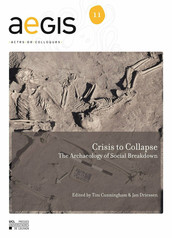
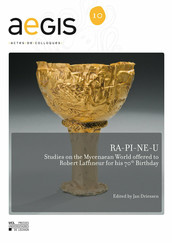
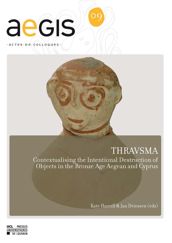
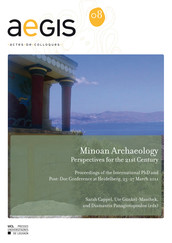
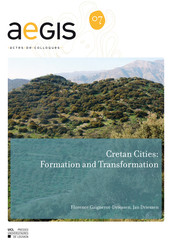
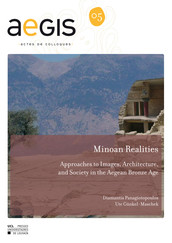
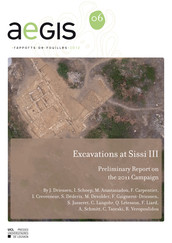
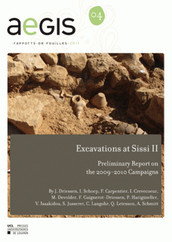
Open Access Monograph Series: AEGIS

 [First posted in AWOL 20 March 2022, updated 31May 2026]

AEGIS

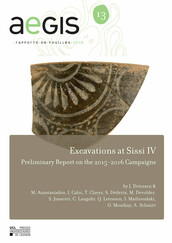
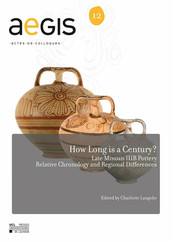
La collection AEGIS, associée au groupe de recherches Aegean Interdisciplinary Studies (CEMA-INCA-UCL), met à la disposition des scientifiques et des amateurs éclairés l'état des lieux de la recherche en matière d'archéologie du monde égéen et minoen en particulier. Monographies, thèses, actes de colloques etrapports de fouilles se complètent pour offrir une vue d'ensemble de cet espace-temps capital pourla compréhension de la Préhistoire en Méditerranée et de ses prolongements historiques, politiques,culturels, symboliques et sociaux.
The series AEGIS (Aegean Interdisciplinary Studies) attempts to make the results of new archaeological research on Aegean and especially Minoan societies available to the scientific and wider public at a rapid pace. Monographs, PhD dissertations, proceedings of scientific meetings and excavation reports complete each other to offer a general view of this time frame which is of primary importance to understand the ancient world and its historical, political, symbolical and social sequences.
    Tuesday, September 2, 2025

    Open Access Journal: Nestor: Bibliography of Aegean Prehistory and Related Areas

     [First posted in AWOL 9 October 2010. Updated most recently 2 September  2025]

    Nestor: Bibliography of Aegean Prehistory and Related Areas


    Nestor is an international bibliography of Aegean studies, Homeric society, Indo-European linguistics, and related fields. It is published monthly from September to May (each volume covers one calendar year) by the Department of Classics, University of Cincinnati. An Authors Index accompanies the December issue. Nestor is distributed in 30 countries world-wide. It is currently edited by Carol R. Hershenson.

    The primary geographic nexus of Nestor is the Aegean, including all of Greece, Albania, and Cyprus, the southern area of Bulgaria, and the western and southern areas of Turkey. Nestor includes publications concerning the central and western Mediterranean, southeastern Europe, the eastern Mediterranean, western Asia, and other regions of archaeological research, if the specific bibliographic items contain Aegean artifacts, imitations, or influences, or make reference to Aegean comparanda.


    Wednesday, November 15, 2023

    Open Access Journal: Minos: Revista de Filología Egea

    [First posted in AWOL 13 January 2010. Updated 15 November 2023

    Minos: Revista de Filología Egea
    ISSN: 0544-3733
    ISSN electrónico: 2530-9110
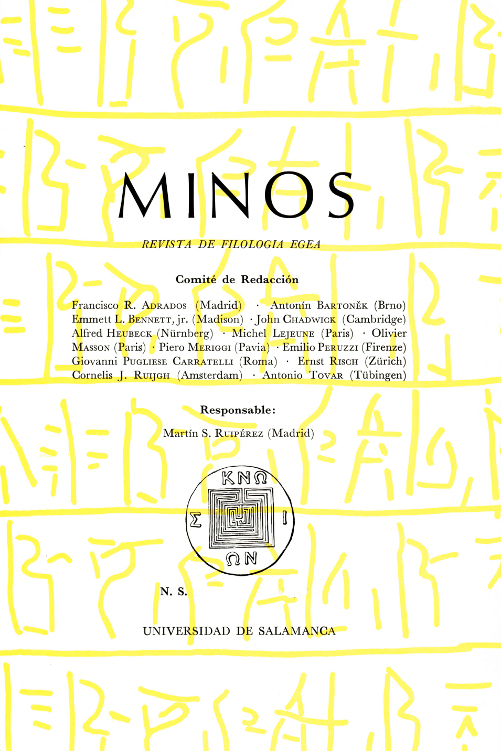
    Revista de Filología fundada en 1951 y cuyo tema es la filología egea. Actualmente, su es Julián MÉNDEZ DOSUNA  profesor de la Universidad de Salamanca.
    La revista tiene una periodicidad anual (1 volumen al año) y publica los textos fundamentalmente en inglés. Esporádicamente publica una serie paralela denominada Suplementos a Minos, en la que han visto la luz hasta el momento 17 títulos monográficos.

    Artículos

     Archivos


    Sunday, August 21, 2022

    Open Access Journal: Electryone - `Hλεκτρυώνη

    [First posted in AWOL 28 January 2014, updated 21 August 2022]

    Electryone - `Hλεκτρυώνη
    ISSN: 2241-4061

    Electryone is an English-language, peer reviewed online journal devoted to ancient historical and philological issues covering the period between the 2nd and 1st millennia BC  and the Roman period A.D.  Electryone welcomes articles between 4,000 and 8.000 words, shorter notes, responses, etc. up to 2,500 words, and book reviews. It also welcomes presentations of new publications, announcements for conferences and information about research programs.

    Electryone focuses on the Mediterranean region and on matters referring to interactions of the Mediterranean with neighboring areas, but presents an international forum of research, innovative interpretations, critical reviews, analyses of ancient text sources, comparative studies, mythological issues, archive research reports, interaction of ancient history with topography and archaeology, and applied new technologies on historical and classical studies.
    Electryone covers the full range of classical studies (i.e. 2nd millennium to late Rome) but is particularly interested in classical antiquity and its relationship to other cultures.
    Volume 8, Issue 1

     | pp.

    28-31

    Abstract:

    Dio Chrysostom’s Euboicus as a rejection of Greco-Roman urban
    civilization1
    Ioannis Papadopoulos ioannispapadopoulos1987@gmail.com

    ELECTRYONE 

    2021
    Volume 8, Issue 1

     | pp.

    19-27

    Abstract:

    Dio Chrysostom’s Euboicus presents a unique case-study of a divergent voice that disrupts the rather smooth discourse of the urban dimensions of the Second Sophistic. The author, having experienced a rather turbulent period of life, during Domitian’s reign and observed alternative ways of life, unfamiliar with the Greek and Roman examples, produced a manifesto of a new view of social living. The ideas and examples presented in the aforementioned work rather reject some of the fundamental social principles of urban living during Classical Antiquity. The extent that Dio was a visionary of social change or a plain reactionary as a result of his personal calamities remains unclear. However, his treatise, describing a remote community in mountainous Euboea, consists not only of a call to a retreat to a more natural and ‘primitivistic’ way of life, but also includes a sharp criticism of the dominant problems of a Greek city during the imperial era. Through his reflection on such issues, Dio, appeared to have reached the fringes of civil disobedience, inspired by cultural otherness and the resistance to the monolithic Greek and Roman social norms.
    ‘The Funeral of Sarpedon’ by Constantine P. Cavafy
    and Kyriakos Charalambidis: convergences - divergences / similarities –
    differences
    Louiza Christodoulidou xristod@aegean.gr

    ELECTRYONE 

    2021
    Volume 8, Issue 1

     | pp.

    8-18

    Abstract:

    Our presentation will be structured, mainly, around three axes. At a first level, our interest is focused on the artistic representations of the archaic angiographies that were the reason for the composition of the two poems, the targeting, the connotations and their consequent role. At a second level we will highlight the poetic function of the "Funeral of Sarpedon" by Konstantinos Cavafy and Kyriakos Charalambidis, as well as the convergencesdiscrepancies between them. At a third level, we will detect the contexts, since the conceptualbridges that direct us in an intertextual walk towards the corresponding contexts of the Iliad are scattered, but also in any differences or upheavals that highlight the ideological meanings of each poem.
    Euripides’ Ion l.528: an example of comic self-consciousness*
    Vasileios Dimoglidis dimoglvs@mail.uc.edu

    ELECTRYONE 

    2021
    Volume 8, Issue 1

     | pp.

    1-7

    Abstract:

    Euripides’ Ion is a play with elements that challenge tragic gravity, and bring about a lighter tone. Although the body of criticism that discusses the comic elements of Euripides’ tragedies (esp. the so-called tragic–comedies) is extensive, little attention has been given to cases of comic self-consciousness. The aim of this paper is to examine Ion’s l.528, and more concretely Ion’s utterance ...ταῦτ᾽ οὖν οὐ γέλως κλύειν ἐμοί;, as an example of comic selfawareness, that is, an instance that Euripides himself recognizes, in a metatheatrical way, as comic, while commenting at the same time on its reception on the audience’s part.