Saturday, March 21, 2026

Tragedy, Authority, and Trickery: The Poetics of Embedded Letters in Josephus


To prove his sons’ treachery, Herod embellished a letter. To certify his history of Vespasian’s Judaean campaign, Josephus marshaled epistolary testimony. To alleviate a domestic problem, the Israelite king David sent a missive with a man it marks for death. Arguing for the importance of the first-century historian Josephus to the study of classical and Hellenistic literature, Tragedy, Authority, and Trickery investigates letters in Josephus’s texts.

Ryan S. Olson breaks new ground by analyzing classical, Hellenistic, and Jewish texts’ use of letters, comparing those texts to Josephus’s narratives, a virtual archive containing hundreds of letters. An external voice similar to speeches, embedded letters raise questions of authority, drive and color dramatic scenes, and function at textual and meta-textual levels to deceive their readers. Josephus, contextualized in a complex intellectual and cultural milieu, sustains and develops epistolarity in important ways that will be of interest to classicists, historians, theologians, and comparatists.

Available for purchase in print via Harvard University Press.

Olson, Ryan Scott. 2010. Tragedy, Authority, and Trickery: The Poetics of Embedded Letters in Josephus. Hellenic Studies Series 42. Washington, DC: Center for Hellenic Studies. http://nrs.harvard.edu/urn-3:hul.ebook:CHS_Olson.Tragedy_Authority_and_Trickery.2010.

This work is licensed under a Creative Commons 3.0 License.


Euripides’ Ino: Commentary, Reconstruction, Text, and Translation


n this groundbreaking study, Smaro Nikolaidou-Arampatzi analyzes the direct and indirect evidence of Euripides’ fragmentary play, the Ino, and reexamines matters of reconstruction and interpretation. This work is a full-scale commentary on Euripides’ Ino, with a new arrangement of the fragments, an English translation in prose, and an extensive bibliography. Nikolaidou-Arampatzi argues that the axial point in the play is Ino’s filicide. Hyginus’ Fabula 4, entitled Ino Euripidis, recounts how, after her forced return from Cithaeron, Euripides’ Ino—in a state of Dionysiac madness—participates in the plotting of the jealous Themisto against her own children without being able to recognize them. Ino was the sister of Dionysus’ mother Semele, and she was also the primordial nurse of the god, a role that infuriated Hera. In his Medea, Euripides refers to Ino as a filicidal woman who, driven mad by Hera, murdered her own children. Nikolaidou-Arampatzi contends, then, that the filicide of Euripides’ Ino in a state of mania can be considered as a dramatic prototype by which his filicide Medea would be judged.

Available for purchase in print via Harvard University Press.

Nikolaidou-Arampatzi, Smaro. 2002. Euripides’ Ino: Commentary, Reconstruction, Text, and Translation. Hellenic Studies Series 90. Washington, DC: Center for Hellenic Studies. http://nrs.harvard.edu/urn-3:hul.ebook:CHS_Nikolaidou-ArampatziS.Euripides_Ino.2022.

This work is licensed under a Creative Commons 3.0 License.


Open Access Journal: Athens Journal of Mediterranean Studies

[First posted in AWOL 20 April 2022, updated 21 March 2026]
 
e-ISSN: 2407-9480   

The Athens Journal of Mediterranean Studies (AJMS) is an Open Access quarterly double blind peer reviewed journal and considers papers from all areas of Arts and Humanities, Social Sciences, Business and Law, Urban Planning, Architecture and Environmental Sciences. The Journal encourages the submission of policy papers and small case or country studies. Many of the papers published in this journal have been presented at the various conferences sponsored by the Center for European & Mediterranean Affairs (CEMA) of the Athens Institute for Education and Research (ATINER). All papers are subject to ATINER’s Publication Ethical Policy and Statement. A journal publication might take from a minimum of six months up to one year to appear.

2026

  • Volume 12, Issue 4, October 2026 (to be uploaded by 30 September 2026)
  • Volume 12, Issue 3, July 2026 (to be uploaded by 30 June 2026)
  • Volume 12, Issue 2, April 2026 (to be uploaded by 31 March 2026)
  • Volume 12, Issue 1, January 2026
Table of Contents
Download the entire issue (PDF)
Front Pagesi-x
The Forgotten Odyssey: Greeks in the Heart of Asia
Oidinposha Pulatovna Imamkhodjaeva
9
On some Egyptian Word Plays with „b3“ „Soul“
Stefan Bojowald
29
The Astronomical Meaning of the Mythical Phoenix
Felice Vinci
39
The Gorgoneion and the Evil Eye: Cultural Importance and Acceptance of Apotropaic Iconography in the Ancient Greco-Roman World
Gloria Rose Angelita Lopez
63


2025


2024

See AWOL's full List of Open Access Journals in Ancient Studies


La population des contreforts de la Crimée et de la plaine hongroise à l’époque romaine : migrations et contacts

Khrapunov, I. N., Je. Ishtvanovich, V. Kul’char, A. A. Stojanova, éd. (2025) : Население предгорного Крыма и Венгерской низменности в римское время: миграции и контакты / Naselenie predgornogo Kryma i Vengerskoj nizmennosti v rimskoe vremja: migracii i kontakty, Simferopol [La population des contreforts de la Crimée et de la plaine hongroise à l’époque romaine : migrations et contacts]

Le livre en ligne : https://disk.yandex.ru/d/NnBTz96NRCkMgA


Friday, March 20, 2026

Plato’s Symposium: Issues in Interpretation and Reception


In his Symposium, Plato crafted a set of speeches in praise of love that has influenced writers and artists from antiquity to the present. Early Christian writers read the dialogue’s “ascent passage” as a vision of the soul’s journey to heaven. Ficino’s commentary on the Symposium inspired poets and artists throughout Renaissance Europe and introduced “a Platonic love” into common speech. Themes or images from the dialogue have appeared in paintings or sketches by Rubens, David, Feuerbach, and La Farge, as well as in musical compositions by Satie and Bernstein.

The dialogue’s view of love as “desire for eternal possession of the good” is still of enormous philosophical interest in its own right. Nevertheless, questions remain concerning the meaning of specific features, the significance of the dialogue as a whole, and the character of its influence. This volume brings together an international team of scholars to address such questions.

Available for purchase in print via Harvard University Press.

Lesher, James, Debra Nails, and Frisbee Sheffield, eds. 2007. Plato's Symposium: Issues in Interpretation and Reception. Hellenic Studies Series 22. Washington, DC: Center for Hellenic Studies. http://nrs.harvard.edu/urn-3:hul.ebook:CHS_LesherJ_NailsD_SheffieldF_eds.Symposium_Interpretation_Reception.2007.

This work is licensed under a Creative Commons 3.0 License.


Open Access Journal: The Israel Museum Studies in Archaeology

 [First posted in AWOL 23 July 2018, updated 20 March 2026]

The Israel Museum Studies in Archaeology
ISNN: 1565-3617

An annual publication of The Samuel Bronfman Biblical and Archaeological Museum of The Israel Museum, Jerusalem, with the support of the Israel Museum Publications Fund 

Contents

Dudi Mevorah
Ruth E. Jackson-Tal
In Memoriam
Download
Arlette David
Amenhotep IV’s Large ‘Commemorative’ Scarabs

Download
Eran Arie
Five Statuette Heads from the Warschaw Collection at the Israel Museum:
Tracing Gaza’s Role in the Distribution of Cypriot Statuary in the Persian-Period Southern Levant
Download
Shimon Gibson,
Rafael Y. Lewis,
Yarden Pagelson,
Dudi Mevorah,
Hadas Seri
A Roman Spatha Sword and Scabbard from Excavations on Mount Zion in Jerusalem
Download
Ofer Pogorelsky
“An Epitaph upon Husband and Wife”

A Greek Funerary Inscription in the Collection of the Israel Museum, Jerusalem

Download
Ohad Abudraham,
Ofer Pogorelsky
A Forgotten Nabataean Inscription from the Moshe Dayan Collection at the Israel Museum

Download


Contents

Laura A. Peri
Rodney E. Soher Curator of Western Asiatic Antiquities
In Memoriam
Rivka Merhav, 1926–2022 Download
Eran Arie
Department of Cultural Heritage, School of Archaeology and Maritime Cultures, The Leon Recanati Institute for Maritime Studies, University of Haifa

Yuval Goren
Department of Bible, Archaeology and the Ancient Near East, Ben-Gurion University of the Negev
The Kernos from Tel Sasa
and a Catalogue of Iron Age Kernoi from the Israel Museum Collection
Download
Eran Arie
Department of Cultural Heritage, School of Archaeology and Maritime Cultures, The Leon Recanati Institute for Maritime Studies, University of Haifa
Three Iron Age Architectural Models
from the Collection of the Israel Museum, Jerusalem
Download
Eran Arie
Department of Cultural Heritage, School of Archaeology and Maritime Cultures, The Leon Recanati Institute for Maritime Studies, University of Haifa
Iron Age Strainer Juglets in the Southern Levant
Download
Eran Arie
Department of Cultural Heritage, School of Archaeology and Maritime Cultures, The Leon Recanati Institute for Maritime Studies, University of Haifa
Strain and Pour: Iron Age Composite Strainers
Download
Eran Arie
Department of Cultural Heritage, School of Archaeology and Maritime Cultures, The Leon Recanati Institute for Maritime Studies, University of Haifa
Iron Age Objects from the Azor Cemetery at the Israel Museum
and their Contribution to the study of Philistia’s Periphery
Download


Volume 10 (2020-20201)

Irene Bald Romano

University of Arizona

Dimitris Tambakopoulos

Laboratory of Archaeometry, National Centre for Scientific Research, "Demokritos," Athens

Yannis Maniatis

Laboratory of Archaeometry, National Centre for Scientific Research, "Demokritos," Athens
A Roman Portrait of Alexander the Great from Beth Shean: "The most important Hellenistic sculpture found in the Holy Land"
Download

Yannis Maniatis

Laboratory of Archaeometry, National Centre for Scientific Research, "Demokritos," Athens

Dimitris Tambakopoulos

Laboratory of Archaeometry, National Centre for Scientific Research, "Demokritos," Athens
Appendix: Marble Analysis
Download

Werner Eck

University of Cologne
Legio IV Flavia Felix at Neapolis: The Funerary Inscription of a Veteran
Download

Daniel Vainstub

Ben-Gurion University of the Negev
New Samaritan Amuletic Rings and Pendants from The Israel Museum Collection
Download
Supplement

Antonio Enrico Felle

University of Bari "Aldo Moro"
New Testament Quotations on Painted Plaster Fragments in the Israel Museum: Addenda et Corrigenda to Biblia Epigraphica (nos. 162–164 and 177)
Download

Rafael Y. Lewis

Ashkelon Academic College and the University of Haifa

Tsadok Tsach

Division of Identification and Forensic Science, Israel Police Headquarters

Nir Finkelstein

Division of Identification and Forensic Science, Israel Police Headquarters
A Collection of Frankish Decorated Sword and Dagger Pommels
Download

Information for Contributors

Abbreviations


Volume 9 • 2018‒2019

Eran Arie

The Israel Museum, Jerusalem
Pomegranate and Poppy-Capsule Headings from Ivory and Bone in the Late Bronze and Iron Ages: Putting the Famous Inscribed Ivory Pomegranate in Context
Download

Amitai Baruchi-Unna

The Hebrew University of Jerusalem

Mordechai Cogan

The Hebrew University of Jerusalem
The Cylinder Inscription of Sargon II: A Study in the Relationship between Text Composition and City Construction
Download

Avner Ecker

Bar-Ilan University

Hannah M. Cotton

The Hebrew University of Jerusalem
The Legio X Fretensis Welcomes the Emperor: A Latin Inscription on a Monument Erected for Hadrian in 129/130 CE
Download

Matthew J. Adams

W. F. Albright Institute of Archaeological Research

Melissa Cradic

University of California, Berkeley

Yoav Farhi

Ben-Gurion University of the Negev

Max Peers

Humboldt-Universität zu Berlin

Yotam Tepper

The Israel Antiquities Authority
A Betyl with a Decorated Base from the Principia of the Roman VIth Ferrata Legionary Base, Legio, Israel
Download

Information for Contributors

Abbreviations


Volume 8 (2016-2017)
Contents


Yigal Bloch and Laura A. Peri

I Placed My Name There: The Great Inscription of Tukulti-NinurtaI, King of Assyria, from the Collection of David and Cindy Sofer, London Download Pdf »

Rachel Caine Kreinin

“Divine Reflexivity”: a Case Study of Greco-Roman Egyptian Terracotta Figurines from the Collection of the Israel Museum, Jerusalem Download Pdf »
Orit Peleg-Barkat, Hillel Geva and Ronny Reich

A Monumental Herodian Ionic Capital from the Upper City of Jerusalem Download Pdf »
Ronny Reich

Addendum 1:
Where was the Capital Incorporated?
Download Pdf »
Orit Peleg-Barkat, Hillel Geva

Addendum 2:
A Monumental Herodian Ionic Capital from the Royal Stoa? – a Reply to Ronny Reich
Download Pdf »
Tali Sharvit

A Marble Sphinx Statue from Horvat Omrit Download Pdf »
Moshe Fischer, Arie Nissenbaum and Yannis Maniatis

Appendix:
Marble Analysis of the Omrit Sphinx
Download Pdf »
Karni Golan, Haim Goldfus and David Mevorah

Why Hide? – Hoarding in Late Antiquity in View of a Byzantine Hoard from Israel Download Pdf »
Bruno Callegher

A Hoard of Byzantine Folles (ca. 610 CE) within a Hoard of Bronze Objects: Some Hypotheses Download Pdf »


Volume 7 - 2015 


Contents
     
Fanny Vitto     Wall Paintings in the Synagogue of Rehov: An Account of Their Discovery
Download Pdf »

Haggai Misgav     The List of Fast Days from the Synagogue of Rehov
Download Pdf »

Edna Engel, Mordechay Mishor     An Ancient Scroll of the Book of Exodus:
The Reunion of Two Separate Fragments
Download Pdf »

Michael Maggen     Appendix 1
The Conservation of MS Ashkar
Download Pdf »

James H. Charlesworth     Appendix 2
Ashkar Manuscript 2:
Introducing a Phenomenal
New Witness to the Bible
Download Pdf »


Open Access Journal: Pallas: Revue d'études antiques

[First posted in AWOL 17 March 2014, updated 20 March 2026]

Pallas: Revue d'études antiques
ISSN: 0031-0387
thumbnail
Revue interuniversitaire, internationale et quadrimestrielle, Pallas publie en français mais aussi en anglais, en espagnol, italien et allemand, des articles d'enseignants, jeunes chercheurs et doctorants. Les sujets abordés, réunis dans des dossiers thématiques traitent des sciences de l’Antiquité au sens large et intéressent tous les domaines des civilisations grecque et romaine : littérature, linguistique, métrique, histoire, archéologie, iconographie.

Tous les deux ans, Pallas accueille le numéro thématique consacré à la nouvelle question d’histoire ancienne aux concours de l’enseignement du CAPES et de l’Agrégation.

Derniers numéros

Note de la rédaction

Les religions polythéistes de l’Antiquité constituent des systèmes de dieux complexes et difficiles à déchiffrer. Les divinités y sont nombreuses et, qui plus est, chaque divinité donne à voir une pluralité de facettes et de fonctions. Pour comprendre comment fonctionne la « société des dieux »,
selon l’expression de Jean-Pierre Vernant, scruter leurs appellations est très révélateur des dynamiques qui orientent les pratiques cultuelles.
Qualifier un dieu de « sauveur » ou de « seigneur », l’associer à d’autres divinités exerçant des fonctions analogues, rattacher divers dieux à un même lieu ou les décrire comme « lumineux » ou à l’inverse comme « sombres » sont autant de manières, pour les hommes et les femmes qui mobilisent la puissance des entités divines, d’en donner une sorte de portrait.
Au terme de six années d’un projet européen visant à récolter les noms divins grecs et sémitiques attestés dans les inscriptions (plus de 24 000 à ce jour), à les mettre en série, à les analyser, à les cartographier, ce dossier thématique dresse un bilan et trace des perspectives qui renouvellent notre appréhension et compréhension des religions de l’Antiquité.


Kition-Bamboula X: L’habitat de la fin du Bronze récent et du début de l’âge du Fer

Thursday, March 19, 2026

Short Writings, Volume IV


Volume four (2016) in a series of online anthologies containing articles written by Gregory Nagy

Nagy, Gregory. 2016. Short Writings, Volume IV. Washington, DC: Center for Hellenic Studies.

This work is licensed under a Creative Commons 3.0 License.


Short Writings, Volume III


Volume three (2014) in a series of online anthologies containing articles written by Gregory Nagy.

Nagy, Gregory. 2014. Short Writings, Volume III. Washington, DC: Center for Hellenic Studies.

This work is licensed under a Creative Commons 3.0 License.


Short Writings, Volume II

Curated Books

Volume two (2012) in a series of online anthologies containing articles written by Gregory Nagy.

Nagy, Gregory. 2012. Short Writings, Volume II. Washington, DC: Center for Hellenic Studies.

This work is licensed under a Creative Commons 3.0 License.


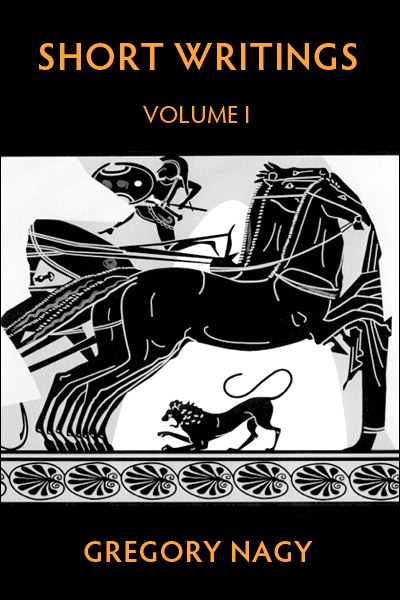
Short Writings, Volume I

Volume one (2012) in a series of online anthologies containing articles written by Gregory Nagy.

Nagy, Gregory. 2012. Short Writings, Volume I. Washington, DC: Center for Hellenic Studies.

This work is licensed under a Creative Commons 3.0 License.


Wednesday, March 18, 2026

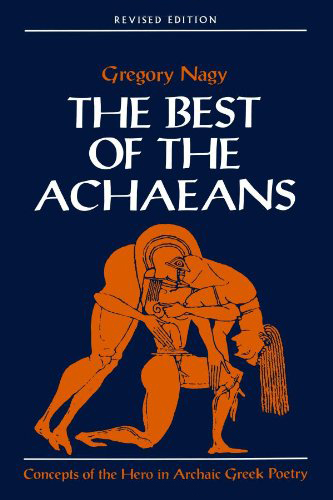
The Best of the Achaeans: Concepts of the Hero in Archaic Greek Poetry

 
Curated Books

Despite widespread interest in the Greek hero as a cult figure, little was written about the relationship between the cult practices and the portrayals of the hero in poetry. The first edition of The Best of the Achaeans bridged that gap, raising new questions about what could be known or conjectured about Greek heroes. In this revised edition, which features a new preface by the author, Gregory Nagy reconsiders his conclusions in the light of the subsequent debate and resumes his discussion of the special status of heroes in ancient Greek life and poetry. His book remains an engaging introduction both to the concept of the hero in Hellenic civilization and to the poetic forms through which the hero is defined: the Iliad and Odyssey in particular and archaic Greek poetry in general

Second edition, originally published in 1999 by The Johns Hopkins University Press. Copyright, The Johns Hopkins University Press. First edition 1979. Available for purchase in print via The Johns Hopkins University Press.

Use the following persistent identifier: http://nrs.harvard.edu/urn-3:hul.ebook:CHS_NagyG.The_Best_of_the_Achaeans.1999.

Copyright, Johns Hopkins University Press. Published here online with permission.

La Table des rois: Contribution à l’histoire textuelle des ›Tables faciles‹ de Ptolémée

Olivier Defaux
 
Published by De Gruyter

How could ancient astronomers accurately calculate celestial phenomena on the scale of several centuries? The Table of Kings is a simple list of rulers with the duration of their reigns, which allowed Ptolemy, an Alexandrian astronomer, to have a count of the years that had passed since the Babylonian king Nabonassar (8th century BC). Initially used for astronomy, this table captivated historians and chronology specialists from Antiquity. Rediscovered in Europe in the modern era, it is a crucial source for establishing a chronology of the Ancient Near East. The Table of Kings has always been a living text, modified by generations of scribes, completed over the centuries, sometimes up to the fall of Constantinople. This document with multiple lives is often quoted but has been little studied for its own sake. Historians of the Near East and specialists in the history of texts and sciences will find in this volume the first critical edition of Ptolemy’s Table of Kings based on all known manuscript witnesses, accompanied by an investigation of the history of this document from its elaboration by Ptolemy to its use by modern historians.

Comment les astronomes de l’Antiquité pouvaient-ils calculer avec précision des phénomènes célestes à l’échelle de plusieurs siècles? La Table des rois est une simple liste de souverains avec la durée de leurs règnes, qui permettait à Ptolémée, astronome alexandrin, de disposer d’un comput des années écoulées depuis le roi babylonien Nabonassar (VIIIe siècle av. J.-C.). D’abord mise au service de l’astronomie, cette table a captivé historiens et spécialistes de chronologie dès l’Antiquité. Redécouverte en Europe à l’Époque moderne, elle est une source cruciale pour l’établissement d’une chronologie du Proche-Orient ancien. La Table des rois a toujours été un texte vivant, modifié par des générations de copistes, complété au cours des siècles parfois jusqu’à la chute de Constantinople. Ce document aux multiples vies est souvent cité mais a été peu étudié pour lui-même. Historiens du Proche-Orient et spécialistes de l’histoire des textes et des sciences trouveront dans ce volume la première édition critique de la Table des rois réalisée sur la base de tous les témoins manuscrits connus, accompagnée d’une enquête sur l’histoire de ce document depuis son élaboration par Ptolémée jusqu’à son utilisation par les historiens modernes.

La Table des rois de Ptolémée, astronome alexandrin du IIe siècle, présente une liste continue de souverains depuis l’Empire néo-assyrien jusqu’à l’Empire romain. Elle est une source cruciale pour notre approche chronologique du Proche-Orient ancien et du monde méditerranéen. Cette étude présente une description des témoins manuscrits grecs de la Table des rois, une nouvelle édition critique et une histoire du texte jusqu’à l’époque moderne.

Peer Review Information

This work has been peer reviewed.

Language

  • French

Date published

Pages

379

ISBNs

  • PDF
    9783111304458
  • Paperback
    9783111303956