skip to main | skip to sidebar

AWOL - The Ancient World Online

ISSN 2156-2253

Showing posts with label Theater. Show all posts

Thursday, July 30, 2026

Open Access Journal: Skenè. Journal of Theatre and Drama Studies

[First posted in AWOL 4 August 20126, updated 31 July 2026]

Skenè. Journal of Theatre and Drama Studies
ISSN: 2421-4353
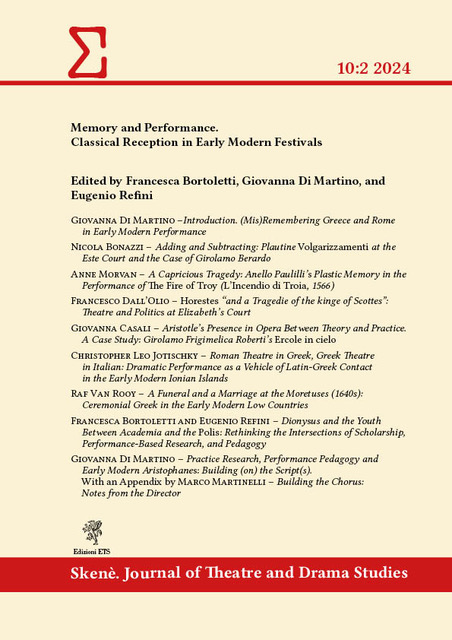
View Vol. 10 No. 2 (2024): Memory and Performance. Classical Reception in Early Modern Festivals

Founded in 2014, Skenè.JTDS wishes to inspire and host, in a new academic site, a vivacious debate on issues, questions and specifics of drama and theatre texts from the antiquity to the present. Areas of special interest are the forms, modes and genres of play texts, and the impact of dramaturgy and performance on their codification. The journal intends to stimulate a discussion on critical approaches to the play text and the performance text within an interdisciplinary context. Philological, linguistic, rhetorical, semiotic, and translation studies, as well as literary and philosophical hermeneutics, reception studies, sociology of theatre, and performance studies will all contribute to a lively confrontation between different perspectives and critical views. The journal promotes the interaction between international scholars of various humanistic areas, furthering a dialogue between renowned and younger researchers. 

 
Skenè. Journal of Theatre and Drama Studies is a peer-reviewed publication.
Issues: Biannual (Spring and Fall), on-line and print on demand, illustrated.

The Journal has no article submission charges or article processing charges.
The Journal has no waiver policy.

Vol. 12 No. 1 (2026): What About Medea’s Children? Euripidean Issues and Contemporary Transformations

					View Vol. 12 No. 1 (2026): What About Medea’s Children? Euripidean Issues and Contemporary Transformations

What About Medea’s Children? Euripidean Issues and Contemporary Transformations. Edited by Anna Chiara Corradino, Massimo Fusillo, and Marta Lietti 

Published: 2026-06-29

Full Issue

  • PDF

Monographic Section

  • Introduction

    Marta Lietti, Anna Chiara Corradino
    • PDF
  • Why the Children? Euripides' Medea in Context

    Giulia Sissa
    • PDF
  • A Tragic Way of Killing Children:  Euripides’ Medea

    Sotera Fornaro
    • PDF
  • The Silent Children: Their Dramatic Role in Euripides’ Medea

    Bernd Manuwald
    • PDF
  • Medea’s Children: A “Dialogue with the Dead”. On Milo Rau’s Play

    Daniela Sacco
    • PDF
  • Medea & Sons. Studio su Medea. Capitolo I, II e III directed by Antonio Latella

    Raffaella Viccei
    • PDF
  • Medea am Spinnrade. Federico Tiezzi and Mephistopheles in Siracusa

    Francesco Morosi
    • PDF
  • The Child Who Remains. Tragedy, Childhood, and the Refusal of Disappearance in Socìetas Raffaello Sanzio

    Annalisa Sacchi
    • PDF

Miscellany

  • Male and Female Gazes: Constructing Subjectivity in the Romeo and Juliet Story

    Silvia Bigliazzi
    • PDF
  • ‘Londini Κάτοπτρον, that is, Speculum, more plainly, Londons Mirrour’: Thomas Heywood’s ‘Small Greek’ Inflections in His Civic Pageants

    Janice Valls-Russell
    • PDF
  • Translating Sophoclean Heroes: Seamus Heaney’s What Passed at Colonus and Testimony: The Ajax Incident

    Sofia Pedroni
    • PDF

Special Section

  • Philipp Lammers, Juliane Vogel, and Christina Wald, Tragedy as a Travelling Form: Itineraries from Thespis to Today

    Giacomo Ferrari
    • PDF
  • Alys Daroy and Paul Prescott, Shakespeare, Ecology and Adaptation

    Victoria Bladen
    • PDF
  • William H. Steffen, Anthropocene Theater and the Shakespearean Stage

    Umberto Costantini
    •   PDF

Archives 

See AWOL's full List of Open Access Journals in Ancient Studies
Posted by Chuck Jones at 1:46 PM 0 comments
Email ThisBlogThis!Share to XShare to FacebookShare to Pinterest
Labels: Theater

Thursday, September 25, 2025

Open Access Journal: Dionysus Ex Machina: Rivista annuale online di studi sul teatro antico

 [First posted in AWOL 16 August 2017, updated 25 September 2025]

Dionysus Ex Machina: Rivista annuale online di studi sul teatro antico
ISSN: 2038-5137 

Dionysus ex machina
Dionysus Ex Machina, rivista on line di studi sul teatro antico pubblicata con cadenza annuale, si articola in sei sezioni (Testi, Dopo l'antichità, Scene, Monumenti, Cinema, Laboratori. Scuola e Università) e in uno spazio ulteriore (Notizie) costantemente aggiornato, che ospita annunci, recensioni e agili schede di spettacoli teatrali, libri, convegni, festival attinenti alla drammaturgia e, più in generale, alla cultura classica. Sono disponibili liberamente tutti gli articoli, i contenuti multimediali, lo spazio Notizie e i link, previa registrazione gratuita. 

I volumi della Biblioteca di DEM possono essere acquistati interamente o per singoli articoli tramite Casalini Libri.

 DeM numero 16 – Anno 2025


Indice
Direttori: Angela Maria Andrisano, Giusto Picone
Redattori: Alice Bonandini, Alessandro Iannucci, Marco De Marinis, Virginia Mastellari, Renata Raccanelli, Luigi Spina


Dionysus ex Machina resta annuale ma, a partire dal n.XIV (2023), assume la forma “aperta”.
Ciò significa che, anche dopo la pubblicazione online, saranno accolti i contributi pervenuti entro l’anno solare e approvati dalla redazione e dai referees


Contributi

La sezione accoglie contributi che affrontano con diversità di metodologie questioni inerenti l'esegesi dei testi teatrali (anche frammentari) greci e latini. Ne discende una molteplicità di chiavi di lettura, diversamente orientate in senso filologico-linguistico, drammaturgico, antropologico, storico-letterario.


Tragic duality and gender identity: the sister pairs in Sophoclean tragedy
Adelaide Fongoni

Bacide, Glanide e il pesce siluro. Su un possibile pun in Ar. Eq. 1003-1004
Barbara Giubilo


Il comico sulla scena. A proposito di una nuova traduzione delle Nuvole di Aristofane
Francesco Puccio


Esopo e la favola nella commedia non aristofanea
Alessandro Maggio


Il marionettista Potino e il pubblico di Atene in Ath. I 19e
Nicola Comentale


Dioniso pacificatore, Dioniso castigatore
Cornelia Isler-Kerényi


Rileggendo (e ricordando) Diego Lanza
Fabio Roscalla


Bisogna correggere anche i Maestri, qualche volta (Arist. Poet. 1456b 8-18)
Luigi Spina


Recitare le Troiane, riscrivere le Troiane. Dialogo con Angela Demattè
Alice Bonandini


Dalla biblioteca al teatro (passando per YouTube). Quasi un diario di scena
Emanuele Stolfi


pdf Scarica l'indice completo in formato PDF


  • DeM numero 01 – Anno 2010
  • DeM numero 02 – Anno 2011
  • DeM numero 03 – Anno 2012
  • DeM numero 04 – Anno 2013
  • DeM numero 05 – Anno 2014
  • DeM numero 06 – Anno 2015
  • DeM numero 07 – Anno 2016
  • DeM numero 08 – Anno 2017
  • DeM numero 09 – Anno 2018
  • DeM numero 10 – Anno 2019
  • DeM numero 11 – Anno 2020
  • DeM numero 12 – Anno 2021
  • DeM numero 13 – Anno 2022
  • DeM numero 14 – Anno 2023
  • DeM numero 15 – Anno 2024


See AWOL's List of

Spanish/Catalan/Portuguese Open Access Journals on the Ancient World

See AWOL's full List of Open Access Journals in Ancient Studies
Posted by Chuck Jones at 2:11 PM 0 comments
Email ThisBlogThis!Share to XShare to FacebookShare to Pinterest
Labels: Ancient, Spain, Theater

Friday, August 15, 2025

Open Access Journal: Frammenti sulla scena (online)

[First posted in AWOL 8 September 2020, updates 15 August 2025]

Frammenti sulla scena (online)
ISSN 2612-3908

Testata della pagina
La rivista scientifica FRAMMENTI SULLA SCENA (ONLINE). STUDI SUL DRAMMA ANTICO FRAMMENTARIO è l'organo scientifico ufficiale del Centro Studi sul Teatro Classico dell'Università degli Studi di Torino.

La rivista accoglie contributi dedicati all'indagine degli aspetti letterari, linguistici, filologici, antropologici, filosofici, storico-archeologici e papirologici del dramma frammentario greco-latino e delle tradizioni teatrali minori del Mediterraneo, nonché studi relativi alla permanenza, alla fortuna e all'esegesi dei testi teatrali in epoca antica, tardoantica, bizantina e paleocristiana.

Lo scopo di questa rivista è pervenire, mediante l'apporto di tutte le discipline afferenti alle Scienze dell'antichità, a delineare una nuova visione di insieme del patrimonio letterario rappresentato dai testi teatrali pervenuti in forma frammentaria o noti per tradizione indiretta.

La rivista è pubblicata dal Centro Studi sul Teatro Classico; direttore scientifico prof. Francesco Carpanelli, direttore editoriale dott. Luca Austa.

I contributi pubblicati nella rivista sono stati sottoposti a una valutazione anonima in doppio cieco e al vaglio definitivo del Comitato scientifico che ne attesta la validità nel rispetto degli standard internazionali di scientificità.

La rivista è pubblicata con cadenza annuale; i singoli contributi inviati alla Redazione sono pubblicati (previo superamento della valutazione in doppio cieco) nei mesi di aprile, agosto e dicembre di ciascun anno. Al termine dell'anno solare la Redazione allestirà il numero definitivo, corredato da un indice dei contenuti.
The scientific journal FRAMMENTI SULLA SCENA” (ONLINE). STUDIES ON  FRAGMENTARY ANCIENT DRAMA is the official scientific body of the Centre for Studies in Greek and Roman Theatre of the University of Turin.

The journal includes papers dedicated to the investigation of the literary, linguistic, philological, anthropological, philosophical, historical-archaeological and papyrological aspects of fragmentary Greco-Roman drama and of the minor theatrical traditions of the Mediterranean, as well as studies concerning permanence, fortune and exegesis of theatrical texts in ancient, late antique, Byzantine and early Christian times.

The purpose of this journal is to outline, new vision of the literary heritage represented by theatrical texts received in fragmentary form or known by indirect tradition.

The journal is published by the Centre for Studies in Greek and Roman Theatre; scientific director Prof. Francesco Carpanelli, editorial director Dr. Luca Austa.

The papers published in this journal are subject to an anonymous double-blind evaluation and to the final scrutiny of the Scientific Committee, which certifies its validity in compliance with international scientific standards.

The journal is published annually; the individual papers sent to the editorial board are published (after passing the double-blind assessment) in April, August and December of each year. At the end of the year the editors will set up the final number, accompanied by an index.

Ultimo numero

N. 5 (2024)

Pubblicato: 2025-08-01

Frontespizio - Indice

1-2

Philologica

Il fr. 971 Kannicht e il Fetonte euripideo: nuove ipotesi di lettura

Sonia Francisetti Brolin

3-13

Lost in Edition? Considerations on Some Sources of Menander’s Hypobolimaios

Mattia De Poli

14-29

Scripta&Scripts

Innocenti (?) e dannati nella Stenebea (e nel Bellerofonte) di Euripide

Francesco Carpanelli

30-55

Ricostruzione ed esegesi di una tragedia frammentaria: la Stenebea di Euripide

Katia Bertone, Giulia Dongiovanni, Maria Domenica Grimaldi, Marilisa Lillo, Cecilia Moroni, Emma Salone

56-90

Laboratorio di riscrittura da frammenti della Stenebea di Euripide

Emanuela Secco

91-102

Recensioni

P.B. Cipolla, Aeschylus’ Satyric Prometheus

Jordi Redondo

103-106

  • Archivi


See AWOL's full List of Open Access Journals in Ancient Studies

Posted by Chuck Jones at 3:05 PM 0 comments
Email ThisBlogThis!Share to XShare to FacebookShare to Pinterest
Labels: Drama, Italy, Theater

Saturday, January 6, 2024

Open Access Journal: Tycho. Revista de iniciación en la investigación del teatro clásico y grecolatino y su tradición

 [First posted in AWOL 27 July 2015, updated 6 January 2024]

Tycho. Revista de iniciación en la investigación del teatro clásico y grecolatino y su tradición
ISSN: 2340-6682
http://pages.uv.es/tycho/cas/imgcabecera.jpg
Tycho es una publicación con una periodicidad anual que desde el marco amplio de las ciencias de la Antigüedad Clásica tiene como objetivo dar apoyo y aliento a los estudiantes en las fases finales de las enseñanzas conducentes a los títulos de Grado y de Máster, que se ocupen del teatro clásico griego y latino así como de su pervivencia en la tradición occidental. 

Con este fin publica artículos resultado de la revisión y reelaboración de trabajos realizados en los programas de grado y postgrado, en los puntos de inflexión de los procesos de formación académica e investigadora en los que se cierra un periodo formativo y se inicia otro, fundamentalmente Trabajos Final de Grado y Trabajos Final de Máster. 

Impulsada por el GRATUV (Grup de Recerca i Acció Teatral de la Universitat de València), Tycho surge como una plataforma que dé visibilidad a los jóvenes postgraduados y les sirva de acicate para adentrarse en el complejo mundo de la investigación, en la esperanza de que sea un estímulo para la realización de Trabajos Final de Grado y Trabajos Final de Máster en el ámbito del teatro grecolatino y la tradición clásica basada en él. 

Creemos, además, que esta publicación puede ser de gran ayuda a los estudiantes en sus primeras etapas en la medida en que les aporta información útil presentada de un modo especialmente accesible para ellos, en un discurso y un lenguaje que les es más cercano.
  • Número 1 (2013)
  • Número 2 (2014)
  • Número 3 (2015)
  • Número 4 (2016)
  • Número 5 (2017)
  • Número 6 (2018)
  • Número 7 (2021)
  • Número 8 (2022) 

  • VOLUMEN COMPLETO

    Volumen publicado con contribuciones al Congreso Internacional GRATUV "Teatro y propaganda. Formas de expresión en el drama griego y la tradición clásica" (2022) bajo el auspicio de la subvención para la organización y difusión de congresos CIAORG2021-033, concedida por la Conselleria de Innovación, Universidades, Ciencia y Sociedad Digital de la Generalitat Valenciana.

    SUMARIO

      • Molina Zorrilla, Isidro: "Sobre el atenocentrismo en Suplicantes de Esquilo"
          • artículo completo
      • Nimis, Margherita: "Pietà, equità, verità: ideali ateniesi nell’Edipo a Colono (oc 1124-27)"
          • artículo completo
      • Scavello, Giacomo: "Teatro e ‘propaganda’ filosofica: la persuasione tra Sofocle e i Sofisti nell’Aiace"
          • artículo completo
      • Egea Sánchez, Joan: "El verbo �ºρá��ζω al servicio de la crítica política en Los Caballeros de Aristófanes"
          • artículo completo
      • Maganuco, Anna: "‘Todos somos Baco’: le proteste femministe in Messico nelle Baccanti secondo Carlus Padrissa (Siracusa 2021)"
          • artículo completo
      • Balaskas, Vasileios: "Glorificación nacional y propaganda franquista: Atlántida en el Festival de Mérida (1966)"
          • artículo completo
      • Quadarella, Vincenzo: "Tra mito e ritualità. Il problema della messinscena tragica contemporanea"
          • artículo completo


See AWOL's full List of Open Access Journals in Ancient Studies
Posted by Chuck Jones at 3:39 PM 0 comments
Email ThisBlogThis!Share to XShare to FacebookShare to Pinterest
Labels: Classics, Spain, Theater

Saturday, April 25, 2020

The Cambridge Greek Play

 [First posted in AWOL 30 October 2015, updaters 25 April 2020]

The Cambridge Greek Play
https://www.cambridgegreekplay.com/sites/www.cambridgegreekplay.com/files/images/carousel-slides/nr_13-10-15_297.jpg
The tradition of performing a Greek play in Cambridge goes back to 1882, when the very first production was of Sophocles’ tragedy Ajax. The two producers were not classicists in the strict sense: the first was John Willis Clark, superintendent of the Museum of Zoology who possessed a passionate interest in the theatre. The other was Charles Waldstein, a classical archaeologist.
  • Home
  • The History of the Cambridge Greek Play
  • The 2019 Play
  • Past Plays
  • Sponsorship
  • Teaching the Plays
  • Contact us
  • Cookies

    Previous Productions


    1882 Ajax

    1883 Birds

    1885 Eumenides

    1887 Oedipus Tyrannus

    1890 Ion

    1894 Iphigenia in Tauris

    1897 Wasps

    1900 Agamemnon

    1903 Birds

    1906 Eumenides

    1909 Wasps

    1912 Oedipus Tyrannus

    1921 Oresteia

    1924 Birds

    1927 Sophocles' Electra/Peace

    1930 Bacchae

    1933 Oresteia

    1936 Frogs

    1939 Antigone

    1947 Frogs

    1950 Oedipus at Colonus

    1953 Agamemnon

    1956 Bacchae

    1959 Antigone

    1962 Clouds

    1965 Oedipus Tyrannus

    1968 Hippolytus

    1971 Birds

    1974 Medea

    1977 Sophocles' Electra

    1980 Euripides' Electra

    1983 Women of Trachis

    1986 Lysistrata

    1989 Bacchae

    1992 Hippolytus

    1995 Birds

    1998 Trojan Women

    2001 Sophocles' Electra

    2004 Oedipus Tyrannus

    2007 Medea

    2010 Agamemnon

    2013 Prometheus/Frogs


    2016 Antigone/Lysistrata
    Posted by Chuck Jones at 8:43 AM 0 comments
    Email ThisBlogThis!Share to XShare to FacebookShare to Pinterest
    Labels: Greek, Theater, UK

    Wednesday, April 3, 2019

    Medea, a Performance History: a multimedia/interactive guide to the production history of Euripides’ Medea

    Medea, a Performance History 
    Fiona Macintosh and Others

    This book is available for download with Apple Books on your Mac or iOS device. Multi-touch books can be read with Apple Books on your Mac or iOS device. Books with interactive features may work best on an iOS device. Apple Books on your Mac requires OS X 10.9 or later
    Medea, a Performance History

    Description

    Medea, a performance history is a multimedia/interactive guide to the production history of Euripides’ Medea – an ancient Greek tragedy about a mother who, betrayed by her husband, exacts revenge by killing her children. First performed nearly 2,500 years ago, and continually reinvented since, Medea remains the most controversial yet alluring female role in the history of theatre worldwide.

    This multimedia/interactive ebook draws on a unique collection of archival material and research at the APGRD (Archive of Performances of Greek and Roman Drama) at the University of Oxford and uses images, film, unique interviews and digital objects to tell the story of a play that has inspired countless interpretations, onstage and onscreen, in dance, drama and opera across the globe from antiquity to the present.

    What's New in Version 1.3

    File size streamlined; outdated introductory video removed; copyright information updated.
    Posted by Chuck Jones at 11:29 AM 0 comments
    Email ThisBlogThis!Share to XShare to FacebookShare to Pinterest
    Labels: Greece, Literataure, Theater, Tragedy

    Wednesday, September 19, 2018

    Theatrum

    Theatrum
     view-source:http://www.theatrum.de/typo3temp/pics/208b4213fa.jpg
    Die Website www.theatrum.de ist als Internetprojekt aus den Aktivitäten zur Erforschung des römischen Theaters von Mogontiacum-Mainz hervorgegangen. Ziel ist, in kurzer Form Basisinformationen zu allen bekannten Theatern der griechisch-römischen Antike zusammenzustellen. So soll ein schneller Zugang zu den Fragen hergestellt werden, was über das Aussehen eines Theaters bekannt ist und was dort veranstaltet wurde – jeweils streng orientiert an der historischen und archäologischen Überlieferung jedes einzelnen Baues. 

    Die antiken Theater waren öffentliche Räume, die bei den großen Feierlichkeiten ihrer Gemeinden im Blickpunkt der gesamten Gesellschaft standen. Hier fanden im fest gefügten Ablauf sakraler Feste nach Opfern und Prozessionen für die Götter oder den Herrscher Bühnenaufführungen unterschiedlicher Art statt. Wer als Mitglied der Gesellschaft diesen Feiern beiwohnte, nahm auch an den Bühnenaufführungen teil und so erklärt sich die nach heutigen Maßstäben enorme Zuschauerkapazität der Theaterbauten. Die mit dem griechischen Wort Euergetismus bezeichnete Wohltätigkeit führender Gesellschaftsmitglieder ermöglichte erst den Bau solch komplexer Anlagen. Als Gegenleistung für diese als Verpflichtung empfundene Großzügigkeit gewährte die Gemeinde dem Spender Ehrenstandbilder im Theater und verewigte ihn bis auf unsere Tage für die Nachwelt. Hiermit ging die Verehrung von Göttern und Herrschern einher, die in jedem Theater ihren Ausdruck in Form einer statuarischen Ausstattung fand.

    Die großen, weithin bekannten Spiele wurden von professionell ausgebildeten Akteuren besucht, deren Erfolge in den Agonen vor allem des griechischen Ostens auf zahlreichen Inschriften aufgelistet wurden. Vielfach machten Münzprägungen Namen und Preise von Spielen im ganzen Reich bekannt. Halten griechische Inschriften den Ablauf von Feiern penibel fest, so teilen uns die lateinischen Inschriften des Westens genau mit, wie viel Geld Spiele (ludi scaenici) oder Baumaßnahmen kosteten und wer diese bezahlte. Unterschiede und Gemeinsamkeiten des Theaterwesens im griechischen Osten und dem lateinischen Westen werden deutlich, ebenso wie regionale Besonderheiten etwa der gallo-römischen Theater oder der orientalischen Kult-Theater.


    Aktualisierungen | Suche | link-Liste | Bibliographie | Lexikon | Autoren | Sitemap | Kontakt | Impressum

    Ägypten
    Afghanistan
    Albanien
    Algerien
    Armenien
    Belgien
    Bulgarien
    Deutschland
    Frankreich
    Griechenland
    Grossbritannien
    Irak
    Iran
    Israel/Palästina
    Italien
    Jordanien
    Kroatien
    Libanon
    Libyen
    Luxemburg
    Marokko
    Mazedonien
    Österreich
    Portugal
    Rumänien
    Schweiz
    Serbien
    Spanien
    Syrien
    Türkei
    Tunesien
    Ukraine
    Ungarn
    Zypern
    See also Amphi-Theatrum
    Posted by Chuck Jones at 4:47 PM 0 comments
    Email ThisBlogThis!Share to XShare to FacebookShare to Pinterest
    Labels: Architecture, Theater

    Wednesday, August 22, 2018

    Open Access Journal: Didaskalia: The Journal for Ancient Performance

    [First posted in AWOL 2 November 2009. Updated 22 August 2018.  n.b.  Founded in 1994, Didaskalia is a Pioneering Open Access Journal]

    Didaskalia: The Journal for Ancient Performance
    ISSN: 1321-4853
    http://www.didaskalia.net/images/home_banner1.jpg
    Didaskalia (διδασκαλία) is the term used since ancient times to describe the work a playwright did to teach his chorus and actors the play.  The official records of the dramatic festivals in Athens were the διδασκαλίαι.  Didaskalia now furthers the scholarship of the ancient performance.
    Didaskalia is an English-language, online publication about the performance of Greek and Roman drama, dance, and music.  We publish double blind, peer-reviewed scholarship on performance as well as reviews of the professional activity of artists and scholars who work on ancient drama.
    We welcome submissions on any aspect of the field, and we provide a uniquely friendly venue for publishing sound, image, and video evidence.  If you would like your work to be reviewed, please write to editor@didaskalia.net at least three weeks in advance of the performance date.  We also seek interviews with practitioners and opinion pieces.

    Volume 13 (2016–2017)

    13.15 Valedictory from the Editor
    Amy R. Cohen
    13.14 Review - Sophocles’ Electra at the Dallas Theater Center
    Thomas E. Jenkins
    13.13 Imperial Pantomime and Satoshi Miyagi’s Medea
    William A. Johnson
    13.12 Review - Two Tragic Worlds of Soldiers: Not Man Apart Physical Theatre Ensemble’s Ajax in Iraq
    Yuko Kurahashi
    13.11 Gamel Panel - The Authenticity of Mary-Kay Gamel
    Ruby Blondell
    13.10 Gamel Panel - Sophocles after Ferguson: Antigone in St. Louis, 2014
    Timothy Moore
    13.09 Gamel Panel - Navigating Tricky Topics: The Benefits of Performance Pedagogy
    Christopher Bungard
    13.08 Gamel Panel - Raising the Stakes: Mary-Kay Gamel and the Academic Stage
    Amy R. Cohen
    13.07 Gamel Panel - Performance, Politics, Pedagogy: a Tribute to Mary-Kay Gamel
    C.W. Marshall
    13.06 Conversation - Deus Ex Machina at the Long Center for Performing Arts, Austin, Texas
    Liz Fisher, Robert Matney, Paul Woodruff, Lucia Woodruff
    13.05 Review - 52nd Season of Classical Plays at the Greek Theatre in Syracuse: Sophocles’ Electra, Euripides’ Alcestis
    Caterina Barone
    13.04 Review - Rhesus at Aristotle's Lyceum
    Scott Andrew Cally
    13.03 Review - Trachiniae at Minor Latham Playhouse, New York
    Claire Catenaccio
    13.02 Review - Sophocles’ Philoctetes at Aquila Theatre
    Tony Tambasco
    13.01 Review - Apollonius’ Argonautika at Gustavus Adolphus College
    Eric Dugdale and William Riihiluoma
    BACK ISSUES
    See AWOL's full List of Open Access Journals in Ancient Studies
    Posted by Chuck Jones at 3:09 PM 0 comments
    Email ThisBlogThis!Share to XShare to FacebookShare to Pinterest
    Labels: Reception, Theater
    Location: Randolph College, 2500 Rivermont Ave, Lynchburg, VA 24503, USA

    Wednesday, January 31, 2018

    Diazoma

    Diazoma
    Diazoma logo
    The DIAZOMA association was founded on the initiative of the former Greek Minister of Culture Stavros Benos and brings together three “families”: the archaeological community (archaeologists, curators, conservators, etc.), Greek artists and intellectuals and local authorities (mayors, regional administrations and citizens).

    Our fundamental goal is to shape vast social networks of synergies in order to protect and promote this unique category of monuments that are the ancient theaters. To this end, Diazoma cooperates on an ongoing basis with the Ministry of Education, Research and Religious Affairs as well as with the Ministry of Culture and Sports and seeks to bring together and engage all actors of Greek society (population, mayors, prefects, universities, cultural associations) around this objective.
    Raising awareness among the populations about the colossal cultural heritage and the unique potential of ancient theaters for their regions, having them participate in their preservation and revival, creating cultural routes and archaeological parks, organizing cultural events, enhancing the natural environment, adopting a charter of quality involving all the local actors (from small producers to local tourist companies), these are all steps to take towards the realization of the ultimate vision of Diazoma : the sustainable development of regions around their cultural heritage.
    As a result, theaters are at the heart of two key encounters: the one with the people and the other with tourism economy, environment and culture.

    Our movement for the ancient theaters is getting stronger and richer each day.
    The effectiveness of our work results from a solid and innovative operational strategy. It is based, on the one hand, on studies involving the greatest names in archeology but also on a comprehensive documentation including publications, articles, documentaries, presentations, etc.

    We also implement three alternative modes of funding, namely sponsorships, contributions from cities / regions and citizen participation in response to DIAZOMA’s “Adopt an Ancient Theater” invitation.

    In addition, we develop programs inspired by original proposals from our members and volunteers such as digital guided tours via mobile phone, 3D representations of monuments, diversification of sponsorship, etc.

    Finally, absolute transparency in all administrative and financial transactions is Diazoma’s golden rule.
    Our efforts have already borne significant fruits, as evidenced by the progress of the works in no less than fifty-five ancient theaters. The following synoptic table will provide you with information on this progress: AT A GLANCE.
    • Diazoma
      • Who are we?
      • Our Mission
      • Get to know us. Memorandum of Association
      • Board of Directors
      • Financial Data
      • Diazoma People
      • General Assemblies
      • Ano Diazoma 
    • Our Family
      • Our Members
      • Corporate Members
      • Synergies
      • Our Sponsors
    • Theaters
      • Identity of Ancient Theaters
      • At a glance
      • Funding Sources
      • Sponsorship documents
      • Donations in total
    • Ancient Paths
      • What is new about Cultural Routes?
      • Cultural routes
      • Archaeological Parks
    Posted by Chuck Jones at 7:40 AM 0 comments
    Email ThisBlogThis!Share to XShare to FacebookShare to Pinterest
    Labels: Greece, Theater

    Monday, January 15, 2018

    Open Access Journal: Archive of Performances of Greek and Roman Drama (APGRD) Newsletter

    [First posted in AWOL 6 March 2013, updated 15 January 2018]

    Archive of Performances of Greek and Roman Drama (APGRD) Newsletter
    http://www.apgrd.ox.ac.uk/sites/default/files/logo-gradient.jpg
    Ancient drama has exerted a uniquely formative influence on cultural and intellectual life since the Renaissance, and today ancient plays are being performed in both the commercial and amateur theatre with greater frequency than at any time since antiquity. The Archive of Performances of Greek and Roman Drama was founded in 1996 by Edith Hall and Oliver Taplin in response to the need for a coordinated research effort devoted to the international production and reception of ancient plays since the Renaissance. They included within its scope revivals and adaptations on stage, film and radio, and in opera and dance.
    To receive the newsletter, sign up to our mailing list.
    Current issue - Newsletter 24 (Spring 2017)

    Previous issues

    Newsletter 23 (Spring 2015)
    Newsletter 22 (Spring 2014)
    Newsletter 21 (Spring 2013)
    Newsletter 20 (Summer 2012)
    Newsletter 19 (Winter 2011)
    Newsletter 18 (Spring 2011)
    Newsletter 17 (Winter 2009)
    Newsletter 16 (Autumn 2009)
    Newsletter 15 (Spring 2009)
    Newsletter 14 (Winter 2007-2008)
    Newsletter 13 (Summer 2007)
    Newsletter 12 (Winter 2006-2007)
    Newsletter 11 (Spring 2006)
    Newsletter 10 (Summer 2005)
    Newsletter 9 (Spring 2005)
    Newsletter 8 (Spring 2004)
    Newsletter 7 (Summer 2003)
    Newsletter 6 (Autumn 2002)
    Newsletter 5 (Summer 2002)
    Newsletter 4 (Spring 2002)
    Newsletter 3 (Autumn 2001)
    Newsletter 2 (Summer 2001)
    Newsletter 1 (Spring 2001)
    The performance database is an online resource that details quantitative information about performances of Greek and Roman drama from antiquity to the present day. The information has been collated by researchers working with the project over several years.


    See AWOL's full List of Open Access Journals in Ancient Studies
    Posted by Chuck Jones at 4:40 PM 0 comments
    Email ThisBlogThis!Share to XShare to FacebookShare to Pinterest
    Labels: Drama, Reception, Theater
    Older Posts Home
    View mobile version
    Subscribe to: Posts (Atom)

    Digital Humanities Award Winner 2021

    Digital Humanities Award Winner 2021
    Digital Humanities Award Winner 2021
    Get new posts by email:
    Powered by follow.it

    Search This Blog

    The AWOL Index

    The AWOL Index: The bibliographic data presented herein has been programmatically extracted from the content of AWOL - The Ancient World Online (ISSN 2156-2253) and formatted in accordance with a structured data model.
    List of Open Access Journals in Ancient Studies
    List of Active Open Access Journals in Ancient Studies
    Alphabetical List of Open Access Monograph Series in Ancient Studies
    Open Access Ancient Language Textbooks, OERs, and Primers

    Digital Humanities Award Winner

    Digital Humanities Award Winner
    Best DH Blog Post or Series of Posts

    En l'an 2000

    En l'an 2000
    The Future of the Past

    Winner of the AIA Award for Outstanding Work in Digital Archeology 2015

    Winner of the AIA Award for Outstanding Work in Digital Archeology 2015

    Translate

    Loading...
    AWOL is a project of Charles E. Jones, Tombros Librarian for Classics and Humanities at the Pattee Library, Penn State University

    AWOL began with a series of entries under the heading AWOL on the Ancient World Bloggers Group Blog. I moved it to its own space here beginning in 2009.

    The primary focus of the project is notice and comment on open access material relating to the ancient world, but I will also include other kinds of networked information as it comes available.

    The ancient world is conceived here as it is at the Institute for the Study of the Ancient World at New York University, my academic home at the time AWOL was launched. That is, from the Pillars of Hercules to the Pacific, from the beginnings of human habitation to the late antique / early Islamic period.

    AWOL is the successor to Abzu, a guide to networked open access data relevant to the study and public presentation of the Ancient Near East and the Ancient Mediterranean world, founded at the Oriental Institute, University of Chicago in 1994. Together they represent the longest sustained effort to map the development of open digital scholarship in any discipline.

    AWOL is syndicated to Facebook and Twitter.

    Pelagios Widget

    Blog Archive

    • ▼  2026 (988)
      • ▼  September (33)
        • Persuasive Language in Cicero’s Pro Milone: A clos...
        • Tacitus, Annals, 15.20-23, 33-45: Latin Text, Stud...
        • Languages, Objects, and the Transmission of Ritual...
        • Life in Nuzi’s Suburbs: Text Editions from Private...
        • Il mito degli Atridi dal teatro antico all’epoca c...
        • Illuminare i testi: La parola-segnale nelle tradiz...
        • La falsificazione epigrafica:Questioni di metodo e...
        • Strumenti digitali e collaborativi per le Scienze ...
        • La tragedia di Eschilo: testo, ipotesti, performan...
        • The Reception of Sumerian Literature in the Wester...
        • Plutarch's Science of Natural Problems: A Study wi...
        • Sofocle, Niobe: Introduzione, testo critico, comme...
        • Epigrafia ostiense dopo il CIL. 2000 iscrizioni fu...
        • The Gift of Altino: Archeology Writings in Honour ...
        • Powers and Legitimacy in the Ancient World: From N...
        • Egyptian Antiquities and Italy: Research Prospects...
        • Altera pars laboris: Studies on the Handwritten Tr...
        • Geschlechterstereotype in der Archäologie: Eine Ku...
        • Open Access Journal: Annuaire de l'École pratique ...
        • Anagnostes: The first AI-driven system that automa...
        • Digital Archive from Archaeological Excavations at...
        • African Pastoral: Versions of Virgil's Eclogues
        • Itinerant Greek Sculpture in Roman Italy and Greec...
        • Graffiti in the pyramid precinct of Sneferu at Mei...
        • Le monument romano-byzantin du secteur ouest de la...
        • Open Access Journal: LANX. Rivista della Scuola di...
        • Open Access Journal: HiMA: revue internationale d’...
        • Open Access Monograph Series: Münchner Vorlesungen...
        • Open Access Journal: Hungarian Assyriological Review
        • Open Access Monograph Series: Suppléments au Bulle...
        • Open Access Monograph Series: Ariadne Supplement S...
        • Open Access Monograph Series: Schediasmata
        • Tilmen Höyük. Report on the 2003 and 2004 Excavati...
      • ►  August (121)
      • ►  July (121)
      • ►  June (117)
      • ►  May (120)
      • ►  April (120)
      • ►  March (124)
      • ►  February (109)
      • ►  January (123)
    • ►  2025 (1265)
      • ►  December (116)
      • ►  November (113)
      • ►  October (118)
      • ►  September (103)
      • ►  August (101)
      • ►  July (111)
      • ►  June (95)
      • ►  May (112)
      • ►  April (99)
      • ►  March (111)
      • ►  February (92)
      • ►  January (94)
    • ►  2024 (1082)
      • ►  December (92)
      • ►  November (82)
      • ►  October (93)
      • ►  September (76)
      • ►  August (73)
      • ►  July (100)
      • ►  June (98)
      • ►  May (98)
      • ►  April (101)
      • ►  March (90)
      • ►  February (89)
      • ►  January (90)
    • ►  2023 (1045)
      • ►  December (73)
      • ►  November (83)
      • ►  October (95)
      • ►  September (76)
      • ►  August (86)
      • ►  July (99)
      • ►  June (80)
      • ►  May (89)
      • ►  April (94)
      • ►  March (89)
      • ►  February (85)
      • ►  January (96)
    • ►  2022 (848)
      • ►  December (73)
      • ►  November (74)
      • ►  October (72)
      • ►  September (88)
      • ►  August (55)
      • ►  July (46)
      • ►  June (72)
      • ►  May (83)
      • ►  April (76)
      • ►  March (69)
      • ►  February (71)
      • ►  January (69)
    • ►  2021 (883)
      • ►  December (61)
      • ►  November (64)
      • ►  October (93)
      • ►  September (65)
      • ►  August (64)
      • ►  July (80)
      • ►  June (61)
      • ►  May (74)
      • ►  April (81)
      • ►  March (88)
      • ►  February (73)
      • ►  January (79)
    • ►  2020 (907)
      • ►  December (67)
      • ►  November (67)
      • ►  October (74)
      • ►  September (78)
      • ►  August (69)
      • ►  July (80)
      • ►  June (84)
      • ►  May (83)
      • ►  April (72)
      • ►  March (81)
      • ►  February (78)
      • ►  January (74)
    • ►  2019 (836)
      • ►  December (61)
      • ►  November (73)
      • ►  October (82)
      • ►  September (65)
      • ►  August (75)
      • ►  July (78)
      • ►  June (71)
      • ►  May (72)
      • ►  April (62)
      • ►  March (70)
      • ►  February (65)
      • ►  January (62)
    • ►  2018 (785)
      • ►  December (62)
      • ►  November (68)
      • ►  October (59)
      • ►  September (77)
      • ►  August (67)
      • ►  July (65)
      • ►  June (60)
      • ►  May (61)
      • ►  April (64)
      • ►  March (75)
      • ►  February (67)
      • ►  January (60)
    • ►  2017 (712)
      • ►  December (71)
      • ►  November (47)
      • ►  October (67)
      • ►  September (55)
      • ►  August (53)
      • ►  July (50)
      • ►  June (68)
      • ►  May (68)
      • ►  April (63)
      • ►  March (61)
      • ►  February (48)
      • ►  January (61)
    • ►  2016 (655)
      • ►  December (56)
      • ►  November (48)
      • ►  October (51)
      • ►  September (54)
      • ►  August (60)
      • ►  July (50)
      • ►  June (49)
      • ►  May (60)
      • ►  April (58)
      • ►  March (59)
      • ►  February (51)
      • ►  January (59)
    • ►  2015 (665)
      • ►  December (49)
      • ►  November (60)
      • ►  October (65)
      • ►  September (59)
      • ►  August (46)
      • ►  July (71)
      • ►  June (42)
      • ►  May (52)
      • ►  April (55)
      • ►  March (57)
      • ►  February (52)
      • ►  January (57)
    • ►  2014 (499)
      • ►  December (36)
      • ►  November (38)
      • ►  October (39)
      • ►  September (41)
      • ►  August (51)
      • ►  July (42)
      • ►  June (31)
      • ►  May (38)
      • ►  April (49)
      • ►  March (50)
      • ►  February (41)
      • ►  January (43)
    • ►  2013 (479)
      • ►  December (41)
      • ►  November (33)
      • ►  October (48)
      • ►  September (37)
      • ►  August (41)
      • ►  July (40)
      • ►  June (37)
      • ►  May (46)
      • ►  April (41)
      • ►  March (37)
      • ►  February (42)
      • ►  January (36)
    • ►  2012 (482)
      • ►  December (39)
      • ►  November (38)
      • ►  October (37)
      • ►  September (27)
      • ►  August (16)
      • ►  July (47)
      • ►  June (46)
      • ►  May (51)
      • ►  April (41)
      • ►  March (46)
      • ►  February (49)
      • ►  January (45)
    • ►  2011 (351)
      • ►  December (45)
      • ►  November (40)
      • ►  October (37)
      • ►  September (24)
      • ►  August (29)
      • ►  July (27)
      • ►  June (30)
      • ►  May (23)
      • ►  April (22)
      • ►  March (25)
      • ►  February (22)
      • ►  January (27)
    • ►  2010 (229)
      • ►  December (19)
      • ►  November (20)
      • ►  October (21)
      • ►  September (21)
      • ►  August (7)
      • ►  July (21)
      • ►  June (17)
      • ►  May (17)
      • ►  April (11)
      • ►  March (22)
      • ►  February (23)
      • ►  January (30)
    • ►  2009 (148)
      • ►  December (19)
      • ►  November (27)
      • ►  October (14)
      • ►  September (10)
      • ►  August (3)
      • ►  July (7)
      • ►  June (17)
      • ►  May (10)
      • ►  April (9)
      • ►  March (7)
      • ►  February (7)
      • ►  January (18)
    This material is Open Knowledge

    Loading...

    Loading...

    FeedBurner FeedCount

    Search JURN

    Contributors

    • Chuck Jones
    • Tom Elliott

    Loading...

    Followers

    Stats


    View My Stats

    Subscribe To AWOL

    Posts
    Atom
    Posts
    All Comments
    Atom
    All Comments
    Stumble It!
    Add to Technorati Favorites
    NetworkedBlogs
    Blog:
    AWOL - The Ancient World Online
    Topics:
    Education, Open Access, Ancient Studies
     
    Join my network
     
    AWOL is one of a suite of online resources initiated by and with the continuing support of The Institute for the Study of the Ancient World


    Creative Commons License

    Creative Commons License
    AWOL - The Ancient World Online by Charles E. Jones is licensed under a Creative Commons Attribution-ShareAlike 3.0 Unported License.