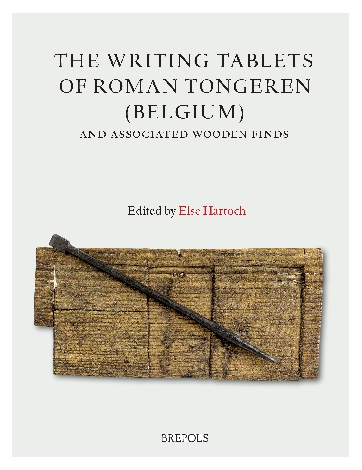
Roman wooden writing tablets, known in Latin as tabulae ceratae, have been found by archaeologists in various locations around the former capital of the civitas/municipium Tungrorum or Roman Tongeren (now the Belgian city of Tongeren-Borgloon). These rare and delicate finds are remarkable not only due to the excellent state of their preservation, but also because they are inscribed with the remnants of texts, once etched into an overlying wax layer, that can, to the discerning eye, still be deciphered. The tablets not only provide concrete information about religious, judicial and administrative practices, but they also enhance our understanding of the complex processes of Romanisation and Latinisation in the northwestern civitates and municipia of the Roman Empire.
Unearthed in the first half of the twentieth century, with a second group discovered in 2013, the Roman tablets housed in the Gallo-Roman Museum of Tongeren-Borgloon and in the city’s municipal heritage depository, became the object of an in-depth study by an international team of specialists piloted by the Gallo-Roman Museum. It is the results of this project that are presented here in this volume for the first time. The painstaking process of deciphering and interpreting the script marks and text fragments is explored via analysis of palaeography, philology and onomastics, along with key scientific techniques such as wax analysis, wood species identification, and script visualisation by Multi-Light Reflectance Imaging. Rich detail is also provided about other associated wooden finds that shed light on how and where the tablets were produced.
The result is a beautifully illustrated and insightful volume that introduces the lost world of Roman Tongeren and its writing tablets to professionals and the general public alike.
The research project
oa Introduction: The project
oa The texts of the Tongeren tablets and their significance
oa Wood use, production of writing tablets, and some associated finds
oa Imaging incised stylus text marks on the Roman wooden writing tablets of Tongeren using Multi-Light Reflectance technology
oa Gas chromatography–mass spectrometry characterisation of wax residues in wooden Roman writing tablets
oa Radiocarbon dating of the wooden tablets
Historical and archaeological context of the tablets
oa To write and read, count and record, certify and attest: The multiple functions of tablets in Greek and Roman Antiquity
oa Atuatuca Tungrorum: A brief introduction
oa The Roman wooden writing tablets of Tongeren: Contextualising the finds
oa A painting of an aristocrat from Roman Tongeren carrying writing tablets
Catalogue
oa A Reader’s Guide
oa Catalogue Part 1: Tablets with legible writing, symbols and/or illegible stylus marks
oa Catalogue Part 2: Tablets without legible writing, symbols and/or illegible stylus marks
oa Catalogue Part 3: Production evidence and production waste
oa Catalogue Part 4: Possible wooden writing equipment
oa Catalogue Part 5: Miscellaneous wooden finds: mouldings
Reflexions
oa General interpretations. The contribution of the Tongeren tablets to knowledge of the institutions of the civitas/municipium Tungrorum and a problem statement concerning the Romanisation and the Latinisation of the city and its region
oa Conclusion
oa Appendices
oa Front Matter (“Table of Contents”, “Acknowledgements”)
oa Back Matter (“Notes on the contributors”)




 Posts
Posts


 Stumble It!


No comments:
Post a Comment