Showing posts with label Semitics. Show all posts

Thursday, June 5, 2025

Open Access Journal: Folia Orientalia

[First posted in AWOL 30 May 2017, updated 5 June 2025]

Folia Orientalia
ISSN: 0015-5675

Folia Orientalia

Folia Orientalia | 2024 | vol. 61

Download PDF Download RIS Download Bibtex


Monday, November 27, 2023

West Semitic Research Project

 [First posted in AWOL 1 February 2010, updated (new text and links) 27 November 2023]


West Semitic Research Project
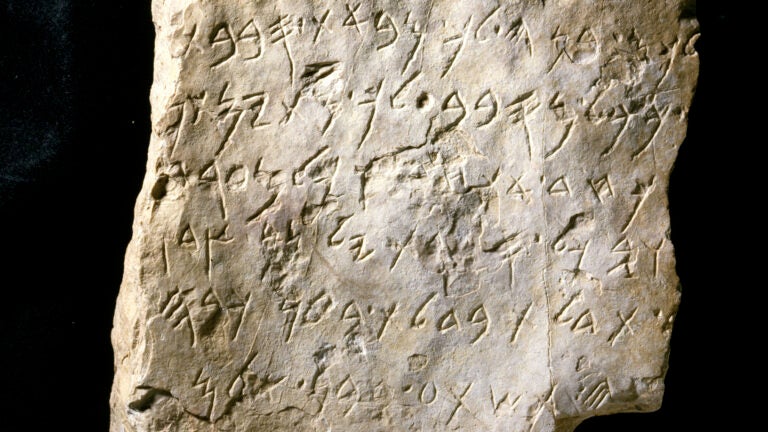
The West Semitic Research Project is an academic project affiliated with the University of Southern California School of Religion and directed by Professor Emeritus Bruce Zuckerman. For the past 40 years WSRP has used advanced photographic and computer imaging techniques to document artifacts and texts from the ancient Near East and Mediterranean worlds. In doing this we have built a vast collection of images that are available to scholars, students, educators and the general public through the USC Digital Library.

About WSRP

WSRP was started in the early 1980s by Bruce Zuckerman and his brother Kenneth. Bruce, a scholar and teacher of the Bible and ancient Semitic languages, was frustrated by the lack of good photographs of important ancient inscriptions. With the help of his brother, Ken, he set out to remedy the situation.

The study of ancient writing is called epigraphy. In this field it has been typical of scholars who read ancient texts to do their own reading, produce a drawing of the text and publish the drawing, translation and transcription as the main tool for study. Photographs, if provided, can rarely be used for study. The reason is that the photographs are either taken by scholars who know little about photography, or by photographers who cannot read what they are looking at and so may miss important data.

The most important principle that governs the work of the WSRP is the combining of good photography with knowledge of the scripts and languages. We believe in training scholars to be good photographers, or at least encouraging them to work closely with photographers to get the best possible results.

For Educators and Students

This site is designed to provide an educational experience for students, teachers and the general public. It includes images of Dead Sea Scrolls, biblical manuscripts and ancient texts relating to the Bible, together with descriptions and informative discussions of the images. We encourage instructors to make these images available, on a non-commercial basis, to their students as a resource in the study of history, culture, religion, biblical studies, and related subjects.

Non-Biblical Ancient Texts Relating to the Biblical World
Biblical Manuscripts
Dead Sea Scrolls
USC Archaeological Research Collection

For Scholars

The image collection of West Semitic Research (WSR) includes a wide variety of inscriptional material, particularly in the languages and scripts of Northwest Semitic. The following is a listing of image collections in high-resolution digital form. Many are subject to arrangements with collaborating institutions. Scholars can use the links here to browse through the image lists.

These images are for study purposes only. Permission to publish must be obtained in writing from WSR and collaborating institutions.

The West Semitic Research Project launched its image database as an Internet database application, InscriptiFact, in 2004. That application is now closed, but the images found on that application, as well as many others, can be found through the USC Digital Library, InscriptiFact–An Image Database of Inscriptions and ArtiFacts.


 Training Program in the Use of Reflectance Transformation Imaging (RTI)

Tuesday, December 15, 2015

A Bibliography of Semitic Linguistics (1940-2012) By Gregorio del Olmo Lete

[First posted in AWOL 15 October 2014, updated (new URLs) 15 December 2015]

A Bibliography of Semitic Linguistics (1940-2012)
Gregorio del Olmo Lete
http://www.aulaorientalis.org/semiticbibliography/images/buttons/head.gif
It seems obligatory at the beginning of this bibliography to set out its limits and justify its objectives. The aim of the bibliography is to collect and arrange systematically only those studies directly or mainly related to subjects of Semitic linguistics, namely, those centered on the study of languages and their phonological, morphological, syntactic and semantic constituents, from both the comparative perspective(close and distant relationship) and the immanent perspective (grammar and lexicon). Consequently, all other studies dealing with the history of the societies which use or used those languages and with everything that is built on them (socio-political history, literature, religion and ‘culture’ in general), remain excluded.

This limitation may seem impossible or at the very least without justification and minimalist, in some way resorting to ‘formalism’, giving up the basic element, whose development a language has to perform, namely, the shaping of a universe of social representations, which generates a particular way of communication and creativity. One could say that it means abandoning the ‘context’ in which every linguistic formulation has its meaning, being at the same time its outcome. But we cannot forget, in answer to such an objection, that our purpose has a fixed point of support: it is constructed exclusively on ‘texts’ as the products of language, which are the reference point for testing and validating results. And if it is true that ‘the proposition is the world’ (Wittgenstein), then linguistic analysis is the basis for the understanding of any representation.

Our intention is to provide specialist information that arranges and classifies as much as possible the vast amount of data constantly presented by the general bibliography on Semitic languages and cultures. In this way, access to such information will be made easier, with better focus on the more important issues of research. At the same time we intend to collect the information and classify it in a uniform manner, in this way making it possible to compare across languages the research being carried out within the various languages, since such research often ignores other languages.

The first installment is devoted to general topics in respect of the Semitic family as a whole. In this connexion, studies dealing with its relationship to other linguistic groups and families (Nostratic, Hamitic or Afro-Asiatic) will be taken into account in as much as they bear on the study of Semitics proper. Here, Nostratic is taken in its wider meaning, as used today among Indo-European scholars. In order to avoid any prejudgements, in successive installments we will offer linguistic bibliographies for each Semitic language as well as for each Semitic language family according to its name, without attempting to decide on its suitability or incorporate it within a particular preferred classification. This is precisely one of the problems the present bibliographical tool aims to address. The series will include the following headings: [East and North Semitic], Akkadian, Eblaite, Amorite, Ugaritic, [Northwest Semitic/Canaanite],Phoenician, Hebrew, Aramaic/Syriac, South Semitic, Old (Epigraphic) North and South Arabian, Modern South-Arabian, Arabic and Ethiopic, both classic and modern, the pertinent dialectal variations being included under the appropriate heading.The steady general bibliographical references are ordered, to easy their use, according to titles instead of authors, which may vary along the years. Otherwise, the alphabetic order according to author’s name is followed.

The cross-references to the individual bibliographies of each of these languages and groups of languages are essential for extracting full information on a specific linguistic issue at either a general or a comparative level. In the first installment, any comparison of (at least two) languages is noted. When the title specifies the language compared, the item will be repeated in the corresponding bibliography (“Comparative Level”). Unlike the other topics, where the aim is to be exhaustive, the Bibliography on Semitic lexicography has been kept within less strict limits, otherwise the task would have been endless.

Studies or references to particular lexemes have not been recorded in the installment devoted to Common Semitics, unless they bear on comparative issues. In principle, only treatments of ‘roots’ or ‘semantic fields’ have been taken into account. Nevertheless, the criterion has not always been applied stringently, since often it is difficult to draw the line between particular and comparative treatments. In the other installments, devoted to particular languages, concrete lexemes also have been recorded, although in a non exhaustive way. In any case, this section of the bibliography has to be taken as merely indicative and perfunctory, and reference to up-to-date lexicographic records is unavoidable. A thorough lexicographical entry should even include reference to the main studies on editions and commentaries on the texts, where the particular lexeme appears, but such textual studies have not been included. As for book reviews, only the most significant that appeared in the last years have been listed.

Barcelona, 04/17/2014
8
4
1
5
13
15
9
10
11
14
3
12
2
6
7
7
7
7