skip to main |
skip to sidebar
[First posted in AWOL 13 February 2010. Updated 20 September 2014]
Hortulus: The Online Graduate Journal of Medieval Studies
Hortulus: The Online Graduate Journal of Medieval Studies is
a multidisciplinary refereed postgraduate journal devoted to the
literatures, cultures, and ideas of the medieval world. Published
electronically twice a year, its mission is to present a forum in which
graduate students from around the globe may share their work.
Hortulus has an open submission policy, so submissions are accepted
throughout the year. Graduate students are welcome to submit previously
unpublished articles that challenge our readers to look at the Middle
Ages from a variety of perspectives by engaging in new theories and
interdisciplinary research. All articles should be submitted via email;
submission guidelines can be found here.
We publish a themed issue each spring, and a general issue each
autumn. Calls for papers for each issue can be found on the main page of
the website. There are also various position openings in Hortulus throughout the year so watch our social media outlets for information.
- Volume 1, Number 1, 2005
- Volume 2, Number 1, 2006
- Volume 3, Number 1, 2007
- Volume 4, Number 1, 2008
- Volume 5, Number 1, 2009
- Volume 6, Number 1, 2010
- Volume 7, Number 1, 2011
- Volume 8, Number 1, 2012
- Volume 9, Number 1, 2013
- Volume 10, Number 1, 2013
- Volume 10, Number 2, 2014
Announcing the Arethusa Annotation Framework
Developers Gernot Höflechner, Robert Lichtensteiner and
Christof Sirk, in collaboration with the Perseus Digital Library at
Tufts (via the Libraries and the Transformation of the Humanities and Perseids projects) and the University of Leipzig’s Open Philology Project, have released Arethusa, a framework for linguistic annotation and curation. Arethusa was inspired by and extends the goals of the Alpheios Project,
to provide a highly configurable, language-independent, extensible
infrastructure for close-reading, annotation, curation and exploration
of open-access digitized texts. While the initial release highlights
support for morpho-syntactic annotation, Arethusa is designed to allow
users to switch seamlessly between a variety of annotation and
close-reading activities, facilitating the creation of sharable,
reusable linguistic data in collaborative research and pedagogical
environments.
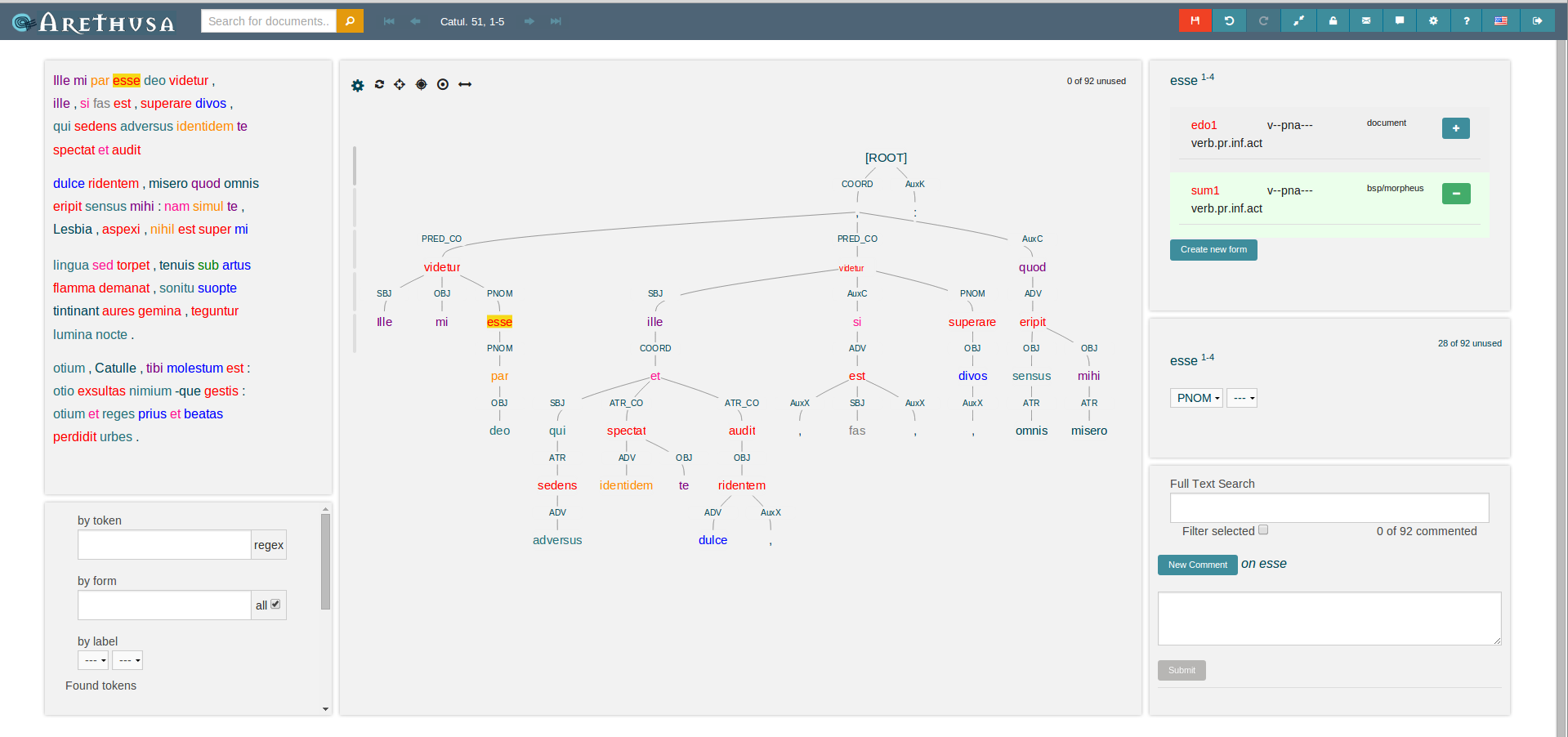
Arethusa is built on the angular.js
javascript web application framework and provides a back-end
independent infrastructure for accessing texts, annotations and
linguistic services from a variety of sources. Extensibility is a
guiding design goal — Arethusa includes tools for automatic generation
of skeleton code for new features as plugins; detailed development
guides are also currently in progress. We hope others will be able to
reuse and build upon the platform to add support for other annotation
types, languages and back-end repositories and workflow engines.
Arethusa is already deployed as a component of the Perseids
platform, where it provides an annotation interface for
morpho-syntactic analyses and will soon also act as a broker between the
Perseids back-end (the Son of SUDA Online
application) and various other front-end annotating and editing
activities, including translation alignments, entity identification and
text editing.
Screencasts
are available that show how the Arethusa application can be used for
syntactic diagram (treebank) and morphological analysis annotations on
Perseids. Additional demos and slides will be made available soon which
highlight additional features along with the architecture and design.
This project has been made possible in part by the Institute of Museum and Library Services (Award LG0611032611), the Andrew W. Mellon Foundation and the European Social Fund.
We also are indebted to Robert Gorman and Vanessa Gorman of the
University of Nebrask and Giuseppe G. A. Celano of the University of
Leipzig for their invaluable contributions to the design and testing of
the platform.
Digital Humanities and the Ancient World
Biblical Archaeology Society Staff
• 08/13/2014
What would happen if the Pope’s library were accidentally burnt? How
can we reconstruct and visualize ancient and medieval pilgrimage routes?
Technology is changing the way we study and preserve texts and
artifacts. In a series of web-exclusive articles written by scholars
engaged in the Digital Humanities, learn how this growing field of study
is helping to analyze textual and archaeological data—and how you can
help.
Digital Humanities: An Introduction
 What if the Dead Sea Scrolls were damaged? What if the Pope’s library burned down? In “Digital Humanities: How Everyone Can Get a Library Card to the World’s Most Exclusive Collections Online,”
George Washington University associate professor of history Diane H.
Cline explores the research opportunities and potential impact of
Digital Humanities projects. This new field not only preserves
publications, it extends access to the humanities to anyone with
Internet access.
What if the Dead Sea Scrolls were damaged? What if the Pope’s library burned down? In “Digital Humanities: How Everyone Can Get a Library Card to the World’s Most Exclusive Collections Online,”
George Washington University associate professor of history Diane H.
Cline explores the research opportunities and potential impact of
Digital Humanities projects. This new field not only preserves
publications, it extends access to the humanities to anyone with
Internet access.
Read
“Digital Humanities: How Everyone Can Get a Library Card to the World’s
Most Exclusive Collections Online” by Diane H. Cline >>
Mapping Technologies
 Want
to follow a fourth-century pilgrim itinerary from Bordeaux via
Constantinople to the Holy Land? Experiment with ancient travel times
and their costs over land, sea and sand in the Roman Empire? University
of Iowa assistant professor of classics Sarah E. Bond explains in “Map Quests: Geography, Digital Humanities and the Ancient World” how the Digital Humanities offers opportunities to explore, interact with and contribute to maps of the ancient world.
Want
to follow a fourth-century pilgrim itinerary from Bordeaux via
Constantinople to the Holy Land? Experiment with ancient travel times
and their costs over land, sea and sand in the Roman Empire? University
of Iowa assistant professor of classics Sarah E. Bond explains in “Map Quests: Geography, Digital Humanities and the Ancient World” how the Digital Humanities offers opportunities to explore, interact with and contribute to maps of the ancient world.
Read “Map Quests: Geography, Digital Humanities and the Ancient World” by Sarah E. Bond >>
Open Access to Digital Data
 Interested
in exploring the results of archaeology projects directly from the
researchers? Cutting-edge technology is helping archaeologists generate a
tremendous amount of digital data each year. At the same time, the
scientific community increasingly expects direct access to the data. In “Open Context: Making the Most of Archaeological Data,”
Alexandria Archive Institute cofounders Sarah Whitcher Kansa and Eric
Kansa describe Open Context, an open access, peer-reviewed data
publishing service that has published over one million digital
resources, from archaeological survey data to excavation documentation
and artifact analyses.
Interested
in exploring the results of archaeology projects directly from the
researchers? Cutting-edge technology is helping archaeologists generate a
tremendous amount of digital data each year. At the same time, the
scientific community increasingly expects direct access to the data. In “Open Context: Making the Most of Archaeological Data,”
Alexandria Archive Institute cofounders Sarah Whitcher Kansa and Eric
Kansa describe Open Context, an open access, peer-reviewed data
publishing service that has published over one million digital
resources, from archaeological survey data to excavation documentation
and artifact analyses.
Read “Open Context: Making the Most of Archaeological Data” by Sarah Whitcher Kansa and Eric Kansa >>
Making University Collections Accessible to All
 Many
university departments across the world have shelves and storerooms
full of books, artifacts and research collected over several decades.
What do you do when the “skeletons in your closet” are a box of
2,000-year-old artifacts? That was the question facing the University of
British Columbia’s Department of Classical, Near Eastern, and Religious
Studies. In “From Stone to Screen: Bringing 21st-Century Access to Ancient Artifacts,” members of the From Stone to Screen
graduate student project at UBC discuss their ongoing efforts to create
digital archives of their department’s artifact collection—making these
fascinating objects accessible to a global audience online.
Many
university departments across the world have shelves and storerooms
full of books, artifacts and research collected over several decades.
What do you do when the “skeletons in your closet” are a box of
2,000-year-old artifacts? That was the question facing the University of
British Columbia’s Department of Classical, Near Eastern, and Religious
Studies. In “From Stone to Screen: Bringing 21st-Century Access to Ancient Artifacts,” members of the From Stone to Screen
graduate student project at UBC discuss their ongoing efforts to create
digital archives of their department’s artifact collection—making these
fascinating objects accessible to a global audience online.
Read “From Stone to Screen: Bringing 21st-Century Access to Ancient Artifacts” >>
Daphnet
Daphnet, the ILIESI’s Digital Archives of PHilosophical texts on the NET, is a portal that gives access to digital platforms dedicated to relevant authors and texts belonging to the history of scientific and philosophical thought. These platforms are characterized by some common aspects: They primarily aim at giving access to primary sources, eventually complemented by secondary sources and critical instruments; they can include both facsimiles and transcriptions of manuscripts and printed texts; they are based on open-source programmes and standard encoding (i.e. html, XLM,...); the text of these platforms can be semantically enriched. Moreover, the platforms are interoperable, open to the collaboration of the scholars, and they are certified by a board of reviewers.
Presocratics Source
Presocratics Source presents the transcription of the famous collection of Presocratic thinkers in ninety chapters originally edited by H. Diels and W. Kranz (Die Fragmente der Vorsokratiker, ed. by H. Diels-W. Kranz, 3 vols., Weidmann, Berlin, 19582), with the parallel Italian translation edited by G. Giannantoni (I Presocratici. Testimonianze e frammenti, a cura di G. Giannantoni, Laterza, Roma-Bari, 19832).
Socratis et Socraticorum Reliquiae Source
Socratis et Socraticorum Reliquiae Source presents the transcription of the collection of testimonies about Socrates and Socratics (Socratis et Socraticorum Reliquiae) originally edited by G. Giannantoni.
Diogenes Laertius Source
Diogenes Laertius Source presents the transcription of Lives and opinions of eminent Philosophers in ten books. Collation of the editions of R. D. Hicks, H. S. Long, M. Marcovich and the Italian translation of M. Gigante with parallel Greek text restored on the bases of his philological notes. The site enable users to access texts, exploit resources, and perform queries. Notes, additional information and a legenda for a better access to the texts are also available.
A complete vocabulary of the Aeneid
I am pleased to say that the DCC Aeneid vocabulary is now up and running. Based on Henry S. Frieze, Vergil’s Aeneid Books I-XII, with an Introduction, Notes, and Vocabulary,
revised by Walter Dennison (New York: American Book Co., 1902), it
includes frequency data derived from a human inspection and analysis of
every word in the Aeneid (Mynors’ text) carried out by teams at the Laboratoire d’Analyse Statistique des Langues Anciennes (LASLA) at the Université de Liège.
Users can search both Latin and English words, and display items alphabetically or by frequency. By using The Bridge, users can create custom lists for line ranges in the Aeneid, including or excluding vocabulary from the DCC core, or from several introductory Latin textbooks.
This data will form the basis for complete running lists for the
whole poem, to be created in the coming years as part of a larger
multimedia edition of the Aeneid...
Short term open access to articles in the current Anatolian Studies

Until 30th November, you can enjoy free access to the following articles from the 2014 volume of Anatolian Studies.
Keep up-to-date with Cambridge archaeology journals by signing up for content alerts. You can also follow us on Twitter and Facebook.
Attic Inscriptions Online News
Attic Inscriptions Online (www.atticinscriptions.com) is pleased to announce publication of a further tranche of new material: Translations of the decree honouring Lykourgos, IG II2 457 +
3207, and the ephebic oath and oath of Plataia from Acharnai, SEG
21.519, added, with notes. Fuller notes added to laws and decrees of
352/1-322/1 BC, IG II3 1, 292-572, and the decree honouring ephebes of the tribe Kekropis, RO 89. Several bug fixes.







 Posts
Posts


 Stumble It!

