Monday, December 5, 2022

Laying the Foundations: Manual of the British Museum Iraq Scheme Archaeological Training Programme

[First posted in AWOL 19 January  2022, updated (Arabic and Kurdish translations) 5 December 2022]
 
edited by John MacGinnis and Sébastien Rey. Paperback; 205x225mm; illustrated in full colour throughout. 808 2022. Available both in print and Open Access. Printed ISBN 9781803271408. Epublication ISBN 9781803271415.

Laying the Foundations, which developed out of the British Museum’s ‘Iraq Scheme’ archaeological training programme, covers the core components for putting together and running an archaeological field programme. The focus is on practicality. Individual chapters address background research, the use of remote sensing, approaches to surface collection, excavation methodologies, survey with total (and multi) stations, use of a dumpy level, context classification, on-site recording, databases and registration, environmental protocols, conservation, photography, illustration, post-excavation site curation and report writing. While the manual is oriented to the archaeology of Iraq, the approaches are no less applicable to the Middle East more widely, an aim hugely facilitated by the open-source distribution of translations into Arabic and Kurdish.

Download Full PDF  
Open Access users: by downloading this eBook you are agreeing to our standard terms and conditions available here.
Institutional subscribers: by downloading this eBook you are agreeing to abide by the subscription licence issued to The Institution. Contact your library for further details. If you encounter any issues with your download please contact info@archaeopress.com 

Also available in Arabic and Kurdish

Sunday, December 4, 2022

The Long Augment in Homer: a formula-based approach

Chiattelli, Edoardo
Thumbnail

In ancient Greek, past tenses of verbs starting with a consonant are prefixed with the vowel epsilon, but some verbs in Homer show an eta instead. These forms were linked to Vedic instances of long augments by part of the relevant literature. Other scholars preferred to explain the Greek instances as inner developments, while others denied any philological validity for the long augment as an actual morpheme, and rather explained its presence in some Homeric verbs as the product of analogical processes. My thesis focusses on specific Homeric forms within the heterogeneous set of evidence offered by ancient Greek. I take these long-augmented verbs to be artificial creations of the Homeric language. This line of interpretation is supported not only by considerations of historical phonology and morphology, but also through an innovative formula-based method. Its aim is to describe, through an analysis of the Homeric traditional language, the possible reasons and dynamics for the creation in the Kunstsprache of artificial long-augmented forms. More specifically, it might be possible to explain them as part of analogical modifications of pre-existent formulaic patterns, so as to provide an accurate description of how (and why) their artificial structure was used as a metrical alternative to their counterparts in the spoken language. The focus of my thesis is on ἠείδη ‘she/he knew’ (and ἠείδης ‘you knew’), ἤϊκτο ‘she/he resembled’, ἀπηύρα ‘she/he took away’, and the trisyllabic forms of the imperfect of εἶμι, i.e. ἤϊα ‘I went’, ‘ἤϊε ‘she/he went’, ἤϊσαν/ἤϊον ‘they went’. A detailed analysis of historical morphology shows that none of them can be assumed to be the result of linguistic processes in the ordinary language. This is also confirmed by their attestations limited to Homeric diction or later poetry imitating it. Furthermore, I show through the formula-based method how most of these long-augmented forms are part of analogical modifications derived from formulaic patterns, which contain forms of the same paradigm but without long augment (i.e. ᾔδεε ‘she/he knew’, ἐϊκυῖα/ἔϊκτο ‘resembling’/‘she/he resembled’, ἴσαν ‘they went’). This suggests that long-augmented forms are used primarily as metrically functional alternatives, which is a feature typical of artificial creations in Homer. Since the results of the method confirm the artificial nature of these forms, they cannot be compared with the Vedic data, nor can their long augment be deemed a genuine morpheme of ancient Greek. It is rather the product of analogical processes within the Homeric Kunstsprache. In particular, I provide a possible narrative for the origin and analogical use of a Homeric long augment in the pluperfect of οἶδα and imperfect of εἶμι, while explaining the initial long vowels of ἠειδ- and ἤϊκτο as analogical temporal augments used by the Homeric poets for metrical purposes. As for ἀπηύρᾱ, this morphologically controversial form is best explained as another analogical use of temporal augmentation, applied by the Ionian bards to original *ἀπεύρᾱ despite its metrical irrelevance. My method shows how forms like ἀπηύρᾱ, which had become extraneous to the Ionian bards, could nonetheless undergo analogical reshaping through the influence of structural connections among formulaic patterns.

Advisors
Meissner, Torsten
Clackson, James
Date
2022-04-22
Awarding Institution
University of Cambridge
Qualification
Doctor of Philosophy (PhD)
Type
Thesis


Mumienmasken – Entstehung und Entwicklung bis zum frühen Mittleren Reich

Kriener, Anita

Diese Dissertation beschäftigt sich mit den Anfängen der Mumienmasken im Alten Ägypten und ihre Entwicklung bis zum frühen Mittleren Reich. Aus dem Alten Reich sind drei verschiedene Typen bekannt. Der zuerst auftretende Typ waren die Leinenhüllen, bei denen der gesamte Körper aus Leinenbinden nachmodelliert und anschließend mit Farbe dekoriert und mit Kleidung versehen war. Sie waren ein Produkt der Oberschicht, wurden aber bereits nach wenigen Generationen in sozial schwächere Schichten übernommen. Ein weiterer Typ waren die Gipsmasken und -hüllen, die aus Stuck modelliert wurden und den Mundbereich des Körpers besonders akzentuierten. Sie traten ausschließlich bei Bestattungen der niederen Beamtenschicht auf und sind das Resultat einer stark zentral-organisierten Rohstoffreglementierung. Im Laufe des Alten Reiches trat ein neuer Typ bei elitären Grablegungen auf, der aus Kartonage gefertigt wurde und eine direkt Weiterentwicklung der Leinenhüllen darstellte. Die Kartonagen charakterisieren sich nicht nur durch das Material, sondern mit ihnen wurde zusätzlich ein Fokus auf den Kopfbereich des Leichnams gelegt. Diese Konzentration auf den Kopf stand in einem unmittelbaren Zusammenhang zu den funerär-religiösen Vorstellungen und rituellen Praktiken. Diese können zwar erst ab dem hohen Mittleren Reich durch schriftliche Quellen erschlossen werden, werden aber bereits im Alten Reich an der Gestaltung der Mumienmasken fassbar. Aus den Kartonagen des Alten Reiches entwickelten sich spätestens in der 1. Zwischenzeit die ebenfalls aus Kartonage hergestellten Helmmasken oder Stülpmasken. Sie weisen oft individuell und aufwendig gestaltete Perücken auf und sind mit einer aufgemalten Barttracht versehen. Der in späteren Epochen für Mumienmasken so charakteristische Kinnbart fehlt bei vielen der frühen Exemplare der 1. Zwischenzeit. Die Art der Gestaltung dieser Masken spiegelt das Antlitz eines menschlichen Wesens wieder, welches sich in der Transition von einer im Diesseits zu einer im Jenseits lebenden Entität befindet. Im frühen Mittleren Reich vollzog sich ein weiterer Schritt, der den Verstorbenen als göttliches Wesen identifizierte und ihn schließlich als Osiris ausdeutete. Diese Veränderung wurde ebenfalls in der Gestaltung der Masken reflektiert, die nun teilweise mit göttlichen Attributen versehen wurden.

This Ph. D. thesis deals with the origins of mummy masks in Ancient Egypt and their development until the early Middle Kingdom. Three different types are known from the Old Kingdom. The first type is called 'linen cover' and is often refered to as 'mummy' in literature. In these cases the entire body was modelled from linen bandages and then decorated with paint and clothing. This treatment of the body was a product of the upper class, but was adopted by lower classes after only a few generations. A second type are plaster masks and covers. They were modelled from stucco and accentuated the mouth area. They appeared exclusively at burials of lower officials and were the result of a strongly centrally organised regulation of materials. In the course of the Old Kingdom, a new type appeared at elite burials. It was made of cartonnage and represents a direct development of the linen covers. Cartonnage is not only characterised by the material used for its production, but also focusses on the head area of the human body. This emphasis on the head was directly related to funerary religious ideas and ritual practices. Although these were first mentioned in written sources from the high Middle Kingdom, they were already evident in the design of the Old Kingdom mummy masks. From the early cartonnages evolved in the First Intermediate Period the so called helmet masks, which were made of cartonnage as well. The first object of this type had often individually and elaborately designed wigs and were decorated with a painted beard. The chin beard, which is characteristic for mummy masks of later periods, is not present in many of the early examples of the First Intermediate Period. The design of these masks in fact the face of a human being which is in transition from an entity living in this world to one living in the afterworld. In the early Middle Kingdom a further development took place. From this point on the deceased was identified as a divine being and finally interpreted as Osiris. This change was also reflected in the design of the masks, some of which were now provided with divine attributes.

License


Friday, December 2, 2022

Punta di Zambrone I: 1200 BCE – a Time of Breakdown, a Time of Progress in Southern Italy and Greece

Jung, Reinhard
Thumbnail

This monograph presents a major part of the scientific results of the archaeological excavations at the Bronze Age settlement site of Punta di Zambrone on the Tyrrhenian coast of Calabria (southern Italy), conducted from 2011 to 2013 in an Italian- Austrian cooperation. The book is the first in a series dedicated to the final publication of those excavations and focuses on the later part of the settlement history (13th–12th cent. BCE). Major topics include the topography of the site (including a harbour bay), its chronology, investigations into the economic basis of the Bronze Age society and its local, regional and interregional interactions.
 
Diese Monographie stellt einen wesentlichen Teil der wissenschaftlichen Ergebnisse der archäologischen Ausgrabungen in der bronzezeitlichen Siedlung von Punta di Zambrone an der tyrrhenischen Küste von Kalabrien (Süditalien) vor, die von 2011 bis 2013 im Rahmen einer italienisch-österreichischen Kooperation durchgeführt wurden. Das Buch ist der erste Band einer der Abschlusspublikation dieser Grabungen gewidmeten Reihe und behandelt schwerpunktmäßig den späteren Abschnitt der Siedlungsgeschichte (13.–12. Jh. v.u.Z.). Die behandelten Themen umfassen die Topographie des Fundorts (einschließlich seiner Hafenbucht), seine Chronologie, Untersuchungen zu den wirtschaftlichen Grundlagen der bronzezeitlichen Siedlungsgemeinschaft und ihrer lokalen, regionalen und überregionalen Verbindungen.
ISBN
978-3-7001-8615-1
Publisher website
https://verlag.oeaw.ac.at/
Publication date and place
2021-07
Classification
Prehistoric archaeology
Italy
Greece
Prehistory


Thursday, December 1, 2022

Perspectives on Public Policy in Societal-Environmental Crises: What the Future Needs from History 

Editors:

Book cover

The only collective multidisciplinary survey of historical responses to risk, mitigation and resilience. International group of specialists in several fields working collaboratively. Directly responds to current concerns about relevance of historical lessons for contemporary policy. This book is open access which means you have free and unlimited access

Part of the book series: Risk, Systems and Decisions (RSD)

  1. Front Matter

    Pages i-ix
  2. Introduction: What Sort of Past Does Our Future Need?

    • Adam Izdebski, John Haldon, Piotr Filipkowski
    Pages 1-5Open Access
  3. History and Public Policy in the Era of Planetary Crisis

    1. Front Matter

      Pages 7-7
    2. History and Utopian Thinking in the Era of the Anthropocene

      • Dariusz Brzeziński
      Pages 33-43Open Access
    3. Globalization as Adaptive Complexity: Learning from Failure

      • Miguel Centeno, Peter Callahan, Paul Larcey, Thayer Patterson
      Pages 59-74Open Access
    4. Disjunctures of Practice and the Problems of Collapse

      • Rowan Jackson, Steven Hartman, Benjamin Trump, Carole Crumley, Thomas McGovern, Igor Linkov et al.
      Pages 75-108Open Access
  4. Crisis and Recovery

    1. Front Matter

      Pages 205-205
    2. Systemic Risk and Resilience: The Bronze Age Collapse and Recovery

      • Luke Kemp, Eric H. Cline
      Pages 207-223Open Access
    3. Panarchy and the Adaptive Cycle: A Case Study from Mycenaean Greece

      • James M. L. Newhard, Eric H. Cline
      Pages 225-235Open Access


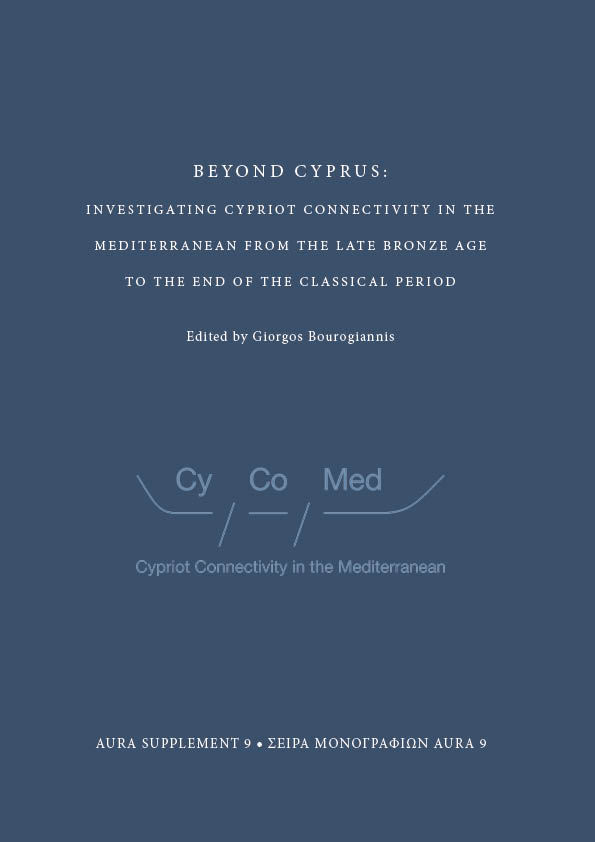
Beyond Cyprus: Investigating Cypriot Connectivity in the Mediterranean from the Late Bronze Age to the End of the Classical Period

Giorgos Bourogiannis
Cover Image


This volume is largely based on papers presented at the international conference “Beyond Cyprus: Investigating Cypriot Connectivity in the Mediterranean from the Late Bronze Age to the End of the Classical Period”, that was held digitally on 8–11 December 2020, under the auspices of the Institute of Historical Research of the National Hellenic Research Foundation.

The conference was organised by the editor of the volume as part of a postdoctoral research project under the same name (acronym CyCoMed), funded by the Hellenic Foundation for Research and Innovation (HFRI) and the General Secretariat for Research and Innovation (GSRI) within the framework of the first HFRI advertisement for postdoctoral research projects, under grant agreement no. 481.

The principal research questions treated in the volume are closely related to the examination and interpretation of Cypriot archaeological, epigraphic and numismatic evidence from extra-insular sites, as well as to the definition of the role Cypriots may have played as participants in the maritime contacts of the ancient Mediterranean. All 41 papers contained in this volume were externally reviewed and revised for publication. They cover a time range that spans approximately the Middle Bronze Age to the Roman period (early second millennium BC to ca AD 300). Equally numerous are the geographic entities examined, covering a large area, from the eastern Mediterranean and the Black Sea to the Iberian Peninsula, thus providing an overview of Cypriot evidence throughout the Mediterranean.

ISSN: 2623-3428 (digital), 2623-3436 (print)

© 2018-2020 National and Kapodistrian University of Athen, Department of History and Archaeology.

Contents

Robin Osborne Cypriot connectivity in the Mediterranean (21-22)

Jennifer M. Webb Cyprus’ maritime connectivity before and during the transition to the Late Bronze Age. The case of the north and northwest (23-34)

Eleni Mantzourani and Giorgos Vavouranakis The anthropomorphic figurines of Cyprus in the Bronze Age. Style, local traditions and foreign associations (35-44)

George Papasavvas Egyptian gold at Enkomi. Α material manifestation of a ruling ideology on Late Bronze Age Cyprus (45-62)

Hartmut Matthäus Cyprus, Egypt and the Levant during the Late Bronze Age. New evidence from ­Enkomi (63-72)

Vasiliki Kassianidou Tracing Cypriot connectivity with the Eastern Mediterranean and beyond through the trade of copper and other metals (73-88)

Hanan Charaf Disentangling the relationships between Cyprus and Lebanon during the second millennium BC. What Sidon can bring to the table (89-108)

Michal Artzy and Huixin Sha Late Bronze II Cypriot counterparts from the Tell abu Hawam anchorage. The White Slip Ware (109-118)

Tatiana Pedrazzi Canaanite jars in Cyprus in the 13th–12th centuries BC. Transfer of goods, transformation of networks (119-130)

Angelos Papadopoulos Cypriot products and Cypriots away from the coast? A view from Late Bronze Age Tell el-Hesi (131-140)

Sarah Vilain Towards a reassessment of Levantine and Egyptian jugs and juglets related to Cypriot Base Ring ­Ware (141-152)

Anna Lekka Pottery fashion in the Late Bronze Age. Αn overview of the stylistic similarities between Cypriot and ­other local wares in the Mediterranean (153-178)

Nikolas Papadimitriou Cyprus and the Aegean in the Late Bronze Age (179-194)

Cassandra M. Donnelly Cypro-Minoan abroad, Cypriots abroad? (195-206)

Joanna S. Smith Cypriot seals and Cypriots overseas (207-224)

Jan Sienkiewicz Social assemblages of things. Drinking practices and inter-cultural interaction between Rhodes and Cyprus in the Late Bronze Age (225-238)

Foteini Zervaki From Cyprus to Rhodes and beyond. Cypriot imports and influence in Rhodes in the 11th and early 10th centuries BC. Links to the Aegean and the central Mediterranean (239-250)

Konstantinos Kopanias, Erato Vemou and Katerina Sidiropoulou 3D model analysis of some Late Bronze Age and Early Iron Age swords from Cyprus (251-262)

Anna Lucia D’Agata Networks of similarities, worlds of shared practices. On the use of the term koine for the connections between Cilicia and Cyprus in the first centuries of the first millennium BC (263-272)

Anastasia Christophilopoulou Ancient migration or ancient mobility? Perspectives from Cyprus (273-286)

Giuseppe Garbati Cypriot (?) gods beyond Cyprus. Some notes on the western Phoenician evidence (287-304)

Adriano Orsingher Sailing east. Networks, mobility, trade and cultural exchanges between Cyprus and the central Levant during the Iron Age (305-323)

Konstantinos Kopanias, Dimitris Papageorgiou, Chara Theotokatou and Ioannis Voskos External contacts and a reassessment of socio-political evolution in the Kouris region during the Late Bronze Age and Early Iron Age (323-334)

Anna Georgiadou and Maria Dikomitou-Eliadou The Iron Age pictorial pottery of Salamis within and beyond. An overview of ceramic styles, wares and fabrics (335-350)

Francisco J. Núñez The beginning of the Cypro-Archaic I period. A revision proposal (351-364)

Giorgos Bourogiannis Cypriot Black-on-Red pottery in Early Iron Age Greece. In search of a beginning and an end (365-388)

Nicholas Salmon The “Spaghetti Workshop” of Rhodes. Cypriot inspirations, Rhodian alterations (389-398)

Nota Kourou The artist and the donor. The inscribed statuettes of Cypriot type found in the Aegean ­revisited (399-410)

Numan Tuna, Nadire Atici, İlham Sakarya and Üftade Muşkara The connectivity of Cyprus and Knidia. Limestone votive statuettes found at the Archaic Apollo sanctuary (411-420)

Stella Demesticha Transport containers and maritime networks. The case of Cyprus (421-436)

Alina Dimitrova Beyond Cyprus. The evidence from the Black Sea (437-448)

Anne Destrooper-Georgiades The evolution of the specific contribution of Cypriot coins in the relations of the island with other geographic entities in the Eastern Mediterranean during the Achaemenid period. The case of Kition and Salamis (449-460)

Evangeline Markou and Yoav Farhi A rare coin of Idalion from Israel and Idalion’s coin production and circulation in the 5th century BC (461-472)

Anna Cannavò Mercenaries. Cypriots abroad and foreigners in Cyprus before the Hellenistic period (473-484)

Agnieszka Halczuk Paphians outside Paphos. Inscriptions in the Paphian Syllabary found outside Cyprus (485-496)

Artemis Karnava Incoming goods and local writing. The case of classical Marion in Cyprus (497-508)

Eirini Paizi Cypro-Archaic and Cypro-Classical pottery from the Knossos Unexplored Mansion. New evidence on connections between Crete and Cyprus (509-518)

Margit Linder Omnium eorum ars urbibus excubabat, pictorque res communis terrarum erat. Artists’ mobility in the Mediterranean from the Archaic era to the end of the Classical period (519-530)

Maria Christidis Equestrian scenes from Kerameikos to Cyprus (531-542)

Gabriele Koiner Cypriot antiquities in Austrian collections and Cypriot archaeology in Graz. An ­update (543-552)

John Lund Cypriot connectivity from the Late Classical to the Roman periods. A diachronic ­perspective (553-564)


Full Text:

PDF


DOI: http://dx.doi.org/10.26247/aurasup.9


Variatio in Kunst und Handwerk: Modulare Arbeitsweisen in spätantiker und frühbyzantinischer Zeit

Stefanie Archut und Sabine Schrenk (Hrsg.) 
 Variatio in Kunst und Handwerk

In Kunst und Handwerk des ersten Jahrtausends n. Chr. arbeitete man mit Voranfertigungen und Vorlagen; man experimentierte mit Motiven. Die Werkstätten setzten Einzelteile „wie aus einem Baukastensystem“ zusammen, teils nach strengem Entwurf, teils spielerisch. Die vorliegenden Beiträge gehen dieser „modularen Arbeitsweise“ und den unterschiedlichen Aspekten, die sie beeinflusst, erstmals übergreifend nach und machen deutlich: Modulare Arbeitsweise erweist sich als ein wesentlicher Motor für kulturelle Weiterentwicklung. Es sind die Ergebnisse eines Projekts, das hauptsächlich Studierende und Promovierende mit Förderung der VolkswagenStiftung im Forschungs- und Lehrprojekt der „Poolforschung“ an der Abteilung Christliche Archäologie der Rheinischen Friedrich-Wilhelms-Universität Bonn durchgeführt haben.

Lizenz

Dieses Werk ist unter der
Creative Commons-Lizenz 4.0
(CC BY-SA 4.0)
veröffentlicht.
Creative Commons Lizenz BY-SA 4.0

Identifikatoren
ISBN 978-3-96929-147-4 (PDF)

Veröffentlicht am 30.11.2022.

Inhaltsverzeichnis
PDF
Titelei
Inhalt
Sabine Schrenk, Stefanie Archut
Modulare Arbeitsweise in spätantiker und frühbyzantinischer Zeit. Einführung
Sarah Fahldieck
Ein Beispiel für eine modulare Bildkomposition
Magdalena Krampe
Modularität in der technischen Fertigung frühbyzantinischer Wand- und Gewölbemosaike
Freyja Droste zu Vischering und Padtberg
Prozesse einer Standardisierung der Kanontafeln
Florian Oppitz
Der Aufschwung von geometrischen opus sectile-Böden in der Spätantike am Beispiel von Ephesos
Stefanie Archut
Überlegungen zu spätantikem Stuckdekor
Henry Maguire
the Concentric Circles Motif
Lara L. Mührenberg
Zur Bedeutung von modularer Produktion für die Transformation spätantiker Männlichkeitskonstruktionen
Prolet Decheva
Überlegungen zum Stifter des Megalopsychia-Mosaiks aus Yakto
Theresa Zischkin
Das Fallbeispiel des Fußbodenmosaiks der Stephanskirche (Umm ar-Rasas)
Stefan Jürgens
Modulare Nutzung von Spolienkapitellen in Rom
Estera M. Golian
Auswirkungen, Modularität, Wiederverwertung
Corinna Mairhanser
Vorhänge als Mittel der modularen Raumkonstruktion in spätantiken Kirchenbauten