skip to main |
skip to sidebar
[First posted in AWOL 6 January 2009. Updated 30 January 2015]
The Open Anthropology Journal
ISSN: 1874-9127
The Open Anthropology Journal
is an Open Access online journal, which publishes research
articles, reviews, letters and guest edited single topic issues
in all areas of Anthropology.
The disciplines that are published in the journal are the
following:
Physical Anthropology; Biological Anthropology; Socio-Cultural
Anthropology; Linquistic Anthropology; Archaeology; Ethnology;
Paleoanthropology; Paleobiology; Paleolithic archaeology;
Osteoarcheology; Evolutionary Biology; Social Biology; Primatology;
Social & Global networks.
The Open Anthropology
Journal, a peer reviewed journal, is
an important and reliable source of current information on developments
in the field. The emphasis will
be on publishing quality articles rapidly and freely
available
to researchers worldwide.
Volume 5, 2012
[General Articles]
Volume 4, 2011
[General Articles]
Special Issues
[Special Issue #001] [Pp. 1-24]
Introduction to Hot-Topic: Migratory
Labor and Social Adversity
Volume 3, 2010
[General Articles]
Special Issues
[Special Issue #001] [Pp. 1-95]
Dental Anthropology in Chinese
[Special Issue #002] [Pp. 153-205]
Health Status, Nutrition and Ageing in India: An Anthropological
Insight
Volume 2, 2009
[General Articles]
Volume 1, 2008
[General Articles]
Journal of Ancient History
ISSN: 2324-8114

The Journal of Ancient History aims to provide a forum for
scholarship covering all aspects of ancient history and culture from the
Archaic Period to Late Antiquity (roughly the ninth century BCE through
the eighth century CE). The journal publishes peer-reviewed articles
concerning the history and historiography (ancient and modern) of the
ancient Mediterranean world and of neighboring civilizations in their
relations with it. The journal is open to submissions in disciplines
closely related to ancient history, including epigraphy, numismatics,
religion and law.
De Gruyter is allowing free access to the first issue for the next 3 months
The project
Work on provincial coins in the Roman Empire has demonstrated their
potential to be used as a source to understand local culture as well as
perceptions of the emperor and Roman power. The provincial coinage of
the Republican period, however, has received little attention. By
examining the iconography of coins struck by Roman officials and cities
outside Rome in the period 168-27 BC, this project seeks to uncover how
Roman power was represented, negotiated or rejected before the creation
of the principate.
The database
Another major aim of the project is to broaden access to and
understanding of this material in disciplines other than numismatics.
Consequently, the raw data generated by the project is being made
available online for free public use. Users should note that the
database only provides an overview of the iconography being struck in
regions under Roman control; it does not list every variation and
subtype. For these, users are recommended to consult the publications
listed in the bibliography.
This is an ongoing project. At the moment, the database has good
coverage of Italy, Africa, Macedonia, and the coins struck by Roman moneyers outside Rome as listed in Crawford’s Roman Republican Coinage. We plan to work on Achaea, Crete and Cyrenaica over the summer.
Rock Art Studies: A Bibliographic Database

Rock Art Studies: A Bibliographic Database
is a compilation in progress which was begun in March, 1993. Currently
the database contains over 27,000 citations to the world's rock art
literature, with an emphasis on English language and North American
citations. Over 9500 of these citations are held in the compiler's
personal library. These and many others were reviewed for annotation.
With the "r11" release, the database became available on the Internet as
a project of the Bay Area Rock Art Research Association Archive,
Bancroft Library, University of California, Berkeley (http://bancroft.berkeley.edu/collections/rockart.html).
A few comments regarding the background and objectives of the
Compiler, and the assembly of the raw data for inclusion in the database
are in order. Leigh Marymor, is a Plumbing Contractor from Berkeley,
California who holds a bachelor's degree in Community Education from the
University of Wisconsin - Milwaukee. He has been interested in rock art
conservation and the literature of rock art studies for over
thirty-five years. He served as President of the American Rock Art
Research Association (2004-2006), is a co-founder of the Bay Area Rock
Art Research Association and has been its Co-chairperson since its
inception in 1983. Leigh Marymor received the American Rock Art Research
Association's Castleton Award for research excellence in 2002 in
recognition of the significance of the compilation of Rock Art Studies: A
Bibliographic Database.
The Rock Art Studies database was initially conceived as a tool
useful in cataloging the rock art literature held in the Compiler's
personal library, which currently consists of approximately 100 shelf
feet of books, periodicals, grey literature, ephemera and research
notes. As the project grew, additional citations were included from over
one hundred additional sources, including: bibliographies, research
archives, library catalogues, on-line search services and other private
holdings (these sources are notated in the "library" field of the
database, and are detailed in the text document, Key to Sources for
Citations).
The scope of the data included in the database has been limited by
the time and energy available to the Compiler, as well as, by his
subjective approach to keyword notations (found in the Keywords field).
The past emphasis in the database on English language literature has
steadily given way to the growing inclusion of the French, Spanish,
Italian and Portuguese literature.
 Bay Area Rock Art Research Association Archive
Bay Area Rock Art Research Association
Bay Area Rock Art Conservation and Education Fund
Search the Rock Art Studies database
Citation information
Related Links
Contact the Compiler
Bay Area Rock Art Research Association Archive
Bay Area Rock Art Research Association
Bay Area Rock Art Conservation and Education Fund
Search the Rock Art Studies database
Citation information
Related Links
Contact the Compiler
CEIPAC: Biblioteca On-line

CENTRO PARA EL
ESTUDIO DE LA INTERDEPENDENCIA PROVINCIAL
EN LA ANTIGÜEDAD CLÁSICA
José Remesal Rodríguez (Cátedra de Historia
Antigua)
remesal@ceipac.ub.edu
Departament de Prehistòria, Història Antiga y Arqueologia
Facultat de Geografia i Història, Universitat de Barcelona
C/ Montalegre 6, 08001 Barcelona, España
Más de 600 publicaciones on-line de los miembros y colaboradores del
grupo. Puedes enviarnos tus artículos en PDF para darles difusión y
compartirlos en nuestra web. Consúlta el catálogo aquí.
La Biblioteca Virtual reune todas las publicaciones realizadas por
los miembros y colaboradores del grupo CEIPAC.
El catálogo está compuesto de libros, artículos,
reseñas y CD-Rom multimedia, escritos en diferentes idiomas.
Desde la biblioteca on-line podrá consultar el catálogo,
editar la ficha de cada título, y bajar a su ordenador algunas
de las publicaciones en formato PDF.
El acceso a la Biblioteca es completamente abierto. Las publicaciones
electrónicas en formato PDF han sido colocadas con la autorización
de sus respectivos autores, con el propósito de dar la más
amplia difusión posible a los temas que estudiamos.
Announcing
cdli tablet
We are delighted to announce the launch of "cdli tablet" for the iPad, combining short text with images of cuneiform inscriptions and related archaeological artifacts. Sponsored by the Cuneiform Digital Library Initiative (Los Angeles & Berlin) and programmed by Sai Deep Tetali, graduate student of UCLA's Computer Science Department, the app gives specialists in the fields of cuneiform studies, Near Eastern archaeology and art history the opportunity to present facets of the writing culture of ancient Mesopotamia to a broad community of experts and informal learners. Short descriptions of the historical relevance of selected text and text-related artifacts together with images that can, but need not be taken from CDLI’s growing open access file archives, are prepared and posted to app pages. Ordered by calendar date in groups of from several to thirty pages, the resulting 'themes' give a running account of these experts' ideas. The free app is conceived as a vehicle for the introduction, to learning communities of all ages, of a variety of chosen topics in cuneiform studies, and in the digital preservation and worldwide dissemination of the shared cultural heritage of ancient Mesopotamia.
Our launch theme is a set of entries prepared by Jacob Dahl (University of Oxford) on proto-Elamite accounts that makes extensive use of high-resolution images of Susa tablets in the collection of the Louvre; we will follow this topic with others dealing with 3rd millennium bricks and brick stamps; cuneiform building plans; the Northwest Palace of Nimrud and Assurnasirpal II's standard inscription; then themes dedicated to collections at Emory University (cuneiform messengers in space!), at the Free Library of Philadelphia and the Princeton Theological Seminary where we are currently working, the Ashmolean, the Louvre, the Vorderasiatisches Museum, and more. A special CDLI webpage is dedicated to the app, with our request for contributions, and directions on how to go about preparing and submitting your own files for future viewing in iPad. We particularly hope that curators of existing cuneiform collections will view "cdli tablet" as an opportunity to highlight artifacts in their care, and we will make every effort to assist them in preparing pages and themes for the app. But Assyriologists and Near Eastern archaeologists too can take advantage of this medium to offer an informal narrative of their past publications, or future plans.
cdli tablet is a free educational app available at the iTunes Store for download to iPads running on IOS 6 (search for "cdli").
Bob Englund
UCLA
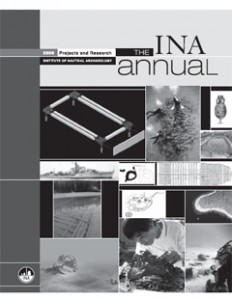
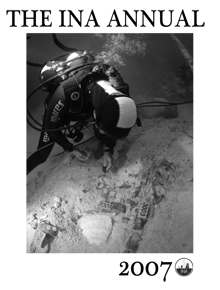
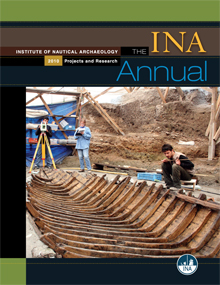
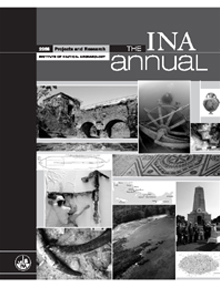
INA Annual
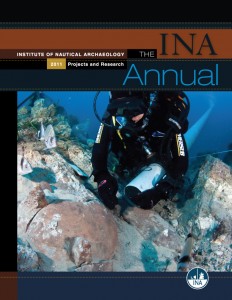
Between 2008 and 2012, the Institute of Nautical Archaeology published The INA Annual, a year-end compilation of INA-supported projects, as a complement to the INA Quarterly. The time and work required to produce The INA Annual
meant that it appeared at least one year later than the fieldwork
reported within. So, in the interests of ensuring that news of INA’s
archaeological discoveries and fieldwork, book reviews, and dive safety
features reach our loyal members in the shortest amount of time, we
chose to suspend publication of The INA Annual in 2013 and return INA field reports to their traditional place on the pages of the INA Quarterly, which has been published four times a year for the past four decades.
ISSUES AVAILABLE FOR DOWNLOAD:
Click on the images below to access pdf files of The INA Annual






 Posts
Posts


 Stumble It!

