Showing posts with label Coptic. Show all posts

Sunday, July 10, 2022

Coptic Dictionary Online

Coptic Dictionary Online

The Coptic Dictionary Online aims to make it easy to look up Coptic words in all dialects and supply freely accessible translations in English, French and German, via human and machine readable interfaces. To learn more about using this dictionary, check out our quick how-to guide.

This project was made possible through the help of the following:

Lexicon preparation

The new Comprehensive Coptic Lexicon is a combination of two parts: the BBAW Lexicon of Coptic Egyptian of the project Strukturen und Transformationen des Wortschatzes der ägyptischen Sprache at the Berlin-Brandenburgische Akademie der Wissenschaften, Berlin, Germany, which includes etymologically Egyptian lexemes of Coptic, and the DDGLC Lexicon of Greek Loanwords in Coptic of the project Database and Dictionary of Greek Loanwords in Coptic at the Ägyptologisches Seminar, Freie Universität Berlin, Germany. Both projects are led by Prof. Tonio Sebastian Richter. The following people mainly contributed to compiling the lexical data:

  • Dylan M. Burns (DDGLC)
  • Frank Feder (BBAW, AdWG)
  • Katrin John (DDGLC)
  • Maxim Kupreyev (BBAW)

moreover

  • Mathew Almond, Sina Becker, Marc Brose, Sonja Dahlgren, Julien Delhez, Anne Grons, Joost Hagen, Jakob Höper, Mariana Jung, Elisabeth Koch, Lena Krastel, Frederic Krueger, Jan Moje, Franziska Naether, Anne Sörgel, Nina Speranskaja, Gunnar Sperveslage, Vincent Walter, Alberto Winterberg.

Each lexicon entry has a stable Thesaurus Linguae Aegyptiae (TLA) ID no.

TEI XML compliant data files of the lexica are published under a CC BY-SA 4.0 license at DOI 10.17169/refubium-2333.

Search interface

The search interface was designed at Georgetown University as part of the project KELLIA by:

  • Emma Manning
  • Amir Zeldes

Projects

Funding

Reporting issues / contributing

For issues regarding dictionary content or the interface, please use our Issue Tracker and choose the appropriate template to report your issue.

How to cite this page

Coptic Dictionary Online, ed. by the Koptische/Coptic Electronic Language and Literature International Alliance (KELLIA), https://coptic-dictionary.org/ (accessed yyyy-mm-dd).
Thursday, May 5, 2022

The Gospel of Thomas Resource Center

 [First posted in AWOL 11 October 2012, updated 5 May 2022]

The Gospel of Thomas Resource Center
This is a resource center for independent research related to the Gospel of Thomas.
Featuring the Internet's first complete Coptic/English translation and Concordance.


"There is a substantial and growing body of evidence that Gos. Thom. is not what it appears to be."
... M.W. Grondin, Sep, 2019

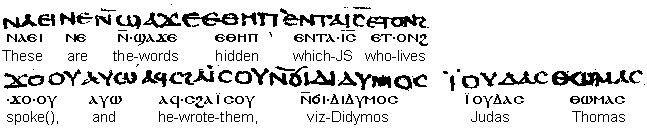
The Hidden Structure of the Coptic Prologue (11-10-9-3-9-10-11)

(A letter-count-based chiastic structure of a complexity presumably rare when unintended)

Coptic ms. counts showing precision design and careful inscription

105 occurrences of the nomina sacra IC/IHC
210 (Greek numeric value of 'IC')
1050 (Greek numeric value of 'Thomas')
500 occurrences of Copto-Greek words and names
2400 letters in those occurrences
16800 letters in main body of text sans prologue (=80*210, 7*2400)
(Proof that the Coptic text of Thomas is NOT the product of ineptitude!)
(The chance of 3 random numbers all being divisible by 100 is 1 in a million.)


Formerly called "The Codex II Student Resource Center" (C2SRC), this is
a resource center for independent research related to Nag Hammadi Codex II.
Featuring the Web's first complete Coptic/English translation of the Gospel of Thomas. 

Saturday, December 11, 2021

Bibliographie Papyrologique en ligne

[Most recently updated 11 Decembre 2021] 

 
Bibliographie Papyrologique en ligne

BP enligne
La «BP en ligne» donne accès à toutes les fiches distribuées par Marcel Hombert et ses successeurs depuis les origines de la BP, en 1932, jusqu'au dernier envoi de l'année écoulée. Les fiches de l'année en cours sont réservées aux abonnés de la «BP courante»; elles seront ajoutées à la «BP en ligne» au cours de l'année prochaine.


Il est possible de chercher une séquence de texte SOIT à travers l'ensemble des champs que comportent les fiches, SOIT dans un (ou plusieurs) champs spécifique(s). Les champs suivants sont distingués:
  • «Index»;
  • «Index bis», réservé aux renvois aux documents (papyrus, ostraca ou tablettes);
  • «Titre», y compris le(s) nom(s) du (ou des) auteur(s);
  • «Publication»;
  • «Internet», où ne sont signalés en principe que les accès gratuits;
  • «Résumé»;
  • «S.B. & S.E.G.»;
  • «C.R.»;
  • «N°», attribué de manière définitive (p. ex. 2007-1262, les quatre premiers chiffres faisant écho à l'année de publication; le N° d'une fiche déplacée ou supprimée ne sera pas réattribué);
  • «Nom», où sont repris tous les noms mentionnés dans les champs «Titre» et «Résumé» (à l'exclusion des prénoms);
  • «Année», où figure l'année de publication (le cas échéant, la première année mentionnée si une publication porte un millésime double, p. ex. 2015-2016).
La «BP en ligne» ne reprend pas le champ «Envoi» où est indiqué, dans la «BP courante», le rang qu'occupe la fiche dans l'envoi (p. ex. 12/1/001). Dans le champ «Résumé», les éditions papyrologiques sont citées conformément aux usages de la BP (abréviation, tomaison, ponctuation). Pour les documents désignés par un N° d'Inv., il est renvoyé soit au S.B., soit aux recueils de textes littéraires, médicaux, juifs ou chrétiens (M.-P.3, LDAB, Marganne, van Haelst), sinon à l'ed. princeps.

On pourra consulter en annexe diverses concordances (téléchargeables, au format pdf):
  • «Codes»: fournit, en plusieurs langues, la clé des index utilisés dans le champ «Index»;
  • «Sigles papyrologiques»: énumère les sigles utilisés pour désigner les recueils de papyrus ou d'ostraca (avec leur correspondants dans la Checklist), en part. dans le champ «Index bis»;
  • «Sigles épigraphiques»: explicite les sigles utilisés pour désigner les recueils d'inscriptions grecques et latines en provenance d'Égypte;
  • «Périodiques»: énumère les sigles utilisés pour désigner les périodiques (avec leurs correspondants dans l'Année Philologique).
Programmation web: Pierpaolo Borghesi < gianni873@libero.it >
Contact: Alain Martin < amartin@ulb.ac.be
>


Retour vers: BP

Wednesday, November 11, 2020

Open Access Digital Library: Bibliothek Goussen

[First posted 10/2/09. Updated 11 November 2020]

Bibliothek Goussen
http://s2w.hbz-nrw.de/ulbbn/domainresource/static/graphics/kopfgrafik_digitalisierung.png
The Goussen library collection is a specialist library for oriental church history. It contains prints in Western classical and modern languages, but predominantly prints in oriental languages such as Syrian, Coptic, Ethiopian, Arabic, Armenian and Georgian languages from the 16th to the 20th century (the focus is on the 18th and the 19th century). The former owner Heinrich Goussen (1863 – 1927) collected nearly every print within the language groups that had ever been published about the subject. The collection contains numerous rare or valuable oriental prints. There could hardly a collection be put together as completely as here, not even from the holdings of large European libraries.

Monday, September 21, 2020

Alin Suciu's Coptic Resources

COLLECTIONS OF COPTIC MANUSCRIPTS
 EGYPT
Cairo (Coptic Museum)
Cairo (Institut français d’archéologie orientale)
Coquin, R.-G., “Le fonds copte de l’Institut français d’archéologie orientale du Caire,” in Écritures et traditions dans la literature copte. Journée d’études coptes, Strasbourg 28 mai 1982 (Cahiers de la bibliothèque copte, 1; Louvain 1983) 9-18
Louis, C., Catalogue raisonné des manuscrits littéraires coptes conservés à l’IFAO du Caire. Contribution à la reconstitution de la bibliothèque du Monastère Blanc (unpublished Ph.D. thesis, École Pratique des Hautes Études, Section des Sciences Religieuses: Paris)
Report this ad
Report this ad
FRANCE
Paris (Bibliothèque Nationale)
Porcher, E., “Analyse des manuscrits coptes 131.1-8 de la Bibliothèque Nationale,” Revue d’Égyptologie 1 (1933) 105-160, 231-278, 2 (1936) 65-123
Lucchesi, E., Répertoire des manuscrits coptes (sahidiques) publiés de la Bibliothèque nationale de Paris (Cahiers d’Orientalisme, 1; Geneva: Patrick Cramer, 1981)
Bouvarel-Boud’hors, A., Catalogue des fragments coptes vol. 1: Fragments bibliques nouvellement identifiés (Paris: Bibliothèque Nationale, 1987)
GERMANY
Berlin (Papyrussammlung)
GREAT BRITAIN
London (British Library)
Layton, B., Catalogue of Coptic Literary Manuscripts in the British Library Acquired Since the Year 1906 (London: British Museum, 1987)
Zanetti, U., “Un catalogue des additions coptes des Londres,” Analecta Bollandiana 106 (1988) 171-181
Manchester (John Rylands Library)
Report this ad
Report this ad
ITALY
Naples
Buzi, P., Catalogo dei manoscritti copti borgiani conservati presso la Biblioteca Nazionale “Vittorio Emanuele III” di Napoli (Accademia dei Lincei – Memorie, Ser. IX, 25/1; Rome: Scienze e lettere, 2009)
Rome
NETHERLANDS
Leiden (Rijksmuseum van Oudheden)
Pleyte, W. & Boeser, P.A.A., Manuscrits coptes du Musée des Pays-Bas à Leide (Leiden: E.J. Brill, 1897)
RUSSIA
Moscow
Elanskaya, A.I., The Literary Coptic Manuscripts in the A.S. Pushkin State Fine Arts Museum in Moscow (Supplements to Vigiliae Christianae, 18; Leiden: E.J. Brill, 1994)
GRAMMAR:
Lambdin, T.O, Introduction to Sahidic Coptic (Macon GA: Mercer University Press, 1983)
LITERATURE
Pachomius
Report this ad
Report this ad
Isaiah of Scetis
The monk Augustinos, Tou hosiou patros hemon abba Esaiaou logoi 29 (Jerusalem, 1911; 2nd ed. S. Schoinas, Volos, 1962)
Hardy, E. R., “A Fragment of the Works of the Abbott Isaias,” Annuaire de l’Institut de Philologie et d’Histoire Orientales et Slaves 7 (1944) 127-140
Mercati, G., “Sul papiro greco dell’Archivio di Stato di Firenze,” Aegyptus 32 (1952) 464-473
Guillaumont, A., L’Asceticon copte de l’abbé Isaïe. Fragments sahidiques édités et traduits (Bibliothèque d’études coptes, 5; Cairo 1956) part 1; part 2
Draguet, R., Les cinq recensions de l’Ascéticon syriaque d’abba Isaïe 4 vols. (CSCO, 289-290, 293-294. Scriptores Syri, 120-123; Louvain: Secrétariat du CorpusSCO, 1968)
Report this ad
Report this ad
Chitty, D.J., “Abba Isaiah,” Journal of Theological Studies n.s., 22 (1971) 47-72
Lucchesi, E., “Le dossier d’Apa Zénobe. Addenda et corrigenda. Appendice II: Un Logos inconnu d’Isaïe de Scété. Chenouté, Isaïe et Moïse,” Analecta Bollandiana 117 (1999) 67-80
Nessim Youssef, Y., “Un complément de l’Asceticon copte de l’Abbé Isaïe,” Vigiliae Christianae 55 (2001) 187-190

Tuesday, July 7, 2020

Open Access Journal: Bulletin d’information du Groupe BCNH

[First posted on AWOL 19 April 2015, updated 7 July November 2020 (with links to the Internet Archive - the Bulletins are no longer available on the original host site)]

Bulletin d’information du Groupe BCNH
La Bibliothèque copte de Nag Hammadi

Lancée en 1974 à l’Université Laval (Québec, Canada), l’édition de la Bibliothèque copte de Nag Hammadi (BCNH) est la seule initiative francophone d’envergure consacrée à ces manuscrits; son but est de produire de ces textes des éditions critiques accompagnées de traductions françaises et de commentaires explicatifs. Conservés au Musée copte du Vieux Caire, les manuscrits sont accessibles par le truchement d’une édition photographique patronnée par l’UNESCO et le service des antiquités de la République Arabe d’Égypte. Cette publication photographique, qui reproduit les feuillets de papyrus tels quels, rend les textes accessibles aux spécialistes et sert de base ensuite aux éditions critiques, qui reconstruisent dans la mesure du possible les lacunes des manuscrits, pour ensuite donner lieu à des traductions, à des analyses philologiques et à des commentaires explicatifs.
C’est à cette entreprise d’édition critique, de traduction française et d’analyse, que s’attaquèrent à l’Université Laval en 1974 les regrettés Jacques É. Ménard et Hervé Gagné, entourés de jeunes chercheurs québécois et étrangers. Deux entreprises analogues avaient été lancées quelques années auparavant, l’une à Berlin par le Berliner Arbeitskreis für koptisch-gnostische Schriften, l’autre à l’Institute for Antiquity and Christianity de Claremont (CA).

Thursday, May 14, 2020

Open Access Journal: International Association for Coptic Studies, NEWSLETTER / BULLETIN D'INFORMATION

 [First posted in AWOL 12 March 2011, updated 14 May 2020]

International Association for Coptic Studies, NEWSLETTER / BULLETIN D'INFORMATION
The IACS publishes a Newsletter as an organ of information about Coptologists and their work. It is sent without charge to all members. Thirty-seven issues (with some special appendices) were published between 1976 and 1998. Copies of back issues are available to members upon request.


The Newsletter regularly publishes: (a) news about the Congresses of Coptic Studies and meetings of the IACS board; (b) the list of names and addresses of IACS members; (c) lists of publications in preparation, forthcoming, or recently published, as announced by members.

    Friday, June 14, 2019

    Catalogue en ligne des céramiques coptes - Base Clémence Neyret

    Catalogue en ligne des céramiques coptes - Base Clémence Neyret 
    Catalogue en ligne des céramiques coptes - Base Clémence Neyret
    La base Neyret présente un catalogue en ligne des céramiques coptes du musée du Louvre dont la plus grande partie est issue des fouilles archéologiques du XIXe siècle et du début du XX siècle. Sont proposées en complément de cette base, des approches historiques et thématiques.
     

    Thursday, February 28, 2019

    Papyri.info Announcement: Images for Corpus Papyrorum Raineri II, IV

     Images for Corpus Papyrorum Raineri II, IV
    Images have now been made available for Coptic texts of volumes II and IV of the CPR series. Images are courtesy of the Österreichische Nationalbibliothek. Thanks to the API of Trismegistos it was easy to match the relative image links to the papyri.info identifiers.

    Corpus Papyrorum Raineri

    • II, Koptische Texte, ed. J. Krall. 1895. Nos. 1—255. Many texts are reedited in CPR IV; see concordance there p. xv; and in CPR XII; see concordance there p. 11. [MF 2.67] cpr;2 
    • IV, Die koptischen Rechtsurkunden der Papyrussammlung der Oesterreichischen Nationalbibliothek, ed. W. Till. 1958. Nos. 1—212. No. 34 reedited in P.Rain.Unterricht 112. [ÖNB] cpr;4 
    All texts in the CPR at Papyri.info

    Monday, November 5, 2018

    Bodmer Papyri: Online catalog of the papyrus and parchment manuscripts in the Bodmer collection

    https://bodmerlab.unige.ch/application/files/7015/2702/3829/1072068360_004.png
    The aim of this constellation is to produce a detailed, online catalog of the papyrus and parchment manuscripts at the Fondation Martin Bodmer. The majority of these were acquired by Martin Bodmer in the 1950s and early 1960s. Many of these items seem to have formed part of a larger ancient collection that included works in Greek, Coptic, and Latin  (though only Greek and Coptic are represented in the Bodmer collection). While a number of the books contain interesting combinations of Christian works (such as PB 3, a codex containing the Gospel According to John and part of Genesis in Coptic), there are also classical books, such as the Menander codex (PB M). Other manuscripts contain both classical and Christian material, such as PB T, a codex that includes parts of the biblical book of Daniel in Greek along with book 6 of Thucydides, among other texts.
    These manuscripts are of course highly important for the history of early Christianity, and because of the excellent state of preservation of many of the codices, they are of exceptional interest for historians of the book as well.
    We employ a numbering system that uses the abbreviation PB (Papyrus Bodmer) and an Arabic number or a Latin letter. In most cases, these numbers correspond to the older system of Roman numerals: P.Bodmer I = PB1; P.Bodmer II = PB 2, etc. In situations when a single codex is composed of several of the old P.Bodmer numbers, we have employed a new "letter" designation: 
    • P.Bodmer V+X+XI+VII+XIII+XII+VIII = PB C, the Bodmer Composite codex
    • P.Bodmer XXV+IV+XXVI = PB M, the Bodmer Menander codex
    • P.Bodmer XX+IX = PB P, the Apology of Phileas and Psalms codex
    • P.Bodmer XXXVIII+XXIX+XXX-XXXVII = PB D, the Bodmer Codex of Visions
    • P.Bodmer XLV+XLVI+XLVII+XXVII = PB T, the Bodmer Susanna-Daniel-Thucydides codex
    Dr. Daniel Sharp, Brigham Young University, Hawaii
    Dr. Brent Nongbri, Honorary Research Fellow at Macquarie University in Sydney, Australia
     

    Thursday, September 6, 2018

    Heidelberger Papyrussammlung - digital

    Heidelberger Papyrussammlung - digital
    Das Heidelberger Institut für Papyrologie beherbergt eine etwa 10.500 Stücke umfassende und wissenschaftlich hoch relevante Sammlung von Papyri, Pergamenten, Hadernpapieren und Ostraka aus Ägypten, die seit den ersten Ankäufen im Jahre 1897 kontinuierlich aufgebaut wurde. Damit ist die Heidelberger Sammlung nach den Berliner Museen Preußischer Kulturbesitz die zweitgrößte Papyrussammlung Deutschlands. Die Sammlung umfasst ca. 5.300 griechische Papyri und Pergamente, ca. 3.200 arabische Papyri und Hadernpapiere, ca. 1.370 koptische Papyri und Pergamente, 815 demotische Papyri, kleinere Bestände an hieratischen, mittelpersischen, hebräischen, aramäischen und syrischen Papyri bzw. Pergamenten und Hadernpapieren sowie 760 Ostraka.
    Die Papyrus-Sammlung wurde 1999 bis 2002 mit Unterstützung der DFG digitalisiert und durch elektronische Kataloge erschlossen, die Onlinepräsentation der ca. 9.000 Bilder und der Erschließungsdaten erfolgte jedoch in heute nicht mehr zeitgemäßer Form über statische HTML-Seiten. In Kooperation mit der UB Heidelberg konnte im Rahmen des Projekts CS-FDP: Community-spezifische Forschungsdatenpublikation" die Bereitstellung nun deutlich verbessert werden. Die bestehenden Filemaker-Datenbanken wurden durch eine MYSQL-Datenbank abgelöst und über eine Schnittstelle Basismetadaten sowie die Scans sowie die Transkriptionen der Texte über das an der UB etablierte Digitalisierungssystem DWork online gestellt. Auf diese Weise werden nicht nur alle DFG-Anforderungen (DFG-Viewer etc.) erfüllt, sondern es können auch alle dort verfügbaren Funktionalitäten nachgenutzt werden: Einsatz von Normdaten inkl. Georeferenzierung, nachhaltige Gewährleistung der Zitierfähigkeit, Langzeitarchivierung der Bilddaten, Schnittstellen für OAI-Harvesting, Annotationsmöglichkeiten, Einbindung von in TEI-P5-codierten Transkriptionen/Übersetzungen, Responsive Design) etc. Alle Stücke sind zudem mit den Nachweisen in der internationalen Datenbank Papyri.info verknüpft.
    Die Online-Edition wird ab Ende 2016 hier nach und nach bereitgestellt.
    Griechische Papyrus-Sammlung
    Koptische Papyrus-Sammlung

    Griechische Papyrus-Sammlung


    Koptische Papyrus-Sammlung

    Tuesday, April 17, 2018

    Checklist of Editions of Greek, Latin, Demotic, and Coptic Papyri, Ostraca, and Tablets

    [First posted in AWOL 9 July 2014, updated 17 April 2018]

    Checklist of Editions of Greek, Latin, Demotic, and Coptic Papyri, Ostraca, and Tablets
    Founding Editors: John F. Oates and William H. Willis
    This new instance of the Checklist is a work in progress. Most of the data already supersede those of the previous site. Previous print and online editions were curated by a board of Editors, founded by the late Professors John F. Oates and William H. Willis. This latest carries forward the spirit of openness and collaboration that they championed. Abbreviations are arrived at after discussion by a variety of stakeholders, including Joshua D. Sosin (Duke), Rodney Ast (Heidelberg), Roger S. Bagnall (NYU), James Cowey (Heidelberg), Mark Depauw (Leuven), Alain Delattre (Brussels), Robert Maxwell (BYU), volume editors, and others, sometimes including the wider papyrological community (via papylist). The quickest way to initiate discussion of updates and abbreviations is to write the papylist, or any one of the individuals named above. Editors are strongly urged to let us know when new volumes are published.

    Friday, July 28, 2017

    Digital Library: Center for the Preservation of Ancient Religious Texts

    [First posted in AWOL 11 August 2009. Updated 28 July 2017]

    Center for the Preservation of Ancient Religious Texts
    http://cpart.maxwellinstitute.byu.edu/wp-content/uploads/sites/3/2013/06/Borgia-13-crop-1-Small.jpg
     Since 1996 the Center for the Preservation of Ancient Religious Texts has sponsored research and conversations relating to ancient Christian, Jewish and Islamic texts. For brief descriptions of completed projects go HERE. To follow the work of the Center see our FACEBOOK page. The Center is directed by Dr. Kristian S. Heal.

    Resources & Publications