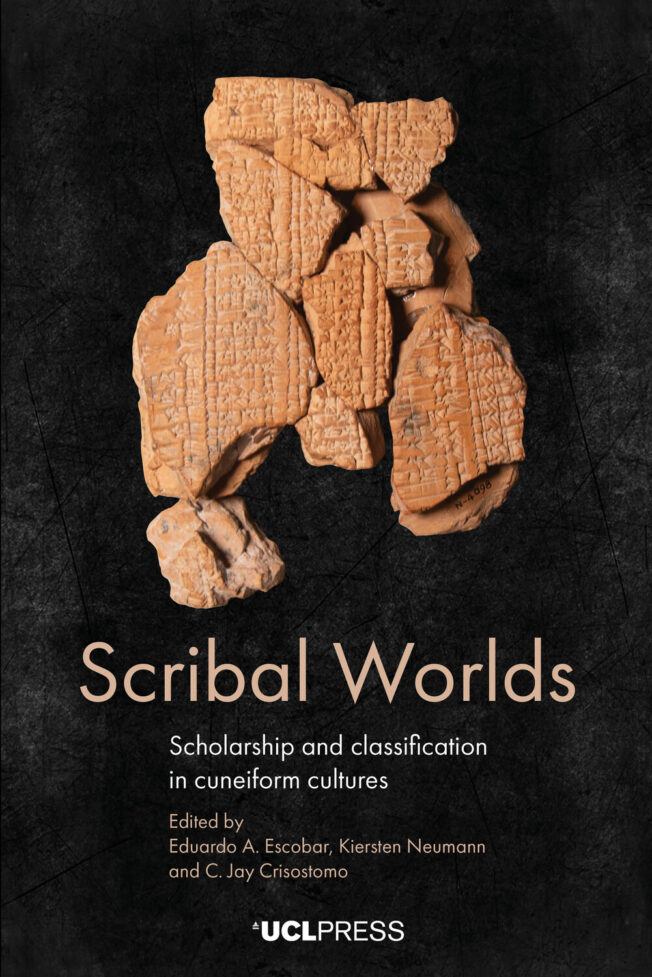
Scribal Worlds: Scholarship and classification in cuneiform cultures delves into the history of the earliest writing cultures of the ancient Middle East, bridging disciplines that include ancient history, philology, semiotics, material culture studies and philosophy of science. Bringing together scholars in the fields of Assyriology, History of Science and Art History, the collection examines how language, ontology, classification and scribal learning shaped cuneiform traditions. Through focused textual and material case studies, contributors employ diverse heuristic tools to reconstruct the intellectual frameworks of scribal cultures and the transmission of knowledge. Inspired by and in appreciation of the work of Niek Veldhuis, this collaborative and timely exploration highlights the interwoven nature of classification and scholarship within cuneiform studies, demonstrating how specific texts, object groups and practices can be interpreted within their cultural contexts. By critically analysing and reframing these sources, the volume exemplifies how scholars extract meaning from even the most fragmentary evidence – truly ‘squeezing juice out of stones’.
DOI: https://doi.org/10.14324/111.9781806550821
Number of illustrations: 81
DOI: 10.14324/111.9781806550821
Number of illustrations: 81
Publication date: 29 June 2026
PDF ISBN: 9781806550821
EPUB ISBN: 9781806550838
Hardback ISBN: 9781806550807
Paperback ISBN: 9781806550814
List of figures
List of tables
List of abbreviations
List of contributors
Editorial conventions
In appreciation of Niek VeldhuisIntroduction: learning from a once-broken list
C. Jay Crisostomo, Kiersten Neumann and Eduardo A. EscobarPart I: Frameworks
1 The Order-of-the-World: things, lumps and texts
Francesca Rochberg2 Is there a Mesopotamian ontology?
Marian H. FeldmanPart II: Categories and classification
3 What’s in a name? Material self-referentiality, aesthetic values and stone classification
Kiersten Neumann4 Imperial hermeneutics: classifying the Assyrian Group Vocabularies
Eduardo A. Escobar and C. Jay Crisostomo5 Gods in stone and clay: classifying figurines in Hellenistic Babylonia
Stephanie Langin-Hooper6 Raven, falcon, dove: birds and the Mesopotamian exorcist
Gina KonstantopoulosPart III: Scribal education and knowledge transmission
7 Back to House F: on community, temporality and locality in Old Babylonian scribal schooling
Eleanor Robson8 The role of Sumerian model contracts in Old Babylonian scribal education: standardisation and variants
Gabriella Spada9 On the formal and social aspects of the acquisition of literacy in Old Assyrian times
Cécile Michel and Piotr Michalowski10 Ezekiel in the edubba
Laurie E. Pearce11 Young Anu-bēlšunu: two rare tablets from Hellenistic Uruk
Enrique JiménezPart IV: Texts and signs
12 Between conservatism and creativity: the Old Babylonian transmission of the Early Dynastic Proverb Collection 1 Jana Matuszak13 Writing Akkadian in Sumer: scenes from the Mesag Archive
Emmanuelle Salgues14 Mesopotamian personal name lists: Classification, education or scholarship?
Paul Delnero15 An Emesal Šuʾila prayer rededicated to Ištar-of-Nineveh and her Akitu festival in Nineveh
Daisuke Shibata16 Wedge order and the character-forming rules of Neo-Assyrian cuneiform
Jonathan TaylorIndex






 Posts
Posts


 Stumble It!


No comments:
Post a Comment