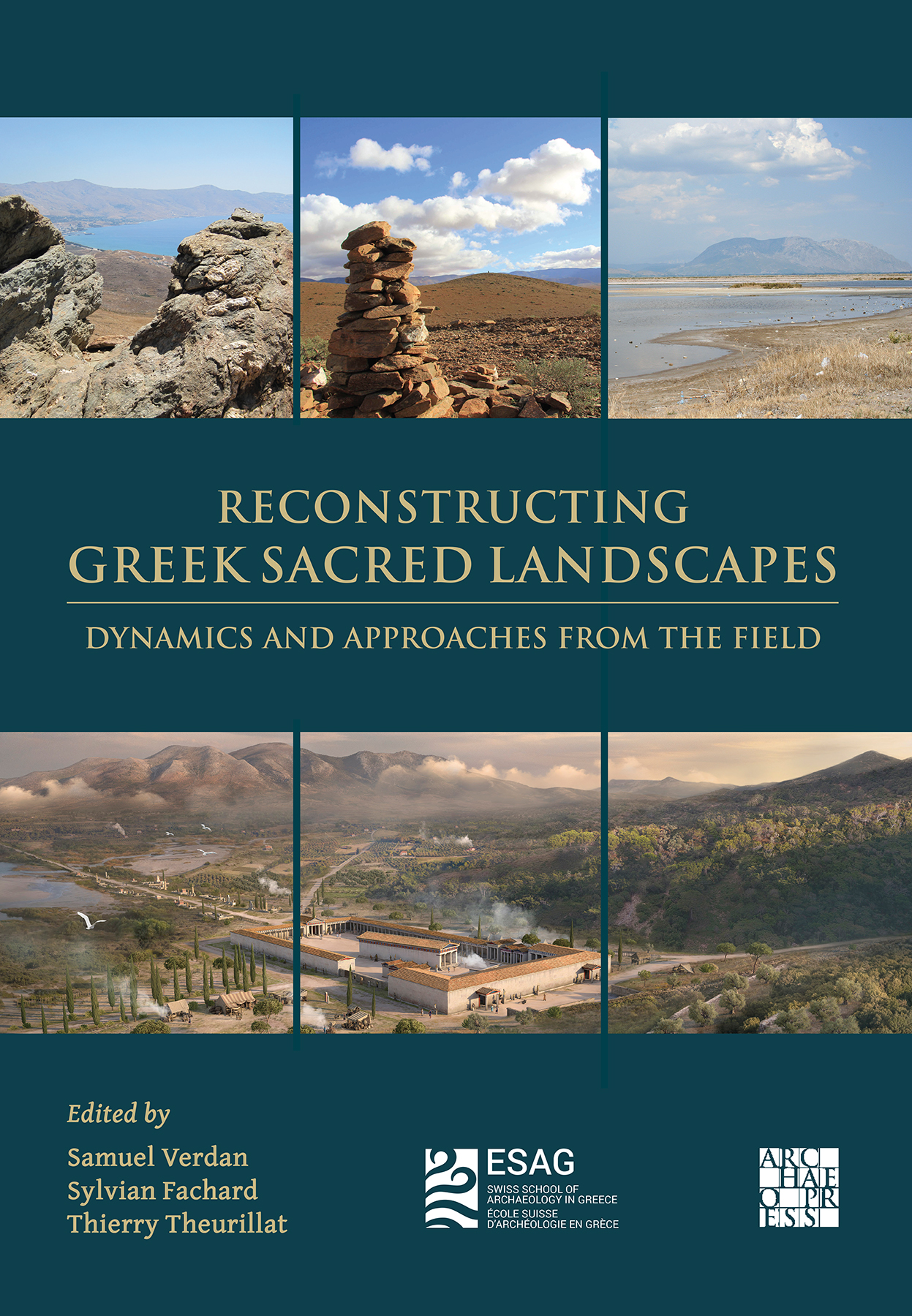
What is meant by “sacred landscape”? How can ancient sacred landscapes, greatly eroded by time, be reconstructed? In the landscape, how did the religious dimension relate to the economic, social and political dimensions? In this book, scholars with many years’ experience of archaeological approaches to Greek religion offer answers to these questions, by presenting a variety of case studies.
The examples selected relate to various regions of the Greek world (Attica, Arcadia, Boeotia, Euboea, Asia Minor) and the periods covered range from the Late Bronze Age to the Byzantine era. Several chapters are based on survey data, which are examined in relation to written sources. Topics covered include the development of sacred landscapes over the long term and the integration of major sanctuaries into their wider environment (Olympia, Kalapodi, Artemision at Amarynthos).
The contributions reveal different understandings of a sacred landscape. As a modern concept, the latter is examined in a methodological introductory chapter. Two recent ethnographic examples, one from Morocco and the other from India, provide further food for thought. The book is intended as an incentive to exploit the heuristic potential of the concept of sacred landscape, while defining its boundaries.
H 290 x W 205 mm
276 pages
161 figures, 1 table (colour throughout)
Published Apr 2026
ISBN
Hardback: 9781805832911
Digital: 9781805832928
Contents
INTRODUCTION – Samuel Verdan, Sylvian Fachard, Thierry Theurillat
I. METHODS AND INSPIRATIONS
1. Samuel Verdan – Between Paysage Religieux and Sacred Landscape: On the Use and Meaning of Terms / Entre paysage religieux et sacred landscape: questions de définitions
2. Romain Simenel – Landscapes of Baraka: Mausoleums, Ruins and Boundary Markers in Morocco
3. Raphaël Rosseleau – Entre la forêt et l’Océan, le temple. Le paysage religieux à Puri (Odisha, Inde)
II. LONG-TERM PERSPECTIVES ON GREEK SACRED LANDSCAPES
4. François de Polignac – Perceptions et constructions du paysage religieux en Grèce ancienne : formes et fonctions de la centralité
5. Madeleine Jost – Quel paysage religieux en Arcadie sans Pausanias?
6. John Bintliff, Anthony Snodgrass, Phil Howard, Christel Müller – The Sanctuary of the Muses in Context: The Contribution of Landscape Archaeology
7. Birgitta Eder – Between Zeus and Poseidon: Sacred Landscapes around Olympia and Samikon
8. Katja Sporn – Kalapodi and the Evolution of a Sacred Landscape in Ancient Phokis
9. Jan Paul Crielaard – Towards a Reconstruction of the Cultic Landscape of Archaic and Classical Karystia
10. Catherine Morgan – Between Political Community and Sacred Landscape in Archaic Northwest Greece (ca. 850–470 BCE)
11. Michael Kerschner – Cultic Space, Cultic Landscape and Mythical Landscape in Ephesos
12. Lorenz E. Baumer – Un réseau à plusieurs couches – dynamiques du paysage religieux de l’Attique envisagé dans la longue durée
13. Fotini Kondyli – Sacred Spaces, Natural Places: The Role of the Natural Environment in Byzantine Religious Life
III. INTERSECTING PERSPECTIVES ON THE ARTEMISION AT AMARYNTHOS
Introduction
14. Denis Knoepfler – A Kome and a Hieron Unlike any Other? Amarynthos within the Political and Religious Structure of the Eretrian Polis
15. Sylvian Fachard, Angeliki G. Simosi, Chloé Chezeaux – Tracing the Sacred in the Eretria-Amarynthos Survey Project
16. Samuel Verdan, Tamara Saggini, Tobias Krapf, Jérôme André, Olga Kyriazi, Thierry Theurillat – The Landscape and the Sanctuary: Wild Spaces, Waters and Ruins at Amarynthos





 Posts
Posts


 Stumble It!


No comments:
Post a Comment