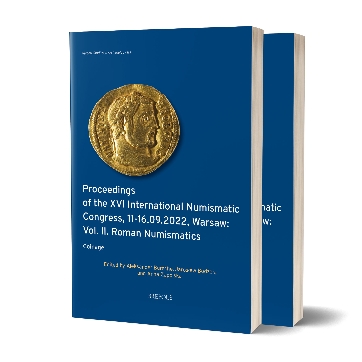
The XVI International Numismatic Congress, held in Warsaw, Poland, in September 2022, was a landmark event, drawing the largest number of participants in its history. With over 550 papers presented during thematic sessions and round tables, this congress showcased the latest advancements and research in the field of numismatics from leading experts and scholars in their field.
A curated selection of papers from the conference have now been drawn together into peer-reviewed conference proceedings, representing a comprehensive spectrum of numismatic studies from antiquity to modern times. Each paper is meticulously illustrated with high-quality images, often of unique specimens, along with detailed diagrams, maps, and die/typological chains. Topics covered include coins and coin finds, medals, tokens, banknotes, the history of collections and collecting, and cutting-edge chemical analyses and technologies used in coin examination.
This volume, the second in four thematic volumes, focuses on Roman coinage. Divided into two separate volumes, covering respectively forty-three chapters on coinage and forty-one on circulation, the contributions gathered here explore not only Rome and the imperial mints, but also local phenomena from Spain to Asia Minor, including graffiti, imitations, and copies of Roman coinage.
© 2025 Brepols Publishers n.v.
Coinage
Front Matter (“Table of Contents”, “List of Illustrations”, “Introduction”)
The Celtic Small Silver Coinage of the Upper Danube
The Contribution of 3D Digitization to the Study of the Riedones Celtic Coins (Fr, 35)
3D Scanning of Celtic Coins and Deep Learning to Identify Monetary Dies
Image Recognition Applied to the Hoard of Le Câtillon II
The Manerbio Hoard (Lombardy, Italy) and 3D Digitization. The Rediscovery of Cisalpine Gaul’s Drachmas
The Roman Republican Die Project (RRDP). History and New Methodologies
The Roman Republican Die Project (RRDP). Methods and Preliminary Findings
The Debasement of the Denarius in the 80s bc
Un caso Singular de la monetización del SO de Hispania en epoca republicana. Mesas do Castelinho (Almodôvar, Portugal)
Minting in the Middle Ground. Counterfeited Roman Coins in the Lake Geneva Region (60–20 bc)
Tracing Roman Gold Stocks with LA-ICP-MS Analysis of Coins from the Second Punic War to the End of the First Century ad
Non-Destructively Determining the Composition of Coinage from Rome and the Mediterranean, from 200 bc to 64 ad
The Representation of Sicily on the Roman Coinage from the Republic to Augustus
Decades Without Bronze Minting in the First Century ad. Their Significance and Impact on Coin Circulation
Riconsiderazioni su un aureo a nome di Plotina Aug Divi dalla collezione Campana
The Return of the Pious Son. Additional Evidence on the Restored Denarius Issue Signed by Hadrian
Einhaltung eines Gewichtsstandards in der Antiken Münzprägung am Beispiel der Cistophoren
The Antonines. An Economy of Silver, not Gold
The Antonine Denarii from Mesopotamia. Preliminary Observations and Interpretations of Two Series from Edessa and Carrhae
Numi plumbei antinoënsi
A Die Study of the Alexandrian Coinage of Commodus
Natus vincere. The Image of Emperor Gallienus (ad 253–268) through Rome’s Mint Coinage
Die aeternitas Augusti im Licht der Münzen
A Spanish Charioteer on a New Contorniate from Rome?
Numismatic Panorama. Mythical Founding Heroes in the Third Century ad
Theomorphic Ruler Images of the Counter-Emperor Postumus. Frontality as an Element of Ruler Representation in the Crisis Period of the 260s ad
La frappe de l’aureus dans les ateliers balkaniques et orientaux entre 293 et 313
Multiple inédit de 2 solidi de Constantin Ier à l’atelier de Trèves
Two Silver Ingots from the Mid-Fourth Century ad
The SM Mark on Honorius Age Bronze Issues
Coins of Antioch and the Transition from Late Antiquity to Early Byzantium (324–610 ad)
A Taxonomy of Bilingual Coins from Augustus to the Mid-Third Century ad
The Coins of Nicopolis ad Istrum Kept in the Medagliere of the Veneranda Biblioteca Ambrosiana (Ambrosian Library). A Preliminary Report
The Mythical Past of Thrace and its Reflection in the Selected Monetary Issues of Hadrianopolis
Rare Coin Types of Pautalia and Serdica
Iconographic Interactions between the Roman Provinces of Thrace, Pontus Bithynia, and Asia Minor
Countermarks on the Coins of Bithynia and Pontus in the Roman Period. Some General Observations
The Identity of the Warrior God on the Coins of Ariassos
A New Year of an Old Era?
More Than Just a Scratch. A Preliminary Categorisation of Graffiti on Roman Gold Coins
Not Only Postumus. Roman and Byzantine Gold Coins with Graffiti in the Collection of the Ossolineum
Los nuevos plomos monetiformes de Eucleratus
Ancient Ponderal Items from the Roman Camp in Cáceres el Viejo (Cáceres, Spain)
The Coin Finds Hub — Italy Project. Management and Use of Numismatic Data from Archaeological Contexts
Circulation
Front Matter (“Table of Contents”, “List of Illustrations”)
The Coin Hoards of the Roman Republic [Online] Database. Reflections and Development after Nine Years
Differences in the Circulation Patterns of Roman Republican Coinage in the Imperial Period with a Particular Focus on the denarii serrati
La présence des deniers républicains en Méditerranée orientale durant les troisième et deuxième siècles avant J.-C.
The Underwater Coin Deposit of Gran Carro, in Lake Bolsena
Preliminary Report on the 2019 Varzi Hoard (Northern Italy, Province of Pavia)
Coin Circulation in Mediolanum between the First Century bc and the Second Century ad. New Data from Archaeological Contexts
The Coin Treasure from the Cardus IV Excavation of Herculaneum (Ancient Campania) in the Coin Cabinet of the Museo Archeologico Nazionale at Naples (562 AR). A Preliminary Report
The Coin Hoards of the Roman Empire Project: 10 Years On! Unum fiat ex pluribus. The Case of Sicily
Late Roman Empire Coin Hoards from Archaeological Excavations in Lamego’s Castle (Portugal)
La continuidad en el uso de nummi tardorromanos cortados y recortados en el Castillo de Viguera (La Rioja)
The Roman Hoard of Tomares. Preliminary Results of a ‘Too Big’ Monetary Find
Nummi tardoantiguos en Gallaecia y Lusitania. Contexto y función de los conjuntos monetales del siglo V d.C.
L’affirmation du pouvoir par la monnaie sous Gunthamund (484–496) et Thrasamund (496–523)
Las monedas del yacimiento tardoantiguo (ss. VI–VII d.C.) de València la Vella (Riba-roja de Túria, València, España)
Hallazgos de moneda antigua en contexto arqueológico de la bahía de Algeciras (Cádiz, España)
Monedas romanas bajoimperiales y tardoantiguas de la excavación de la Plaza de la Catedral de Tortosa (Tarragona, España)
El conjunto monetario hallado en el balneum de la villa romana de Vilauba (Catalunya)
The Beaurains (Arras) Hoard. A Hundred Years Later
Usages et usagers des monnaies d’or en territoire Éduen sous l’Empire romain
Initiators, Status, Degree of Tolerance of Authorities and Other Key Features of Irregular Radiates. An Updated Overview
Usages et circulation monétaires dans le sud de la Gaule aux v e et vi e siècles. Le cas des monnayages de bronze
The Monetization of the Rural Countryside in the German Rhineland
The Coin Hoards of the Roman Empire and Switzerland
Coin Finds from the insulae 3, 13 and 15 in Aventicum/Avenches (Switzerland)
The Roman Hoard of Ueken 2015 (Canton of Aargau, Switzerland)
The Claustra Alpium Iuliarum. A Frontier for Monetary Circulation in the Late Roman Period
Coin Hoards from the Fourth Century ad Found in the Administrative Territory of Augusta Traiana/Beroe
First Insights of Roman Monetary Circulation in Ancient Armenia
Roman Denarius Hoards in Denmark. A Methodological Critique
Large Imperial Gold Medallions from the Fourth Century. The Hoard from Vindelev, Denmark
The Manufacture and Use of Roman Imperial denarii subaerati by Barbarian Inhabitants of Central, Eastern, and Northern Europe. An Overview
Multidisciplinary Studies of Counterfeit Roman Imperial Denarii from Belarus
Irregular Roman Coins from Roman and Migration Period Settlements in Western Lesser Poland
From Individual Finds to a Broader Picture. The Influx and Circulation of Solidi in the Polish Part of Barbaricum
Cast Copies of Roman Imperial Denarii Discovered in Western Moldavia (Romania)
Some Aspects of the Distribution of Cast Copies of Roman Denominations in the Barbarian Territories of Southeastern Europe
Ancient Coins from Pest County
Updating Roman Coins from India. Ultra posse nemo obligatur
The Movement of Roman Coins into Southeast Asia. What Does it Mean?
Interference in Ancient Numismatics in the Ossolineum in Wrocław and the National Museum in Warsaw





 Posts
Posts


 Stumble It!


No comments:
Post a Comment