Friday, June 24, 2016

Heidelberger digitale Ressourcen zur Ägäischen Archäologie

Heidelberger digitale Ressourcen zur Ägäischen Archäologie
Das Themenportal Ägäische Archäologie soll interessierten Wissenschaftlern, Studierenden und Laien einen vielfältigen digitalen Apparat zur Minoischen, Mykenischen und Kykladischen Kultur bieten.
Hauptziel des Portals ist
  • zahlreiche relevante Quellen (Webseiten, Datenbanken, Tagungen etc.) zur Ägäischen Archäologie systematisch zu sammeln
  • und diese strukturiert über verschiedene Sucheinstiege online zugänglich zu machen.
Um das bereits bestehende Angebot anderer Portale zur Ägäischen Archäologie (NESTOR, AEGAEUS) sinnvoll zu erweitern, soll hier in erster Linie die Schaffung einer digitalen Bibliothek vorangetrieben werden. Diese wird sowohl digitalisierte ältere Publikationen, die im Open Access online bereitgestellt werden und durch eine Volltextsuche zugreifbar sind, als auch neuere Aufsätze oder noch unveröffentlichte Manuskripte umfassen. Darüber hinaus sollen relevante Internetquellen erschlossen und aktuelle Informationen zu Kongressen und anderen wissenschaftlichen Aktivitäten angeboten werden. 

Vorschläge für die Digitalisierung Alter Drucke sind willkommen! Kontaktieren Sie bitte Maria Effinger oder Diamantis Panagiotopoulos.

Thursday, June 23, 2016

A computational approach to Latin verbs: new resources and methods


A computational approach to Latin verbs: new resources and methods
Barbara McGillivray

This thesis presents the application of computational methods to the study of Latin verbs. In particular, the author describes the creation of a sub-categorization lexicon extracted automatically from annotated corpora. Furthermore she presents a probabilistic model for the acquisition of selection preferences from annotated corpora and Latin WordNet. Finally, the author describes the results of a diachronic quantitative study on Latin spatial preverbs.


Wednesday, June 22, 2016

New Open Access Journal: Santander Art and Culture Law Review

Santander Art and Culture Law Review

Open Access Journal: Jewish Bible Quarterly

 [First posted in AWOL 19 January 2011. Updated 22 June 2016]

Jewish Bible Quarterly
ISSN: 0792-3910
The Jewish Bible Quarterly provides timely, authoritative studies on biblical themes. As the only Jewish-sponsored English-language journal devoted exclusively to the Bible, it is an essential source of information for anyone working in Bible studies. The Journal publishes original articles, book reviews, a triennial calendar of Bible reading and correspondence.


Monday, June 20, 2016

British Library Catalogue of Illuminated Manuscripts: Glossaries

British Library Catalogue of Illuminated Manuscripts: Glossaries
Harley MS 2904, f. 144
Abbreviations were often used to save space and effort when writing. They generally fall into three categories: suspensions, in which the end of a word is abbreviated, signalled by the use of a horizontal bar or another graphic symbol; contractions, in which another part of a word is abbreviated with the use of a graphic symbol; abbreviation symbols, used for whole words and often derived from the tachygraphic (shorthand) systems of ANTIQUITY (that of Tiro, Cicero's secretary, being most influential). All three types of abbreviation could be used in the same manuscript, as variable and invariable forms and as phonetic equivalents.

During Antiquity a few common elements were often abbreviated (notably the Latin word endings -bus and -que and the final m and n). These short forms are known as notae communes, while abbreviations for specialized jargon in legal texts are known as notae iuris. Abbreviations for nomina sacra ('sacred names'), such as the Greek xps form of Christus (see CHI-RHO), occur in EARLY CHRISTIAN works. INSULAR scribes were especially fond of abbreviations, including tironian notae, and Irish scribes used them extensively in order to produce pocket-size GOSPEL BOOKS for study purposes (pocket Gospels). With the growth of universities, from around 1200, the use of abbreviations proliferated. Medieval readers would have been familiar with such devices, although there were probably always some that were particularly obscure, and there is evidence that SCRIBES themselves sometimes puzzled over certain abbreviations. 
A  B  C  D  E  F  G  H  I  J  K  L  M  N  O  P  Q  R  S  T  U  V  W  X  Y  Z  Hebrew  


The Library of Antiquity on The New TLG (features)

The Library of Antiquity on The New TLG (features)
A few weeks ago, I took a quick spin through the New TLG. In that post, I covered the basics of locating a word, text, or author using basic search functions. That’s all pretty much the same as the old TLG, although the interface is new. This post moves on to some of the New TLG‘s features. Everything I discuss in this post is new, so you won’t find it if you continue to use the old interface. Some of these changes won’t affect advanced TLG users, but novices will find them helpful; others may change how you choose to use the TLG.

The most obvious change between New and Old TLG appears when you start to read longer passages of text. To put this post in context, you may want to consider where we left off at the end of the previous New TLG post: we’d located a passage using the browse feature and clicked on the box-and-arrow icon to go to the full TLG page for that passage. I mentioned that for certain authors, it can be difficult to connect the TLG page to your bibliographical reference, because the numbering systems have not been standardized for all classical authors. These discrepancies mean that browse isn’t always your best choice, and search may be a better option.
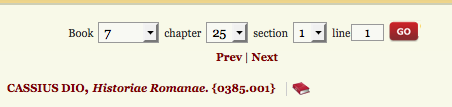
Dio is one of the authors where the browse option isn’t necessarily helpful: the editions of this text vary considerably (at least in the fragmentary books). So we’re going to assume we know what passage we want (7.25). If we browse to Dio, we can use the dropdown menus to reach the passage we want.
tlg greek texts read dio roman history
Read the rest.


Saturday, June 18, 2016

Open Access Journal: Working Papers Contested Order/ eAQUA Working Papers

Working Papers Contested Order/ eAQUA Working Papers
ISSN: 2363-975X
eAqua Working Papers @ Digitale Altertumswissenschaften
Die eAQUA Working Papers sind aus der Reihe der Working Papers Contested Order des Profilbildenden Bereichs Contested Order der Universität Leipzig hervorgegangen. Ausgehend von den Forschungen zu dem Thema „Riskante Ordnungen – Contested Order“ sind in der Reihe Beiträge von Politikwissenschaftlern, Historikern und Altertumswissenschaftlern publiziert worden. Das Forschungsprogramm des Profilbildenden Bereichs thematisierte insbesondere lokale Verhältnisse, deren partikulare Gleichgewichtszustände nicht wohlbedachte Ergebnisse scharfsinniger Pläne sind, sondern von Mal zu Mal „strittig“ ausgehandelt werden müssen. Die diesem ursprünglichen Profil der Reihe entsprechenden Bände Nr. 2, 4, 5, 6, 8, 11 stehen hier weiterhin zum freien Download zur Verfügung.

In den Bänden Nr. 1, 3, 7, 9, 10 dieser Reihe sind Ergebnisse aus dem Forschungsfeld der Digital Humanities veröffentlicht worden, die in dem Projekt eAQUA entstanden sind. eAQUA ist als Projekt das Ergebnis einer langjährigen Zusammenarbeit zwischen Altertumswissenschaftlern und Informatikern an der Universität Leipzig gewesen und hat zum Aufbau des Portals eAQUA geführt (www.eaqua.net). Durch das Förderprogramm «Wechselwirkungen zwischen Geistes- und Naturwissenschaften» des Bundesministeriums für Bildung und Forschung wurde der Aufbau des Portals im Zusammenhang der Entwicklung fachspezifischer Anwendungen auf der Grundlage der Sprachen Latein und Griechisch von 2008 bis 2011 gefördert (Koordination: G. Heyer, Informatik, Universität Leipzig und Ch. Schubert, Alte Geschichte, Universität Leipzig).

Von 2011 bis 2013 hat das Projekt eine weitere Förderung durch  das Bundesministeriums für Bildung und Forschung erhalten (Leitung: Ch. Schubert, Alte Geschichte, Universität Leipzig), die die Verstetigung des eAQUA-Portals und die Weiternutzung der in eAQUA entwickelten Verfahren unterstützt.

Im Rahmen dieser Forschungsprojekte sind zahlreiche Beiträge von Wissenschaftlern und Wissenschaftlerinnen aus Hamburg, Heidelberg und Leipzig entstanden, für die ein Publikationsort gefunden wurde.

Die eAQUA Working Papers haben im Rahmen der Reihe der Working Papers Contested Order des Profilbildenden Bereichs Contested Order der Universität Leipzig ein eigenes Profil entwickelt.

Diese Beiträge, die in Working Papers Contested Order publiziert wurden, sind nun hier versammelt und stehen ebenfalls als Einzelband oder Einzelbeitrag zum freien Download zur Verfügung.

Da die Publikationen aus dem Projekt eAQUA eine gute Resonanz und hohe Nachfrage erzeugt haben, soll dieser Publikationsort für wissenschaftliche Beiträge, die Methoden der Digital Humanities auf Fragestellungen aus der Alten Geschichte und der Klassischen Archäologie anwenden, für Nachwuchswissenschaftlern und Nachwuchswissenschaftlerinnen und insbesondere auch für hervorragende Ergebnisse aus studentischen Projekten weiterhin zur Verfügung stehen.


2010