skip to main |
skip to sidebar
[First posted in AWOL 7 June 2014, updated 1 January 2020]
Getting started on Classical Latin
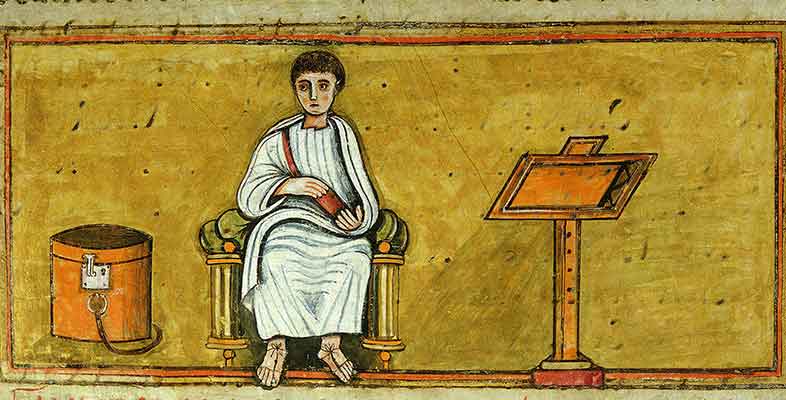
The aim of this free course is to enable you to get started on
learning Latin in a fairly leisurely but well-focused way. It has been
developed in response to requests from students who had had no contact
with Latin before and who felt they would like to spend a little time
preparing for the kind of learning that studying a classical language
involves. This course will give you a taster of what is involved in the
very early stages of learning Latin. Along the way, you will learn some
Latin words, master the pronunciation of Latin and explore the links
between Latin and English. Importantly, too, you will gain a basic
understanding of how Latin ‘works’ – its grammar and sentence structure –
and gain a useful impression of what learning Latin actually involves.
The material which follows is designed to be studied in small sections.
In all, it will probably take about 8–10 hours to work through. But even
if you have only a small amount of time available, you will find it
useful to work through the early sections and familiarise yourself with
some basic grammatical terms.
This OpenLearn course is an adapted extract from the Open University course A276 Classical Latin: the language of ancient Rome .
The International Greek New Testament Project (IGNTP)
The IGNTP
began in 1948, following on from the Critical Greek Testament project
of 1926. It consists of a committee of textual scholars from numerous
countries who oversee editorial work and contribute their own expertise
to the projects. The first output of this collaborative project was the IGNTP edition of The Gospel according to St Luke
in 1984 (vol. 1) and 1987 (vol. 2), an extensive critical apparatus of
the variant readings preserved in witnesses to the New Testament, not
just in Greek but in a variety of early translations and other secondary
sources.
Since then, work has proceeded on the Gospel according to John,
with editions published of the papyrus and majuscule witnesses.
Following an agreement made in March 2005 with the Institut für neutestamentliche Textforschung (INTF), the IGNTP has taken on responsibility for the Novum Testamentum Graecum, Editio Critica Maior edition of John. In 2016, the IGNTP formally began work on the edition of the Pauline Epistles, which is expected to take around two decades to produce.
Project Publications Online
An online edition of the majuscule manuscripts of John, featuring full transcriptions and a critical apparatus, is available at www.iohannes.com
Individual transcriptions from the IGNTP edition of John are
available for download as XML files from the University of Birmingham
Institutional Repository; for a full listing, see the Transcriptions page, or search the repository.
The IGNTP has also produced a complete electronic transcription
of Codex Bezae (Cambridge UL, Nn.2.41) sponsored by Cambridge University
Library. Further information is available here. The transcription can be viewed alongside the manuscript in the Cambridge Digital Library or downloaded from the University of Birmingham Institutional Repository: Greek text; Latin text




 Posts
Posts


 Stumble It!

