Gesellschaft und Familie bei Etruskern und Italikern.
Akten des 18. Treffens der Arbeitsgemeinschaft Etrusker & Italiker
(Wien, Institut für Alte Geschichte und Altertumskunde, Papyrologie und Epigraphik, 6.–7. März 2020)
herausgegeben von
Petra Amann, Raffaella Da Vela, Robinson Peter Krämer
Dieser Band enthält die Beiträge des 18. Treffens der
Arbeitsgemeinschaft ‚Etrusker & Italiker‘ des Deutschen
Archäologenverbands (DarV), das am 6. und 7. März 2020 am Institut für
Alte Geschichte und Altertumskunde, Papyrologie und Epigraphik der
Universität Wien stattgefunden hat. Die Arbeitsgemeinschaft versteht
sich als Gruppe von Wissenschaftler*innen der deutschsprachigen Länder,
die sich in regelmäßigen Workshops und Tagungen austauschen, miteinander
diskutieren und aktuelle Projekte vorstellen (https://www.darv.de/arbeitsgemeinschaften/etrusker-und-italiker/).
Unter den mittlerweile mehr als 100 Mitgliedern ist die gesamte
akademische Bandbreite von Studierenden bis zu Professor*innen mit den
unterschiedlichsten Erfahrungen, Perspektiven und Forschungen vertreten.
Anlässlich des zehnjährigen Jubiläums war es ein besonders
glücklicher Umstand, das Treffen der Arbeitsgemeinschaft am Gründungsort
Wien durchführen zu können. Erst im Nachhinein wurde schließlich
deutlich, dass diese Jubiläumstagung zu Beginn der Pandemie für zwei
Jahre das letzte Treffen der Arbeitsgemeinschaft in Präsenz sein würde.
Das Thema lautete ‚Gesellschaft und Familie bei Etruskern und
Italikern‘, der Fokus lag dabei auf den familiären Strukturen und ihrer
engen Verflechtung mit der sie umgebenden Gesellschaft im gesamten
italischen Raum des 1. Jahrtausends v. Chr., und zwar in den
unterschiedlichsten Kontexten (etwa im Grabbereich, im religiösen Feld
oder in Wohn- und Siedlungskontexten). Sozialstrukturen und -dynamiken
sind generell immer noch ein stark unterrepräsentiertes Themenfeld der
etruskisch-italischen Forschung. Es ist deshalb umso erfreulicher, dass
soziale Fragestellungen im ‚vorrömischen‘ Italien in letzter Zeit
deutlich mehr Aufmerksamkeit erlangen und verstärkt diskutiert werden.
Der vorliegende Band wird mit einem Beitrag von Petra Amann
eröffnet, der als ‚Einführung‘ die bisherige Geschichte zur Erforschung
der etruskischen Gesellschaft kritisch vorstellt, aber auch Desiderate
und neue Entwicklungen aufzeigt.
Die folgenden elf Aufsätze decken das gesamte erste vorchristliche
Jahrtausend ab und behandeln den Raum von der Po-Ebene bis nach Sizilien
(siehe Abb.). Sie sind hier in vier thematische Blöcke gegliedert.
Der erste Themenkomplex lautet ‚Nekropolen und Sozialstrukturen im eisenzeitlichen Italien (ca. 1000-500 v. Chr.)‘.
Hier werden die Lage von Gräbern, Grabbeigaben und Bestattungsriten für
den Versuch der Rekonstruktion von Familienstrukturen, (engeren und
weiteren) Verwandtschaftsverhältnissen und Gesellschaftsgruppen
verwendet. Claudio Negrini untersucht in seinem Beitrag das Phänomen der Doppel- und Mehrfachbestattungen in der Po-Ebene des 9.–7. Jhs. v. Chr. Olaf Dörrer
analysiert die Nekropolen des 8.–7. Jhs. v. Chr. in Pontecagnano im
Hinblick auf potentielle Verwandtschaftsgruppen. Schließlich diskutiert Giacomo Bardelli
anhand reicher Bestattungen im Numana des 7.–5. Jhs. v. Chr. mögliche
religiöse und sozio-politische Rollen elitärer Frauen in der picenischen
Gesellschaft.
Im zweiten Block geht es um ‚Soziale Beziehungen und Geschlechterverhältnisse in Etrurien‘, die anhand von Grabinschriften und bildlichen Darstellungen untersucht werden. Gertraud Breyer
vergleicht etruskische und lateinische Inschriften und Namenformulare,
um den Stellenwert der Frau in der etruskischen Gesellschaft zu
rekonstruieren. Im nächsten Beitrag stellt Marie-Laurence Haack
Paardarstellungen auf Deckeln von Urnen und Sarkophagen zusammen und
diskutiert deren Bedeutung für das etruskische Konzept der Ehe(paare).
Zuletzt analysiert Patrick Zeidler eine Vielzahl an
bildlichen Darstellungen, um Abhängigkeitsverhältnisse und soziale
Ungleichheiten sowie deren Repräsentation in Etrurien besser erfassen zu
können.
Die dritte Sektion widmet sich ‚Repräsentationsstrategien etruskischer Familien im Hellenismus‘, die mithilfe von Grabkontexten, Darstellungen auf Sarkophagen und funerären Inschriften rekonstruiert werden. Laura Nazim
interpretiert in ihrem Beitrag Motive auf Steinsarkophagen, die bisher
als Jenseitsreisen aufgefasst wurden, als eheliche und familiäre Szenen.
Im Folgenden analysiert Robinson Peter Krämer Grabinschriften aus Tarquinia und dem ager Tarquiniensis auf ihre soziale Aussagekraft hin und sieht diese als Ausdruck von gezielten kommemorativen Strategien. Paul Pasieka
diskutiert schließlich hellenistische Wiederbelegungen älterer
prominenter Familiengräber in Cortona, Chiusi und Vetulonia und sieht
darin Resilienzstrategien und Identitätskonstruktionen in Krisenzeiten.
Im letzten thematischen Abschnitt geht es um ‚Hausgemeinschaften, Siedlungsstrukturen und Landschaften‘.
Hierbei wurden anhand von landschaftlichen und makroregionalen Analysen
Familien- und Sozialstrukturen in Süditalien und auf Sizilien
untersucht. Raffaella Da Vela rekonstruiert anhand von
Daten aus Gräbern, Sakralorten und Haushaltskontexten die Rolle und den
Aufbau der Familie im eisenzeitlichen Hirpinien und deutet diese als
soziale Ressource. Schließlich analysiert Maria Carmen D’Onza
Ritualplätze des 9.–6. Jhs. v. Chr. im Rahmen indigener Siedlungen auf
Sizilien als Orte sozialer Prozesse und Kommunikationsstrategien.
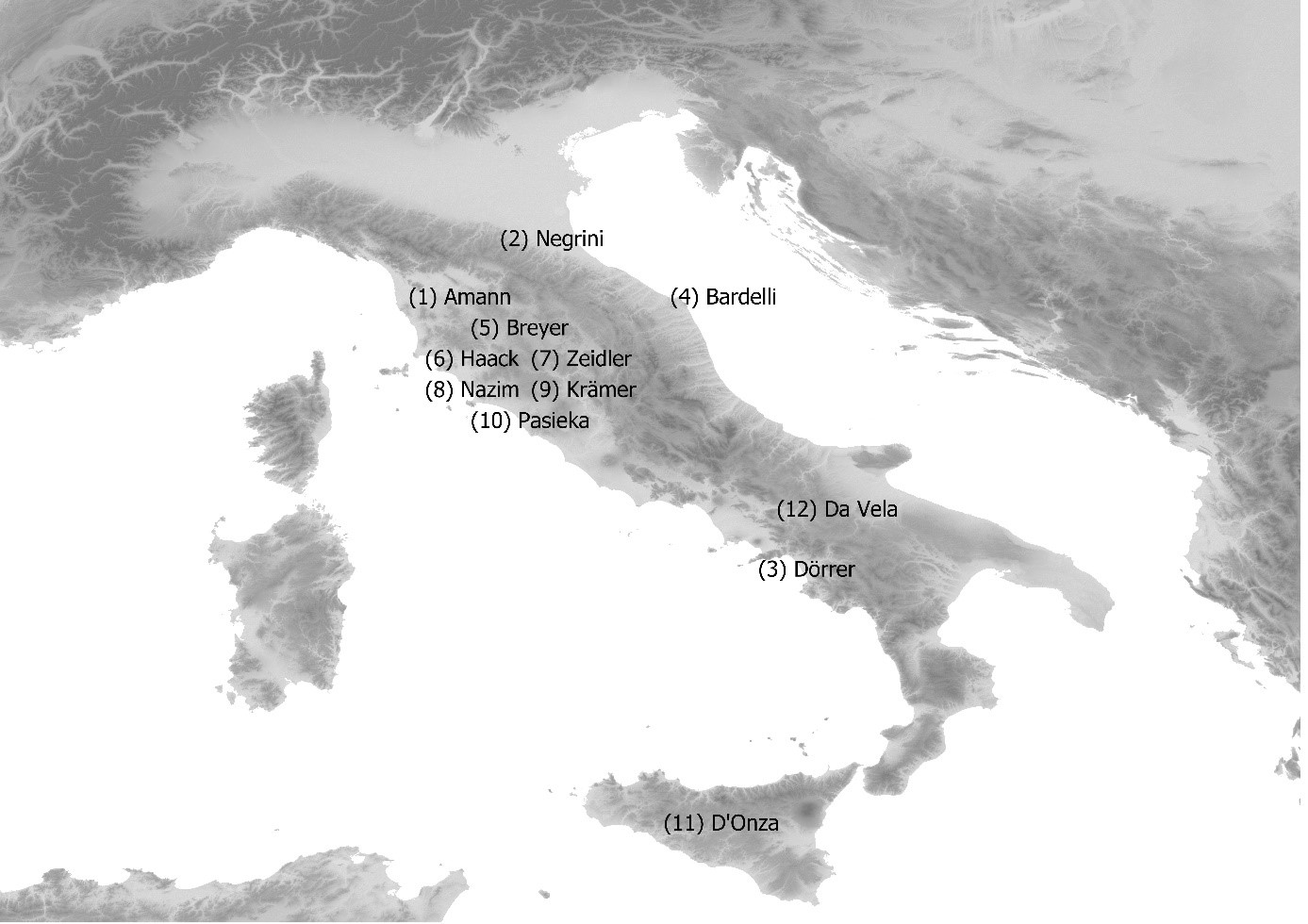 Geographische Verteilung der Beiträge in diesem Band (Raffaella Da Vela mit QGIS 3.24, <http://www.qgis.org>;
Geodaten: EPSG:4326; SRTM Data: A. Jarvis, H. I. Reuter, A. Nelson, E.
Guevara, 2008, Hole-filled seamless SRTM data V4, International Centre
for Tropical Agriculture (CIAT), available on <http://srtm.csi.cgiar.org>)
Geographische Verteilung der Beiträge in diesem Band (Raffaella Da Vela mit QGIS 3.24, <http://www.qgis.org>;
Geodaten: EPSG:4326; SRTM Data: A. Jarvis, H. I. Reuter, A. Nelson, E.
Guevara, 2008, Hole-filled seamless SRTM data V4, International Centre
for Tropical Agriculture (CIAT), available on <http://srtm.csi.cgiar.org>)
Für sehr hilfreiche und tatkräftige Unterstützung während des
Treffens in Wien danken wir Univ.-Prof. Luciana Aigner-Foresti sowie
David Hack. Ebenfalls zu Dank verpflichtet sind wir Franziska Beutler,
die als Verantwortliche für die Reihe ‚Wiener Beiträge zur Alten
Geschichte online‘ (WBAGon) unsere Ta





 Posts
Posts


 Stumble It!

