https://doi.org/10.30549/actaath-4-55
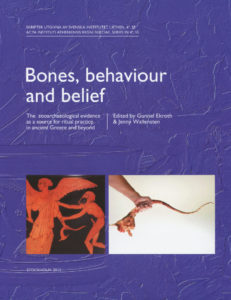
The importance of the zooarchaeological evidence as a source for
ritual practices in ancient Greece is gradually becoming widely
recognized. Animal bones form the only category of evidence for Greek
cult which is constantly significantly increasing, and they can
complement and elucidate the information provided by texts, inscriptions
and images. This volume brings together sixteen contributions exploring
ritual practices and animal bones from different chronological and
geographical perspectives, foremost ancient Greece in the historical
period, but also in the Bronze Age and as early as the Neolithic period,
as well as Anatolia, France and Scandinavia, providing new empirical
evidence from a number of major sanctuaries and cult-places. On a
methodological level, the complexity of identifying ritual activity from
the zooarchaeological evidence is a recurrent theme, as is the
prominence of local variation visible in the bone material, suggesting
that the written sources and iconography may offer simplified or
idealized versions of the rituals actually performed. Although
zooarchaeology needs to and should be integrated with other kinds of
sources, the independent study of the bones in an unbiased manner is of
utmost importance, as the bones can provide a different “reality” than
that encountered in our other sources.
Contents
‘Table of contents’, 5
https://doi.org/10.30549/actaath-4-55-01
Download PDF - Size: 33.36 KB - Downloads: 603 (since 2023)
‘Preface’, 7
https://doi.org/10.30549/actaath-4-55-02
Download PDF - Size: 64.09 KB - Downloads: 128 (since 2023)
Jenny Wallensten & Gunnel Ekroth, ‘Introduction: bones of contention?’, 9-13
https://doi.org/10.30549/actaath-4-55-03
Download PDF - Size: 182.36 KB - Downloads: 136 (since 2023)
Gunnel Ekroth, ‘What we would like the bones to tell us: a sacrificial wish list’, 15-30
https://doi.org/10.30549/actaath-4-55-04
Download PDF - Size: 779.50 KB - Downloads: 167 (since 2023)
Armelle Gardeisen, ‘L’assemblage osseux comme un dernier état de la
présence animale en contexte archéologique. Gestuelle et comportements
vis-à-vis de l’animal’, 31-49
https://doi.org/10.30549/actaath-4-55-05
Download PDF - Size: 1.10 MB - Downloads: 131 (since 2023)
Maria Vretemark, ‘Evidence of animal offerings in Iron Age Scandinavia’, 51-59
https://doi.org/10.30549/actaath-4-55-06
Download PDF - Size: 533.91 KB - Downloads: 130 (since 2023)
Katerina Trantalidou, ‘Dans l’ombre du rite : vestiges d’animaux et
pratiques sacrificielles en Grèce antique. Note sur la diversité des
contextes et les difficultés de recherche rencontrées’, 61-86
https://doi.org/10.30549/actaath-4-55-07
Download PDF - Size: 1.22 MB - Downloads: 140 (since 2023)
Valasia Isaakidou & Paul Halstead, ‘Bones and the body politic? A
diachronic analysis of structured deposition in the Neolithic–Early Iron
Age Aegean’, 87-99
https://doi.org/10.30549/actaath-4-55-08
Download PDF - Size: 202.26 KB - Downloads: 137 (since 2023)
Peter R.W. Popkin, ‘Hittite animal sacrifice. Integrating zooarchaeology and textual analysis’, 101-114
https://doi.org/10.30549/actaath-4-55-09
Download PDF - Size: 425.29 KB - Downloads: 126 (since 2023)
Ola Magnell, ‘The taphonomy of ritual bone depositions. An approach to
the study of animal bones and ritual practice with an example from
Viking Age Frösö, Sweden’, 115-127
https://doi.org/10.30549/actaath-4-55-10
Download PDF - Size: 609.09 KB - Downloads: 141 (since 2023)
Michael MacKinnon, ‘“Side” matters: animal offerings at ancient Nemea’, 129-147
https://doi.org/10.30549/actaath-4-55-11
Download PDF - Size: 712.00 KB - Downloads: 148 (since 2023)
Dimitra Mylona, ‘Dealing with the unexpected. Unusual animals in an
Early Roman cistern fill in the Sanctuary of Poseidon at Kalaureia,
Poros’, 149-166
https://doi.org/10.30549/actaath-4-55-12
Download PDF - Size: 364.17 KB - Downloads: 142 (since 2023)
Hélène Brun & Martine Leguilloux, ‘Rituels sacrificiels et offrandes animales dans le Sarapieion C de Délos’, 167-179
https://doi.org/10.30549/actaath-4-55-13
Download PDF - Size: 964.89 KB - Downloads: 139 (since 2023)
Deborah Ruscillo, ‘Thesmophoriazousai. Mytilenean women and their secret rites’, 181-195
https://doi.org/10.30549/actaath-4-55-14
Download PDF - Size: 602.01 KB - Downloads: 140 (since 2023)
Tatiana Theodoropoulou, ‘The sea in the temple? Shells, fish and corals
from the sanctuary of the ancient town of Kythnos and other marine
stories of cult’, 197-222
https://doi.org/10.30549/actaath-4-55-15
Download PDF - Size: 667.32 KB - Downloads: 142 (since 2023)
Sabine Sten, ‘Sacrificed animals in Swedish Late Iron Age monumental mound burials’, 223-231
https://doi.org/10.30549/actaath-4-55-16
Download PDF - Size: 392.98 KB - Downloads: 133 (since 2023)
Gerhard Forstenpointner, Alfred Galik & Gerald E. Weissengruber,
‘The zooarchaeology of cult. Perspectives and pitfalls of an
experimental approach’, 233-242
https://doi.org/10.30549/actaath-4-55-17
Download PDF - Size: 456.53 KB - Downloads: 144 (since 2023)
Scott Scullion, ‘Bones in Greek sanctuaries: answers and questions’, 243-255
https://doi.org/10.30549/actaath-4-55-18
Download PDF - Size: 207.06 KB - Downloads: 158 (since 2023)
Stella Georgoudi, Véronique Mehl & Francis Prost, ‘Archéozoologie et
pratiques rituelles: méthodes, matériaux et perspectives’, 257-260
https://doi.org/10.30549/actaath-4-55-19
Download PDF - Size: 127.40 KB - Downloads: 136 (since 2023)
‘Maps’, 261-264
https://doi.org/10.30549/actaath-4-55-20
Download PDF - Size: 1.41 MB - Downloads: 130 (since 2023)
‘Index’, 265-272
https://doi.org/10.30549/actaath-4-55-21
Download PDF - Size: 126.64 KB - Downloads: 130 (since 2023)
Bibliographical information
Gunnel Ekroth & Jenny Wallensten, eds., Bones, behaviour and belief. The zooarchaeological evidence as a source for ritual practice in ancient Greece and beyond (Skrifter
utgivna av Svenska Institutet i Athen, 4°, 55), Stockholm 2013. ISSN
0586-0539. ISBN 978-91-7916-062-3. Hardcover: 272 pages.
Reviews
American Journal of Archaeology 119:3, 2015 (Nerissa Russel)
L’Antiquité Classique 84, 2015, 487-489 (A. Palamidis)
Kernos (Online), 27, 2014 (Jan-Mathieu Carbon)
Chapter abstracts
What we would like the bones to tell us: a sacrificial wish list
By Gunnel Ekroth (Uppsala University), https://doi.org/10.30549/actaath-4-55-04
Animal bones comprise the only category of evidence for Greek cult
which is constantly significantly increasing. The use of ever more
sophisticated excavation methods demonstrates the importance of
zooarchaeological material for the study of Greek religion and how such
material can throw light on texts, inscriptions and images, as the
animal bones constitute remains of actual ritual actions and not mere
descriptions or representations of these actions. This paper outlines
some areas where the zooarchaeological evidence may be of particular
pertinence, for example, in elucidating the complex and idiosyncratic
religious terminology of shares of sacrificial victims mentioned in
sacred laws and sacrificial calendars, or in providing a context for a
better understanding of the representations of animal parts on Attic
vases. The role of meat within ancient Greek society, the choice of
sacrificial victims and the handling of “non-sacrificable” animals such
as game, dogs and equids within Greek cult can also be clarified by
comparisons with the animal remains.
Back to top
L’assemblage osseux comme un dernier
état de la présence animale en contexte archéologique. Gestuelle et
comportements vis-à-vis de l’animal
By Armelle Gardeisen (Université de Montpellier 3), https://doi.org/10.30549/actaath-4-55-05
Faunal assemblages from different archaeological contexts are
presented here as examples of different methods of zooarchaeological
interpretation. The aim of this contribution is to discuss the
interpretation of bone assemblages according to the context and what is
to be considered as relevant against the background of all
species/anatomical elements present in the faunal record, in relation to
religious practices or not. Emphasis will be given to specific bone
assemblages from protohistorical contexts in southern France and their
interpretation. The main purpose of the methodology of the
zooarchaeological analyses is to give comprehensive information about
human behaviour in ritual or non-ritual procedures.
Back to top
Evidence of animal offerings in Iron Age Scandinavia
By Maria Vretemark (Västergötlands museum), https://doi.org/10.30549/actaath-4-55-06
Written contemporary sources of animal sacrificial rituals in Iron
Age Scandinavia are almost non-existent. However, we have some rare
descriptions about the people of northern Europe from Roman historians.
Most famous of these is of course Tacitus who gives us valuable
information about life in Scandinavia during the first century AD. Among
other things we learn about fertility rituals carried out in
sacrificial bogs and we understand the close connection between the
goddess and water. Tacitus’ descriptions, as well as younger sources
such as the Old Norse religious texts of Scandinavia, also clearly tell
us about the magic role of different animals such as birds, wild boar,
wolf and horse. In the archaeological material we try to recognize
traces of religious acts that once took place. But how can we tell the
difference and distinguish between the remains of ritual animal
offerings on one hand and the normal kitchen waste on the other? This
paper deals with some examples of horse offerings in bogs and ponds and
with ritual deposits of animal bones in dry settlement contexts in
Sweden. Zooarchaeological analysis gives us valuable data and a key to
interpret the animal bone assemblages as evidence of animal offerings.
Back to top
Dans l’ombre du rite : vestiges
d’animaux et pratiques sacrificielles en Grèce antique. Note sur la
diversité des contextes et les difficultés de recherche rencontrées
By Katerina Trantalidou (Ephorate of Palaeoanthropology-Speleology of Southern Greece), https://doi.org/10.30549/actaath-4-55-07
In all ancient civilisations, as well as in numerous contemporary
societies, animals were implicated in many aspects of religion.
Sacrifice and alimentary rituals regulated social life and animals
underwent diverse treatments in accordance with particular cults.
Zooarchaeological material constitutes direct evidence for animals that
were slaughtered and often eaten in a sacred context. Also, the status
of a departed person in life could be indicated by the faunal and
vegetal funerary offerings that accompanied him or her to the grave.
Still, it is not possible to ascribe every zooarchaeological deposit
showing unusual characteristics a religious significance, nor does all
animal bone assemblages found in a sanctuary constitute the remains of a
sacrifice. The interpretation must rest on the interaction between the
archaeological context, the taphonomy and the iconographical and
literary sources relevant for the particular society. The present
article aims at exploring existing hypotheses concerning the
zooarchaeological evidence by posing questions and confronting the Greek
prehistoric and historical material, as ritual practices were neither
static nor linear. This discussion brings to bear on the most recent
discoveries, partly still unpublished.
Examination of the zooarchaeological evidence from 63 sites allows us to
conclude that focus on a particular criterion can result in
misinterpretations, as what was common practice in one community was not
necessarily so in another. The definition of the actual length of every
event is also paramount. Only a careful stratigraphic and
zooarchaeological methodology, combined with a multitude of questions
posed, will yield information precise enough to determine the species,
reconstruct the practices and reformulate our questions.
Back to top
Bones and the body politic? A diachronic analysis of structured deposition in the Neolithic–Early Iron Age Aegean
By Valasia Isaakidou (University of Sheffield) & Paul Halstead (University of Sheffield), https://doi.org/10.30549/actaath-4-55-08
The meanings of the terms “ritual” and “sacrifice” are discussed as a
basis for considering whether and how animal bones might be recognized
as remnants of ritual behaviour or sacrifice. These methodological
issues are explored “in practice”, taking structured deposits of burnt
bones from the Mycenaean “Palace of Nestor” at Pylos as a case study.
The paper then places this and other apparent examples of Mycenaean
animal sacrifice in a wider context, by examining zooarchaeological
evidence for anatomically selective manipulation and for deliberate or
“structured” deposition of animal bones from the Neolithic to Early Iron
Age in the Aegean. It is argued that anatomically selective treatment
and structured deposition of bones increase through time and that these
tendencies are matched by changes in the treatment of human remains, in
the form and deposition of ceramics associated with commensality, and in
architectural organization of space. These trends reflect not only
increasing elaboration of material culture but also increasing
qualitative, spatial and temporal differentiation of social life.
Although the precise form and meaning of Mycenaean sacrificial ritual
may be difficult to discern, its material traces mirror and probably
helped to promote radical social change during the Aegean Bronze Age.
Back to top
Hittite animal sacrifice. Integrating zooarchaeology and textual analysis
By Peter R.W. Popkin (Archaeological Services Inc.), https://doi.org/10.30549/actaath-4-55-09
In 2008, the disarticulated remains of a young male sheep skeleton
deposited within a small Late Bronze Age pit were recovered at Kilise
Tepe in south-central Turkey approximately 40 km inland from the
Mediterranean coast. The pit, which exclusively contained the sheep
skeleton, was located within a building whose size, design and
artefactual contents indicate it was associated with ritual activity.
The lack of disturbance to the pit and excellent state of preservation
of the bones suggest elements that are missing were not originally
deposited. The carcass was thoroughly dismembered, disarticulated and
filleted prior to deposition. Contextual analysis of these skeletal
remains provides a significant opportunity to move beyond the limits of
textual analysis when studying Hittite animal sacrifice. By
demonstrating the benefits of zooarchaeological analysis conducted in a
context-specific fashion this paper offers the beginnings of a
methodology for Anatolian specialists interested in examining ritual
behaviour. More than a simple case study, this article combines two
separate strands of archaeological evidence to investigate the complex
issue of Hittite animal sacrifice.
Back to top
The taphonomy of ritual bone
depositions. An approach to the study of animal bones and ritual
practice with an example from Viking Age Frösö, Sweden
By Ola Magnell (Swedish National Heritage Board), https://doi.org/10.30549/actaath-4-55-10
In this paper an approach to studying ritual bone depositions by
reconstructing the taphonomic history of the zooarchaeological remains
is presented. By methodically examining the taphonomic evidence from the
chain of events, from the selection of animals to the killing, from the
processing and utilization of the carcass to the deposition of the
bones, different stages of a ritual, such as animal sacrifice, can be
studied and understood. A bone assemblage from a Viking Age cult place
at Frösö church in Jämtland in central Sweden (late 10th–early 11th
century AD) will serve as an example of the approach. The analysis shows
that brown bear and piglets were specifically selected to be used in
the rituals, while horses were not important sacrificial animals in the
cult, as has otherwise been indicated by written sources. Seasonal
analysis indicates that sacrifices took place at three periods of the
year. Butchering marks reveal the intense utilization of the carcasses
and that meat was consumed. Body part frequency shows that bears were
treated differently from other species, which could be the result of an
influence of Saami ritual practice. The bones were deposited on the
ground beneath a birch tree and carcasses were not hung in the tree as
some written sources indicate.
Back to top
“Side” matters: animal offerings at ancient Nemea
Michael MacKinnon (University of Winnipeg), https://doi.org/10.30549/actaath-4-55-11
As the locus of the Nemean games, Ancient Nemea was an important
Greek cult and festival center, especially during the Archaic period
(6th–5th century BC). Examination of excavated faunal materials deriving
from “sacred” and “secular” contexts at the site yields clues about the
distribution of meat to gods (such as Zeus, the patron deity of the
area), to heroes (in this case Opheltes, on whose legendary death the
Nemean Games were founded), and to the mortal officials, spectators, and
athletes participating in the events at Nemea. As regards “sacrificial”
assemblages, most of which consisted of bone remains of burnt offerings
as collected from altars and other ritual-type contexts, the data
indicate a preference for sheep as the standard sacrificial animal, but
show a definite preference for the hind limb sections of the left side
in the case of sacrifice to the hero Opheltes, as opposed to the god
Zeus. “Secular” deposits show different trends, such as the presence of
unburnt bones, or the remains of wild animals and fish, taxa not
typically sacrificed in Greek antiquity. Examination of
zooarchaeological remains from various contexts at the site, at one
level, and across other sites, at a larger level, helps develop a larger
more integrated picture of animal use in ancient Greek cult practices.
Back to top
Dealing with the unexpected. Unusual animals in an Early Roman cistern fill in the Sanctuary of Poseidon at Kalaureia, Poros
By Dimitra Mylona (The Kalaureia Research Program), https://doi.org/10.30549/actaath-4-55-12
The excavation of the Early Roman fill of an Archaic cistern in the
Sanctuary of Poseidon at Kalaureia on Poros produced the remains of a
range of animals that are not usually found together in closed contexts.
Consideration of taphonomic parameters and of the specific features of
the assemblage indicates that it represents the remains of ritual
activities. This paper aims to explore the possibilities of using the
material remains (in this case the bones and shells) to detect ritual
activities of a type not referred to in the written sources. Such an
exploration brings forward issues of definition and interpretation of
what can be seen as sacred or profane in the context of a cult place
such as a sanctuary.
Back to top
Rituels sacrificiels et offrandes animales dans le Sarapieion C de Délos
By Hélène Brun (Université Paris-Sorbonne [Paris IV]) & Martine Leguilloux (Centre archéologique du Var – Établissement de Toulon), https://doi.org/10.30549/actaath-4-55-13
In 2001, 2002 and 2004 two hearth altars (escharones) were excavated
in the Sarapieion C on the island of Delos in Greece. They contained
remains of sacrifices, notably rich zooarchaeological evidence, which
has thrown light on the rituals practised in this sanctuary. The
inscriptions are silent on this matter and the study of the bone
assemblage thus constitutes important evidence. The rituals involved
sacrifices of poultry (Gallus domesticus), making up 90% and 70% of the
bone material collected in each hearth altar deposit, respectively.
These poultry sacrifices were combined with those of small ruminants and
pigs. The handling of the victims differed according to the species:
the cocks and hens were consecrated whole while only parts of the sheep
and the pigs were offered.
The two altars excavated in the Sarapieion C do not belong to the
same period and a study of the bone evidence brings out distinctions
between them. The oldest altar was no doubt abandoned when the younger
one was brought into use, probably at the end of the 2nd century BC. It
is interesting to note such differences that perhaps are to be explained
by the development of the ritual practices in the sanctuary during the
2nd century BC.
The zooarchaeological material also gives information on the
performance of the sacrifices, which differed in accordance with the
animal species involved. All the bones from gallinaceous birds show
traces of carbonization and these burnt bones indicate sacrifices of
entire animals, of the holocaustic kind. The bone evidence from the
small ruminants and pigs are partially burnt and some bones are even
unburnt, which indicates only a selective burning of the bodies.
One can of course compare the sacrificial practices identified in the
Sarapieion C on Delos with those studied at other sanctuaries dedicated
to the same divinities and thus demonstrate the presence of a possible
“koine” in Isis worship. However, similar sacrifices were also performed
in cults of healing deities (foremost in sanctuaries of Asklepios).
Historical interpretation should thus proceed with caution.
Back to top
Thesmophoriazousai. Mytilenean women and their secret rites
By Deborah Ruscillo (Washington University in St. Louis), https://doi.org/10.30549/actaath-4-55-14
During the 1984–1994 excavations on the acropolis in Mytilene, a
sanctuary devoted to Demeter from the Late Archaic to the Early
Hellenistic period was discovered. A series of five or more altars to
the east of the site was excavated, producing approximately 5,000 animal
bones. The bones of young sheep, goat and pigs predominated, in
contrast with other contemporary Demeter sanctuaries in the Greek world
which have yielded a characteristic predominance of pig bones. The
sanctuary in Mytilene also produced figurines of Kybele, Isis, Aphrodite
and Eros, reflecting the polytheistic nature of this place of worship.
These different associations may provide the reason for the high
percentage of bovid bones from this sanctuary. A circular ash pit at the
western end of the row of altars was found filled with calcined bones
of perinatal piglets. The exclusive sacrifice of piglets, particularly
in this sanctuary context, is reminiscent of Thesmophoric ritual.
Ancient testimonia of the rites of the Thesmophoria are examined in this
paper, and compared to the faunal evidence in order to reconstruct the
ancient ritual that took place on the acropolis in Mytilene. Special
attention is paid to the timing of the placement of the piglets in the
megara prior to their offering on the altar.
Back to top
The sea in the temple? Shells, fish
and corals from the sanctuary of the ancient town of Kythnos and other
marine stories of cult
By Tatiana Theodoropoulou (American School of Classical Studies at Athens), https://doi.org/10.30549/actaath-4-55-15
A broad variety of animal remains have been recorded from several
cult contexts across Greece. They usually involve sacrificial victims
and a variety of animals, and often corroborate ancient sources on the
use of animals in ancient Greek cult. Although zooarchaeological or
textual evidence regarding the presence of marine faunas in this type of
contexts is not missing, their specific role within the sacrificial
sphere is usually not extensively discussed. This paper aims to bring
together available shell and other marine evidence from sanctuary
deposits from ancient Greece with the aim of exploring the role of the
sea within Greek cult. In order to bring forward research questions
related to this group of remains from cult places, a case study from the
adyton of the Archaic–Hellenistic temple of the Middle Plateau in the
ancient town of Kythnos in the Cyclades will serve as the backbone of
this approach. Careful study of shell and other marine remains in their
specific context aims to detect possible ritual actions related to the
marine world within an island sanctuary, and to find possible links
between the latter and the identity of the worshippers and worshipped
deity. What is underlined by this study is the everyday, individual and
personal aspect of the cult beyond the official function of sanctuaries
in the Greek world. The importance of careful recovery and study of all
types of remains from excavations related to cult places is highlighted.
Back to top
Sacrificed animals in Swedish Late Iron Age monumental mound burials
By Sabine Sten (Uppsala University), https://doi.org/10.30549/actaath-4-55-16
Osteological analyses of prehistoric burials from Sweden often
consider skeletal remains not only from the buried person, but also from
animals. During the Swedish Iron Age Period (500 BC to AD 1050)
cremation was common and towards the end of the period (AD 400 to 1050)
many different animal species represented by a high number of
individuals are often found in a single cremation grave. The skeletal
remains represent animals that have been sacrificed and buried together
with the dead person. Sometimes only parts of the animal bodies are
found in the grave while in other instances the whole animal is present.
The animal bone finds can be divided into two groups: animals that have
been consumed, such as cattle, pig and sheep, and animals that were
used in daily life such as dogs, horses, cats and birds of prey. Dogs
are the most common animal in the cremation graves, while finds of birds
of prey in particular indicate the high status of the buried person and
suggest that falconry was practised.
Back to top
The zooarchaeology of cult. Perspectives and pitfalls of an experimental approach
By Gerhard Forstenpointner (University of Veterinary Medicine, Vienna), Alfred Galik (University of Veterinary Medicine, Vienna) & Gerald E. Weissengruber (University of Veterinary Medicine, Vienna), https://doi.org/10.30549/actaath-4-55-17
A broad variety of ritual behaviours involve the killing and/or
consumption of domestic as well as game animals, and are functionally
assigned to most important social procedures and ceremonies such as
religious worship, activities of public administration or funerary rites
and very often also to subsistence-oriented sacrifice. Material remains
indicative of these ceremonies reveal specific aspects of the ritual
procedure, but their significance is always dependent on the degree of
scrutiny that has been spent during archaeological excavation and more
so in the analysis of the finds. Focusing on ritual patterns in
Mediterranean antiquity, the remains of burnt offerings and
agglomerations of caprine horn cores are attested frequently by the
zooarchaeological record. Even when literary descriptions of all of
these sacrificial activities are available, obvious uncertainties about
the actual procedure of burning meria and osphys and of the consecration
of goat horns made experimental efforts necessary. Experimental
approaches characterize a well established methodological tradition in
archaeological and historical research, not only enhancing our
understanding of poorly handed down evidence of ancient life, but also
allowing the feasibility of reconstructive suggestions to be judged. On
the other hand, obtaining evidence by means of experimental studies
always has to take into account potential and maybe biasing phenomena of
convergence. Talking in terms of evolutionary biology, the
phenotypically similar appearance of archaeological findings and
experimental results has to be understood as the outcome of two
distinctly evolved and necessarily different processes.
Back to top
Bones in Greek sanctuaries: answers and questions
By Scott Scullion (University of Oxford), https://doi.org/10.30549/actaath-4-55-18
The paper begins by surveying some old problems in the study of Greek
ritual to which the zooarchaeological evidence has brought answers, or
at any rate illuminating new perspectives (sacrifice to Herakles on
Thasos, and Herakles’ identity there; sacrifice at Kalapodi/Hyampolis).
The focus then shifts to the attestation by the bones of the eating of
“nonsacrificable” species of animal in sanctuaries, suggesting that we
ought at least to reckon with the possibility that such consumption was
common, that sacrificable animals too were not uncommonly eaten without
being sacrificed, and that in general the Greeks may have been less
scrupulous about sacrificial feasting, and about meat-eating in general,
than modern scholars have tended to suppose. It may be that in this
sphere, as (I have argued elsewhere) in others, the sacrality of the
central ritual “tapered off ” quite sharply, and that the banqueting,
like festival events such as parades, markets, athletics, and dramatic
and musical performances, was in practice felt to be essentially
“secular”.
Back to top







 Posts
Posts


 Stumble It!

