Saturday, February 26, 2022

Les Royaumes d’Afrique du Nord: Émergence, consolidation et insertion dans les aires d’influences méditerranéennes (201-33 av. J.-C.)

Les Royaumes d’Afrique du Nord

Bibliothèque des Écoles françaises d’Athènes et de Rome

Comment ont émergé les royaumes numide et maure, dont l’existence nous est révélée dans le contexte des guerres puniques ? Quelles sont les dynasties en place et comment maintiennent-elles le pouvoir sur le nord du Maroc, de l’Algérie et le nord-ouest tunisien actuels ? Des territoires souvent dirigés par des rois belliqueux ou ambitieux, dont les limites évoluent au gré des alliances ou des rivalités entre peuples voisins, et composés de communautés urbaines et rurales qu’il fallait tolérer, voire contrôler. Comment ces royaumes évoluent-ils au contact des autres régions méditerranéennes ? Quel est l’impact de l’implication de leurs rois dans les guerres puniques et les guerres civiles républicaines ? Comment l’insertion de ces royaumes dans l’orbite de Rome conduit à la disparition du royaume numide (41 av. J.-C.) et l’intégration de la Maurétanie dans l’ager publicus (33 av. J.-C.) ?
Voici quelques-unes des questions auxquelles cet ouvrage tente de répondre face à une documentation qui demeure fragmentaire et parfois déroutante mais qui offre une diversité de sources textuelles et archéologiques, dont la synthèse permet de proposer un regard novateur sur l’histoire de ces régions entre la 2e guerre punique et la mort du roi Bocchus II (201-33 av. J.-C.).

  • Publisher : Publications de l’École française de Rome
  • Series : Bibliothèque des Écoles françaises d’Athènes et de Rome | 387
  • Place of publication : Rome
  • Year of publication : 2020
  • Published on OpenEdition Books : 25 février 2022
  • EAN (Print version) : 9782728314218
  • Electronic EAN : 9782728315246
  • Number of pages : 296 p.


Open Access Journal: Geniza Fragments

 [First posted in AWOL 15 December 2017, updated 26 February 2022]

Geniza Fragments

The Newsletter of Cambridge University's Taylor-Schechter Genizah Research Unit at Cambridge University Library

These pages contain back issues of Genizah Fragments, our twice-yearly newsletter.

Due to  difficulties accessing printing and mailing resources during the pandemic, we have decided to retire the ‘Genizah Fragments’ newsletter with a final edition this autumn (2021). However, you will still be able to keep up with Genizah news through our blog page which went live this summer. 

The Database of Religious History

[First posted in AWOL 7 January 2018, updated 26 February 2022]

The DRH began as one of the flagship initiatives of the Cultural Evolution of Religion Research Consortium (CERC), based at the University of British Columbia in Vancouver. It now continues as an independent academic initiative, based at UBC but involving partners and collaborators from all over the world.

It is intended as a platform for unprecedented academic collaboration, reflecting a commitment to rigorous, scholarly standards and a deep appreciation for interdisciplinary work in the sciences and humanities.

Accessible, centralized clearing house for historical data

The DRH is designed to serve as a centralized clearinghouse for scholarly knowledge of the historical record, bringing together a core of quantified, standardized data with qualitative comments, references to crucial resources, and links to on-line text and image databases.

The pace of scholarly production concerning the religious historical record has increased rapidly over the past decades, making it difficult for scholars maintain a comprehensive overview of new monographs, journals and on-line resources. The DRH aims to respond to the problem of information overload by creating a core of standardized, searchable, visualizable knowledge surrounded by rich qualitative comments, references and links to otherwise scattered and hard to find on-line repositories of texts and images.

Friday, February 25, 2022

Eschilo, I Persiani (1-268)


Premessa

Il progetto Euporia proposto alla classe VA del liceo classico Tommaso Gargallo di Siracusa nell’ambito del Percorso per le Competenze Trasversali e l’Orientamento (precedentemente Alternanza scuola lavoro) ha avuto inizio nell’anno scolastico 2017/18. L’attività prevede un lavoro strettamente filologico di analisi, di annotazione e di traduzione di un testo greco, condotto con l’ausilio delle tecnologie informatiche più avanzate messe a disposizione dall’Istituto di linguistica computazionale del CNR.

Il progetto ha come partner l’Istituto di Linguistica Computazionale “Antonio Zampolli” del Consiglio Nazionale delle Ricerche e si giova anche della collaborazione con il VeDPH dell’Università Ca’ Foscari di Venezia e con il corso di laurea in Informatica Umanistica dell’Università di Pisa. Il tutor esterno è il dottor Federico Boschetti, che ha messo a disposizione degli studenti Euporia, una piattaforma web per l’annotazione tramite Domain Specific Languages di testi multilingui disposti in parallelo. Gli incontri con il dott. Boschetti si sono tenuti a distanza tramite Hangouts-Meet. La classe ha svolto anche la funzione di tester fornendo dei feedback volti a migliorare l’interagibilità con il programma. Nell’anno scolastico 2018/2019 ha partecipato al progetto anche la classe III C del Liceo Gargallo guidata dalla prof.ssa di Greco Rossella Romeo, svolgendo il lavoro di analisi e di traduzione di una parte del primo episodio dei Persiani, i versi 248-268. Dal 2018/19 due classi del liceo classico Galilei di Pisa hanno cominciato a utilizzare la medesima piattaforma informatica già sperimentata dagli alunni del Liceo Gargallo.

Il lavoro della V A ha subito una battuta d’arresto a causa della sospensione delle lezioni in presenza per l’emergenza coronavirus, pertanto si presenta in una veste non definitiva e necessita di un’ulteriore revisione.

L’oggetto del lavoro

Gli studenti hanno lavorato sui Persiani di Eschilo.
Il testo è stato suddiviso in porzioni prendendo come punto di riferimento la divisione interna di una tragedia: Prologo, parodo, episodi, stasimi ed epilogo. Nel corso delle 97 ore dedicate al progetto gli studenti hanno completato 210 versi, la parodos della tragedia e una parte del primo episodio. Il lavoro è stato condotto sull’edizione critica di Hermann risalente al 1852 e dunque non coperta da copyright, disponibile on line sul sito di libera consultazione archive.org. L’analisi del testo è stata rivolta alle figure retoriche e ai composti. Il lavoro ha previsto anche il confronto con la traduzione di Giuseppe Fraccaroli del 1872.


HomePage
 | Figure Retoriche | Composti | Entità nominate | Descrizione del progetto | Relazione degli studenti | Locandine

BENI NUMISMATICI - MUSEO DI ARCHEOLOGIA COLLECTION HOME PAGE

Logo
La collezione numismatica del Museo di Archeologia dell’Università di Pavia. Nel 1818 Pietro Vittorio Aldini partecipa al concorso per la prima cattedra di Archeologia presso l'Università di Pavia, la più antica in Italia, vinto l'incarico l’anno seguente prende servizio e nel 1820 fonda l’attuale Museo di Archeologia con il nome originario di Gabinetto di Numismatica e Antiquaria, Diplomatica ed Araldica. Il patrimonio numismatico del Museo conta circa ottomila pezzi e comprende nuclei di monete puniche, greche, magno-greche, tolemaiche, romane repubblicane e imperiali, celtiche, tardoantiche, bizantine ed include anche monete medievali e moderne, andando a coprire un ampio arco cronologico. Sono esemplificate monete di tutto il bacino del Mediterraneo. La collezione fu concepita fin dalle origini dal fondatore del Museo, il prof. Aldini, con intento didattico-scientifico per fornire agli studenti la possibilità di osservare direttamente le monete e altri reperti antichi, integrando così l’apprendimento teorico dell’Archeologia con la visione di una collezione molto variegata e di un monetiere molto ricco, comprendente emissioni diverse per epoche, zone geografiche, materiali, zecche e autorità emittenti. La catalogazione SIRBeC, supportata da Regione Lombardia, delle monete romane repubblicane e delle monete celtiche del medagliere è stata effettuata agli inizi degli anni Duemila da Alessia C. Bolis, sotto la supervisione del prof. Maurizio Harari Direttore del Museo, ed è stata pubblicata nel volume della collana Fonti e studi dell’Università di Pavia: Alessia C. Bolis - Ermanno A. Arslan, La collezione numismatica dell’Università di Pavia, Cisalpino-Monduzzi, Milano, 2003. Da queste schede di catalogo sono stati estratti i dati per le schede pubblicate nella Digital Library dell’Università di Pavia, mentre le fotografie sono state scattate ex-novo a colori dalla curatrice del Museo Anna Letizia Magrassi Matricardi nel 2020.
Browse


Thursday, February 24, 2022

Pompeii in Color: The Life of Roman Painting

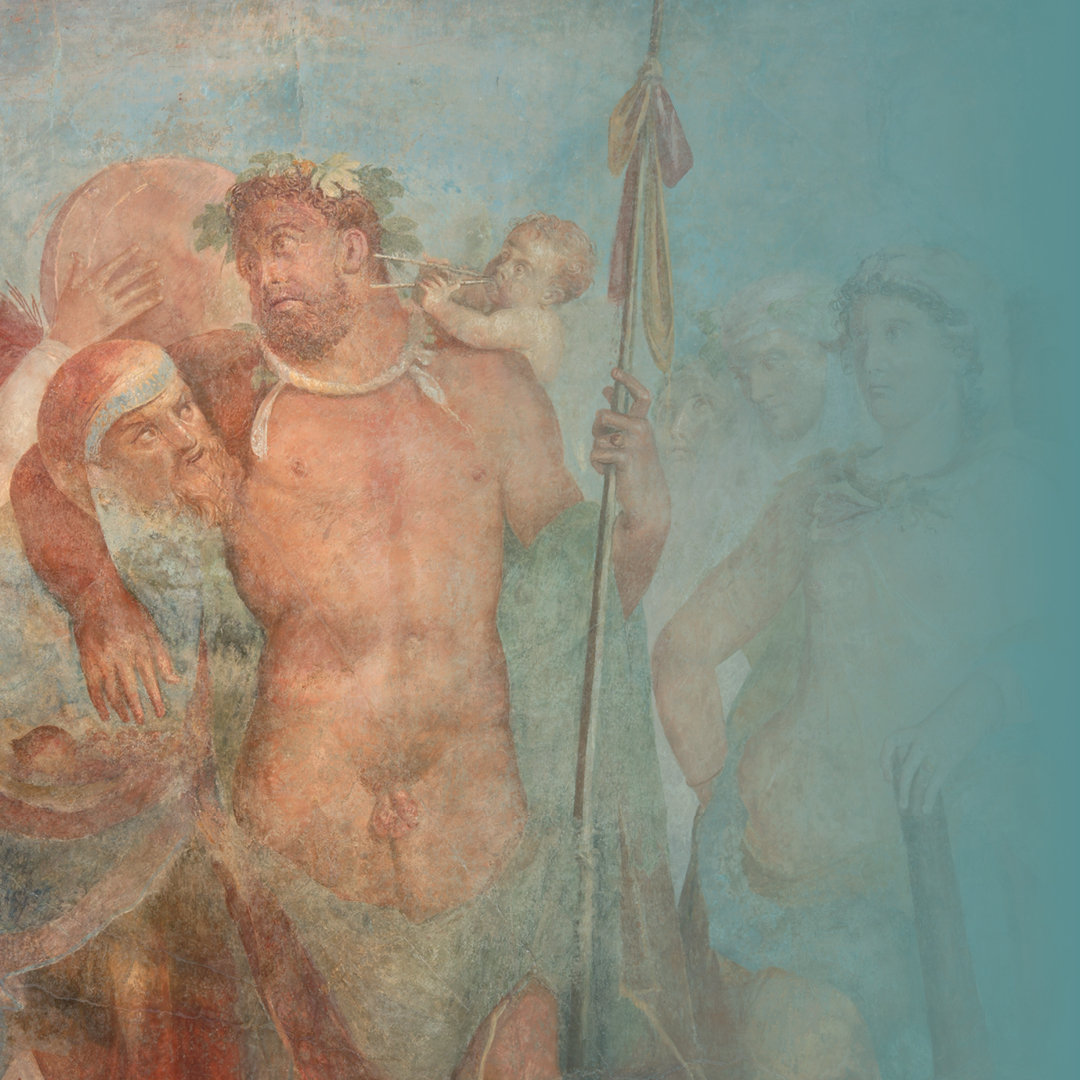
The central figure of a nude man wears an ivy-leaf crown and holds a spear in his left hand. His wine cup has fallen to the ground, and he is supported under his right arm by an elderly bearded man. At the right a partially nude woman with a robe draped across her groin and legs leans against the man’s club with her left hand. She wears a lion-skin headdress. Several standing figures look on in the background. Three small childlike figures of erotes are also at play. One blows pipes into the younger man’s left ear; one peeps out from under the robes of the elderly man; and a third attempts to set the wine cup aright.

Pompeii in Color: The Life of Roman Painting presents frescoes from the National Archaeological Museum of Naples. All originally from Roman homes, the subjects of these works range from mythological scenes to landscapes, portraits, still lifes, and more, each rich with meaning for homeowners and their guests.

This digital complement to the exhibition at NYU’s Institute for the Study of the Ancient World presents an opportunity to learn about ancient painting, the tastes and values of the Romans who lived with these works, and the techniques used by the artists who created them.

These remarkably well-preserved frescoes invite us to see beyond the ashes of the tragic city, and instead experience the vibrant world of the ancient Roman home as the Pompeians themselves knew it.
 
Presented by the Institute for the Study of the Ancient World and organized with the National Archaeological Museum of Naples and MondoMostre.


Meters of Ancient Drama

About the database
The Meters of Ancient Drama database is an ongoing project from Professor Timothy Moore of the Washington University in St. Louis Classics department. The database was created with the technical assitance of Washington University's Humanities Digital Workshop summer fellows Di Wang and Jennifer McLish, as well as the HDW's Douglas W. Knox and Stephen Pentecost.
 
How to use the database
Navigation Grid
The large gray boxes in the navigation grid represent parts of the play. The smaller colored boxes represent sections of lines with the same meter. In the case of sections of lyric meters, the section is labeled according to the general category of the meters (see A.M Dale, 1948). Clicking a part-of-play box will expand the section and make the line numbers of the meter sections visible.