Saturday, March 2, 2024

Topographie et urbanisme de la Rome antique

Topographie et urbanisme de la Rome antique

Symposia

Le colloque « Topographie et urbanisme de la Rome antique » a été organisé fin 2019 en vue de compléter le modèle virtuel de la Rome du IVe siècle ap. J.-C. développé à l’université de Caen Normandie (https://rome.unicaen.fr/). L’intérêt porté à la réalité virtuelle par la communauté scientifique est maintenant acquis, à la fois pour représenter mais aussi pour expérimenter. Le modèle virtuel de Rome se place dans la lignée directe des travaux entrepris par Paul Bigot à la Villa Médicis au début du XXe siècle. Les vingt-six communications réunies, signées des plus grands spécialistes du domaine, proposent de nouvelles fonctionnalités sur ce modèle interactif (vieillir la ville, le sonoriser, nommer les lieux…) et de nouvelles hypothèses pour l’enrichir sur différents secteurs (Champ de Mars, esplanade capitoline, Palatin, forum républicain et forums impériaux, confins de la ville).

  • Éditeur : Presses universitaires de Caen
  • Collection : Symposia
  • Lieu d’édition : Caen
  • Année d’édition : 2022
  • Publication sur OpenEdition Books : 29 février 2024
  • Nombre de pages : 490 p.
Philippe Fleury
Introduction

Monuments et secteurs


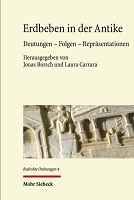
Erdbeben in der Antike: Deutungen - Folgen - Repräsentationen

Contributor(s): Borsch, Jonas (editor); Carrara, Laura (editor)
 Thumbnail

Der mediterrane Raum gehört weltweit zu den Gebieten mit der höchsten seismischen Aktivität. Insbesondere Griechenland und die heutige Türkei, aber auch große Teile Italiens oder der Levante wurden und werden in regelmäßigen Abständen von Erdbeben heimgesucht, die nicht selten katastrophale Folgen haben. Diese Ereignisse wurden bereits in der antiken Literatur in vielfältiger Art und Weise reflektiert und gedeutet. Innerhalb der altertumswissenschaftlichen Forschung ist das Thema Erdbeben in den letzten Jahrzehnten zwar verschiedentlich aufgegriffen worden, doch konzentrierte man sich dabei auf einige wenige Aspekte: Im Vordergrund standen die Katalogisierung von Einzelfällen, die Aufbereitung antiker Erklärungsansätze sowie die Untersuchung des materiellen Bewältigungshandelns. Zu vertiefenden Analysen, die das Phänomen über die Jahrhunderte hinweg, in seiner breiten räumlichen Ausdehnung und unter Berücksichtigung der verschiedenen Zeugnisformen betrachten, ist es bisher nicht gekommen. An dieser Stelle setzt der vorliegende Sammelband an. Er fragt nach den Beziehungen zwischen dem Eintreten von extremen seismischen Ereignissen und zeitgenössischen Weltanschauungen, nach Möglichkeiten und Grenzen der Rekonstruierbarkeit vergangener Bebenkatastrophen sowie nach den Modi ihrer literarischen Repräsentation. Zu diesem Zweck versammelt der Band Expertisen aus unterschiedlichen altertumswissenschaftlichen Disziplinen (Geschichts- und Literaturwissenschaft, Archäologie, Epigraphik) und darüber hinaus (historische Seismologie, Sinologie).
Keywords
Religion; History; Ancient
ISBN
9783161541698, 9783161541704
Publisher
Mohr Siebeck
Publisher website
https://www.mohrsiebeck.com/
Publication date and place
2016
Imprint
Mohr Siebeck GmbH & Co. KG
Classification
Religion & beliefs
Ancient history: to c 500 CE
History of religion


Tower of Babylon Stele in 3D photogrammetry

Black stone stele in two fragments with the only known original side illustration of the Tower in Babylon and the only picture of the king Nebuchadnezzar II so far found in Mesopotamia. The tower or ziggurat was 90 x 90 m with a height also of 90 m. The stele was discovered in Babylon in the early 1990s, for 28 years it was housed in the Schøyen Collection Oslo, and since December 2023 it is back in Iraq and the Iraq Museum Baghdad. The photogrammetry was produced by Olof Pedersén in October 2023 as documentation before the stele was given to Iraq.


Friday, March 1, 2024

Mines Database

Database coordinator: Andrew Wilson

This database provides information on the mines of the Roman empire, principally those producing the main metals used in the production of coinage: gold, silver and copper. Since many silver mines also produced lead from the same ores, many lead mines are listed, and some iron mines have also been included, although the coverage of lead and iron mines cannot yet be regarded as systematic. We do hope to have included the known gold, silver and copper mines, although we would always be grateful to receive notification of new discoveries, or of omissions or errors in our database.

The database was compiled by Andrew Wilson and by Dr Hannah Friedman during her employment as an OXREP Research Assistant.

For each mine, information is recorded on: Name, Mining Area, Country, [Roman] Province, Longitude, Latitude, Date range, Metals produced (Gold, Silver, Copper, Lead, Iron), and the number of mines at the site.

It should be noted that dating of Roman mining is difficult, and little or no information is available for many sites. For mines in Dacia, broad date ranges have been assigned based on the Roman occupation of the province.


Investigating Linked Data Usability for Ancient World Research

Middle, Sarah 

(2022). Investigating Linked Data Usability for Ancient World Research. PhD thesis The Open University.
 Linked Data technologies are used to describe and connect entities, based on features they have in common. Rich semantic descriptions, disambiguation capabilities, and interoperability allow investigation of new research questions and reveal previously undiscovered relationships. However, previous studies have shown that uptake of Linked Data among Humanities researchers has, thus far, been low, partly due to usability issues with the resulting tools and resources. I therefore set out to investigate how their usability might be improved, and how Linked Data technologies might most effectively be integrated with existing research methods. My study focused on the Ancient World, where Linked Data implementation seems to be higher than in other Humanities disciplines, and involved a survey and interviews to elicit user and producer needs from researchers in this subject area.

I start this thesis by introducing and contextualising my research topic in Chapter 1. In Chapter 2, I consult existing literature and datasets to discuss Linked Humanities Data implementation, its advantages, and current barriers. Chapter 3 provides an outline of my survey and interview methodologies, while Chapter 4 presents initial survey analysis and identifies themes for discussion in the subsequent chapters. Chapter 5 focuses on five research methods already embedded in the practices of Ancient World researchers, where Linked Data could effectively be integrated: Discovering, Gathering, Data Recognition, Annotating, and Visualization. In Chapter 6, I explore the user experience more broadly, including aspects such as interface design, reliability, and data quality. Chapter 7 then discusses areas of the production process that affect Linked Data usability: training, collaboration, user-centred design, documentation, access, and sustainability. My findings form the basis of a series of recommendations in Chapter 8, which focus on teamwork, openness and transparency, extensibility, user consultation, discoverability, sustainability, and communities, culminating in a Five-Star Model for Linked Humanities Data Usability.


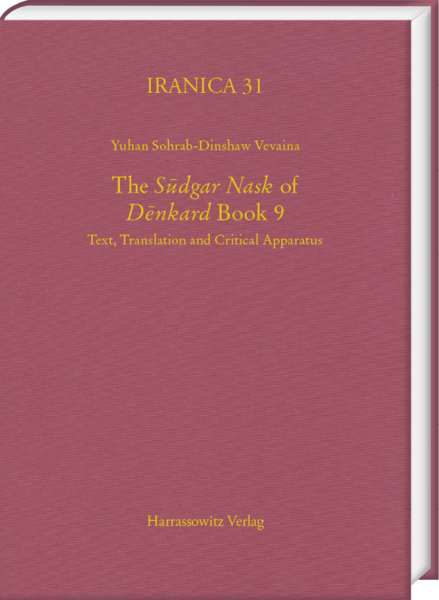
The "Sudgar Nask" of "Denkard" Book 9: Text, Translation and Critical Apparatus

Vevaina, Yuhan Sohrab-Dinshaw
The Sūdgar Nask of Dēnkard Book 9 is one of the most enigmatic and yet fundamental texts of Zoroastrianism. It is a commentary on the ‘Old Avesta’ of the 2nd millennium BCE produced in Pahlavi (Zoroastrian Middle Persian) in the Sasanian (224–651 CE) and early Islamic centuries. This commentary purportedly based on earlier Pahlavi translations and commentaries of lost Young Avestan tractates commenting in turn on the 'Old Avesta' is a value-laden, ideologically motivated discourse that displays a rich panoply of tradition-constituted forms of allegoresis. This terse yet highly allusive text mobilizes complex forms of citation, allusion, and intertextuality from the inherited Avestan world of myth and ritual in order to engage with and react to the profound changes occurring in the relationships between theology, religious praxis, national identity, and imperial politics in Iranian society. Despite its value and importance for developing our nascent understanding of Zoroastrian hermeneutics and the self-conception of the Zoroastrian priesthood in Late Antiquity, this primary source has attracted scant scholarly attention due to the extreme difficulty of its subject matter and the lack of a reliable translation. This volume represents the first critical edition and translation of this formidable text which will contribute to the philological, theological, and historiographical study of Zoroastrianism in a pivotal moment in its rich and illustrious history.

Reihe:
Bandnummer: 31
Umfang/Format: XXXII, 290 pages
Sprache: English
Ausstattung: Book (Hardback)
Abmessungen: 17.00 × 24.00 cm
Gewicht: 754g
Erscheinungsdatum: 28.02.2024
Preise: 78,00 Eur[D] / 80,20 Eur[A]
ISBN: 978-3-447-12105-7
DOI: 10.13173/9783447121057


Greek and Latin Inscriptions from Classical Antiquity for History of Georgia

Phiphia,N., E. Kobakhidze et T. Dundua (2023) : ანტიკური ხანის ბერძნულ-ლათინური წარწერები, როგორც საქართველოს ისტორიის წყარო / Greek and Latin Inscriptions from Classical Antiquity for History of Georgia, Tbilissi

Cet ouvrage bilingue veut publier l’ensemble des inscriptions concernant la Géorgie. Il est organisé en deux parties : la première partie concerne la partie occidentale de la Géorgie (Colchide/Lazique) et la seconde partie, la partie orientale. Les près de 122 notices sont classés dans l’ordre chronologiques. La nature des textes est assez variée : graffiti, timbres, inscriptions sur pierre, monnaies, bijoux, découverts à la fois en Géorgie et dans le reste du monde antique.

Une version parallèle uniquement en anglais semble exister, mais uniquement sur les réseaux sociaux.

64 inscriptions sont illustrées en couleur.

Un recueil de sources utiles

Le livre en ligne : https://dspace.tsu.ge/items/9fb9ade4-ac8c-475e-9554-e91da0a1eb52