Monday, February 6, 2023

OF RABID DOGS, HUNCHBACKED OXEN, AND INFERTILE GOATS IN ANCIENT BABYLONIA: STUDIES PRESENTED TO WU YUHONG ON THE OCCASION OF HIS 70TH BIRTHDAY

edited by Sven Günther, Wayne Horowitz, and Magnus Widell 
Changchun 2021
Institute for the History of Ancient Civilizations

Supplements to the Journal of Ancient Civilizations (ISSN: 1004-9371), vol. 7

The complete Festschrift for Wu Yuhong on the sad occasion of the death on 6 February 2023 The Institute for the History of Ancient Civilizations (IHAC) at Northeast Normal University, Changchun, is deeply moved to convey the sad news of the passing of its colleague and former director Prof Wu Yuhong on 6 February 2023. As a dedicated researcher and teacher, Yuhong has built and substantially shaped modern Chinese Assyriology and Ancient Near Eastern Studies by educating the next two generations of Chinese Assyriologists, with many of them today holding key-positions at institutions for higher education in China. His broad international experience and research network made it possible to build long-lasting connections with renowned institutions, for the advantage of dozens of students, who over the years, have been able to conduct their studies around the world. His excellence in research is reflected in an impressive number of publications, both in Chinese and English, particularly focusing on the Ur III period. As professor at and ultimately as director of IHAC he worked hard that this unique institute, which was the first to offer study programs in Assyriology, Egyptology, and Classics in whole China and every year invites 4–5 international visiting professors to closely work with students and scholars, and its Journal of Ancient Civilizations (JAC) become a point of reference in the fields worldwide. For celebrating his 70th birthday, academic friends and colleagues published a Festschrift in 2021 with appreciations, a list of publications, and 15 contributions, which all till last hoped to deliver in person to him and has been now made available open access on the sad occasion of his death. Letters of condolence may be directed to the institute’s address (Institute for the History of Ancient Civilizations, Northeast Normal University, 5268 Renmin Street, 130024 Changchun, Jilin Province, China) or electronically to svenguenther@nenu.edu.cn.
 

The Diorisis Ancient Greek Corpus

An annotated corpus of literary Ancient Greek sourced from the Perseus Canonical Greek Lit repository (https://github.com/PerseusDL/canonical-greekLit), “The Little Sailing” digital library (http://www.mikrosapoplous.gr/en/texts1en.html), and the Bibliotheca Augustana digital library (http://www.hs-augsburg.de/~harsch/augustana.html#gr).

The corpus consists of 820 texts spanning between the beginnings of the AG literary tradition (Homer) and the fifth century AD, and it counts 10,206,421 words.

Funding

This work was supported by The Alan Turing Institute under the EPSRC grant EP/N510129/1 and the seed funding grant SF042.


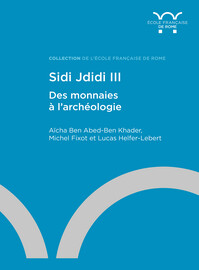
Sidi Jdidi III:Des monnaies à l'archéologie

Sidi Jdidi III

Collection de l'École française de Rome

Cet ouvrage complète les deux volumes qui rendaient compte des fouilles intervenues entre 1991 et 2006 à Sidi Jdidi, l’ancienne Aradi. Ils traitaient respectivement d’une basilique chrétienne et du groupe épiscopal étudiés dans leur contexte. Le troisième volume concerne le matériel numismatique issu des deux sites, soit 938 monnaies. À partir des identifications dues à Cl. Brenot, elles ont été rapportées à la stratigraphie et livrent un échantillon de la circulation monétaire dans le cadre des lieux de culte et de leurs dépendances dans une petite cité africaine entre Ve et VIIe s.
Les données sont confrontées aux interprétations avancées dans les volumes précédents et dans celui de T. Mukaï qui traitait du matériel céramique du groupe épiscopal. Elles les confirment et montrent qu’au cours de l’ensemble de la période, les échanges quotidiens reposent de façon minoritaire sur des frappes de la seconde moitié du IVe s. tandis que la part essentielle revient aux imitations de ces mêmes espèces, sans renouvellement notable du stock. Quelques unités apportent des précisions sur les datations, occasion d’un retour sur l’histoire de cette partie de la cité, voire de la cité elle-même.

  • Éditeur : Publications de l’École française de Rome
  • Collection : Collection de l'École française de Rome | 610
  • Lieu d’édition : Rome
  • Année d’édition : 2023
  • Publication sur OpenEdition Books : 06 février 2023
  • Nombre de pages : 164 p.
Faouzi Mahfoudh
Préface


Sunday, February 5, 2023

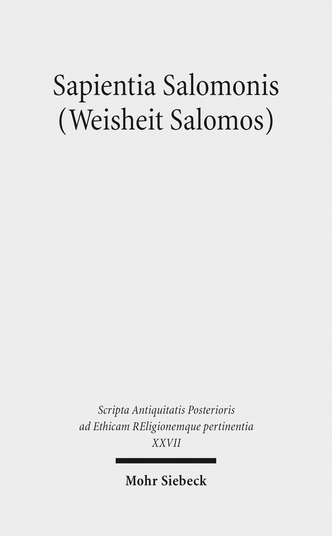
Sapientia Salomonis (Weisheit Salomos)

Eingel., übers. u. mit interpretierenden Essays versehen v. Karl-Wilhelm Niebuhr, Walter Ameling, Folker Blischke, Mareike V. Blischke, Alfons Fürst, Rainer Hirsch-Luipold, Heinz-Günther Nesselrath u.a.
Sapientia Salomonis (Weisheit Salomos)

[Sapientia Salomonis (Wisdom of Solomon).]

eBook PDF
ISBN 978-3-16-156428-4
Open Access: CC BY-NC-ND 4.0
Sponsored by: Akademie der Wissenschaften zu Götting
Published in German.
The Sapientia Salomonis (Wisdom of Solomon) has been an accepted part of the Christian Bible since Late Antiquity and was transmitted as part of the Old Testament. The work has therefore deeply influenced the development of religious and philosophical traditions in the Christian world right up to the present day. The work was however originally derived from ancient Hellenistic Judaism, most likely from Alexandria around the beginning of the Common Era, making it a typical example of intensive interaction between biblical tradition and classical Greco-Roman culture. This can be seen in the reception of biblical and ancient oriental sapiential texts in the Wisdom of Solomon and their combination with topics, terms and forms of Greek philosophy. The ensuing Hellenistic blend had an important spiritual-cultural influence on the authors of New Testament writings.


Saturday, February 4, 2023

Gegen falsche Götter und falsche Bildung: Tatian, Rede an die Griechen

Eingel., übers. u. mit interpretierenden Essays versehen v. Peter Gemeinhardt, Marie-Luise Lakmann, Heinz-Günther Nesselrath, Ferdinand R. Prostmeier, Adolf Martin Ritter, Holger Strutwolf u. Andrei Timotin. Hrsg. v. Heinz-Günther Nesselrath
Gegen falsche Götter und falsche Bildung

[Against False Gods and False Education. Tatian's Address to the Greeks.]

eBook PDF
ISBN 978-3-16-156427-7
Open Access: CC BY-NC-ND 4.0
Sponsored by: Akademie der Wissenschaften zu Göttingen

Written after the middle of the 2nd century CE by an educated Christian, Tatian's »Address to the Greeks« is a powerfully eloquent and all-encompassing attack against both Hellenic culture and Hellenic gods. It is thus an important precursor of the vehement spiritual conflicts of the 4th century CE between traditional Graeco-Roman paganism and Christianity. The volume presents an introduction into the author and his writings as well as into the »Address« itself, followed by the original Greek text (which has been subjected to a thorough revision with regard to earlier editions), a new German translation with a thorough annotation elucidating the numerous details of content to be found in the work, and after that by a number of essays putting the »Address« in its theological, religious and generally »ideological« context and shedding light on its subsequent reception.

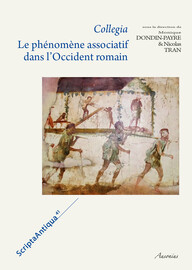
Collegia: Le phénomène associatif dans l'Occident romain

Collegia

Scripta Antiqua

Les collèges sont sans doute les structures collectives non institutionnelles les plus répandues dans l'Empire romain. Où qu'ils soient, leur organisation est similaire : un règlement régit l'inscription, l'administration, les réunions, les objectifs de ces communautés, dont le fonctionnement est soumis aux lois de l'empire, qui sont reconnues sur le plan administratif et surveillées par les autorités, soucieuses de ne pas laisser se développer des pratiques susceptibles de troubler l'ordre public. Les collèges sont désignés par un nom, qui semble refléter le lien qui rapproche leurs membres : une divinité, une profession, une spécialité, un ancrage territorial, une pratique funéraire ... ; mais tous sont polyvalents, se réunissent pour célébrer un culte, pour partager un banquet, pour choisir des représentants, pour solliciter un patronage, pour honorer l'empereur, pour goûter la convivialité. Nés en Italie, ils se diffusent dans tous les corps sociaux, armée comprise et, dans toutes les provinces, notamment en Occident où leur nombre et leur variété sont considérables. Ils constituent donc un témoignage de romanisation, et leur étude est susceptible d'éclairer “l'Empreinte de Rome sur l'Occident” sous un aspect non pas élitiste, mais “populaire” au sens premier, c'est-à-dire qui concerne l'ensemble de la société, non pas à titre exceptionnel, mais dans le quotidien. Pour appréhender au mieux le phénomène, leur diversité est mise en valeur tant sur le plan thématique (religieuse, professionnelle, funéraire, structures associatives parallèles ...), que géographique (provinces nord-occidentales, péninsule Ibérique, rives de l'Adriatique, Égypte), ou chronologique (persistance des collèges jusqu'au IVe s.), à travers une série de contributions, les unes larges, les autres ciblées par région ou par spécilisation, fondées sur une documentation essentiellement épigraphique et papyrologiques, dont l'exploitation est facilitée par les indices.

  • Éditeur : Ausonius Éditions
  • Collection : Scripta Antiqua | 41
  • Lieu d’édition : Bordeaux
  • Année d’édition : 2012
  • Publication sur OpenEdition Books : 03 février 2023
  • Nombre de pages : 312 p.
Ségolène Demougin
Des collèges en Gaule Belgique


Open Access Digital Library: Classica Digitalia

 [First posted in AWOL 2 December 2009. Updated 24 February 2023]

Classica Digitalia
Coimbra University Press
The online library CLASSICA DIGITALIA - VNIVERSITATIS CONIMBRIGENSIS is designed to create a wide communication network devoted to the area of Classical Studies. The library welcomes contributions from the whole academic community, although special attention is given to the creation of synergies within the Portuguese-speaking world. Its editorial policy is set by the editorial board, with all contributions being subjected to review by an international panel of referees. All works available in CLASSICA DIGITALIA are also published in printed format.
História Antiga: Relações Interdisciplinares II
#56
Ancient History: Interdisciplinary Approaches: Urban, Rural & Social Landscapes
Carmen Soares, José Luís Brandão, Pedro C. Carvalho
November 1, 2018
Apolónio de Rodes
#63
Argonautica. Books I and II. Literary Study, Translation and Notes
Ana Alexandra Alves de Sousa
March 25, 2021
Ser Clássico no Brasil: Apropriações Literárias no Modernismo e Pós
#7
Being Classical in Brasil: Literary Appropriations in Modernism and Post
Tereza Virgínia Ribeiro Barbosa, Júlia Batista Castilho de Avellar, Rafael Guimarães Tavares da Silva
February 15, 2022
A Poética Calimaquiana e sua Influência na Poesia Epigramática Callimachean Poetics and its Influence on Epigrammatic Poetry
Fernando Rodrigues Jr., Breno Battistin Sebastiani, Bárbara da Costa e Silva
April 1, 2021
Estudos Clássicos IV Classical Studies IV: Routes
Gabrieli Cornelli, Luciano Coutinho
December 21, 2018
Clásicos en Escena Ayer y Hoy
#5
Classics on Stage Yesterday and Today
María Teresa Amado Rodríguez, Begoña Ortega Villaro, Maria de Fátima Silva
March 3, 2020
Conimbriga Diripitur
#67
Conimbriga Diripitur: Aspects of the later occupations of a ancient Roman town
José Ruivo, Virgílio Hipólito Correia
October 20, 2021
Constelações do Zodíaco
#60
Eratosthenes. Constelações do Zodíaco
Reina Marisol Pereira
July 27, 2020
Figures de sages
#61
Figures of wise men, figures of philosophers in the work of Plutarch
Delfim F. Leão, Olivier Guerrier
September 19, 2019
Fragmentos de Aristófanes Fragments of Aristophanes
Karen Amaral Sacconi
June 12, 2020
Das Culturas da Alimentação ao Culto dos Alimentos Vol. I From food cultures to food cults. Volume I
Paula Barata Dias, Wanessa Asfora, Carmen Soares, Allen Grieco
December 28, 2022
Das Culturas da Alimentação ao Culto dos Alimentos Vol. II From food cultures to food cults. Volume II
Paula Barata Dias, Wanessa Asfora, Carmen Soares, Allen Grieco
December 28, 2022
Casas, património, civilização
#62
Houses, patrimony, civilization. Nomos versus physis in Greek Thought
Maria de Fátima Silva, Maria da Graça de Moraes Augusto, Maria do Céu Fialho
November 15, 2019
A Ilíada Latina
#11
Ilias Latina
Priscilla Adriane Ferreira Almeida
November 9, 2021
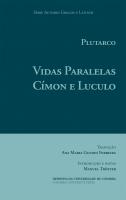
Vidas Paralelas. Címon e Luculo
#64
Parallel Lives. Cimon and Lucullus
Ana Maria Guedes Ferreira, Manuel Tröster
November 18, 2021
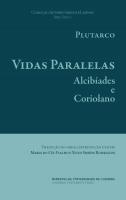
Vidas Paralelas: Alcibíades e Coriolano Parallel lives: Alcibiades and Coriolano
Maria do Céu Fialho, Nuno Simões Rodrigues
April 6, 2012
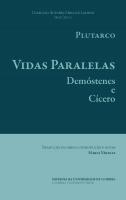
Vidas Paralelas: Demóstenes e Cícero Parallel lives: Demosthenes and Cicero
Marta Isabel de Oliveira Várzeas
June 6, 2012
Pausânias
#65
Pausanias. Description of Greece: First Book
Maria de Fátima Silva
January 21, 2022
Pausânias. Descrição da Grécia. Livro II
#67
Pausanias. Description of Greece. Book II
Maria de Fátima Silva
May 3, 2022
1-25 of 40


#68
Pausanias. Description of Greece. Book III
Maria de Fátima Silva
November 8, 2022
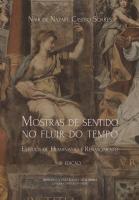
Plutarco e as Artes Plutarch and the arts: painting, cinema and decorative arts (2nd edition)
Luísa de Nazaré Ferreira, Paulo Simões Rodrigues, Nuno Simões Rodrigues
April 6, 2012
#66
Plutarch. How should young people listen to poets?
Marta Isabel de Oliveira Várzeas
March 15, 2022
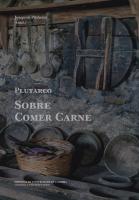
Sobre Comer Carne
#12
Plutarch. On the eating of flesh
Joaquim Pinheiro
September 26, 2019
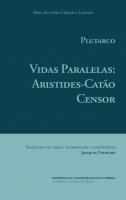
Vidas Paralelas: Aristides-Catão Censor
#61
Plutarch. Parallel Lives: Aristides-Cato the Censor
Joaquim Pinheiro
February 25, 2021
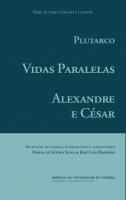
Vidas Paralelas - Alexandre e César
#57
Plutarco. Parallel Lives – Alexander and Caesar
Maria de Fátima Silva, José Luís Brandão
September 3, 2019
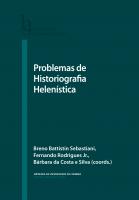
Problemas de Historiografia Helenística
#59
Problems of Hellenistic Historiography
Breno Battistin Sebastiani, Fernando Rodrigues Jr., Bárbara da Costa e Silva
August 21, 2019
Estátuas na religião romana
#65
Statues in Roman Religion
Claudia Beltrão, Federico Santangelo
October 4, 2020
Mesa dos Sentidos II
#14
Table of the Senses & Senses of the Table: Vol. II
Carmen Soares, Anny Jackeline Torres Silveira, Bruno Laurioux
April 26, 2021
As Diatribes de Epicteto, Livro I
#58
The Diatribes of Epictet, book I
Aldo Dinucci
January 20, 2020
Teofrasto. Cauas das Plantas
#14
Theophrastus. Causes of the plants
Maria de Fátima Silva , Jorge Paiva
October 19, 2020
Urban Transformations in the Late Antique West
#63
Urban Transformations in the Late Antique West: Materials, Agents, and Models
André Carneiro, Neil Christie, Pilar Diarte-Blasco
June 30, 2020
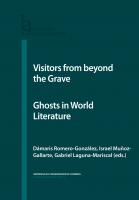
Visitors from beyond the Grave
#60
Visitors from beyond the Grave: Ghosts in World Literature
Dámaris Romero-González, Israel Muñoz-Gallarte, Gabriel Laguna-Mariscal
October 21, 2019
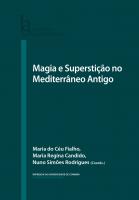
Magia e Superstição no Mediterrâneo Antigo
#68
Witchcraft and Superstition in the Ancient Mediterranean
Maria do Céu Fialho, Maria Regina Candido, Nuno Simões Rodrigues
December 10, 2021

 See AWOL's Alphabetical List of Open Access Monograph Series in Ancient Studies