Thursday, April 4, 2019

“Comprehensive Odyssey”, a digital critical repository of the Odyssey and its sources: perspectives and consequences.

“Comprehensive Odyssey”, a digital critical repository of the Odyssey and its sources: perspectives and consequences.
Doctoral ThesisDoctor of Philosophy
This dissertation includes a digital proof of concept called the “Comprehensive Odyssey”, which provides the text of the first 105 lines of the Odyssey, the secondary sources for each line and the scholia. This digital project was the focus of an analysis of the possibilities of the digital medium to produce a digital critical edition or rather a digital critical repository of the Homeric poems and their indirect tradition. The dissertation presents all the stages in this analysis. As this edition deals with Homer’s Odyssey, one chapter here takes into consideration the present situation in Homeric scholarship. The analysis also embraces an overview of the theory of oral composition, traditional referentiality, notional fixity and the process from oral to print to digital, bearing in mind that the project deals with a poem whose origin is not in the form of a written composition, but of an oral composition in performance. To assess the possibilities of creating a digital project concerning Homer, a review has been carried out of digital projects in Classics, some of which are centred on Homer. We also discuss the theories both of digital editing and of textual editing. Assessing digital theories helps when deciding about which framework to use for a digital project, and it was what assisted us in understanding the difficulties that would have to be overcome in order to make this project feasible. Moreover, this dissertation includes a detailed overview of all the technical challenges encountered while producing it, by this meaning the encoding process with XML and TEI and the visualisation process with XSLT. One chapter aims to provide examples of research that can stem from the collection of secondary sources and their understanding as fragmentary authors, together with an awareness of the problems arising from the creation of an edition from printed critical editions. The purpose of this dissertation is to assess the chances that this proof of concept may become a fully functional project and help in understanding the Homeric tradition. Most importantly, this proof of concept would be a never-ending repository which, with the help of encoding in XML and TEI, would always remain open to changes and improvements. The hindrances that the digital medium faces, such as copyright and ‘comprehensiveness’, are also pointed out. The concept of crowdsourcing is discussed, as it seems that it might serve to complete the encoding of all the sources of the “Comprehensive Odyssey”. Finally, the outcomes that might result from the above-mentioned ‘voyage’ are examined, leading to the conclusion that a project such as the one we envisaged is too ambitious, since it contains several different aspects within one project, yet is not a failure. It is a worthwhile journey that helps us understand the importance of studying orality in connection with collaboration in the digital medium and the value of studies on quotations and fragmentary authors for the secondary sources.
Original languageEnglish
Awarding Institution
Supervisors/Advisors
Award date2017

Wednesday, April 3, 2019

Open Access Publications of the Institut Català d'Arqueologia Clàssica

Institut Català d'Arqueologia Clàssica
L'ICAC és un centre de recerca públic en Arqueologia Clàssica creat per la Generalitat de Catalunya i la Universitat Rovira i Virgili, amb la participació del Consell Interuniversitari de Catalunya. Té com a finalitat la recerca, la formació avançada i la difusió de la civilització i cultura clàssiques. L'Institut desenvolupa la seva tasca a partir de la col·laboració i les sinergies amb les universitats i institucions de recerca de Catalunya que treballen en el mateix camp, amb l'objectiu d'esdevenir un referent científic internacional en aquest àmbit. Com a centre de recerca ha establert línies i programes d'investigació a desenvolupar i es dotarà de personal investigador. El seu àmbit de coneixement és l'Arqueologia Clàssica en un sentit ampli, tant des d'una perspectiva geogràfica (l'arc mediterrani i l'entorn on es van desenvolupar les cultures clàssiques) com cronològica (comprenent les civilitzacions grega i romana, i els altres pobles relacionats directament amb aquestes)

Collections

Altres [61] Antiguitat tardana [5] Arqueologia clàssica i ciències de l'antiguitat. Fonts textuals, epigrafia i numismàtica [97] Arqueologia clàssica i produccions artístiques [89] Arqueologia de la Protohistòria de la Mediterrània Occidental [93] Arqueologia de la ciutat antiga [269] Arqueologia del paisatge, poblament i territori [144] Arqueologia grega [43] Continguts institucionals [15] Instrumentum domesticum. Materials i comerç en el món antic [112] Laboratoris virtuals [1]

Recent Submissions

Pera, Joaquim; Carreras Monfort, César; Rodrigo Requena, Esther; Romaní i Sala, Núria; Padrós Font, Núria; Solà Gómez, Gemma de; Guitart i Duran, Josep, 1946-
Macias Solé, Josep Maria; Puche i Fontanilles, Josep Ma; Solà-Morales, Pau; Toldrà Domingo, Josep M.; Fernández Pino, Ivan

Medea, a Performance History: a multimedia/interactive guide to the production history of Euripides’ Medea

Medea, a Performance History 
Fiona Macintosh and Others

This book is available for download with Apple Books on your Mac or iOS device. Multi-touch books can be read with Apple Books on your Mac or iOS device. Books with interactive features may work best on an iOS device. Apple Books on your Mac requires OS X 10.9 or later
Medea, a Performance History

Description

Medea, a performance history is a multimedia/interactive guide to the production history of Euripides’ Medea – an ancient Greek tragedy about a mother who, betrayed by her husband, exacts revenge by killing her children. First performed nearly 2,500 years ago, and continually reinvented since, Medea remains the most controversial yet alluring female role in the history of theatre worldwide.

This multimedia/interactive ebook draws on a unique collection of archival material and research at the APGRD (Archive of Performances of Greek and Roman Drama) at the University of Oxford and uses images, film, unique interviews and digital objects to tell the story of a play that has inspired countless interpretations, onstage and onscreen, in dance, drama and opera across the globe from antiquity to the present.

What's New in Version 1.3

File size streamlined; outdated introductory video removed; copyright information updated.

Tuesday, April 2, 2019

Pleiades Datasets version 1.1

Pleiades Datasets version 1.1
Creators: Tom Elliott Copyright © The Contributors. Sharing and remixing permitted under terms of the Creative Commons Attribution 3.0 License (cc-by).
Last modified Apr 01, 2019 07:21 PM
Archival copies of our latest set of platform-independent download data files have been published.
Pleiades Datasets version 1.1
Periodically we archive copies of the export files generated nightly and distributed via our downloads page. Version 1.1 of the Pleiades Datasets (1 April 2019) may be downloaded from any of the following archives:
We encourage third parties to obtain, store, and reuse our data under terms of a Creative Commons Attribution 3.0 license.
If you are interested in providing an additional public venue for archiving or preserving Pleiades data, please contact the editors via pleiades.admin@nyu.edu.

Attic Inscriptions Online Update

Attic Inscriptions Online Update

AIO


2 April 2019: In this release we complete our coverage of Assembly decrees datable to before the late 450s BC, adding IG I3 2, 3 (and the related dedication, SEG 51.48), 4, 8, and lightly revising IG I3 1, 5, 7 and 6 (which will be further revised shortly in the context of AIUK). We also publish the dedications by soldiers and military officials, IG II3 4, 243 - 328 and 528, Bugh, Cavalry Inscriptions 1, and some related texts: decrees honouring a phylarch and a military figure; two decrees of the Paraloi, IG II2 1254, Petzl, Das Wrack 3; a decree of the prodromoi. We have continued adding up-to-date Greek texts where they are not available online elsewhere in open access, focussing in this release mainly on important 5th-century inscriptions: OR 108, 121, 136, 137, 138, 139, 148, 150, 152, 154, 155, 157, 161, 166, 170, 178, 182, 183A, 188, 189, IG I3 5, 82, 131, 236B. The corresponding translations and notes have been lightly revised. We have also added an up-to-date Greek text of the unique Athenian decree of 302/1 BC honouring a public slave. For a full list of the 94 new translations published today see Publication 2 April 2019. In January we published AIO Papers 10, a short teaching guide to materials available on AIO, with FAQs.

Monday, April 1, 2019

Launched: Digital Central Asian Archaeology (DCAA) Collection

Digital Central Asian Archaeology (DCAA) Collection
The Digital Central Asian Archaeology (DCAA) is a collection in the Ancient World Digital Library (AWDL), a project of Library of the Institute for the Study of the Ancient World at New York University. AWDL’s mission is to identify, collect, curate, and provide access to a broad range of scholarly materials relevant to the study of the ancient world.
The DCAA collection is an outgrowth of the SilkRoDE Digital Library Project, organized by Sebastian Stride, Bernardo Rondelli, and Philipp Reichmuth (now at SIRIS Academic) between 2004 and 2005. One desideratum that emerged from the international scholarly communities in Central Asia at the beginning of the millennium was a digital archive and library of Soviet-era and later archaeological reports, surveys, and scholarship on Central Asia. Much of the archaeological material was unpublished, and even published material was very rare, since print runs often did not rise above 100 copies. Therefore, both preservation and general accessibility of publications were identified as pressing issues. Stride and his collaborators assembled an impressive coalition of institutions, scholars, and international grant agencies for this project, including:
Over the course of 2006 and 2007 the project undertook a large-scale scanning effort, overseen by Nabikhan Utarbekov and Enver Assanoff from the Tashkent company Media Land. For logistical, financial, and other reasons, the envisioned digital archive and library never proceeded beyond the prototype stage. In 2015, the ISAW Library agreed to accept a portion of what had been digitized, curate the collection, clear the rights with the various publishing houses, preserve the digital copies in NYU’s Faculty Digital Archive, create high-quality metadata for the digital copies to maximize discoverability, and make the works accessible to the general scholarly public. (Follow this link and this link for more information about our rights-clearing process and the fair use doctrine at NYU.)
The first batch of items in the DCAA collection were published in September 2018 via Omeka. The next phase of the project will entail increasing the search capacity within the collection and adding more items to the collection.
If you are an author or publisher who would like to partner with the ISAW Library by adding to the DCAA collection, please email ISAW-Library@nyu.edu.

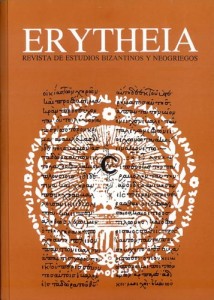
Open Access Journal: Erytheia: Revista de Estudios Bizantinos y Neogriegos

 [First posted in AWOL 9 February 2011, updated [links repaired] 1 April 2019]

Erytheia: Revista de Estudios Bizantinos y Neogriegos
ISSN: 0213-1986
http://www.hispanohelenica.org/wp-content/uploads/erytheia-214x300.jpg
Erytheia. Revista de Estudios Bizantinos y Neogriegos fue fundada en 1982 como órgano de expresión de la Asociación Cultural Hispano-Helénica. El número 0 de 1982 apareció bajo el nombre de Hespérides, que para el segundo volumen se cambió por el de Erytheia, una de las Hespérides más conocidas. Ha sido dirigida por Pedro Bádenas de la Peña (1982-1992), Luis Gil (1993-2005) y José M. Floristán (2006–). En los últimos cuarenta años ha sido el principal órgano de difusión de los estudios y trabajos de investigación en el campo de la bizantinística y del neohelenismo. Erytheia está abierta a todos los estudiosos que deseen utilizar sus páginas para dar a conocer trabajos originales de investigación. Publica estudios y notas relacionados con los diversos campos de la civilización bizantina y neohelénica (lengua, literatura, historia, arte, geografía, filosofía, derecho, etc.). Los trabajos pasan un proceso de selección por pares ciegos. Erytheia cumple los siguientes requisitos de calidad: CNEAI (13/18), ANECA (16/22), LATINDEX (31/33). Está indizada y evaluada en las siguientes bases de datos: DIALNET, DICE, ISOC, MIAR, Periodical Index Online, Regesta Imperii.
Open access through no. 34 (2013)

See AWOL's List of