Showing posts with label Sudan. Show all posts

Friday, February 27, 2026

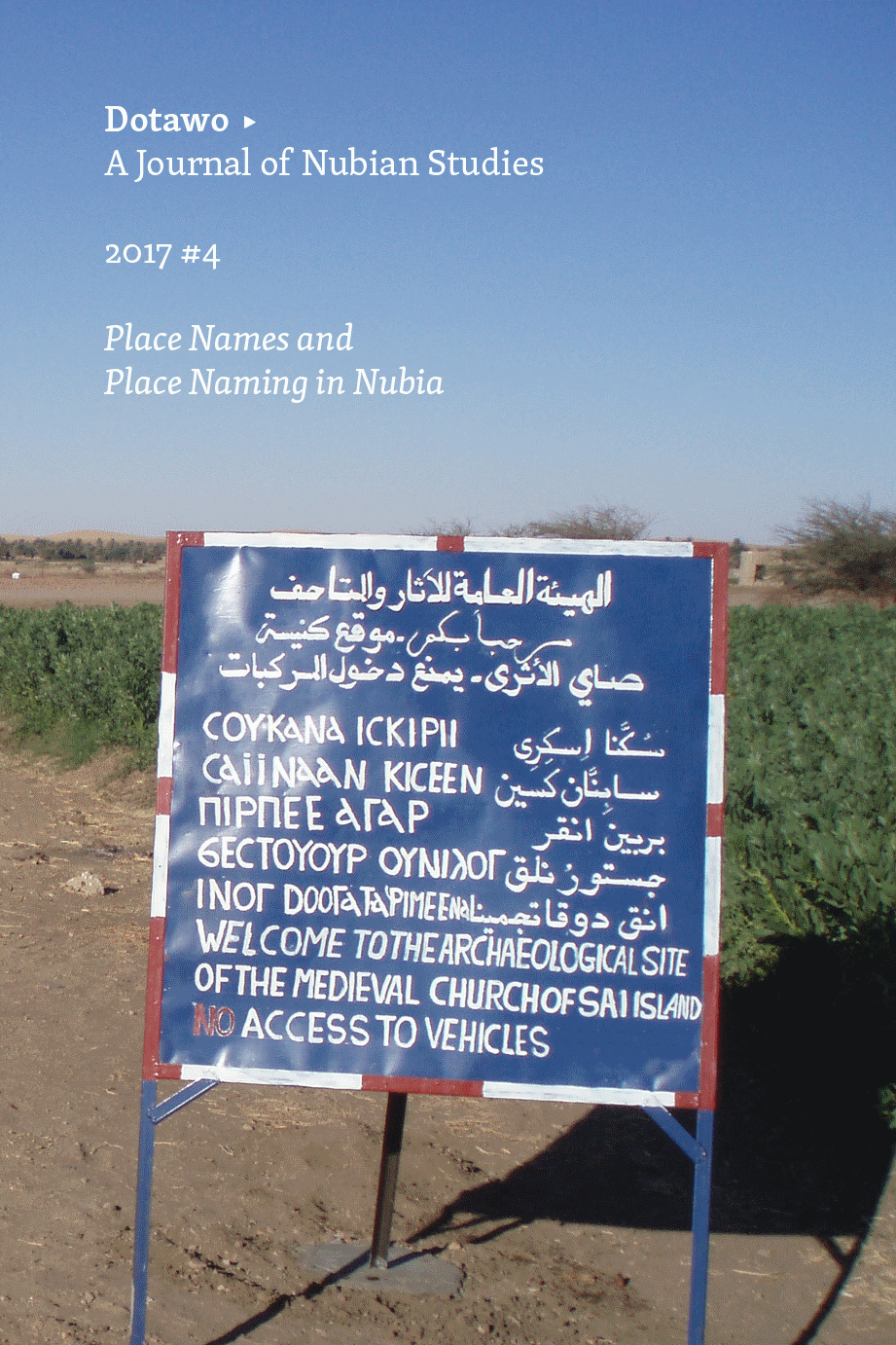
Open Access Journal: Dotawo: A Journal of Nubian Studies

 [First posted in AWOL 13 June 2014, updated (new URLs) 27 February 2026]

Dotawo: A Journal of Nubian Studies
Nubian studies needs a platform in which the old meets the new, in which archaeological, papyrological, and philological research into Meroitic, Old Nubian, Coptic, Greek, and Arabic sources confront current investigations in modern anthropology and ethnography, Nilo-­Saharan linguistics, and critical and theoretical approaches present in post­colonial and African studies.

The journal Dotawo: A Journal of Nubian Studies brings these disparate fields together within the same fold, opening a cross­-cultural and diachronic field where divergent approaches meet on common soil. Dotawo gives a common home to the past, present, and future of one of the richest areas of research in African studies. It offers a crossroads where papyrus can meet internet, scribes meet critical thinkers, and the promises of growing nations meet the accomplishments of old kingdoms.

We embrace a powerful alternative to the dominant paradigms of academic publishing. We believe in free access to information. Accordingly, we are proud to collaborate with DigitalCommons@Fairfield, an institutional repository of Fairfield University in Connecticut, USA, and with open-access publishing house punctum books. Thanks to these collaborations, every volume of Dotawo will be available both as a free online pdf and in online bookstores.
Volume 9, 2026

Articles

From Homescape to Flora Landscape

In Sudan, the study of earthen construction materials is very rare, mudbricks were and still are widely used as building materials in many regions. This paper gives a new perspective for applying the technique of extorted plant remains from mudbrick in Sudan. The material was collected during the fieldwork of Mahas Archaeological project in April 2019 from four Christian mudbrick sites, approximately four kilograms (one kilogram from each site). The material was soaked in water for six hours to dissolve the hard mud and sand. Two metal sieves with a mesh size of 0.5 and 1 mm were used. The separated material was dried and examined under binoculars and for identification fresh seed was used as a reference collection and determination literature. Seven plant species were as seeds, fruits were extracted and identified. These include *Triticum aestivum, Hordeum vulgare, Sorghum bicolor, Setaria italica, Adansonia digitate, Acacia nilotica* and *Cyperus rotundus*. In addition, some large unidentified deposits of glumes of wild grasses (of the Poaceae family) were presented in the samples from the four sites. Some animal dung and insect remains were separated during the sorting processing of the plant macro-remains. The archaeobotanical evidence from these four Christian mudbrick sites in El Mahas region provided evidence of the economy and flora landscape in this area. This flora can be divided into three types, i.e. riverine wild flora, cultivated flora, and wild trees.

A Bioarchaeological Approach to Everyday Life: Squatting Facets at Abu Fatima

Human skeletal remains adapt throughout the life course, thereby recording a lived experience. Bioarchaeologists can interpret skeletal data in light of everyday life, a crucial component to social practice, structure, and transformation. In this article, I examine tibial squatting facets, as an embodied product of repetitive squatting, to elucidate everyday life in Bronze Age Nubia. I use the site of Abu Fatima (2500-1500 BCE, Third Cataract) as a case study. At Abu Fatima, 95% of individuals (20/21) had squatting facets, suggesting the vast majority of the population repetitively engaged in a squatting position throughout their lifecourse. This included men and women of all ages. This is much higher than most other comparative studies on tibial squatting facets. Additionally, I reference previous strontium isotope analysis to speak to whether or not migrants or locals were more likely to squat. Both groups, were squatting with regularity. While we cannot speak to the exact activities that were being done while squatting, this study posits a few suggestions and draws an interesting line of continuity between the daily lives of ancient and modern Nubian populations.

Textiles Activities in Context: An Example of Craft Organization in Meroitic Sudan

In Sudan and Nubia, textile implements such as spindle whorls and loom weights are common finds, especially in the excavations of both rural and urban Meroitic settlements. This paper will focus on restoring the textile implements to their archeological locations in order to identify and understand the context of textile activities within the two settlements of Tila Island and Meroe-city. The two sites - a small rural settlement on one hand and the royal capital city on the other hand - offer various examples of how craft production was integrated amidst the Meroitic urban landscape. From domestic production inside living quarters to the creation of multi-tasking industrial areas, the making of textiles was tightly woven into the economic fabric of the Meroitic kingdom.

The Use and Experience of Painting Materials in Ancient and Modern Nubia

Homes in Nubia are decorated by their inhabitants, using materials from the landscape around them. This has been the case for thousands of years. Taking the ancient town of Amara West (c. 1250 BC--800 BC) and the modern residents of its environs as a case study, the procurement and application of painting materials and their social implications are considered, using archaeological evidence and recently conducted interviews. The ancient evidence includes paint on walls, pigments, paint palettes, grindstones, and painted coffins, samples of which were scientifically analysed to determine the pigments and binders used. Twelve interviews were conducted via translator with modern residents living near to Amara West about their use of paint in their houses, including how they collected painting materials, when painting took place, and who was responsible. Several paints were re-created with tools and materials that were used by the ancient population in order to experience the process and consider it from a sensory perspective. Taking all of this evidence as inspiration, several fictional passages have been added to attempt to imagine ancient events relating to paint making and use.

A House Against Housing: Post-Displacement Nubian Domesticity

This text discusses the displacement of the Nubian community and their houses due to hydropower projects, particularly the Aswan Low Dam, and subsequent developments. The impact of these projects led to economic hardships, male migration to urban areas for work, and women managing the Nubian houses. Despite these challenges, the Nubian community displayed resilience in rebuilding their villages. The text also examines the housing project initiated by the state for resettlement, known as \"New Nubia", by the state but referred to unfavorably as \"*Al Tagheer*\" by Nubians. The planning and implementation of this project were criticized for not adequately considering the Nubian culture and community needs, resulting in dissatisfaction among residents. Here, I highlight how Nubians took matters into their own hands, making modifications to the state-built dwellings to align them with their cultural norms. Nubian women played a crucial role in these modifications and the construction of houses, displaying their resilience and adaptability.

Nubian Architectural and Environmental Features Before and After Displacement: The Model of the Village Tūmās wa ʿĀfya

This essay concerns the history of the three main Nubian groups that were displaced as a result of the building of the Aswan High Dam, and their reactions to this displacement. The loss of their homes was a traumatic experience for most Nubians, as the house was more than just a physical object for them. These were valued spaces, where day-to-day existence, festivities, and family customs unfurled. The Nubian house was imbued with social importance, addressing the heredity of a family and a community. The resettlement that the families had to endure cut off the associations with these social and hereditary spaces, leaving a void that the new homes couldn't fill. This paper compares traditional old Nubian homescapes before relocation with the new governmental dwellings built for them following their forced displacement. I have focussed upon the village of Tomas wa 'Afya, which was located 220 kilometers south of the town of Aswan, discussing the history of the village, the houses that were built there, and the failures of the government's promises to the people. While the families that were displaced were deeply disappointed in the new area and houses, they were eventually able, through their resilience and resourcefulness, to retain a lot of the aspects and details of their heritage, habits, and traditions.

Remaking Home After Displacement: A Case Study From Egyptian Nubia

For centuries, the Nubians lived between the First and Fourth Cataracts of the Nile as an ethno-linguistic group united by their language, customs and distinctive architecture. However, the construction of the High Dam in 1964 forced the displacement of Nubians from their homeland to another location completely different to the environment in which the Nubian culture arose and developed. In this research I examine the daily life in the Nubian village Abu Hor in Old and New Nubia as a case study to explore how the Nubians tried to regain the sense og being-at-home in the aftermath of their displacement. I use auto-ethnographic tools to explore the material and social techniques they had developed to create a sense of home in New Nubia. The research demonstrates how the displacement of Nubians and the changing spatial context have deeply affected their culture, and how they used and adapted their culture to overcome alienation feelings and displacement by remaking their homes and homeland in the new settlement.

Nubian Women’s Bridal Rooms

The article discusses the decoration of wedding rooms in Egyptian Nubia before the resettlement of the population due to the construction of the Aswan High Dam in 1964. In the former Nubian villages, it was the task of a bride to decorate a special place, the so-called bride’s room, before the marriage. This activity was part of the extensive house-decoration, consisting foremost of wall paintings, which the women painted with earth colors on their home’s outer and inner walls. Their rich and often opulent adornment with three-dimensional objects made the Nubian bridal rooms particular. Homemade handiwork hung up on the walls or suspended from the ceilings formed the main feature of the room’s design. On top of this, a mixture of peculiar items was displayed. These could be anything the brides considered valuable and composed inventively into an artistic design, whether as an assemblage or as “objets trouvés”. The custom to furnish a bridal room in this manner was discontinued after the Nubians were moved to the new villages north of Aswan. The article is a part of my forthcoming publication “Colors of Nubia, the lost art of women’s house decoration”.

Houses of Egyptian Nubia: West Aswan — Then and Now

Most of the Nubians in Sudan and Egypt were relocated when the Egyptian High Dam was constructed in 1964, but not all of them were. Several Nuban villages sitting north of the High Dam were in no danger of inundation, and were not evacuated. The houses which the Nubians built and continue to build in these villages, distinctive and beautiful, continue to be cherished by their owners. Here I present photographs of the houses in the village of West Aswan, where I lived for 3 ½ years, showing traditional as well as more modern styles, to demonstrate that the extraordinary Nubian culture, ancient as it is, has not disappeared despite great change.

Stereotypes and Negative Indexes of the Nubians in Egypt

This paper examines the stigmatized portrayal of Nubians, particularly Fadija and Kunuz speakers, in Egyptian media, focusing on negative stereotypes that continue to permeate these representations. Nubian speakers of Fadija and Mattoki are frequently depicted as unintelligible in Arabic, blackfaced, and confined to lower-class roles. Terms such as 'barbari' (barbarian), and 'bijtkalem ʕarabi mekasar' (speaking broken Arabic) reinforce social and racial biases, fostering prejudice and discrimination. As a result, some Nubians feel compelled to adopt Arabic to avoid mockery and marginalization. Nonetheless, many Nubians remain resolute in preserving their mother tongues to maintain cultural identity, linguistic heritage, and ideological values. Applying the theory of indexicality, this study explores how both linguistic and non-linguistic elements—including language, dress, occupation, skin color, and character traits—are utilized in media to perpetuate negative stereotypes. It underscores the importance of learning Nubian languages at home to sustain linguistic diversity and preserve cultural values deeply rooted in Nubian homescapes. The study reveals how media producers deliberately create and reinforce negative racial and social indexes, shaping public perceptions of Nubians. It also investigates how Nubian speakers perceive and resist these stereotypes by preserving their language and culture within their households. Nubian homes are presented not merely as physical dwellings but as vibrant embodiments of history, identity, and social structure. While Arabic proficiency is associated with prestige and social status in domains such as education, religion, and media, the paper emphasizes the need for public awareness and counter-narratives to foster positive representations of Nubian language and culture. It concludes that language preservation within the home is crucial for cultural continuity and combating negative portrayals of Nubians in Egyptian media.

The Homescapes of the Manasir: A Book Review of Welsby, Derek A. (ed.), Archaeology by the Fourth Nile Cataract.

This book review discusses the first volume in the series announced by the Sudan Archaeological Research Society to present the results of their work within the Merowe Dam Archaeological Salvage Project. It places particular emphasis on how the theme of the volume—“Homescapes”—is expressed in the context of the Archaeology of the Fourth Nile Cataract, with a focus on the homescapes of the Manasir, the people who lived in this region.

A Conversation with Khalid Shatta

Anna Boozer interviewed visual artist Khalid Shatta about his artwork and its relationship to homelife over Zoom on August 22nd 2024. The following interview offers a transcript of that conversation, while smoothing over side comments and transitions.


Thursday, January 8, 2026

Open Access Journal: Sudan & Nubia: The Sudan Archaeological Research Society Bulletin

[First posted in AWOL 9 November 2012, updated 8 January 2026]

Sudan & Nubia: The Sudan Archaeological Research Society Bulletin
ISSN: 1369-5770
Sudan & Nubia is published each autumn. It contains much of interest on recent archaeological fieldwork in Sudan, including many articles on surveys and excavations only undertaken during the previous winter.

The bulletin is an ideal way to keep abreast of current British activities in Sudan, and also contains contributions by eminent foreign scholars. It is profusely illustrated with line drawings and monochrome and colour photographs.

Sudan & Nubia is free of charge to Society members, who receive it a year in advance of online release … JOIN THE SOCIETY >

Individual articles can be read (free) through the online reading service ISSUU by following the links below. If a download is preferred, sign up to ISSUU, which will then provide download links (free).

Most recent available issue online:

Sudan & Nubia : No. 28
Bulletin of the Sudan Archaeological Research Society, London, 2024

318 pages
Cover, maps, index, book reviewsdownload [ 4.6Mb ]
Obituariesdownload [ 2.2Mb ]

THE KIRWAN MEMORIAL LECTURE
Mariusz Drzewiecki. Forts in Upper Nubia and a new perspective on the first centuries of Alwa and Makuriadownload [ 2Mb ]

REPORTS
Joanna A. Ciesielska, Agnes Dudek and Fatima Edres Ali Mahmoud. Keepers of tradition: preliminary remarks from the ethnographic investigation of customs associated with clothing and authority among Sudanese womendownload [ 1.7Mb ]
Hugo Dussart and Vincent Francigny. Sai Island: medieval architectural remains of a flourishing eradownload [ 2.5Mb ]
Geoff Emberling, Tim Skuldbøl, El–Hassan Ahmed Mohamed, Sami Elamin, Gregory Tucker, Pawel Wolf, Burkart Ullrich, Suzanne Davis, Saskia Büchner–Matthews, Dobiesława Bagińska, Rebecca Bradshaw, Tohamy Abulgasim, Jan Peeters, Timotheus Winkels, Richard Redding, Anna den Hollander, Dorian Q Fuller, Abagail Breidenstein, Taylor Bryanne Woodcock and Jochen Hallof. Jebel Barkal 2018–2023: new research on the Napatan and Meroitic citydownload [ 5.5Mb ]
Fakhri Hassan Abdallah Hassan. Archaeological discoveries in the hills and coastline of the Red Sea State, Eastern Sudan 2016-2021. Preliminary reportdownload [ 2.6Mb ]
Hamad Mohamed Hamdeen, Al Bagir Badwi, Siddig Mahadi, Manahil Mohammed Farah, Mukhtar Maalieldin and, Abdelhai Abdelsawi. Archaeological and paleoenvironmental survey in the White Nile state (first season, 2022)download [ 3Mb ]
Tomasz Herbich and Marie Millet. Survey of the Meroitic site of el-Hassa. Understanding the links between the Amun temple of Amanakhareqerama and the settlementdownload [ 3.9Mb ]
Mohamed Fath al-Rahman Ahmed Idris. Rescue excavations at Jebel Barkal by Dongola University’s Department of Archeology (Seasons 14 and 15) … download [ 3.7Mb ]
Franck Monnier and Vincent Francigny. Sai Island: defensive architecture of a New Kingdom town in Ndownload [ 3.5Mb ]
Mohammed Nasreldein. Newly identified macrobotanical remains from Old Dongola (14th-18th centuries AD), Northern Sudan: a breakthrough in archaeobotanical research
download [ 1.1mb ]
Derek A. Welsby. The Sudan Military Railway between Wadi Halfa and Abidiya
download [ 6.9Mb ]

STUDIES
Henry Cosmo Bishop-Wright. Metal anklets at Faras and other Meroitic sites: form, function, chronology and a response to Vila’s ‘gens à anneaux’download [ 2.1Mb ]
Mar Casquero, Víctor M. Fernández, Salomé Zurinaga Fernández-Toribio, Mohamed Saad and Luis Ríos. The ancient Nubian skeletal collection at Universidad Complutense de Madrid, Spaindownload [ 1.1Mb ]
Zoe Cormack. Darfur in the early 1980s: a photographic record of communities, craft, and changedownload [ 1.5Mb ]
Mahmoud A. Emam. Further insights into a forgotten aspect of Meroitic religion: the amulets of Apedemakdownload [ 1Mb ]
Kenneth Griffin. Sudan in Swanseadownload [ 2.1Mb ]
T. O. Moller. Excavating ‘Areika’: Cuthbert Balleine and the 1907 Eckley B. Coxe Jr. Expedition to Nubiadownload [ 1.9Mb ]

Thursday, October 2, 2025

Open Access Monograph Series: Fontes historiae Nubiorum : textual sources for the history of the Middle Nile Region between the eighth century BC and the sixth century AD

 [First posted in AWOL 11 March 2013, updated 2 October 2025]

Fontes historiae Nubiorum : textual sources for the history of the Middle Nile Region between the eighth century BC and the sixth century AD 

Richard Holton Pierce; Tormod Eide; Tomas Hægg; Lázló Török

1994

Textual sources for the history of the Middle Nile Region between the eighth century BC and the sixth century AD.

Arkeologi, Tekstanalyse, Nubia, Kilder

Richard Holton Pierce; Tormod Eide; Tomas Hægg; Lázló Török

1996

Textual sources for the history of the Middle Nile Region between the eighth century BC and the sixth century AD.

Arkeologi, Tekstanalyse, Nubia, Kilder

Richard Holton Pierce; Tormod Eide; Tomas Hægg; Lázló Török

1998

Textual sources for the history of the Middle Nile Region between the eighth century BC and the sixth century AD.

Arkeologi, Tekstanalyse, Nubia, Kilder

Richard Holton Pierce; Tormod Eide; Tomas Hægg; Lázló Török

2000

Textual sources for the history of the Middle Nile Region between the eighth century BC and the sixth century AD.

Arkeologi, Tekstanalyse, Nubia, Kilder


Sunday, August 18, 2024

Open Access Journal: Archéo-Nil: Revue de la société pour l'étude des cultures prépharaoniques de la vallée du Nil

 [First posted in AWOL 24 October 2012, updated  (new host) 18 August 2024]

Archéo-Nil: Revue de la société pour l'étude des cultures prépharaoniques de la vallée du Nil

ISSN: 1161-0492

Couverture fascicule 

Fondée en 1990 par Béatrix Midant-Reynes, avec le soutien du Professeur Jean Leclant (AIBL), la revue Archéo-Nil est le fer de lance de l'association du même nom. Son but: offrir un lieu de réflexion et d'échanges interdisciplinaires sur l'Égypte des ve et ive millénaire dans le contexte d'une recherche internationale réactivée depuis les années quatre-vingt. Cette période voit émerger les premières sociétés agro-pastorales de la vallée du Nil, puis s'amorcer et s'intensifier un développement culturel, social et économique particulier, qui aboutit à la naissance d'une royauté unifiée et aux premières dynasties pharaoniques. Bien que centrées sur l'Égypte, vallée et déserts, les études publiées dans la revue couvrent une aire géographique plus large, qui s'étend à l'Afrique centrale, au Sahara, aux rives orientales de la Méditerranée, à la Mer Rouge et au Proche-Orient. Les thématiques abordées sont le reflet des travaux archéologiques les plus récents. Ils concernent tous les aspects sociaux, culturels, économiques, politiques et idéologiques des sociétés pré-pharaoniques, aussi bien du point de vue des implications théoriques de la recherche que de ses méthodes.

Mots clés décrivant « Revue » : Egypte Archéologie Pré et protohistoire Anthropologie Anthropobiologie Ethnologie Géoarchéologie Début de l'écriture.

1990-1999

  • 1990
  • 1991
  • 1992
  • 1993
  • 1994
  • 1995
  • 1996
  • 1997
  • 1998
  • 1999

2000-2009

2010-2019

2020-...

Archéo-Nil. Revue de la société pour l'étude des cultures prépharaoniques de la vallée du Nil, n°31, 2021. La violence II.

expandcollapse
Sommaire  [tables et index]
3 - 4

Lectures

160 - 168


Monday, June 12, 2023

Open Access Monograph Series: Institute for the Study of Ancient Cultures (Oriental Institute) Nubian Expedition (OINE)

[First posted in AWOL  4 June 2014, updated 12 June 2023]

Institute for the Study of Ancient Cultures (Oriental Institute) Nubian Expedition (OINE)

And see also:


And for an up to date list of all Oriental Institute publications available online see