Friday, July 3, 2020

Open Access Monograph Series: Travaux de la Maison de l'Orient

[First posted in AWOL 1 June 2014, updated 3 July, 2020]

Travaux de la Maison de l'Orient
ISSN: 0766-0510
thumbnail
La collection des Travaux de la Maison de l’Orient (TMO) publie les résultats des travaux réalisés dans le cadre des thèmes de la Fédération de Recherche. Mais elle accueille également d’autres ouvrages individuels ou collectifs en rapport avec les programmes de recherche développés au sein de la Maison de l’Orient et de la Méditerranée, en particulier les études archéologiques et géographiques dont l’illustration nécessairement abondante trouve sa place dans ce grand format (21 x 29,7).
    And see all of the

    See AWOL's Alphabetical List of Open Access Monograph Series in Ancient Studies

    Nile Valley Collective: Talk with our experts on how to situate your work on the Nile River Valley in its African context.

    Nile Valley Collective
    Nile Valley Collective 
    Talk with our experts on how to situate your work on the Nile River Valley in its African context.
    We are a group of scholars who work on the ancient cultures of the Nile River Valley. We work in the areas of art history, ancient history, historical linguistics, philology, archaeology, biological anthropology, cultural anthropology, and museum studies.

    The AAI/Open Context invites applications for two Postdoctoral Researcher positions in our new Data Literacy Program

    We’re hiring! The AAI/Open Context invites applications for two Postdoctoral Researcher positions in our new Data Literacy Program:
    Position 1:
    Postdoctoral Researcher (Data Interpretation and Public Engagement)
    This is a remote position. Full time (40 hours/week). 
    Application review will begin July 15, 2020 and will continue until filled.
    The Alexandria Archive Institute (AAI/Open Context) is a non-profit technology company working to improve research and teaching through innovative uses of the Web. Our work promotes greater transparency in the research process and broader collaboration through the curation and reuse of research data. The primary focus of our work is Open Context, an open access Web-based publication system for archaeology and other field sciences.
    With funding from Andrew W. Mellon Foundation and the National Endowment for the Humanities, the AAI/Open Context is launching a 3-year Data Literacy Program. The program will widen and diversify community engagement with cultural heritage data, providing much-needed scaffolding to guide professionals, students, and lifelong learners in thoughtful engagement with research data, especially in archaeology.
    We are seeking a Postdoctoral Researcher to develop aspects of the Data Literacy Program related to data interpretation and public engagement. This person will work closely with another postdoctoral researcher who will focus on the more technical aspects of data visualization and reproducibility as part of the same Data Literacy Program.
    The Postdoctoral Researcher will help shape the Data Literacy Program by identifying and developing themes for “data stories”— publicly-engaging narratives that are based on analysis of archaeological (and other) open access research data sets. The Postdoctoral Researcher will primarily contribute engaging, publicly-oriented written interpretations supported by open access research data. In addition, they will help learners understand the “behind-the-scenes” analytic steps, problems, and judgement calls involved in gathering and interpreting data. While this is not primarily a technical data analysis or software development role, we seek candidates willing to develop some technical competencies and can collaborate with technically oriented colleagues to guide learners in the use of data and code.
    This individual will work closely with Data Literacy Program staff to produce at least 4-6 data stories annually (approx. 70% of the role). As this is a newly launched program, we will seek candidates with ideas to understand and evaluate outcomes, shape program strategy, and provide quarterly reports on impacts to the AAI/Open Context’s Executive Director and Board of Directors (approx. 5% of the role). In addition to this internal role, the Postdoctoral Researcher will have a public voice in promoting data literacy and public engagement in archaeology. This individual will make contributions to the wider professional community through a combination of journal publication, service, conference presentations, and contributions to a “best practices” edited volume (approx. 25% of the role). 
    Due to the pandemic, this will be a remote position; thus, the successful candidate must be able to work both independently and collaboratively with a remote team.
    The following qualifications and skills are highly desired for this position, but we would like for each applicant to highlight how their own set of skills and experiences will help launch and shape this new program.
    • Ph.D. or doctoral student who will soon complete their degree
    • Doctoral studies in archaeology, anthropology, or a related field
    • Primary research interests in education, data analysis, communication, public engagement, and ethics
    • Secondary research interests and familiarity with digital data, digital publishing, and scholarly communications issues
    • A willingness to engage with geographically and chronologically diverse archaeological research topics
    • A demonstrated commitment to community archaeology and other aspects of interpreting, communicating, and collaborating with broader communities
    • Ability to find and evaluate the quality and suitability of datasets for interpretive goals
    • Developing and teaching instructional courses in archaeology
    • Enthusiasm to develop skills with Web (HTML, CSS, Javascript) technologies
    • Enthusiasm to develop skills with R or Python, and geospatial analysis
    Position and Salary:
    This is a 3-year, full-time position (40 hours/week). The salary range is $50,000-$60,000 with benefits (medical, dental, vision, 401K). Depending on pandemic-related health and safety concerns, some travel, especially for conference presentation, may be encouraged and supported with additional funds. AAI/Open Context is located in the San Francisco Bay Area, but this can be a remote position. 
    To apply:
    Please submit a letter of interest describing your vision for this position and data literacy in archaeology, as well as a CV describing your contributions, qualifications, technical skills, and experience. Include a short writing sample tailored for a non-academic audience, especially if that sample illustrates uses of research data. Please also provide the names of three references, including one who can speak to your technical qualifications. We especially encourage applicants with backgrounds and experiences underrepresented in archaeology.
    Please submit your application by email to: jobs@opencontext.org
    The Alexandria Archive Institute (Open Context) is committed to creating a diverse environment and is proud to be an Equal Opportunity/Affirmative Action Employer. All qualified applicants will receive consideration for employment without regard to race, color, religion, sex, sexual orientation, gender identity, national origin, disability, or protected veteran status.
    Position 2:
    Postdoctoral Researcher (Data Visualization and Reproducibility)
    This is a remote position. Full time (40 hours/week). 
    Application review will begin July 15, 2020 and will continue until filled.
    The Alexandria Archive Institute (AAI/Open Context) is a non-profit technology company working to improve research and teaching through innovative uses of the Web. Our work promotes greater transparency in the research process and broader collaboration through the curation and reuse of research data. The primary focus of our work is Open Context, an open access Web-based publication system for archaeology and other field sciences.
    With funding from Andrew W. Mellon Foundation and the National Endowment for the Humanities, the AAI/Open Context is launching a 3-year Data Literacy Program. The program will widen and diversify community engagement with cultural heritage data, providing much-needed scaffolding to guide professionals, students, and lifelong learners in thoughtful engagement with research data, especially in archaeology.
    We are seeking a Postdoctoral Researcher to develop aspects of the Data Literacy Program related to data visualization and reproducibility. This person will work closely with another postdoctoral researcher who will focus on data interpretation and public engagement aspects of the same Data Literacy Program. 
    The Postdoctoral Researcher will help shape technical aspects of the Data Literacy Program’s “data stories”— publicly-engaging narratives that are based on analysis of archaeological (and other) open access research data sets. Working with Data Literacy Program staff, the Postdoctoral Researcher will develop reproducible code and visualization for data stories produced by the program. In addition, this individual will help learners understand code and visualization steps for presenting the data. Thus, this role emphasizes technical data analysis, open source software development, and technical documentation.
    This individual will work closely with Data Literacy Program staff to produce at least 4-6 data stories annually (approx. 70% of the role). As this is a newly launched program, we will seek candidates with ideas to understand and evaluate outcomes, shape program strategy, and provide quarterly reports on impacts to the AAI/Open Context’s Executive Director and Board of Directors (approx. 5% of the role). In addition to this internal role, the Postdoctoral Researcher will have a public voice in promoting data literacy and public engagement in archaeology. This individual will make contributions to the wider professional community through a combination of journal publication, service, conference presentations, and contributions to a “best practices” edited volume (approx. 25% of the role).
    Due to the pandemic, this will be a remote position; thus, the successful candidate must be able to work both independently and collaboratively with a remote team.
    The following qualifications are highly desired for this position, but we would like for each applicant to highlight how their own set of skills and experiences will help launch and shape this new program.
    • Ph.D. or doctoral student who will soon complete their degree
    • Doctoral studies in archaeology, anthropology, library and information science, or relevant computationally-oriented humanities and social sciences
    • Primary research interests in reproducible research, data analysis and visualization, research data management
    • Secondary research interests and familiarity with ethics, digital publishing and scholarly communications issues
    • Willingness to engage with geographically and chronologically diverse archaeological research topics
    • Familiarity with environmental sciences and geospatial data
    • A passion for making data and code empowering for members of broader and more diverse communities
    In addition to the above, we seek individuals with some combination of the following technical skills. Please note, we do not expect applicants to have prior experience or expertise in each of these areas. Rather, we ask applicants to demonstrate their commitment to cultivate these technical skills through ongoing professional development as part of the position.
    • At least some prior experience with scripting / programming in Python, Javascript or R. Commitment to develop, document, and publicly share working code via Jupyter Notebooks and other methods (such as Javascript)
    • Enthusiasm to cultivate skills with reproducible research practices (including software documentation and Git version control)
    • Commitment to use a variety of structured data formats, including as JSON, XML, RDF (various)
    • Commitment to write using Markdown and HTML
    • Commitment to use linked data and/or Web services (APIs)
    • Software development workflows (issue management, code documentation, code review)
    • Any specialized area of computing such as (but not limited to) machine learning, semantic / ontology engineering, API and service design
    • Skills in data visualization and interaction design
    • Proactive problem-solver, but comfortable asking for help when needed
    This is a 3-year, full-time position (40 hours/week). The salary range is $50,000-$60,000 with benefits (medical, dental, vision, 401K). Depending on pandemic related health and safety concerns, some travel, especially for conference presentation, may be encouraged and supported with additional funds. AAI/Open Context is located in the San Francisco Bay Area, but this can be a remote position. 
    To apply:
    Please submit a letter of interest describing your vision for this position and data literacy in archaeology,  as well as a CV describing your contributions, qualifications and technical skills. Include a short writing sample as well as sample data analysis or visualization code (especially links to publicly accessible software repositories). Please also provide the names of three references, including one who can speak to your technical qualifications. We especially encourage applicants with backgrounds and experiences underrepresented in archaeology or technology.
    Please submit your application by email to: jobs@opencontext.org
    The Alexandria Archive Institute (Open Context) is committed to creating a diverse environment and is proud to be an Equal Opportunity/Affirmative Action Employer. All qualified applicants will receive consideration for employment without regard to race, color, religion, sex, sexual orientation, gender identity, national origin, disability, or protected veteran status.

    Thursday, July 2, 2020

    Hethitologie Portal Mainz Online

    [First posted in AWOL 28 July 2011, updates 2 July 2020]

    Hethitologie Portal Mainz
    http://www.hethport.uni-wuerzburg.de/HPM/pics/schrift-logo-weiss6symb720trapa.png


    Das Hethitologie Portal Mainz (HPM) ist von 2001-2007 mit Mitteln der Deutschen Forschungsgemeinschaft unter der Leitung von Gernot Wilhelm in Zusammenarbeit mit Gerfrid G.W. Müller aufgebaut worden. 

    „Informationsinfrastruktur für digitale Publikation keilschriftlicher Staatsverträge der Hethiter und für darauf bezogene netzbasierte Forschungs­kooperation“ (III N 4 – 554 951, Laufzeit 01.05. 2001 – 31.7.2007)
     
    Ausgangspunkt waren vor allem zwei Überlegungen:
    1. Die Konkordanz, an der Silvin Košak seit 1988 im Rahmen des Akademieprojekts Hethitische Forschungen arbeitete und von der bis 2001 vier gedruckte Bände vorlagen, veraltete durch den Fortschritt der Hethitologie rasch. Die Überführung in eine internetbasierte, allgemein zugängliche Datenbank erschien als die einzig sinnvolle Lösung dieses Problems.
    2. Das herkömmliche Format hethitologischer Texteditionen hatte sich als unzulänglich erwiesen, als Basis für Untersuchungen zur Manuskriptdatierung sowie zur Text- und Überlieferungsgeschichte zu dienen. Gernot Wilhelm formulierte daher die Notwendigkeit, eine Darstellungsform zu entwickeln, in der wahlweise eine zeilensynoptische Darstellung mit syntaktisch definierten Zeilen und eine Darstellung der einzelnen Manuskripte mit dem Zeilenumbruch der jeweiligen Tafeln möglich war. Diese Anforderungen wurden von Gerfrid Müller in ein entsprechendes Programm umgesetzt.
    Als Textgruppe, für die dies exemplarisch durchgeführt werden sollte, wurden die Staatsverträge der Hethiter ausgewählt, da hierzu umfangreiche Vorarbeiten aus einem älteren DFG-Projekt (WI 534-09, -010) vorlagen. 

    Nach Abschluss des DFG-Projekts ist das HPM im Rahmen des Akademievorhabens Hethitische Forschungen sowie durch die Mitwirkung zahlreicher Hethitologinnen und Hethitologen im In- und Ausland, die eigene Projekte in das Portal eingebracht haben, weiter ausgebaut worden.
    Das Rechenzentrum der Johannes-Gutenberg-Universität Mainz, das auch den Internetzugang für die Akademie der Wissenschaften und der Literatur, Mainz, bereithält, sowie das Rechenzentrum der Julius-Maximilians-Universität Würzburg stellen die digitalen Ressourcen für den weltweiten Zugriff auf die Daten des Portals zur Verfügung.

    Wednesday, July 1, 2020

    Latin Novella Database (LNDb)

    Latin Novella Database (LNDb)

    Diverse & Multicultural Identities

    The methodology for LNDb's analysis of diverse and multicultural identities is adapted from Crisp et al. (2016)'s study, which looked at the multicultural and diverse identities featured in children's books.

    Parallel cultures

    Crisp et al. (2016) define parallel cultures as “cultural groups that have a history of marginalization in the United States,” such as “African Americans, American Indians, Asian/Pacific Americans, Latino/a Americans, Middle Eastern Americans, and mixed- race Americans” (p. 33).

    Applying this principle to a Roman context, stories about “parallel cultures” refers to stories about non-Roman cultures or to cultures in the process of Romanization. LNDb does not assume the cultural identity of any character unless it is explicitly stated.

    Why is this important? Find out more here and here.

    Gender identity

    LNDb considers the gender and gender identity of each of the leading characters (i.e. the character(s) on whom the story is focused or through whose perspective the story is told).

    Gender is defined in the same way as Crisp et al. (2016): "Although it reinforces binary constructions of language, when coding for gender identity, we relied on normative understandings of gendered nouns (e.g., girl, woman) and pronouns (e.g., she, he) to categorize leading characters in books as cisfemale/ciswoman, cismale/cisman, transwoman, transman, ungendered, other, or (in cases in which gender identities were entirely absent) N/A" (p. 36).

    Why is this important? Find out more here and here.

    Sexual identity

    LNDb examines the romantic/sexual attractions and relationships in the stories. If a story only includes male–female attraction or relationships, it is coded as featuring a heterosexual identity. If it includes male–male or female– female attraction or relationships, it is classified as featuring a gay or lesbian identity respectively. Stories where a character is attracted to multiple sexes are classified as bisexual, and any relationship or attraction that does not apply to the above categories is classified as “other,” specifying the nature of the relationship or attraction.

    Why is this important? Find out more here and here.

    Religion

    LNDb classifies a story with this criterion if it specifically identifies the religious tradition of the story or its characters. For example, a story is coded as including Roman religion if its characters perform Roman religious rituals such as sacrifices or augury. The description of religion can apply to not only main characters but secondary characters, as well; for example, if the main character learns about a certain religion through meeting a secondary character who practices that religion, the story is coded with that religion.

    Why is this important? Find out more here.

    SES/class

    LNDb classifies stories in this category if the characters’ SES or class is a clear factor in the story, with no assumptions made based on the characters' lifestyle. Also included in this category are depictions of enslaved people, which is also an area in which many Latin instructional materials are, to say the least, problematic.

    Why is this important? Find out more here and here.

    Disabilities, developmental differences, and chronic illnesses

    LNDb classifies stories with this criterion if characters have disabilities (e.g. visual impairment, using a wheelchair or braces), developmental differences (e.g. Down syndrome, autism), or chronic illnesses (e.g. asthma, diabetes).

    Why is this important? Find out more here.
     
    Author Title Core Word Count Glossed Words Core + Glossed Word Count Proper Nouns Total Word Count
    Arnold Cloelia: Puella Romana 165 52 217 23 240
    Ash Camilla 207 30 237 10 247
    Ash & Patrick Pluto: Fabula Amoris* 121 14 135 9 144
    Belzer Lucia Heros 246 36 282 32 314
    Belzer Lucia Puella Mala* 79 21 100 3 103
    Belzer & Pelegrin Fortuna Fortibus Favet†


    Berg Romulus Rex 97 36 133 5 140
    Buczek Iter Mirabile Dennis et Debrae 211 15 226 17 243
    Buczek Itinera Liviae et Amicorum†


    Buczek Maximus et Caecilia* 129 11 140 11 151
    Craft Mellisurgus†


    Craft Odyssea Magistri Craft†


    Craft Templum Romanum* 292


    477
    Cunning Cupido et Psyche†


    Cunning Domini Secretum 182 46 228 21 249
    Cunning Ira Veneris†


    Cunning Medea et Peregrinus Pulcherrimus* 185 38 223 22 245
    Cunning Ridiculi et Horribiles Dei et Deae†


    Demuth Leo Molossus†


    Demuth Ovidius Mus 160 43 203 11 214
    Demuth Tres Fabulae Horrificae†


    Floyd Coronis 415 0 415 22 437
    Gaab, trans. Slocum Bailey Brando Brown Canem Vult* 178 43 221 15 236
    Gibbins Legonium: Season One 835 11 846 35 881
    Hirschler Calio: Fabula Latina†


    Hirschler De Claustro Magico†


    Hirschler Leonidas: De Ducibus Graecis†


    Hirschler Themistocles: De Ducibus Graecis†


    Olimpi Ego, Polyphemus 151 30 181 11 192
    Olimpi Familia Mala: Duo Fratres†


    Olimpi Familia Mala: Saturnus et Iuppiter* 133 64 197 20 217
    Olimpi Filia Regis et Monstrum Horribile 215 86 301 16 317
    Olimpi Labyrinthus* 175 40 215 12 227
    Olimpi Lars Romam Odit†


    Olimpi Pandora†


    Olimpi Perseus et Rex Malus†


    Olimpi Perseus et Medusa†


    Olimpi Via Periculosa 163 102 265 12 277
    Olimpi Vox in Tenebris†


    Patrick, M. Eurydice: Fabula Amoris†


    Patrick, R. Itinera Petri: Flammae Ducant†


    Pettersson & Rosengren Pugio Bruti* 340 0 340 27 367
    Piantaggini Agrippina Mater Fortis* 71 21 92 23 115
    Piantaggini Drusilla et Convivium Magarum†


    Piantaggini Drusilla in Subura 34 18 52 21 73
    Piantaggini Fragmenta Pisonis vol. 1†


    Piantaggini Piso et Syra et Potiones Mysticae†


    Piantaggini Piso Ille Poetulus* 119 33 152 30 182
    Piantaggini Piso Perturbatus†


    Piantaggini Quintus et Nox Horrifica†


    Piantaggini Rufus et Arma Atra* 43 13 56 15 71
    Piantaggini Rufus Lutulentus 18 10 28 24 52
    Piantaggini Syra Sola 33 11 44 26 70
    Piantaggini Tiberius et Gallisena Ultima†


    Piantaggini Tres Amici et Monstrum Saevum†


    Rodríguez, trans. Piantaggini & Bracey Marcus et Imagines Suae Bonae* 138 35 173 46 220
    Rowan, trans. Ring Dominus Quixotus: Eques Ultimus* 269 0 269 17 286
    Shaw Bellovesus in Gallia* 398 125 523 29 552
    Shaw Charybdis: Capellus Valde Esuriens* 175 92 267 4 271
    Shaw In Vineto 389 146 535 13 548
    Simpson Clavis Apollinis†


    Simpson Iter Icari* 298 0 298 23 321
    Sipes Sisyphus: Rex Improbus 154 13 167 11 178
    Sipes Unguentum†


    Vanderpool Eumachia†


    Vanderpool Kandake Amanirenas, Regina Nubiae 127 31 158 41 199
    Vanderpool Incitatus: Fabula Equi Senatorii†


    Vanderpool Sacri Pulli 62 19 81 10 91
    Vanderpool Surus Elephantus†


    Point of View Publishing: Biblical Studies eTextbooks

    Point of View Publishing: Biblical Studies eTextbooks
    Point of View Publishing collects academic articles from a variety of perspectives, each designed to spark student engagement in biblical studies courses. Teachers select articles suitable for their specific classes, and POV publishes the chosen set as a free Amazon Kindle ebook for students. 
    We work collaboratively with numerous scholars and educators to build a large, dynamic repository of high quality, accessible, and stimulating articles. Since the collection is constantly evolving, teachers have access to timely, cutting-edge material to enhance student learning. It's our way of trying to make the world a better place through study of the Bible.

    Free, fast, flexible—the way textbook publishing in higher education should be. 
    If you are interested in working with us, please Contact Us.

    Announcing the second beta version of EVT 2!

    Announcing the second beta version of EVT 2!
    30 Giu
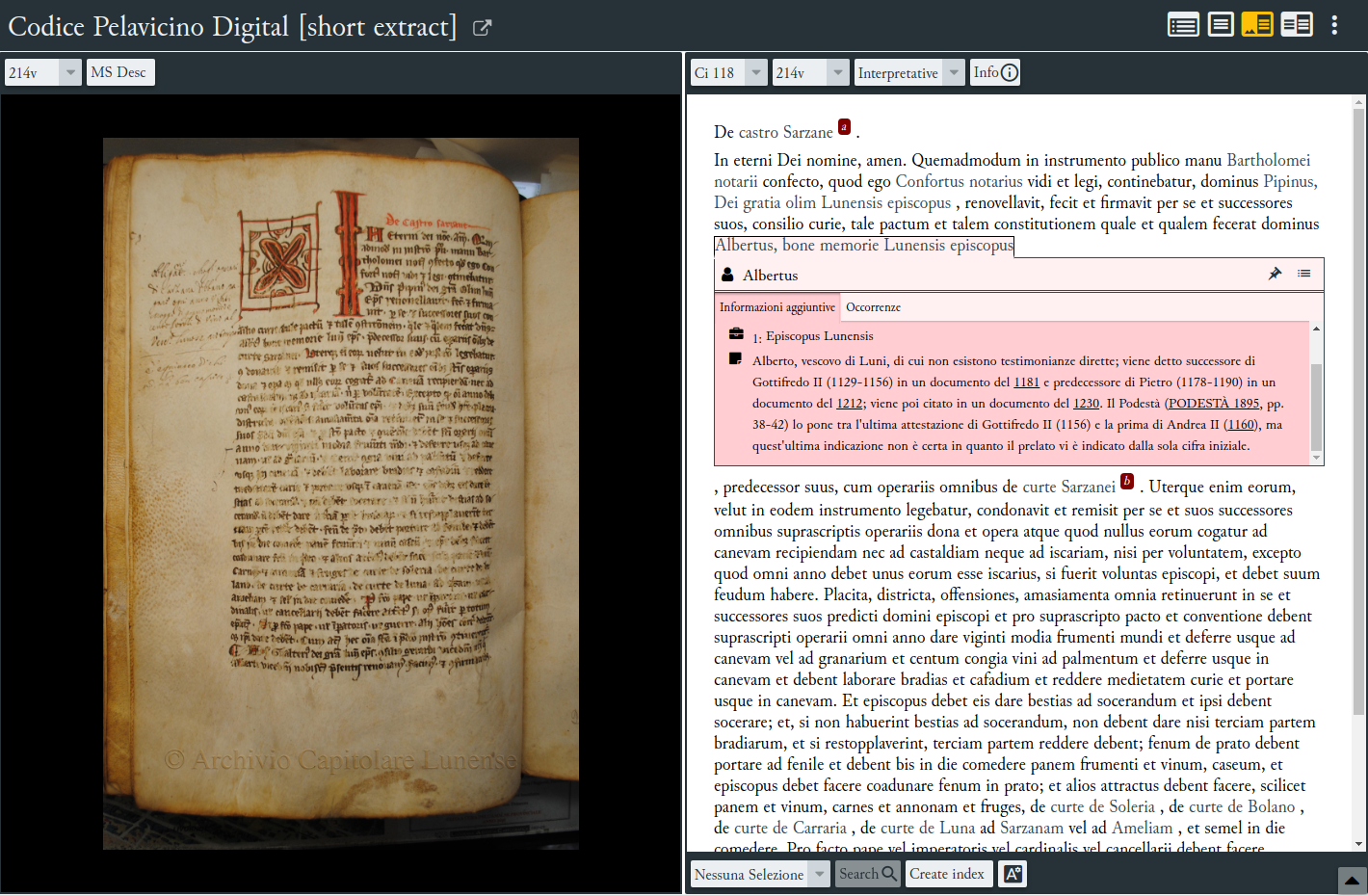
    After we published the first beta version of EVT 2, quite popular but still focused on the critical edition support only, development continued on many different fronts: catching up with EVT 1 with regard to diplomatic support, in particular, was high on our priority list. We are particularly happy, therefore, to release a second beta version for EVT 2 that catches up with EVT 1.3 under almost all that regards diplomatic edition support! But this is not the only new feature, here is a short list of all that goes into EVT 2 beta 2:
    • [NEW] support for diplomatic and interpretative editions: all the main features available in EVT 1, such us an advanced image viewer, text-image linking, support for <choice> elements, etc. are now implemented in EVT 2 as well;
    Text-image linking in EVT 2
    • [NEW] navigation bar: a navigation bar similar to the one available in EVT 1 has been added;
    • [NEW] TOC page: a new table of contents page has been added to the general menu, to improve organization and presentation of introductory material;
    • [NEW] textual search engine: complete with virtual keyboard, precise word search, highlight while you type in the search field and case sensitive search this is a great addition for diplomatic/interpretative editions;
    Textual search engine in EVT 2
    • [NEW] VisColl support: another feature to catch up with EVT 1, the VisColl XSLT style sheet has been added to the standard EVT 2 installation so that it is now possible to prepare a description of manuscript structure and have EVT automatically create SVG diagrams which can be browsed in a dedicated frame;
    VisColl support in EVT 2
    • [NEW] 3DHOP integration: now you can have a view dedicated to present and browse 3D models thanks to the 3DHOP software; this is a very recent development, still in an experimental state, but you are welcome to play with it! after this release work will start again to add 3D model – text linking;
    Report this ad
    Report this ad
    • [NEW] a Web interface for easy configuration is available for experimental purposes at this URL: http://evt.labcd.unipi.it/evt2-config/; note, however, that there have been so many changes that some of the options are not yet present in the web app;
    • [NEW] EVT 2 manual available in the doc folder: this is very much a work in progress, incomplete in some parts, but may be already be useful to our users;
    • [IMPROVED] named entities support: this feature has been refined so that it can work with diplomatic editions, also it is now possible to set named entities as entries in the pin area;
    Named entities support in EVT 2
    • lots of bug fixes and minor enhancements.
    The release can be downloaded from the usual Sourceforge page or directly from the home page, all the source code is available on GitHub. You can also browse the sample edition(s) directly from the project home page.

    Known bugs and issues

    We’ve come a long way, but please remember that this is a beta release: EVT 2 is not by all means a finished product, and while it can be used to publish digital editions there are still some bugs left and some features missing which will have to wait until the next release. The most significant issues are as follows:
    • some EVT 1 features, such as support for translations and for verse visualization, are not yet implemented in EVT 2;
    • text in the <front> element is going to be shown in the Info frame, there is no support yet for <titlePage> and/or original document content;
    • textual search is not working in the critical edition level, moreover for diplomatic/interpretative editions text indexes have to be created every time the edition is loaded;
    • named entities lists are not supported in the <back>, only in <sourceDesc>;
    • entries in named entities lists may be not shown if too many;
    • full screen 3DHOP view shows a distorted 3D model.