The British Museum's Ashurbanipal Library Project focused on the Babylonian
texts from Nineveh (Kouyunjik) is investigating the kind of Babylonian compositions
the Assyrian king Ashurbanipal (668-627 BC) ordered to include into his
royal library and their relation to the rest of the Kouyunjik Collection and
to the king's collecting activities. This project was conceived with a six
months research on the Kouyunjik Collection itself and became reality in March 2003 through
the generous funding by the Townley Group of the Friends of the British Museum. As a result
of the first part of the project I made 86 joins and created a database on the Babylonian Nineveh tablets.
A second part of the Ashurbanipal Library Project was conducted from
October until December 2005.
This time I made 59 joins. During the third part of the Ashurbanipal
Library Project (April until June 2006), I was able to make an
additional 38 joins.
During the three months in 2005, I also went through the files of the Museum to collect information
on the Nineveh tablet fragments that have been rejoined so far. During the first weeks of 2006
I created a database on the Nineveh joins, the Assyrian and Babylonian ones.
The RAS Collections hold only two reels of film. These have been digitised and are available to view.
We are grateful to Amara Thornton and Michael McCluskey from the UCL, Filming Antiquity project for their insights into this film.
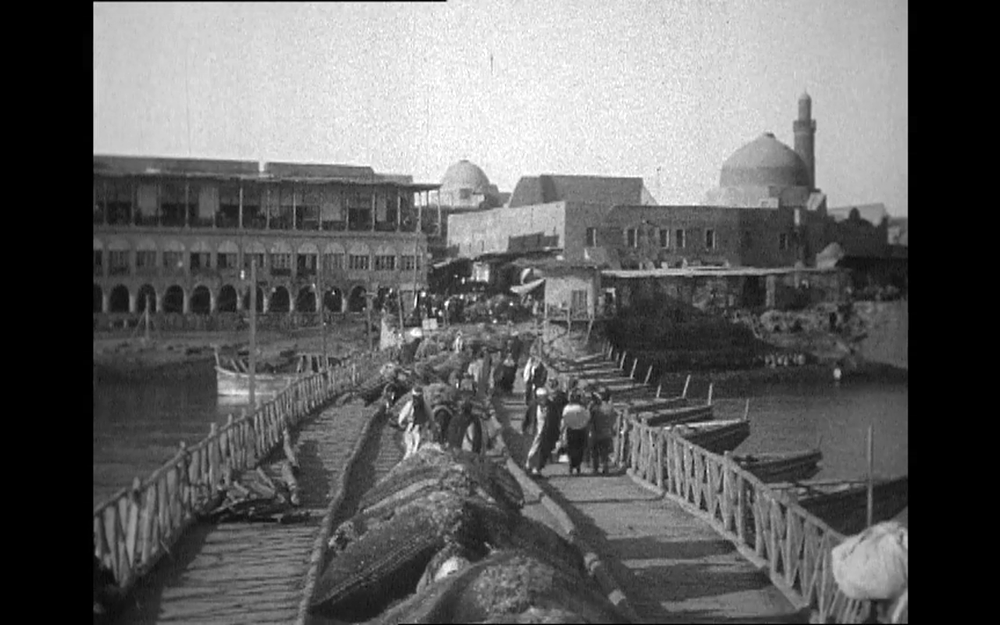
The footage dates from the late 1920s/early 1930s and shows
excavations in Iraq at the mound of Kouyunjik, scenes in the village of
Nebi Yunus, across the Khosr river from Kouyunjik within the ancient
city boundaries of Nineveh, and scenes in the city of Mosul, across the
river Tigris from Nineveh. The footage (at present) has been attributed
to Nineveh excavator Reginald Campbell Thompson (1876-1941), a British Assyriologist, epigrapher and archaeologist.
Campbell Thompson directed four seasons at Nineveh – the initial
1927/28 season was followed by three in succession – 1929/30, 1930/31
and 1931/32. He focused on the mound of Kouyunjik, the location of
Ashurnasirpal’s palace, and also sought evidence of a temple of the
Assyrian goddess Ishtar, which was eventually discovered during the
1930/31 season. Campbell Thompson’s wife, Barbara, joined him on site
for all four seasons, credited in the official publications with her
work on the “domestic” arrangements. A varied cast of team members
included two friends of Barbara’s – Miss Isabel Shaw (1929/30) and Miss
M. Hallett (1930/31) – as well as Richard Hutchinson (1929/30) and
Robert W. Hamilton (1930/31) and Max Mallowan and Agatha Christie
(1931/32). Of the Iraqi members of the excavation, Campbell Thompson
specifically credited his overseers Yakub and Abd-el-Ahad, as well as
Mejid Shaiya, whom Campbell Thompson referred to as “my old henchman”.
The film has impromptu title cards (no more formal than paper pinned
up for the camera) which lead viewers through a sequence of scenes.
Reginald Campbell Thompson was intensely interested in the customs,
culture and biographies of the people who worked with him and for him on
site. Campbell Thompson’s footage, if indeed he was behind the camera,
offers scenes similar to other excavation films from this period and
other, striking images unique to his own sense of the city of Mosul and
its dynamism. Through the camera lens we see the work of the dig in the
context of the local culture and geography. We see craft work, leisure
activities, and what one intertitle describes as a fête complete with
makeshift Ferris wheel.
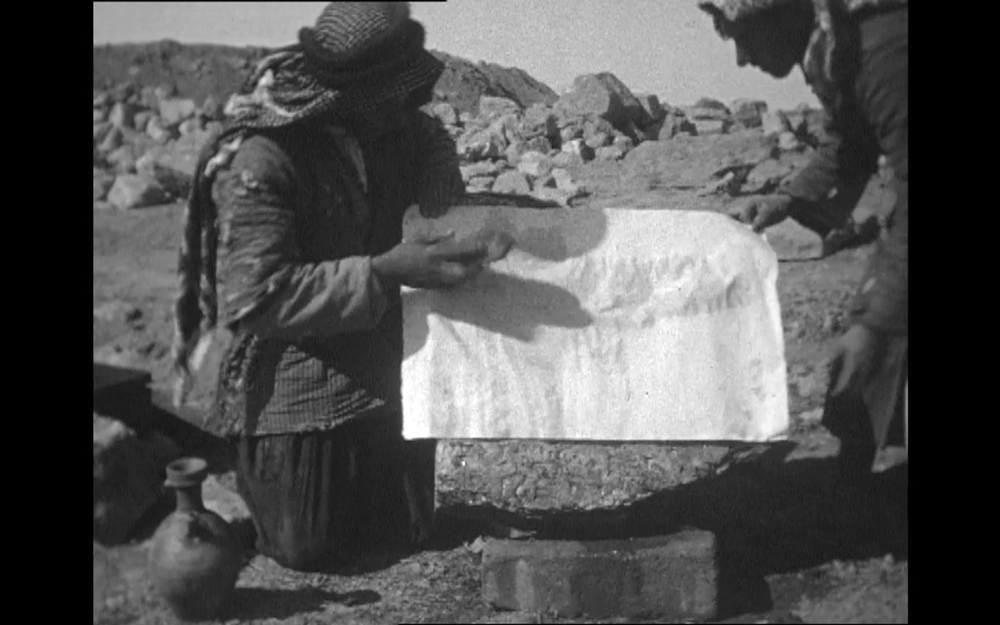
Other shots are more pedagogical and seemingly geared toward
students: a scene shows the ‘squeeze’ process of transferring stone
inscriptions onto paper and washing delicate pottery fragments. One
interesting sequence shows off the different modes of transportation
that intersect each day; crossing the screen we see a donkey drawing a
carriage, a bicycle, and a motor car. This interest in different modes
of transportation extends to the delicate process of ‘sending home’
items unearthed on the dig as we see workers ‘packing antiquities’ to be
sent presumably to Britain.
It is unknown when the reels of film came into the RAS Collections,
though it was noted in the Minutes for 13 November 1941 to thanks Mrs
Campbell-Thompson for Assyrological slides. It is possible that the
films were donated at the same time or were left after a Lecture.
Campbell Thompson gave “Excavations at Nineveh 1929-1930” (jointly with
R. W. Hutchinson) at the Royal Asiatic Society at 4.30 pm on 25
September 1930; and another lecture on 1 October 1931 (for the 1930-31
season).
The AWOL Index: The bibliographic data presented herein has been programmatically extracted from the content of AWOL - The Ancient World Online (ISSN 2156-2253) and formatted in accordance with a structured data model.
AWOL is a project of Charles E. Jones, Tombros Librarian for Classics and Humanities at the Pattee Library, Penn State University
AWOL began with a series of entries under the heading AWOL on the Ancient World Bloggers Group Blog. I moved it to its own space here beginning in 2009.
The primary focus of the project is notice and comment on open access material relating to the ancient world, but I will also include other kinds of networked information as it comes available.
The ancient world is conceived here as it is at the Institute for the Study of the Ancient World at New York University, my academic home at the time AWOL was launched. That is, from the Pillars of Hercules to the Pacific, from the beginnings of human habitation to the late antique / early Islamic period.
AWOL is the successor to Abzu, a guide to networked open access data relevant to the study and public presentation of the Ancient Near East and the Ancient Mediterranean world, founded at the Oriental Institute, University of Chicago in 1994. Together they represent the longest sustained effort to map the development of open digital scholarship in any discipline.






 Posts
Posts


 Stumble It!

