Sunday, November 21, 2021

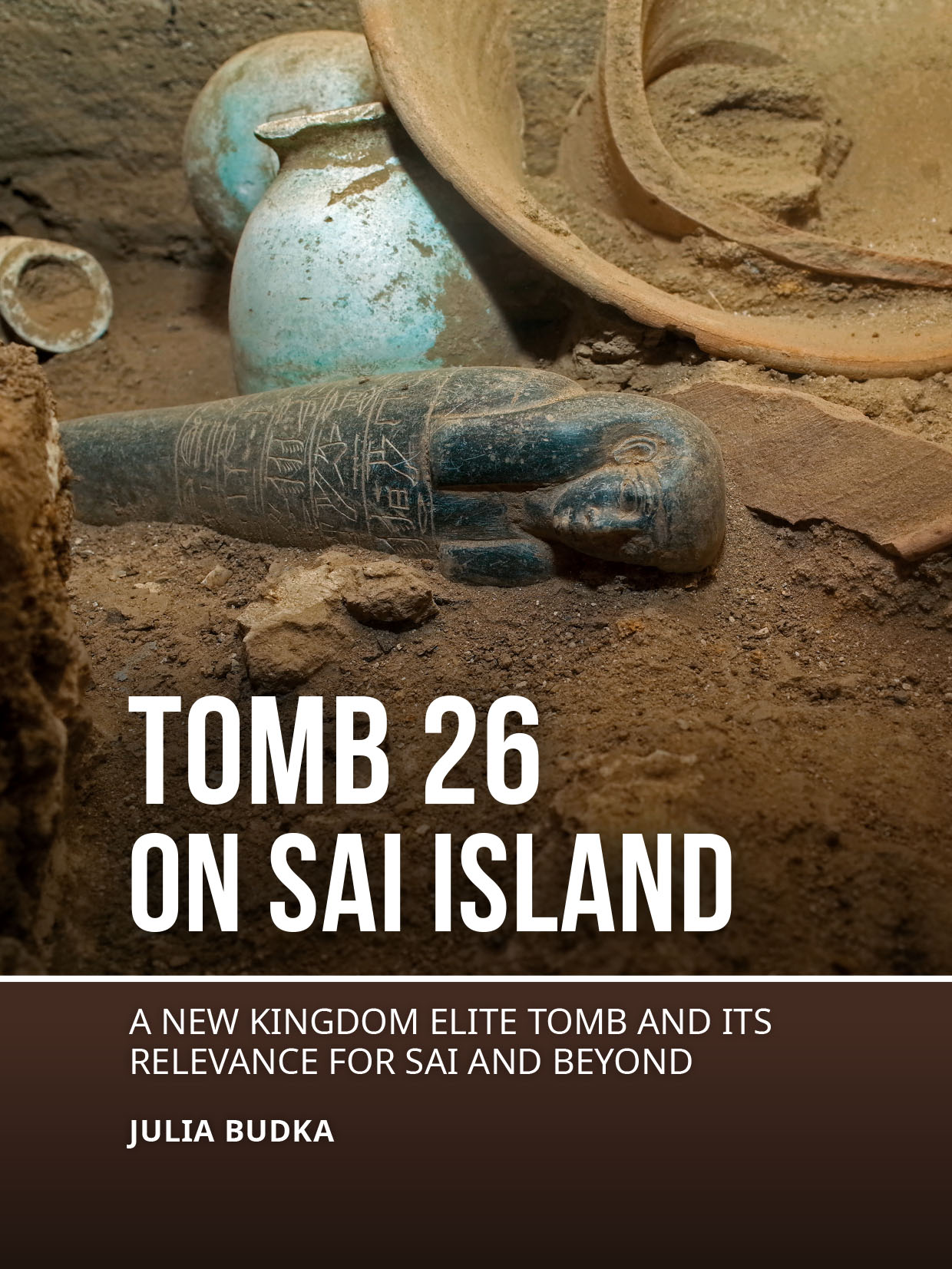
Tomb 26 on Sai Island: A New Kingdom elite tomb and its relevance for Sai and beyond

Julia Budka | 2021 
Paperback ISBN: 9789464260151 | Hardback ISBN: 9789464260168 | Imprint: Sidestone Press | Format: 210x280mm | 380 pp. | Language: English | 75 illus. (bw) | 275 illus. (fc) | Keywords: Sudan; Nubia; New Kingdom; Sai Island; funerary practise; tomb architecture; burial customs; funerary archaeology; Egyptian archaeology; Egyptology | download cover

New Kingdom burial customs in Nubia (northern Sudan) are well traceable by means of large cemeteries, in particular Egyptian style rock-cut shaft tombs with pyramidal superstructures. These tombs and their contents have lately been discussed as important data sets offering insights into the diverse population, material culture, funerary and social practices in New Kingdom Nubia.

A new rock-cut shaft tomb, potentially with pyramidal superstructure (Tomb 26), was discovered by the AcrossBorders project on Sai Island in 2015. This tomb yielded intact interments of officials connected with the Egyptian administration of colonial Nubia, buried together with family members and rich burial assemblages. Tomb 26 allows a close comparison with contemporaneous evidence from the nearby New Kingdom town of Sai, therefore providing a more complete picture of life and death in New Kingdom colonial Nubia. This book is the final publication of Tomb 26, its architecture and material culture, including chapters on geology, human remains, scientific analyses and a compilation of the material discovered. New information provided by AcrossBorders excavations of Tomb 26 contribute to recently discussed questions regarding cultural encounters and social practices in New Kingdom Nubia. Comparable material from other tombs on Sai and elsewhere in Nubia is discussed in order to stress the relevance of the new discovery.

The archaeological contextualisation of Tomb 26, in combination with scientific analyses like strontium isotope analysis, offers fresh information on the complex coexistence of various cultural groups on Sai with slightly different approaches to their cultural and social affinities during the New Kingdom. Overall, Tomb 26 and its associated finds are of prime significance for understanding lived experience on New Kingdom Sai and more broadly in New Kingdom Nubia.

with contributions by
Johannes Auenmüller, Cajetan Geiger, Rennan Lemos, Andrea Stadlmayr and Marlies Wohlschlager

Preface
Julia Budka

Chapter 1: Introduction
Julia Budka

Chapter 2: AcrossBorders’ excavations in SAC5
Julia Budka

Chapter 3: The architecture and building phases of Tomb 26
Julia Budka

Chapter 4: The geology of Tomb 26
Cajetan Geiger

Chapter 5: The artefacts including the ceramics of Tomb 26
Julia Budka

Chapter 6: Anthropological report of human remains recovered from Tomb 26
Marlies Wohlschlager and Andrea Stadlmayr

Chapter 7: The individual tomb groups of Tomb 26
Julia Budka

Chapter 8: The reconstruction of the use-life of Tomb 26
Julia Budka

Chapter 9: Tomb 26 in the context of cemetery SAC5
Julia Budka

Chapter 10: Cemetery SAC5 and its relation to the New Kingdom town of Sai
Julia Budka

Chapter 11: Khnummose and a group of New Kingdom stone shabtis – insights into colonial society in 18th Dynasty Nubia
Johannes Auenmüller and Rennan Lemos

Chapter 12: Summary
Julia Budka

Bibliography
Appendix


Saturday, November 20, 2021

Open Access Journal: Syrian Studies Association Newsletter

[First posted in AWOL 7 September 2009. Updated 20 November 2021]

https://ojcs.siue.edu/ojs/public/journals/5/pageHeaderLogoImage_en_US.gif
The Syrian Studies Association (SSA) is an international association organized to encourage and promote research and scholarly understanding of Syria in all academic disciplines. The SSA defines Syria as the area included in historic "Bilad al-Sham" until 1918 and Syria following that. We invite scholars who study the peoples and territories of what is today Syria, Jordan, Lebanon and Palestine before 1918 and those who study Syria after that to join our organization and to contribute to our newsletter. The Newsletter is particularly interested in articles on research and scholarship underway in Syria; reviews of new books on Syria, particularly those in Arabic and those that are not widely distributed; and articles on research and study opportunities in Syria.

Vol 25, No 1 (2021): Syrian Studies Association Bulletin

Table of Contents

Entire Volume in PDF Format

 
PDF

Letter from the Editor

Edith Szanto

Syrian Studies Association News

Dawn Chatty

Feature Articles

Lily Hindy
Arsheen Devjee
Davide Grasso

Book Reviews

Sumaira Nawaz
Kyle Bradley Ashley
Gabriel Lariviere
Gibson Gray


Vol 24, No 1 (2020): Syrian Studies Association Bulletin

Table of Contents

Entire Volume in PDF Format

 
PDF

Letter from the President


Letter from the Editor

Edith Szanto

Syrian Studies Association News

Paul Cobb
Fred Lawson

Feature Articles

Leila Asadi
Zakia Aqra
Arsheen Devjee

Research Notes

Ugur Umit Ungor

Book Reviews

Elyse Semerdjian
Sherwan Hindreen Ali
James Reilly
Matt Buehler


2015

Cover Page

Vol 20, No 1 (2015): Spring 2015 Issue

  • Title: Damascus and environs. Damascus. El Meidan. The 'Panhandle' street of Damascus
  • Creator(s): American Colony (Jerusalem). Photo Dept., photographer
  • Date Created/Published: [approximately 1920 to 1933]
  • Medium: 1 negative : glass, dry plate ; 4 x 5 in.
  • Reproduction Number: LC-DIG-matpc-11766 (digital file from original photo)
  • Rights Advisory: No known restrictions on publication.
  • Call Number: LC-M31- 3687-A [P&P]
  • Repository: Library of Congress Prints and Photographs Division Washington, D.C. 20540 USA
  • URL: http://www.loc.gov/pictures/item/mpc2005002943/PP/ 

2014

Vol 19, No 2 (2014): Fall 2014 Issue

The bulletin is a biannual publication of the Syrian Studies Association. 
Cover Page

Vol 19, No 1 (2014): Spring 2014 Issue

Nasser Rabbat's parents, Omar and Nihad, in 1955

2013

Entrance to Syrian refugee camp, Jordan

Vol 18, No 1 (2013): The Syrian Uprisings: Reflections on the Past Two Years

The bulletin is a biannual publication of the Syrian Studies Association. This issue includes feature articles focusing on the past two years of the conflict in Syria. It also includes news of the Syrian Studies Association and book and film reviews.

2012

taxis at Baramkeh Garage on a rainy day in early 2006

Vol 17, No 2 (2012): Syria: Past, Present, Future

Syria's famous old yellow taxis, shown here at Baramke Garage in Damascus on a rainy day in winter 2006.
Cover Page

Vol 17, No 1 (2012): The Syrian Uprisings: Reflections on the Past 14 Months

Spring 2011 cartoon by "The Syrian People Know Their Path": "Before Lifting the Emergency [Laws] / After Lifting the Emergency [Laws]"


2009

A man, wearing a fez, selling drinks from an ornate, portable, samovar-like dispenser in the Syrian Quarter of New York City.

Vol 15, No 1 (2009): Syrians in the Americas

A man, wearing a fez, selling drinks from an ornate, portable, samovar-like dispenser in the Syrian Quarter of New York City. George Grantham Bain Collection (Library of Congress). Original artwork by Vladimir Tamari.
Cover Page

Vol 14, No 2 (2009): Spring 2009 Issue

Original artwork by Palestinian artist Vladimir Tamari who resides in Tokyo.

2008

Kouefati factory in Aleppo.

Vol 14, No 1 (2008): First Electronic Issue

Feature Article: Shana Marshall, "Syria and the Global Financial Crisis: Insulated or Isolated?"


0

Cover Page

SSA Newsletter Archives

Past issues of the Syrian Studies Association Newsletter.


ARCE Conservation Archives

Beginning in the early 1990s with support from the United States Agency for International Development (USAID), ARCE engaged in vital conservation work at monuments and sites throughout Egypt, leading to a unique collection of material documenting conservation projects that constitute the ARCE Conservation Archives. In total, the Conservation Archives includes 79 collections, each documenting a different project conducted in Egypt.

The Conservation Archives covers a wide range of Egyptian history spanning over 7,000 years. Geographically and historically diverse, the projects include Pharaonic, Coptic, Islamic, and other Egyptian cultural heritage sites of significance. Some examples include Theban tombs TT50, TT69, and TT110, the Roman Wall Paintings at Luxor Temple, The Red Monastery, and the Bab Zuwayla monument in Historic Cairo. Project work includes conservation and archaeological field training, structural preservation, wall paintings conservation, and historical and archaeological documentation.

Each collection contains photographic and written material including 35mm and 120mm color and black & white slides, born-digital images, technical reports, and various grant-related documentation, in addition to a select number of project artifacts and architectural drawings. There are around 70,000 photographic slides, 200,000 images, 1,200 documents, 1,000 drawings, as well as a small selection of artifacts and multimedia content.

In 2015, ARCE began a partnership with the University of California, Los Angeles (UCLA) to digitize, describe, and publish content from the Conservation Archives. During the first phase of this partnership, ARCE and UCLA worked together to publish two archival collections in UCLA’s International Digital Ephemera Project (IDEP): the Luxor Roman Wall Paintings and the Tomb of Anen collections. In 2019, ARCE was awarded an National Endowment for the Humanities (NEH) Foundations Grant for Humanities Collections and Reference Resources to publish an additional three collections and build a new ARCE web portal to showcase these collections.


Friday, November 19, 2021

A Note to AWOL Subscribers

 Dear AWOL Subscribers,

Thanks for your patience as we here at AWOL Plaza try make the new email delivery service work more effectively. I'm working to reduce the notifications to one each day.

The previous service was no longer supported by its proprietor, and will be closed.  Follow.it is the best of the alternatives that cost me and you nothing. This is of course one of the principles behind AWOL. Scholarly resources on the ancient world that are free to read on line.

I'll do my best to make adjustments that improve the quality of the service.

In the meantime, If you know of something that might be useful to others, please let me know.

-Chuck Jones-
Editor, AWOL


Wikipedia List of cuneiform signs

Jump to navigation Jump to search

Cuneiform is one of the earliest systems of writing, emerging in Sumer in the late fourth millennium BC.

The signs in the following list are ordered by their 2004 Borger number (MesZL). Archaic versions of cuneiform writing, including the Ur III (and earlier, ED III cuneiform of literature such as The Barton Cylinder) are not included due to extreme complexity of arranging them consistently and unequivocally by the shape of their signs;[1] see Early Dynastic Cuneiform for the Unicode block.

The columns within the list contain:

  1. MesZL: The sign numbers of Rykle Borger's Mesopotamisches Zeichenlexikon (2004);
  2. ŠL/HA: The Deimel Numbers from Šumerisches Lexikon (ŠL), completed and accommodated in Ellermeier and Studt's Handbuch Assur (HA);
  3. aBZL: The numbers of Mittermayer's Altbabylonische Zeichenliste der sumerisch-literarischen Texte (2006);
  4. HethZL: The numbers of Rüster and Neu's Hethitisches Zeichenlexikon (1989);
  5. Sign Name according to MesZL, HA etc.;
  6. The Unicode code points numbers (»A & B« and »A & B & C« indicates the numerous characters that must be written by combining two or three shorter signs);
  7. The Unicode sign names;
  8. Comments.

In MesZL, signs are sorted by their leftmost parts, beginning with horizontal strokes (single , then stacked TAB, 16), followed by the diagonals GE23 and GE22, the Winkelhaken U and finally the vertical DIŠ. The relevant shape for the classification of a sign is the Neo-Assyrian one (after ca. 1000 BC); the standardization of sign shapes of this late period allows systematic arrangement by shape.

The difference between the conventional sign names - they are used in MesZL, HA, aBZL and other standard publications - and the names in the Unicode 5.0 cuneiform encoding standard is often very significant. So the Unicode names as well as the standard ones are listed.

At Sumerisches-Glossar.de the complete sign list as PDF with all cuneiform signs and with an introduction by Rykle Borger is to be found.


Was vom Himmel kommt: Stoffanalytische Zugänge zu antiken Mythen aus Mesopotamien, Ägypten, Griechenland und Rom

What Comes from the Sky: Material Analysis Approaches to Ancient Myths from Mesopotamia, Egypt, Greece, and Rome
book: Was vom Himmel kommt
  • Funded by: Georg-August-Universität Göttingen
  • Edited by: Gösta Ingvar Gabriel, Brit Kärger, Annette Zgoll and Christian Zgoll
Volume 4 in the series Mythological Studies

 In ancient myths, the sky is a numinous space. What comes from it is of outstanding importance. This transdisciplinary volume by the Collegium Mythologicum explores myths that involve transfers from the sky. The volume utilizes the hylistics established by Christian Zgoll to combine and compare its findings. Ultimately, transfers from the sky prove to be indicators of numinosity in mythical garb.

Frontmatter
Open Access

I
Vorwort
Open Access
VII
Inhalt
Open Access
IX
Abkürzungsverzeichnis
Open Access
XXIII

Teil 1: Einführendes und Theoretisch- Methodisches


Was vom Himmel kommt
Gösta Gabriel, Brit Kärger, Annette Zgoll and Christian Zgoll
Open Access
3
Grundlagen der hylistischen Mythosforschung
Christian Zgoll
Open Access
11

Teil 2: Überblicksbeiträge


Götter, Tempel, numinose Machtmittel ...
Brit Kärger
Open Access
55
Demons and Tutelary Deities from Heaven
Elyze Zomer
Open Access
161
Skyfall oder mythische Hyleme zum Herabkommen aus dem Himmel
Franziska Naether
Open Access
189
Göttergaben und Götterstürze
Christian Zgoll
Open Access
221

Teil 3: Einzelstudien


Wie der erste Tempel auf die Erde kommt
Annette Zgoll
Open Access
271
Von Adlerflügen und numinosen Insignien
Gösta Gabriel
Open Access
309
Vom Himmel oder nicht vom Himmel?
Jörg v. Alvensleben
Open Access
409
Vom Himmel gefallen
Christian Zgoll
Open Access
457
Wie Hypnos nach Lemnos kam
Matthias Theißen
Open Access
493
Himmelsschilde und Blitze
Nils Jäger
Open Access
511

Teil 4: Komparative Auswertungsbeiträge


Ausgangs- und Zielpunkte des Transfers vom Himmel in antiken Mythen
Brit Kärger
Open Access
547
Wer oder was vom Himmel kommt
Annette Zgoll
Open Access
553
Akteure von Transfers vom Himmel
Annika Cöster-Gilbert
Open Access
563
Art und Weise des Transfers vom Himmel
Jörg v. Alvensleben and Nils Jäger
Open Access
567
Mittel des Transfers vom Himmel
Franziska Naether and Elyze Zomer
Open Access
569
Lugalbandas Königtum und das Feuer des Prometheus
Annette Zgoll and Christian Zgoll
Open Access
571
Namens-, Sach- und Stellenregister
Open Access
609
  • Language: German
  • Publisher: De Gruyter
  • Copyright year: 2021
  • Audience: Scholars in the fields of (comparative) literary studies, ancient Near East studies, classical studies, egyptology, ethnology
  • Pages
    • Front matter: 26
    • Main content: 626
  • Illustrations
    • Illustrations: 7
    • Coloured Illustrations: 2
    • Tables: 148
  • Keywords: Myth; classical antiquity; ancient Near East; Greece
eBook
  • Published: September 7, 2021
  • ISBN: 9783110743005
Hardcover
  • Published: September 7, 2021
  • ISBN: 9783110742879