Showing posts with label Student Journal. Show all posts

Monday, April 27, 2026

Open Access Journal: Past Imperfect

[Firsts posted in AWOL 27 October 2012, updated 27 April 2026]

Past Imperfect
ISSN: 1192-1315

Past Imperfect Logo: A quill pen broken just before the nib next to the text Past Imperfect.

Past Imperfect is a peer-reviewed graduate student journal based out of the Department of History, Classics, and Religion at the University of Alberta. We welcome submissions, in French or in English, from graduate students in all areas of History, Classics, and/or Religious Studies. This open access journal provides an opportunity for developing scholars to gain experience with peer-reviewed academic publishing.

Past Imperfect welcomes original research articles and book reviews covering a broad range of both time and geography. The journal especially encourages the submission of revised term papers, conference presentations, or thesis chapters. Articles that appear in Past Imperfect are abstracted in “America: History and Life” and “Historical Abstracts.”

  • Archives
  •  

    Sunday, September 7, 2025

    Open Access Journal: Brown Classical Journal

    [First posted in AWOL 5 September 2013, updated  (new URL) 7 September 2025]

    Brown Classical Journal
    ISSN 1043-0156
    The Brown Classical Journal was founded in 1984 by Professor Alison Goddard Elliott, who

    The Brown Classical Journal was founded in 1984 by Professor Alison Goddard Elliott, who nurtured the editors and contributors of that first volume as Faculty Editor. Sadly, the volume was dedicated to her memory. Susan Hueck Allen, then a graduate student, designed the logo for the journal, which was used for the first eleven volumes. The BCJ is published annually and typically is printed in the spring.

    The purpose of the BCJ is "to encourage and to reward well written essays by students of the Classics at Brown University." 

    We welcome submissions of essays, original poetry, translations from the Greek and Latin, art work, or original photographs on a classical theme, from any undergraduate with an interest in the classics. Although we anticipate that the bulk of accepted submissions will focus on Greco-Roman antiquity and on the traditions of classical antiquity in subsequent eras, we also welcome submissions that treat the cultures of any ancient society, East or West.


    Sunday, July 6, 2025

    Open Access Journal: Berkeley Undergraduate Journal of Classics

    [First posted in AWOL 12 November 2013, updated 6 July 2025]

    Berkeley Undergraduate Journal of Classics
    e-ISSN 2373-7115
    Berkeley Undergraduate Journal of Classics banner
    The Berkeley Undergraduate Journal of Classics is committed to the progress and proliferation of scholarship in the field of Classics and to providing a common medium through which undergraduates from all relevant disciplines can actively engage in one another’s work. In order to establish a channel for interdepartmental exchange and collaboration, we seek to publish exceptional papers and translations from a wide range of fields pertaining to Classics and the world of the ancient Mediterranean.

    Volume 9, Issue 1, 2023


    Forematter

    Cover photo

    This is the cover photo

    Cover Letter

    This is the cover letter for volume nine issue one

    Articles

    Manly Women and Womanly Men: An Analysis of Gender Stereotypes and Inversions in Terence’s Hecyra

    In Roman New Comedy, each role is a caricature informed by societal expectations: the passive matrona, the grouchy uir, the abused but patient young uxor, the egotistical adulescens, and the self-serving meretrix. Hecyra stands out among Terence’s plays because it is unclear whether he is reinforcing or deconstructing these familiar stereotypes. Most scholars focus on the role of women, who are more involved in this play than any other by Terence. They seem to drive the plot forward and have more information than the men, but at the same time, they might be said to placate their husbands and sacrifice for their children. This begs the question, “Are the women in Hecyra acting unusually?” This paper will examine the expectations of women in New Comedy in relation to scenes where women in Hecyra might be said to be contradicting their prescribed roles. This discussion will prove that the wives are not acting in unexpected...

    Defining Amantem: Dido and Popular Modern English Translations of the Aeneid

    In the Aeneid, Ancient Rome’s seminal epic poem and Vergil’s greatest work, a queen falls in love and later commits suicide. This queen’s name is Dido, and her story contains some of Vergil’s best poetry, but it has also long been a source of interpretive debate by translators. This paper seeks to illuminate how popular, modern, English translations of the Aeneid have depicted this dynamic, tragic character. These translations (i.e. Ruben, Fitzgerald, Lewis, and others) are the ones read in classrooms and disseminated to the wider public. This paper will attempt to understand them by examining how a translator’s personality and philosophy affect their decisions about the translation’s fidelity, cadence, and expressiveness. It is a comprehensive outline of Dido’s journey through the modern age and how that journey may change as more translators come to the fore who have their own distinct, diverse stories. The Aeneid lives through its...

    AGAINST FATE AND FORTUNE: The Ethics of Agency in Books 1-6 of Statius' Thebaid

    Statius' Thebaid, a Roman retelling of the infamous Oedipus myth, owes much to its literary forebears. The central tale the epic explores is borrowed from an ancient source: Greek accounts of an unlucky Oedipus and his unhappy offspring. But this first-century rendering is not a carbon copy of its antediluvian precedents, and Statius' treatments of fate, fortune, and human agency diverge distinctly from those of his most immediate narrative parallels. Indeed, it is in the Thebaid's departure from the causal framework of these assorted sources that its author's influence is most clear.

    Throughout the epic's early books, the doubled determinism of Statius' literary inheritance gives way to a possibility of ethical independence for creator and...

    Reception of Epicureanism at Rome: Cicero, Lucretius, and the Flexibility of Greek Models in the Late Republic

    Epicureanism, a Greek philosophical school founded in Athens c. 307 BCE, conceives of “pleasure” (αταρξία) as the ultimate human good. This essay aims to investigate the reception of Epicureanism at Rome in the mid-1st century BCE, drawing on Cicero’s In Pisonem and Lucretius’ De Rerum Natura as case studies. Each work addresses the question of whether Epicurus could operate within the framework of Roman cultural and political values and, consequently, whether he should be appropriated into Roman thinking. Through close examination of these two texts, I argue that each author ultimately builds his own version of “Epicurus” to serve his distinctive rhetorical aims. Cicero and Lucretius therefore come together to provide examples of a broader phenomenon surrounding the issue of Hellenization at Rome, namely, that of Greek figures being rewritten and repurposed in different contexts to serve different Roman agendas, revealing...

    Ancient Information War within Greek Colonial Narratives: An Analysis of the Theraian-Cyrenean Founding Myth through Historiography and Archaeology

    During the Greek Archaic Period, the Greek world saw rapid development in culture, economy and political organization.  These advancements led to increased prosperity and facilitated the formation of distinct political units.  However, these developments introduced new pressures on these nascent governments, which led to waves of Greek colonization across the Mediterranean world.  This introduced the new political relationship of ‘mother city’ and ‘colony’ into existing trans-Mediterranean networks, a complex structure that would play a large role in the politics of the Greek Classical Period.  This paper explores the colonial foundation narrative of Cyrene, one of the most well documented foundation myths surviving, by looking at the competing and contrasting claims put forward by Cyrene and Thera.  This paper examines the both the historical context and the geopolitical considerations at play behind the various components...

    See AWOL's full List of Open Access Journals in Ancient Studies

    Friday, April 4, 2025

    Open Access Journal: eisodos: Zeitschrift für Antike Literatur und Theorie

    [Firsts posted in AWOL 2 June 2014, updated 4 April 2025]

    eisodos: Zeitschrift für Antike Literatur und Theorie
    ISSN: 2364-4397
    eisodos-Logo
    eisodos – Zeitschrift für Antike Literatur und Theorie ist eine peer-reviewed, open-access, online-Zeitschrift für B.A.- und M.A.-Studierende sowie Doktoranden zu Beginn ihrer Promotion. Es werden sowohl Studierende der Klassischen Philologie als auch Studierende der Byzantinistik, des Mittel- und Neulatein, der Allgemeinen & Vergleichenden Literaturwissenschaft oder einer modernen Literaturwissenschaft eingeladen, Beiträge in deutscher oder englischer Sprache einzusenden.

    Thematischer Schwerpunkt von eisodos sind Fragen der Interpretation von antiker Literatur und des Theorievergleichs. Interpretation von Literatur meint hier gleichberechtigt Studien zu Einzelwerken von Literatur, zu Einzelaspekten in diesen Werken sowie zu Literatur allgemein. Die theoretische Basis für verschiedene Herangehensweisen an Literatur sollen dabei stets auch thematisiert werden.
    eisodos – Journal for Ancient Literature and Theory is a peer-reviewed, online-journal for B.A.- and M.A.-students as well as Ph.D.-Students in the early stages of their Ph.D. Classisicsts, students of Byzantine and Modern Greek Studies, as well as students of Middle and New Latin, Comparative Literature or any other Literary Studies are invited to submit contributions.

    eisodos has as its focus questions on the interpretation of Ancient literature. The comparison of different literary theories is a further key aspect on which eisodos will welcome submissions. Interpretation here is intended to include both studies on individual works of literature or specific aspects in individual works of literature as well as studies on literature in general. The theoretical framework and approach that forms the basis of any of these interpretations should always be articulated.

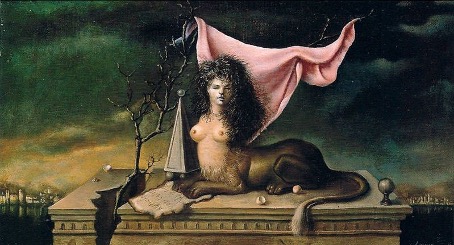
    Gemälde. Eine Figur mit Frauenoberkörper inklusive nackter Brüste und Löwenunterkörper (Fell, Schwanz). Wilde längere schwarze Haare, hinter der Figur ein wehendes rose Tuch, die Figur sitzt auf einer Art steinernem Podest, das an der linken Seite einen durchgehenden Riss hat, aus dem ein Baum wächst. Der Himmel ist dunkel-bedrohlich, im Hintergrundeine Stadt.

    Rezeption & Subversion – Mythen aus feministischer Perspektive ist der thematische Schwerpunkt der vorliegenden eisodos-Ausgabe 2025 (1). Ungebrochen ist die Relevanz der Frage nach weiblicher Selbstermächtigung in misogynen Systemen, die im antiken Mythos ebenso vielschichtig verhandelt werden wie in den späteren Neuschreibungen und Neuinterpretationen, die im Fokus dieser Ausgabe stehen: Göttinnen, Hexen, Nymphen, (un-)treue Gattinnen und weiblich gegenderte Fabelwesen, Monster und Statuen kehren im Zuge der Blumenberg’schen „Arbeit am Mythos“ auf subversive Art wieder, bevölkern Bücherregale, Theaterbühnen und Serienbildschirme und üben – zumindest in den in dieser Ausgabe untersuchten Werken – Kritik an Ungleichheit, Gewalt, Krieg und heroischem Leichtsinn. Johanna Böttiger beschäftigt sich mit dem genderfluiden Wesen Sphinx, Milena Hofmeister mit drei Versionen der umstrittenen Helena, Franziska Fritsch mit Pygmalions erweckter Statue und Ibsens erwachter Toter, Marisa Morell mit dem Konflikt zwischen Athene und Medusa und Leonie Zinth mit der Begegnung von Kirke und Medea. Die Beiträge, die hier versammelt sind, haben ihren Anfang in einem BA-Seminar genommen, das im Wintersemester 2021/2022 von Sophie Seidler an der LMU München abgehalten wurde. 

    Veröffentlicht: 08.03.2025


    Monday, October 30, 2023

    Open Access Journal: Diogenes

     [First posted in AWOL 31 July 2016, updates 30 October 2023]

    Diogenes
    ISSN: 2054-6696

    http://gembirminghamdotorg.files.wordpress.com/2013/09/cropped-gem_thing_2_by_pastel_hime-d6lwzi3.png
    Launched in January 2014, Diogenes (ISSN 2054-6696) is a peer-review and open-access journal edited by the postgraduate students at the Centre for Byzantine, Ottoman and Modern Greek Studies, University of Birmingham. This collaboration of postgraduate students aims at providing a venue at which postgraduate students can further develop their research ideas and communicate them to a general audience.

    The unique combination of research interests at the Centre brings together the often separate fields of Byzantine, Ottoman and Modern Greek Studies. We look forward to any article that actively engages with any of these fields, from universities in the UK and abroad.

    It is published twice a year: in April and October.

    DIOGENES 14, JULY 2022

    The editors are pleased to present the fourteenth issue of Diogenes! The contents of this issue are as follows: Articles Dimitrios Bogdantsalis, The brigand Indacus of Papirium Alexandros Makris, International Veterans’ Organisations during the Interwar period and their impact on Greece Sofia Puchkova, The Last Commandment as a Homoousian Doctrinal Formula: An Analysis of Theodore of Mopsuestia’s Interpretation of Mt … More DIOGENES 14, JULY 2022

    Advertisements
    Report this ad

    Diogenes 13, January 2022

    The editors are pleased to present the thirteenth issue of Diogenes! The contents of this issue are as follows: Article Dimitrios Bogdantsalis, Οἰκεῖοι: The network of Empress Verina Konstantinos Karatolios, Exercising Justice in 14th century Byzantium. A comparison study between Kallimachos and Chryssorhoe and On the Imperial Office Lida-Maria Dodou, The Habsburg impact on Salonica … More Diogenes 13, January 2022

    CALL FOR CONTRIBUTIONS

    The editorial team is proud to announce the Call for Contributions for the 13th issue, to be published in December 2021. We look forward to receiving contributions in English by postgraduate students in Byzantine, Ottoman, and/or Modern Greek Studies in the UK and abroad, in the following forms: Article We welcome articles on topics of history, … More CALL FOR CONTRIBUTIONS

    Diogenes 11, June 2021

    The editors are pleased to present the eleventh issue of Diogenes! The contents of this issue are as follows: Article Joaquin Serrano del Pozo, The Cross-standard of Emperor Maurice (582-602 AD) Clark R. Bates, Stoudios: The Convergence of History, Palaeography, and Textual Criticism on the Greek Minuscule HandMaria Ester Portokali, Emotional alterations on stage: the … More Diogenes 11, June 2021

    DIOGENES 10, DECEMBER 2020

    The editors are pleased to present the tenth issue of Diogenes! The contents of this issue are as follows: Article Irene Caracciolo, John Orphanotrophos and Saint Nicholas: a special relationship?Some observations in light of figural evidence Foivi-Eirene Georgiadi, Slaves’ lives in saints’ Lives: What information about slaves can be found in Byzantine Lives of saints? … More DIOGENES 10, DECEMBER 2020

    DIOGENES 9, JULY 2020

    The editors are pleased to present the ninth issue of Diogenes! The contents of this issue are as follows: Article Elena Nonvellier, The Brumalia festival from Rome to Byzantium: continuity or ideological reinvention? Zoe Kokka, Banquets as theatre of cultural difference in 12th century byzantine romance Review Fuka Fujita, Orthodox Cyprus under the Latins, 1191-1571: Society, … More DIOGENES 9, JULY 2020

    Diogenes 7, March 2019

    The editors are pleased to present the seventh issue of Diogenes! The contents of this issue are as follows: Article Evan Andersson, University of California, Reforming the Image of the Philosopher: The Emperor Julian in the Historia Ecclesiatica of Socrates of Constantinople   James Cogbill, University of Birmingham, A historiographical examination of the Byzantine family system under … More Diogenes 7, March 2019

    Diogenes

    The Call for Submissions for Diogenes (7.2) is now closed. Thank you very much to those who submitted their papers. Authors will be notified by the general editor within a month for the status of their submission.

    Issue 6, November 2017

    The editors are pleased to present the sixth issue of Diogenes! The present issue is a by-product of some of the papers presented at the PGR Colloquium on Multiculturalism from late Antiquity to Modernity organised at the Centre for Byzantine, Ottoman and Modern Greek Studies in June 2017 by Gemma Masson and Francisco Lopez-Santos Kornberger. The … More Issue 6, November 2017

    Diogenes, Issue 5 (November 2016)

    The editors are pleased to present the fifth issue of Diogenes! The contents of this issue are as follows: Articles: The Monastic Revolution: The Case of Sozomen’s Church History – Matteo Antoniazzi Between the Local, the Global, and the Political: Local Poetics and Social Activism in Yiannēs Makridakēs’s Work – Vassiliki Kaisidou Greek attitudes towards … More Diogenes, Issue 5 (November 2016)

    Diogenes – Release of the 4th Issue

    Issue 4 April 2016 Issue 4 (Whole) Halil Deligöz: On the Quality of Economic Institutionalization in the Late Ottoman Period: The Introduction of Intellectual Property Rights Sophie Rigby: To impress (upon) a people: ceramic tile decoration in the context of Orthodox Bulgaria Deniz Sever: A Pilgrim’s Self-Identification: Sixth and Seventh Century Lead Pilgrim Flasks from … More Diogenes – Release of the 4th Issue

    Diogenes – Release of the 3rd Issue

    Issue 3 April 2015 Issue 3 (Whole) Wei-sheng Lin: Editorial Francisco Lopez-Santos Kornberger: Review – Striking Images, Iconoclasms Past and Present Joseph Parsonage: Review – The Byzantine world Michael Strain: Review – The Author in Middle Byzantine Literature: Modes, Functions, and Identities Georgia Tsatsani: Review – Re-imagining the Past: Antiquity and Modern Greek Culture Tomoo … More Diogenes – Release of the 3rd Issue

    Diogenes -Release of the 2nd Issue

    Issue 2 October 2014 Issue 2 (Whole) Wei-sheng Lin: Editorial Murat Issi: Οι σκέψεις των Νεο-Οθωμανών περί του Ισλάμ Styliani Lepida: The poll tax (cizye) in Cyprus during the 17th century: A depiction for the administration of its revenue Dimos Ntentos: Όψεις αυτοαναφορικότητας στην Expeditio Persica του Γεωργίου Πισίδη Gözde Önder: Ceramics and Carpets: Icons … More Diogenes -Release of the 2nd Issue


    Monday, September 18, 2023

    Open Access Journal: Chronika: The Institute for European and Mediterranean Archaeology Graduate Student Journal

    [First posted in AWOL 5 May 2014, updated 18 September 2023]

    Chronika: The Institute for European and Mediterranean Archaeology Graduate Student Journal
    ISSN: 2159-9904
    EISSN: 2159-9912
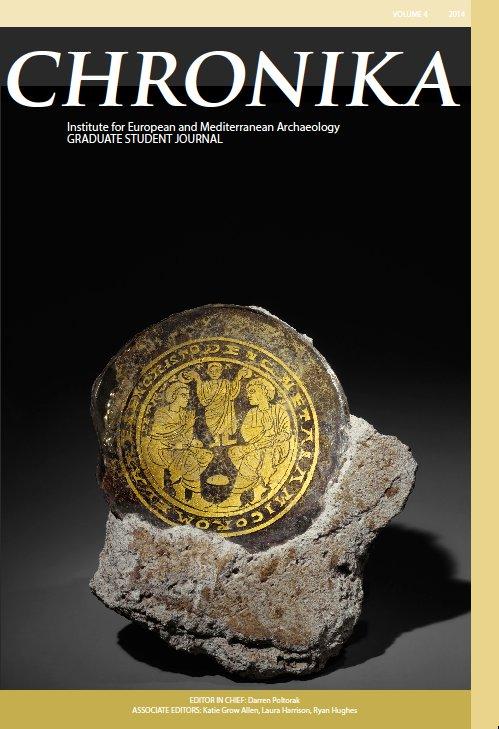
    http://www.chronikajournal.com/resources/cover.jpg.opt499x729o0%2C0s499x729.jpg 
    Chronika is an interdisciplinary journal for graduate students studying the art and archaeology of the Mediterranean world. 
    Chronika, like its parent organization The Institute for European and Mediterranean Archaeology (IEMA), promotes interdisciplinary dialogues and innovative approaches to the study of the past. Chronika is an open access journal and aims to publish cutting edge research in a timely fashion and make it widely available to the scholarly community. We encourage collaborative, interdisciplinary scholarship by making the content of our journal freely available online.
    Chronika is produced by University at Buffalo graduate students, but welcomes submissions from graduate students at other colleges and universities worldwide. Students are encouraged to submit an article here.
     Current Issue:

    Current Issue

    Chronika, Volume 11, Full Text 

    Chronika volume 11.pdf Chronika volume 11.pdf
    Size : 4834.089 Kb
    Type : pdf

    Letter from the Editor: 

    Letter from editor.pdf Letter from editor.pdf
    Size : 162.542 Kb
    Type : pdf

    Articles: 

    Brittany Proffitt, University of Missouri

    "Seat of Power: The Afterlife of the Achaemenid Throne on Minted Coinage"

    Proffitt.pdf Proffitt.pdf
    Size : 1157.927 Kb
    Type : pdf

    Francis Mahon, University of York

    "The Colonial City: Eden, Amazonia, and the Humanist Imagination"


    Mahon.pdf Mahon.pdf
    Size : 291.476 Kb
    Type : pdf

    Jennifer Weigel, Florida State University


    "Spears and Speculation: Deconstructing Gender Assumptions in Etruscan Tombs"


    Weigel.pdf Weigel.pdf
    Size : 576.343 Kb
    Type : pdf

    Erin Brantmayer, The University of Texas at Austin


    "Almost Heaven, West Arkadia: Reconsidering the Ritual Use of Mountains in Late Bronze Age Greece"


    Brantmayer.pdf Brantmayer.pdf
    Size : 715.084 Kb
    Type : pdf

    Aleksandra Cetwińska, University of Warsaw


    "Breaking Pots? Late Neolithic Rituals Among Paraneolithic Hunter-Gatherers in North-Eastern Poland"


    Cetwinska.pdf Cetwinska.pdf
    Size : 623.875 Kb
    Type : pdf

    Konrad Bennett Hughes, University of Missouri

    "Imitations and Alterations:Numismatic Evidence of the Relationship between the Varangian-Rus and the Khazars"

    Hughes.pdf Hughes.pdf
    Size : 552.17 Kb
    Type : pdf

    Maciej Sadło, University of Warsaw

    "Experimental Studies in the Field of Ballistics on Different Types of Arrow Shafts "

    Sadlo.pdf Sadlo.pdf
    Size : 1911.036 Kb
    Type : pdf

    Brent Whitford, University at Buffalo

    Book Review: McCoy, M.D. 2020. Maps for Time Travelers.

    Whitford.pdf Whitford.pdf
    Size : 256.903 Kb
    Type : pdf


    Back Issues

    Friday, December 9, 2022

    Open Access Journal: Studies in Mediterranean antiquity and classics

    [First posted in AWOL 6 July 2013, updated  9 December 2022]

    Studies in Mediterranean antiquity and classics
    ISSN: 1934-3442
    SMAC features the outstanding research of undergraduates at Macalester College in the study of ancient Mediterranean people and cultures. Papers are welcome addressing the languages, literature, material culture, societies or history of the ancient Mediterranean world or their reception in later historical periods. Submissions are peer reviewed by advanced students at Macalester College.

    Current Issue: Volume 6, Issue 1 (2022) Qumran and the Dead Sea Scrolls

    Introduction

    Editor

    Nanette Scott Goldman

    Articles