Monday, July 4, 2016

Polonsky Foundation Digital Project: A Collaboration Between the Bodleian Libraries and the Biblioteca Apostolica Vaticana

[First posted in AWOL 3 December 2013, updated 4 July 2016]

Polonsky Foundation Digital Project: A Collaboration Between the Bodleian Libraries and the Biblioteca Apostolica Vaticana 
 http://bav.bodleian.ox.ac.uk/sites/default/files/styles/home_page/public/azx0012_0.jpg?itok=h7d6fRAo
The Bodleian Libraries of the University of Oxford and the Biblioteca Apostolica Vaticana (Vatican Library) have joined efforts in a landmark digitization project with the aim of opening up their repositories of ancient texts. Over the course of the next four years, 1.5 million pages from their remarkable collections will be made freely available online to researchers and to the general public.

The initiative has been made possible by a £2 million award from the Polonsky Foundation. Dr Leonard Polonsky, who is committed to democratizing access to information, sees the increase of digital access to these two library collections — among the greatest in the world — as a significant step in sharing intellectual resources on a global scale.

Dr Polonsky said: ‘Twenty-first-century technology provides the opportunity for collaborations between cultural institutions in the way they manage, disseminate and make available for research the information, knowledge and expertise they hold. I am pleased to support this exciting new project where the Bodleian Libraries and the Biblioteca Apostolica Vaticana will make important collections accessible to scholars and the general public worldwide.’

The digitization project will focus on three main groups of texts: Hebrew manuscripts, Greek manuscripts, and incunabula, or 15th-century printed books. These groups have been chosen for their scholarly importance and for the strength of their collections in both libraries, and they will include both religious and secular texts. For the launch of the project, however, the two libraries have focused on bringing to light a smaller group of Bibles and biblical commentaries, each of which has been chosen for its particular historical importance.


Sunday, July 3, 2016

The Center for Study and Preservation of the Majority Text (CSPMT)

The Center for Study and Preservation of the Majority Text (CSPMT)
http://www.cspmt.org/themes/zeropoint/_custom/headerimg/rotate.php
The Center for Study and Preservation of the Majority Text (CSPMT) is an organization dedicated to scholarly study, research and preservation of Byzantine Greek New Testament manuscripts. This textual tradition is found in various printed editions in the West and is also preserved in the Greek New Testament and lectionary text of the Orthodox church. 

Our board members at CSPMT are leading ecclesiastical officials, pastors and textual scholars from various traditions which uphold the Byzantine text of the Greek New Testament. At CSPMT we are dedicated in sharing this rich legacy with scholars, clergy and other interested parties.

Saturday, July 2, 2016

Hanghaus 2 in Ephesos Volumes Online

Hanghaus 2 in Ephesos Volumes Online

cover

Hanghaus 2 in Ephesos. Die Wohneinheit 7, Textband 2

Rathmayr, ElisabethSubjects:HumanitiesArchaeologyArchaeology by period / region__Classical Greek and Roman archaeology

The artsArchitectureResidential buildings, domestic buildings__Houses, apartments, flats, etc

HumanitiesHistoryHistory: earliest times to present day__Ancient history: to c 500 CE

HumanitiesReligion and beliefsOther non-Christian religions__Ancient religions and mythologies

cover

Hanghaus 2 in Ephesos. Die Wohneinheit 6. Textband II

Thür, Hilke & Rathmayr, ElisabethSubjects:HumanitiesArchaeologyArchaeology by period / region__Classical Greek and Roman archaeology

The artsArchitectureResidential buildings, domestic buildings__Houses, apartments, flats, etc

HumanitiesHistoryHistory: earliest times to present day__Ancient history: to c 500 CE

HumanitiesReligion and beliefsOther non-Christian religions__Ancient religions and mythologies


Friday, July 1, 2016

OpenEdition is joining Annotate all Knowledge Coalition

OpenEdition is joining Annotate all Knowledge Coalition
Annotate All Knowledge Coalition gathers over 40 scholarly publishers, platforms, libraries and technology partners that share the goal of building an open conversation layer over all knowledge. Over the next several years this coalition will be working together to define, design and implement a common framework for scholarly collaboration from peer-review through post-publication discussion, all based on open standards.
OpenEdition serves the humanities and social sciences research communities through four publication and information platforms: OpenEdition Books (books series), Revues.org (scientific journals), Hypotheses (research blogs), Calenda (academic announcements).
OpenEdition is recognizing the potential for what annotation can bring to scholarship and is invested in experiments by implementing the annotation tools within the Openedition platforms in the framework of HORIZONS 2020 projects.
In particular OpenEdition has recently achieved an experiment on Open Peer Review using hypothes.is annotation tool for OpenAire2020 project. The report can be read here : https://hal.archives-ouvertes.fr/hal-01302597v1

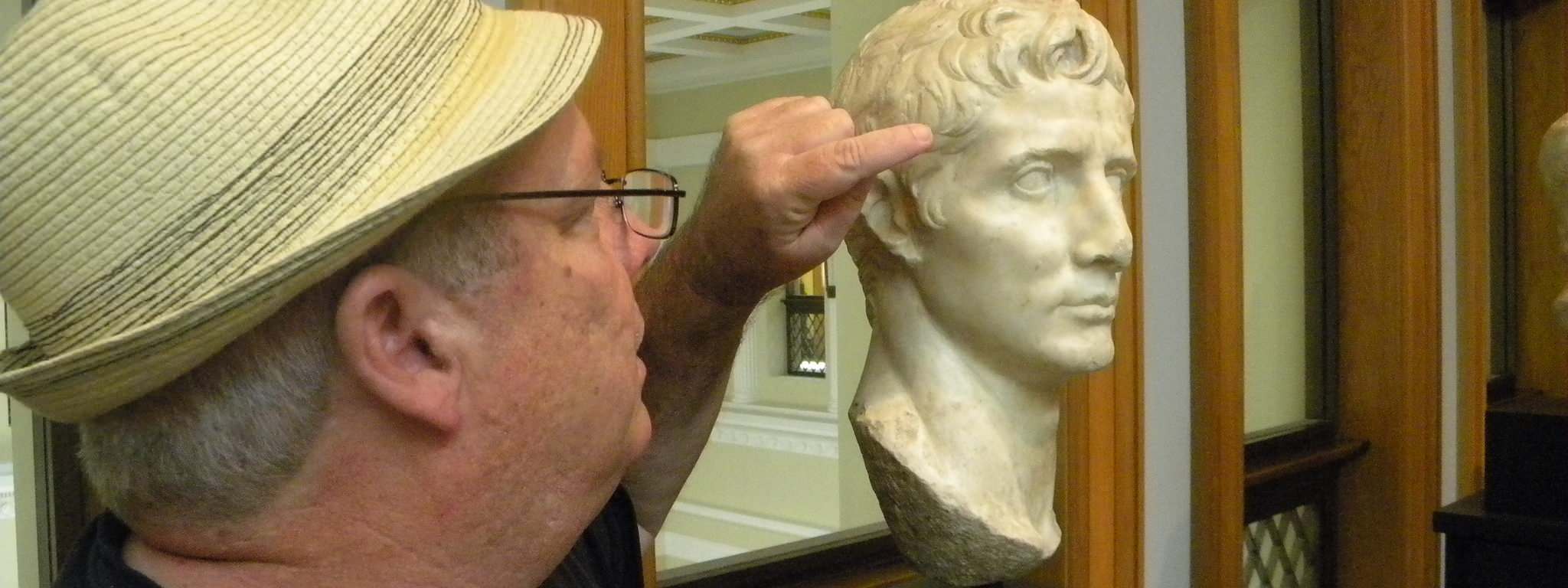
Julio Claudian Art, Roman Portraiture and Coins flickr Stream

Julio Claudian Art, Roman Portraiture and Coins flickr Photostream
https://farm6.staticflickr.com/5460/coverphoto/93273909@N00_h.jpg?1401996965#93273909@N00
Anything that has to do with the time Julius Caesar,Augustus Caesar,Tiberius Caesar,Gaius (Caligula) Caesar,Claudius Caesar,Nero Caesar.: VESPASIAN, TITUS, GALBA, OTHO, DOMITIAN AND VITELLIUS.

REMEMBER ALL ITEMS AND PHOTOS ARE FOR EDUCATIONAL USE ONLY. WE DO THIS SITE FOR THE LOVE OF THE JULIO CLAUDIAN DYNASTY AND TO HELP OTHERS IN THEIR RESEARCH. 
And see AWOL's list of Institutional flickr Photostreams

Archives Ouvertes de l'Institut français du Proche-Orient

Archives Ouvertes de l'Institut français du Proche-Orient
Archives ouvertes de l'Ifpo
L'Institut français du Proche-Orient (Ifpo) sert aujourd'hui, dans toutes les disciplines des sciences humaines et sociales, de l'Antiquité jusqu'à nos jours, la connaissance du Proche-Orient en général et celle de la Syrie, du Liban, de la Jordanie, des Territoires palestiniens et de l'Irak en particulier.
Fort de ses trois départements scientifiques (Études contemporaines, Études médiévales, arabes et modernes, Archéologie et histoire de l'antiquité), l'Ifpo développe aujourd'hui, dans un spectre scientifique très large, des partenariats grâce auxquels ses chercheurs entendent, avec les sociétés dont ils sont les hôtes, comme avec le reste de la communauté scientifique, construire ensemble des savoirs scientifiques partagés.
De la mise en libre accès sur le site Hal-SHS des travaux de ses chercheurs l'Ifpo attend notamment un accroissement de leur visibilité régionale et internationale : la diffusion aussi systématique que possible de résumés (ou d'articles) en langue anglaise, mais également en langue arabe, (désormais acceptée sur cette archive ouverte) doit permettre à l'institut d'accroître la « transparence » de ses missions dans son environnement régional et favoriser une interaction plus systématique avec l'ensemble de la communauté scientifique mondiale.
The French Institute for the Near East (Ifpo) is today at the service of all the disciplines of humanities and social sciences, from Antiquity to our times, and at the understanding of the Near East in general and that of Syria, Lebanon, Jordan, the Palestinian territories and Iraq in particular. 
Strong with its three scientific departments (Contemporary Studies, Medieval and Modern Arab Studies and Archaeology and Ancient History), today Ifpo develops on a large academic spectre, thanks to collaborations by which its researchers are appreciated by the societies that host them, as well as with the rest of the academic community, to collectively build its shared scientific knowledge. 
By putting up the works of its researchers online and open access on the HAL-SHS website, Ifpo achieves in particular an increase in their regional and international visibility. As much as possible, a systematic diffusion of abstracts (or articles) in English as well as Arabic (henceforth accepted on this open archive) should allow the Institute to augment the ‘transparency’ of its missions in its regional environment and favour a more systematic interaction with the international academic community as a whole.

Open Access Journal: Archaeological Horizons | افاق اثرية

Archaeological Horizons | افاق اثرية
آفاق أثرية - صحيفة مستقلة تُعنى بشؤون الآثار والمتاحف
Archaeological Horizons (افاق اثرية) is the name of an Arabic-language periodical about Libyan archaeology, archaeological sites, museums, and all other related matters. It was founded in July 2011, during an explosion of print media that occurred once cities like Benghazi were free of the regime, and its most recent issue appeared in September 2014. All 19 issues of the periodical are available for free download as PDFs at the following site: http://afaqatherya.com/

The periodical is full of all sorts of interesting information—there are articles about numerous different sites in Libya (from ancient to early modern), news about digs and expeditions, calls for action regarding antiquities lost during the regime or during the revolution, and even the occasional publication (and translation into Arabic if necessary) of Islamic grave inscriptions or pre-Islamic ones. Foreign works on Libyan archaeological matters are also taken into notice; for example, in Issue 19 (2014), the 2013 volume of the journal Libyan Studies is reviewed.

For those who are interested in the entire gamut of Libyan archaeology — from the perspective of Libyan writers(!) — this periodical provides great starting points as well as up-to-date news. Given recent upheavals in Libya, its publication has no doubt had to take a break, but here’s hoping we see Issue 20 in the near future…

حميل العدد Download issue 19


عدد شهر سبتمبر


September


2014


آفاق أثرية - العدد 0
عدد شهر يوليو
July
2011
آفاق أثرية - العدد 1
عدد شهر أغسطس
August
2011
آفاق أثرية - العدد 2
عدد شهر سيتمبر
September
2011
آفاق أثرية - العدد 3
عدد شهر أكتوبر
October
2011
آفاق أثرية - العدد 4 و 5
عدد مزدوج شهر نوفمبر وديسمبر
November + December
2011
آفاق أثرية - العدد 6
عدد شهر يناير
January
2012
آفاق أثرية - العدد 7+8
عدد مزدوج شهر قبراير ومارس
February +March
2012
آفاق أثرية - العدد 9
عدد شهر أبريل ومايو
April +May
2012
آفاق أثرية - العدد 10
عدد شهر يونيو
June
2012
آفاق أثرية - العدد 11
عدد شهر يوليو و أغسطس
July + August
2012
آفاق أثرية - العدد 12
عدد شهر ديسمبر
December
2012
آفاق أثرية - العدد 13
عدد شهر فبراير
Febreuary
2013
آفاق أثرية - العدد 14
عدد شهر يونيو
June
2013
آفاق أثرية - العدد 14
عدد شهر أكتوبر
October
2013
آفاق أثرية - العدد 14
عدد شهر مارس
March
2014