Wednesday, December 31, 2025

New Open Access Journal: Valonia: A Journal of Anatolian Pasts

 [First posted in AWOL 16 January 2025, updated 31 December 2025]

Valonia: A Journal of Anatolian Pasts


Valonia: A Journal of Anatolian Pasts is the international, peer-reviewed journal of Koç University’s Research Center for Anatolian Civilizations (ANAMED). Published online in open-access format and in limited print runs, the journal aims to bring forth in a timely manner selections of the latest innovative, critical, and synthetic scientific research on the broad range of subjects that fall within ANAMED’s mission: the archaeology, architectural and art history, heritage, and history of Anatolia and its affiliated geographies, from deep prehistory through Late Ottoman times. Valonia publishes one special or one open-topic issue per year. The selection of topics for special issues as well as articles for open issues aims for chronologically and disciplinarily balanced representation.

Creative Commons

Valonia: A Journal of Anatolian Pasts is an Open Access journal, and all articles are published under the terms of the Creative Commons Attribution-NonCommercial-NoDerivatives License (https://creativecommons.org/licenses/by-nc-nd/4.0/) which permits non-commercial re-use, distribution, and reproduction in any medium, provided the original work is properly cited and is not altered, transformed, or built upon in any way.

Volume: 2   - 2025 

PEER-REVIEWED RESEARCH ARTICLES
1. The Multiple Voices of A Reused Funerary Relief: The Inscribed Lintel At The Church of Saint Anne In Trebizond
Spyros Avgerinopoulos
doi: 10.5505/valonia.2025.08208  Pages 1 - 18

2. Traces of A Lost Public Space and Monument in A Changing City: The Hill And Church Of Profitis Elıas in Ayvalık
Hasan Sercan Sağlam
doi: 10.5505/valonia.2025.07279  Pages 19 - 45

3. Mesopotamian Fish Skin: Between Ritual and Material Reality
Elisa Palomino
doi: 10.5505/valonia.2025.46330  Pages 47 - 71

4. Bioarchaeology at a Rescue Site: Stable Isotope Analysis of the Iouliopolis (Juliopolis) Necropolis
Elena Vorobyeva
doi: 10.5505/valonia.2025.58076  Pages 73 - 79


 Volume: 1   - 2024

1. Editorial Introduction: A New Journal From ANAMED
Christopher H. Roosevelt
doi: 10.5505/valonia.2024.58066  Pages 7 - 10
Abstract |Full Text PDF

2. In Memory of Robert G. Ousterhout
Tolga B. Uyar
Page 11
Abstract |Full Text PDF

RESEARCH ARTICLES
3. Cappadocia: Old Questions, New Approaches – A Historian’s Perspective
John Haldon
doi: 10.5505/valonia.2024.21931  Pages 17 - 33

4. Byzantine Rock-Cut Architecture in Cappadocia and Beyond: The State of Scholarship
Görkem Günay
doi: 10.5505/valonia.2024.43531  Pages 35 - 63

5. Some Notes on the Byzantine Houses of Cappadocia
Stavros Mamaloukos, Dimitrios Anastasiadis
doi: 10.5505/valonia.2024.29392  Pages 65 - 90

6. Byzantine Settlements in Cappadocia: Lives between Ostentation and Austerity
Fatma Gül Öztürk Büke
doi: 10.5505/valonia.2024.66375  Pages 91 - 109

7. Two Cappadocian Pseudo-Mosaics
Ivan Drpic
doi: 10.5505/valonia.2024.03511  Pages 111 - 134

8. Deconstructing an Iconography: Depictions of Constantine and Helena in Middle Byzantine Cappadocia
Lynn Jones
doi: 10.5505/valonia.2024.54264  Pages 135 - 155

9. The Mavrucan Valley: Documentation of a Byzantine Agricultural Settlement
Nilüfer Peker, Tolga B. Uyar
doi: 10.5505/valonia.2024.32042  Pages 157 - 171

10. Visualizing Mobility in Cappadocia
Scott Redford
doi: 10.5505/valonia.2024.09719  Pages 173 - 191

11. Soil Story: An Earthly Investigation
Sibel Horada, Robert G. Ousterhout
doi: 10.5505/valonia.2024.65375  Pages 193 - 205
Abstract |Full Text PDF

12. Imagining a Cappadocian Future
Robert G. Ousterhout
doi: 10.5505/valonia.2024.46338  Pages 207 - 213
Abstract |Full Text PDF

See AWOL's full List of Open Access Journals in Ancient Studies

Open Access Journal: Wiener Beiträge zur Alten Geschichte online (WBAGon)

 [First posted in AWOL 30 June 2020, updated 31 December 2025] 

Wiener Beiträge zur Alten Geschichte online (WBAGon)
ISSN: 2664-1100

Die Wiener Beiträge zur Alten Geschichte online (WBAGon) ist eine Reihe, die für Publikationen aus dem Bereich der Alten Geschichte und Altertumskunde sowie der Epigraphik und Papyrologie zur Verfügung steht. Das können sowohl monographische Werke als auch Sammlungsbände, wie etwa Akten zu Kongressen, umfassen.
Die WBAGon möchten für Autoren von höchstqualifizierten Publikationen eine rasche und unkomplizierte Plattform bieten, ihre wissenschaftlichen Erkenntnisse einem möglichst breiten Publikum frei zugänglich machen.
Interessierte Autoren können direkt mit der Redaktion in Kontakt treten.
Manuskripte können als Worddokumente (doc oder docx) sowie als PDF per E-Mail an die Redaktion (franziska.beutler@univie.ac.at; katharina.knaepper@univie.ac.at) eingereicht werden. Die Autoren werden gebeten, für eine Einheitlichkeit der Zitierweise innerhalb eines Bandes zu sorgen. Es werden unten stehende Richtlinien empfohlen, aber auch andere Zitierweisen werden akzeptiert. Eine individuelle Gestaltung nach den Bedürfnissen des Bandes ist nach Absprache mit der Redaktion möglich.
Für Inhalt und Form der Beiträge sind sachlich und rechtlich allein die Autoren bzw. die Herausgeber des Bandes verantwortlich

Gesellschaft und Familie bei Etruskern und Italikern. Akten des 18. Treffens der Arbeitsgemeinschaft Etrusker & Italiker (Wien, Institut für Alte Geschichte und Altertumskunde, Papyrologie und Epigraphik, 6.–7. März 2020)
Bd. 4 (2022)

Gesellschaft und Familie bei Etruskern und Italikern.
Akten des 18. Treffens der Arbeitsgemeinschaft Etrusker & Italiker
(Wien, Institut für Alte Geschichte und Altertumskunde, Papyrologie und Epigraphik, 6.–7. März 2020)

herausgegeben von

Petra Amann, Raffaella Da Vela, Robinson Peter Krämer

Dieser Band enthält die Beiträge des 18. Treffens der Arbeitsgemeinschaft ‚Etrusker & Italiker‘ des Deutschen Archäologenverbands (DarV), das am 6. und 7. März 2020 am Institut für Alte Geschichte und Altertumskunde, Papyrologie und Epigraphik der Universität Wien stattgefunden hat. Die Arbeitsgemeinschaft versteht sich als Gruppe von Wissenschaftler*innen der deutschsprachigen Länder, die sich in regelmäßigen Workshops und Tagungen austauschen, miteinander diskutieren und aktuelle Projekte vorstellen (https://www.darv.de/arbeitsgemeinschaften/etrusker-und-italiker/). Unter den mittlerweile mehr als 100 Mitgliedern ist die gesamte akademische Bandbreite von Studierenden bis zu Professor*innen mit den unterschiedlichsten Erfahrungen, Perspektiven und Forschungen vertreten.

Anlässlich des zehnjährigen Jubiläums war es ein besonders glücklicher Umstand, das Treffen der Arbeitsgemeinschaft am Gründungsort Wien durchführen zu können. Erst im Nachhinein wurde schließlich deutlich, dass diese Jubiläumstagung zu Beginn der Pandemie für zwei Jahre das letzte Treffen der Arbeitsgemeinschaft in Präsenz sein würde.

Das Thema lautete ‚Gesellschaft und Familie bei Etruskern und Italikern‘, der Fokus lag dabei auf den familiären Strukturen und ihrer engen Verflechtung mit der sie umgebenden Gesellschaft im gesamten italischen Raum des 1. Jahrtausends v. Chr., und zwar in den unterschiedlichsten Kontexten (etwa im Grabbereich, im religiösen Feld oder in Wohn- und Siedlungskontexten). Sozialstrukturen und -dynamiken sind generell immer noch ein stark unterrepräsentiertes Themenfeld der etruskisch-italischen Forschung. Es ist deshalb umso erfreulicher, dass soziale Fragestellungen im ‚vorrömischen‘ Italien in letzter Zeit deutlich mehr Aufmerksamkeit erlangen und verstärkt diskutiert werden.

Der vorliegende Band wird mit einem Beitrag von Petra Amann eröffnet, der als ‚Einführung‘ die bisherige Geschichte zur Erforschung der etruskischen Gesellschaft kritisch vorstellt, aber auch Desiderate und neue Entwicklungen aufzeigt.

Die folgenden elf Aufsätze decken das gesamte erste vorchristliche Jahrtausend ab und behandeln den Raum von der Po-Ebene bis nach Sizilien (siehe Abb.). Sie sind hier in vier thematische Blöcke gegliedert.

Der erste Themenkomplex lautet ‚Nekropolen und Sozialstrukturen im eisenzeitlichen Italien (ca. 1000-500 v. Chr.)‘. Hier werden die Lage von Gräbern, Grabbeigaben und Bestattungsriten für den Versuch der Rekonstruktion von Familienstrukturen, (engeren und weiteren) Verwandtschafts­verhältnissen und Gesellschaftsgruppen verwendet. Claudio Negrini untersucht in seinem Beitrag das Phänomen der Doppel- und Mehrfachbestattungen in der Po-Ebene des 9.–7. Jhs. v. Chr. Olaf Dörrer analysiert die Nekropolen des 8.–7. Jhs. v. Chr. in Pontecagnano im Hinblick auf potentielle Verwandtschaftsgruppen. Schließlich diskutiert Giacomo Bardelli anhand reicher Bestattungen im Numana des 7.–5. Jhs. v. Chr. mögliche religiöse und sozio-politische Rollen elitärer Frauen in der picenischen Gesellschaft.

Im zweiten Block geht es um ‚Soziale Beziehungen und Geschlechterverhältnisse in Etrurien‘, die anhand von Grabinschriften und bildlichen Darstellungen untersucht werden. Gertraud Breyer vergleicht etruskische und lateinische Inschriften und Namenformulare, um den Stellenwert der Frau in der etruskischen Gesellschaft zu rekonstruieren. Im nächsten Beitrag stellt Marie-Laurence Haack Paardarstellungen auf Deckeln von Urnen und Sarkophagen zusammen und diskutiert deren Bedeutung für das etruskische Konzept der Ehe(paare). Zuletzt analysiert Patrick Zeidler eine Vielzahl an bildlichen Darstellungen, um Abhängigkeitsverhältnisse und soziale Ungleichheiten sowie deren Repräsentation in Etrurien besser erfassen zu können.

Die dritte Sektion widmet sich ‚Repräsentationsstrategien etruskischer Familien im Hellenismus‘, die mithilfe von Grabkontexten, Darstellungen auf Sarkophagen und funerären Inschriften rekonstruiert werden. Laura Nazim interpretiert in ihrem Beitrag Motive auf Steinsarkophagen, die bisher als Jenseitsreisen aufgefasst wurden, als eheliche und familiäre Szenen. Im Folgenden analysiert Robinson Peter Krämer Grabinschriften aus Tarquinia und dem ager Tarquiniensis auf ihre soziale Aussagekraft hin und sieht diese als Ausdruck von gezielten kommemorativen Strategien. Paul Pasieka diskutiert schließlich hellenistische Wiederbelegungen älterer prominenter Familiengräber in Cortona, Chiusi und Vetulonia und sieht darin Resilienzstrategien und Identitätskonstruktionen in Krisenzeiten.


Im letzten thematischen Abschnitt geht es um ‚Hausgemeinschaften, Siedlungsstrukturen und Landschaften‘. Hierbei wurden anhand von landschaftlichen und makroregionalen Analysen Familien- und Sozialstrukturen in Süditalien und auf Sizilien untersucht. Raffaella Da Vela rekonstruiert anhand von Daten aus Gräbern, Sakralorten und Haushaltskontexten die Rolle und den Aufbau der Familie im eisenzeitlichen Hirpinien und deutet diese als soziale Ressource. Schließlich analysiert Maria Carmen D’Onza Ritualplätze des 9.–6. Jhs. v. Chr. im Rahmen indigener Siedlungen auf Sizilien als Orte sozialer Prozesse und Kommunikationsstrategien.
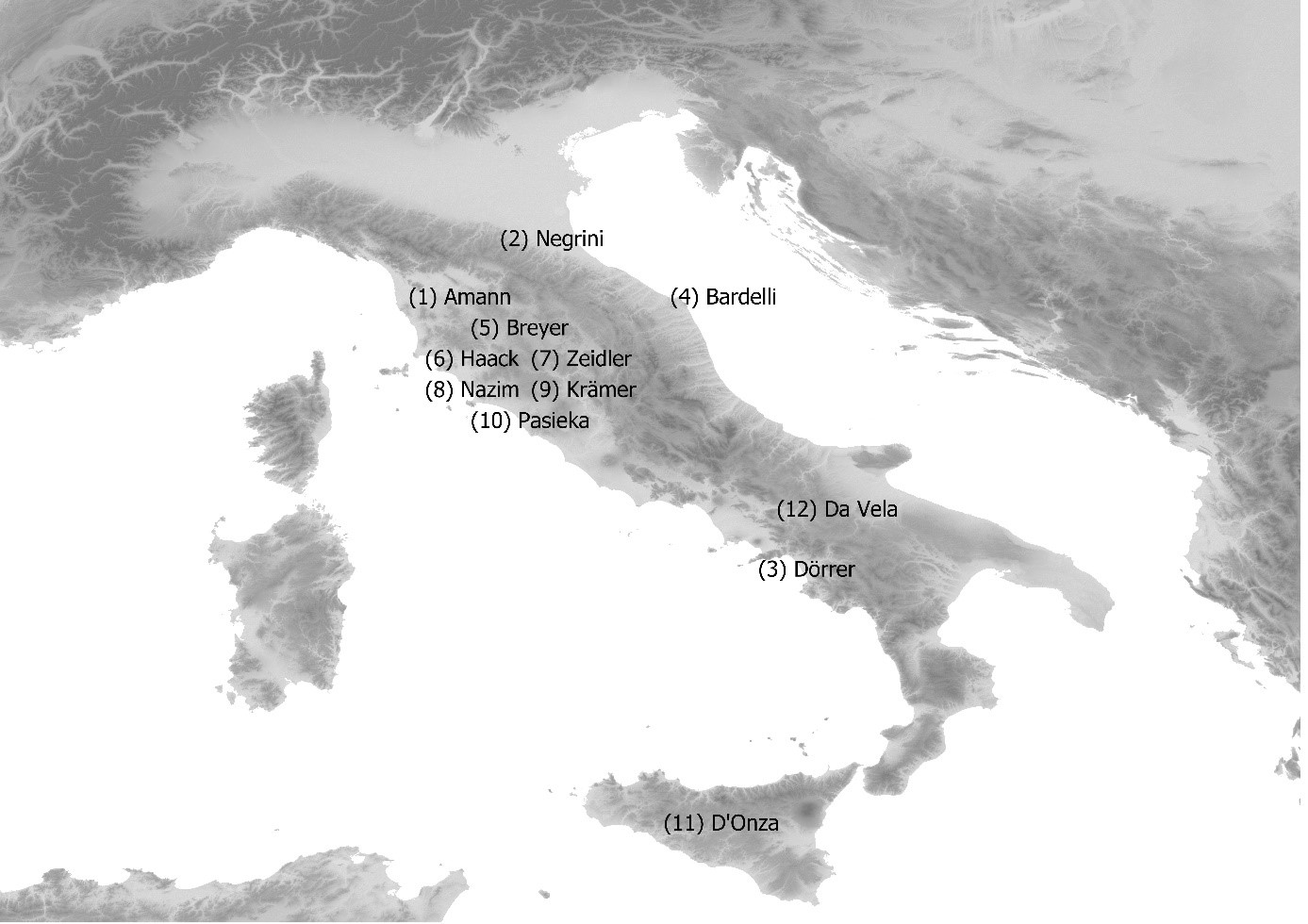
Geographische Verteilung der Beiträge in diesem Band (Raffaella Da Vela mit QGIS 3.24, <http://www.qgis.org>; Geodaten: EPSG:4326; SRTM Data: A. Jarvis, H. I. Reuter, A. Nelson, E. Guevara, 2008, Hole-filled seamless SRTM data V4, International Centre for Tropical Agriculture (CIAT), available on <http://srtm.csi.cgiar.org>)

Für sehr hilfreiche und tatkräftige Unterstützung während des Treffens in Wien danken wir Univ.-Prof. Luciana Aigner-Foresti sowie David Hack. Ebenfalls zu Dank verpflichtet sind wir Franziska Beutler, die als Verantwortliche für die Reihe ‚Wiener Beiträge zur Alten Geschichte online‘ (WBAGon) unsere Ta
 

Bd. 3 (2020): Municipal Structures in Roman Spain and Roman Italy. A Comparison, Proceedings of the Colloquium Vienna, 3rd July 2018
Municipal Structures in Roman Spain and Roman Italy. A Comparison
Proceedings of the Colloquium
Vienna, 3rd July 2018

edited by Federico Russo

Idem ius municipi flavi Irntiani esto, quod esset, si municipi Italiae libertus esset. Questa breve citazione, tratta da un capitolo della Lex Irnitana che pone un preciso parallelo tra il municipio irnitano e un qualunque municipio sul suolo italico a proposito della procedura della manumissio, sintetizza in modo icastico l’essenza e lo spirito dell’incontro internazionale che è stato ospitato dall’Institut für Alte Geshichte dell’Università di Vienna nel luglio 2018. In sintesi, la premessa da cui i lavori hanno preso l’avvio, e che è alla base dei contributi raccolti nelle prossime pagine, si fonda sulla considerazione che ciò che valeva per una comunità spagnola, poteva valere anche per una comunità italica, e viceversa, ad indicare una stretta vicinanza tra aree pure così distanti (e non solo dal punto di vista geografico)
La vicinanza in tema di norme, leggi, regolamenti e disposizioni varie tra i municipi (o le colonie) della Spagna romana e le comunità dell’Italia appare come fatto noto già in età antica, e come tale è stato a più riprese studiato dalla critica moderna. Naturalmente, a questi due poli se ne aggiunge un terzo, vale a dire Roma, che, con la sua produzione legislativa relativa alla gestione dell’Impero ma anche dell’urbs stessa, avrà senza dubbio funzionato da punto di riferimento (o modello tout court), più o meno diretto, per le leggi che regolavano la vita amministrativa delle comunità locali, italiche e provinciali.
Alla luce di tali richiami, espressamente denunciati dalla documentazione epigrafica a nostra disposizione, è parso tanto doveroso quanto stimolante esplorare ulteriormente alcuni aspetti delle strutture amministrative dei centri locali spagnoli e italici per individuare ulteriori analogie e differenze tra di essi, spesso rimaste in ombra o inesplorate. Un approccio di questo tipo ha certo contribuito a migliorare la nostra conoscenza delle strutture ammnistrative locali e, per conseguenza, le modalità tramite cui, al momento di una fondazione coloniale o municipale, le leggi di un centro locale assumevano la loro fisionomia.
Vorrei concludere questa breve introduzione esprimendo la mia gratitudine, oltre che agli autori, agli ospiti e ai partecipanti del Convegno, all’Austrian Science Fund (FWF), che ha finanziato l’incontro entro il Progetto M-2142, e all’Institut für Alte Geschichte und Altertumskunde, Papyrologie und Epigraphik dell’Università di Vienna, che lo ha ospitato e supportato.
Desidero in particolare ringraziare, per l’impagabile collaborazione e aiuto offerti, il Prof. F. Mitthof, il Prof. H. Taeuber, il Prof. E. Weber e la Dr. F. Beutler.
Inoltre, esprimo la mia gratitudine ai curatori di WBAGon per aver accettato la pubblicazione di questi contributi ed in particolare alla Dr. F. Beutler per averne seguito il processo editoriale con grande attenzione.
Un sentito grazie va, infine, a tutti coloro che in vario modo, con idee, suggerimenti e critiche, hanno preso parte alla stimolante discussione che ha avuto luogo in occasione dell’incontro e alla successiva fase di pubblicazione.
Federico Russo
(Università di Milano)
Veröffentlicht: 2020-04-23
Archiv

See AWOL's full List of Open Access Journals in Ancient Studies

ASOR Publications at HathiTrust

 ASOR Publications at HathiTrust

1 to 92 of 92 items

Excavations at ancient Nabratein : synagogue and environs / by Eric M. Meyers and Carol L. Meyers ; with contributions by Gabriela Bijovsky ... [et al.] ; architectural plans, sections, and drawings prepared by Lawrence Belkin and Lindsey Bute

Field O : the "synagogue" site / by Marylinda Govaars, Marie Spiro, and L. Michael White

Shechem IV : the Persian-Hellenistic pottery of Shechem/Tell Balâṭah / by Nancy L. Lapp ; edited for the expedition by Edward F. Campbell

The archaeology of difference : gender, ethnicity, class and the "other" in antiquity : studies in honor of Eric M. Meyers / edited by Douglas R. Edwards and C. Thomas McCollough

The middle Bronze Age IIA cemetery at Gesher : final report / edited by Yosef Garfinkel and Susan Cohen

Tel Tanninim : excavations at Krokodeilon Polis, 1996-1999 / by Robert R. Stieglitz ; with contributions by Ya'el D. Arnon ... [et al.].

Tel Tanninim : excavations at Krokodeilon Polis, 1996-1999 / by Robert R. Stieglitz ; with contributions by Ya'el D. Arnon [and others].

Results of the 2001 Kerak Plateau Early Bronze Age survey / by Meredith S. Chesson ... [et al.]. Two early alphabetic inscriptions from the Wadi el-Ḥôl : new evidence for the origin of the alphabet from the western desert of Egypt / by John Coleman Darnell ... [et al.]. v.59

Cult image and divine representation in the ancient Near East / edited by Neal H. Walls

The Tafila-Busayra archaeological survey 1999-2001, west-central Jordan / by B. MacDonald ... [et al.].

The Tafila-Busayra archaeological survey 1999-2001, west-central Jordan / by B. MacDonald [and others].

Annual meeting program book / American Schools of Oriental Research 2003

Near Eastern archaeology v.65-66 2002-2003

Preliminary excavation reports and other archaeological investigations : Tell Qarqur, Iron I sites in the North-Central highlands of Palestine / edited by Nancy Lapp v.56

Sotira Kaminoudhia : an early Bronze Age site in Cyprus / edited by Stuart Swiny, George (Rip) Rapp, Ellen Herscher

One hundred years of American archaeology in the Middle East : proceedings of the American Schools of Oriental Research centennial celebration, Washington DC, April 2000 / edited by Douglas R. Clark and Victor H. Matthews

The Near East in the southwest : essays in honor of William G. Dever / edited by Beth Alpert Nakhai

Shechem III : the stratigraphy and architecture of Shechem/Tell Balâṭah / Edward F. Campbell ; illustrated by Lee C. Ellenberger, photographer and G.R.H. Wright, architect v.2

Shechem III : the stratigraphy and architecture of Shechem/Tell Balâṭah / Edward F. Campbell ; illustrated by Lee C. Ellenberger, photographer and G.R.H. Wright, architect v.1

An ASOR mosaic : a centennial history of the American Schools of Oriental Research, 1900-2000 / edited by Joe D. Seger ; contributing authors Jeffrey A. Blakely [and others].

Engendering Aphrodite : women and society in ancient Cyprus / edited by Diane Bolger and Nancy Serwint

Archaeology and the religions of Canaan and Israel / by Beth Alpert Nakhai

The Earliest prehistory of Cyprus : from colonization to exploitation / edited by Stuart Swiny


Desire, discord, and death : approaches to ancient Near Eastern myth / by Neal Walls

The Greek and Latin inscriptions of Caesarea Maritima / by Clayton Miles Lehmann, Kenneth G. Holum

Preliminary reports of ASOR-sponsored excavations, 1982-89 / edited by Walter E. Rast, assisted by Marion Zeiger

Building God's house in the Roman world : architectural adaptation among pagans, Jews, and Christians / L. Michael White

Preliminary reports of ASOR-sponsored excavations, 1983-87 / edited by Walter E. Rast ; assisted by Marion Zeiger

Preliminary reports of ASOR-sponsored excavations, 1983-87 / edited by Walter E. Rast ; assisted by Marion Zeiger

Bulletin of the American Schools of Oriental Research no.265-268 1987

The Synagogue in late antiquity / edited by Lee I. Levine

Romans and Saracens : a history of the Arabian frontier / S. Thomas Parker

American archaeology in the mideast : a history of the American schools of oriental research / Philip J. King

Palestine in transition : the emergence of ancient Israel / edited by David Noel Freedman and David Frank Graf

The new discoveries in St. Catherine's Monastery : a preliminary report on the manuscripts / by James Hamilton Charlesworth, assisted by George Themelis Zervos ; with a foreword by David Noel Freedman

Symposia celebrating the seventy-fifth anniversary of the founding of the American Schools of Oriental Research (1900-1975) / edited by Frank Moore Cross ; [cover design by Madeline Chruchill].

Pastoral nomadism in the Mari Kingdom (ca. 1830-1760 B.C.) / by Victor Harold Matthews

Taanach I : studies in the iron age pottery / by Walter E. Rast ; edited by Albert E. Glock

Essays in honor of George Ernest Wright / edited by Edward F. Campbell and Robert G. Boling

The Biblical archaeologist reader / edited by G. Ernest Wright and David Noel Freedman v.2

Studies in the history of Caesarea Maritima / Glanville Downey [and others] ; Charles T. Fritsch, editor

The role of human sacrifice in the ancient Near East / by Alberto Ravinell Whitney Green

First preliminary report : seasons of 1971 and 1972 / edited by Lawrence E. Stager, Anita Walker, G. Ernest Wright

Reconstructing complex societies : an archaeological colloquium. / Edited by Charlotte B. Moore for the organizers and conveners of the colloquium held at Massachusetts Institute of Technology, April 29-30, 1972. Colloquium organized for the Cambridge Archaeology Seminar by Miranda C. Marvin, Lawrence E. Stager [and] Anita M. Walker


Bulletin of the American Schools of Oriental Research no.93-108 1944-1947

The Annual of the American Schools of Oriental Research v.24 1944/1945

Mathematical cuneiform texts, edited by O. Neugebauer and A. Sachs; with a chapter by A. Goetze

Mathematical cuneiform texts / edited by O. Neugebauer and A. Sachs; with a chapter by A. Goetze

Mathematical cuneiform texts / edited by O. Neugebauer and A. Sachs; with a chapter by A. Goetze

The Annual of the American Schools of Oriental Research v.23 1943/1944

Bulletin of the American Schools of Oriental Research no.77-92 1940-1943

An indexed bibliography of the writings of William Foxwell Albright : published in honor of his fiftieth birthday by a committee of his former students / prepared for the committee by Harry M. Orlinsky

Bulletin of the American Schools of Oriental Research no.65-76 1937-1939

The Annual of the American Schools of Oriental Research v.18-19 1937/1939

The Haverford symposium on archaeology and the Bible, by William F. Albright, George A. Barton, Henry J. Cadbury [and others] ... and Elihu Grant, editor

Gerasa, city of the Decapolis; an account embodying the record of a joint excavation conducted by Yale university and the British school of archaeology in Jerusalem (1928-1930), and Yale university and the American schools of oriental research (1930-1931, 1933-1934) edited by Carl H. Kraeling

The Haverford symposium on archaeology and the Bible, by William F. Albright, George A. Barton, Henry J. Cadbury [and others] ... and Elihu Grant, editor

The Annual of the American Schools of Oriental Research v.17 1936/1937

Bulletin of the American Schools of Oriental Research no.49-64 1933-1936

The Annual of the American Schools of Oriental Research v.16 1935/1936

The Annual of the American Schools of Oriental Research v.15 1934/1935

Publications of the Bagdad School. Texts v.5 1934

Publications of the Bagdad School. Texts v.4 1934

Bulletin of the American Schools of Oriental Research no.25-48 1927-1932


Bulletin of the American Schools of Oriental Research no.25-48 1927-1932

The Annual of the American Schools of Oriental Research v.12 1930/1931

Publications of the Bagdad School. Texts v.3 1931

The Annual of the American Schools of Oriental Research v.11 1929/1930

Publications of the Bagdad School. Texts v.2 1930

The Annual of the American Schools of Oriental Research v.10 1928/1929

The Annual of the American Schools of Oriental Research v.9 1927/1928

The Annual of the American Schools of Oriental Research v.8 1926/1927

Publications of the Bagdad School. Texts v.1 1927

The Annual of the American Schools of Oriental Research v.7 1925/1926

Bulletin of the American Schools of Oriental Research no.2-24 1920-1926

Bulletin of the American Schools of Oriental Research no.1-24 1919-1926

The Annual of the American Schools of Oriental Research v.6 1924/1925

The Annual of the American Schools of Oriental Research v.5 1923/1924

The Annual of the American Schools of Oriental Research v.4 1922/1923

The Annual of the American Schools of Oriental Research v.20

Tell en-Nasbeh excavated under the direction of the late William Frederic Badè v.1

The Tell el-Hesi field manual / by Jeffrey A. Blakely and Lawrence E. Toombs ; edited by Kevin G. O'Connell