Wednesday, August 31, 2011

New Open Access Journal: Revista DJESER


        Con este primer número damos un nuevo paso a otro de nuestros proyectos: la Revista DJESER, que nace para dar cabida a estudios sobre Arte, Arqueología y Egiptología, así como al amplio campo de disciplinas afines. Presentaremos trabajos de investigación, inéditos, pero también artículos sobre exposiciones, monumentos, piezas. Etc.
        Su publicación será de cuatro números anuales y, en principio, se podrá descargar gratuitamente desde nuestra web. En este número leeremos sobre los mingqi, los yong y los muyong, objetos de los ajuares de las dinastías chinas Zhou, Qin y Han que muchas veces hemos observado en los  museos, sin conocer bien su historia y significado.
        Un interesante estudio de la obra de Chardin, que hemos podido visitar en la exposición organizada por el Museo del Prado, lo analiza y compara con obras de otros autores coetáneos.
        La Fundación Mapfre nos trajo a Madrid piezas maestras del arte románico. Así hemos podido ver de cerca elementos arquitectónicos, tablas de altar y orfebrería religiosa. Algunas piezas mejor expuestas que otras.
        A pesar de los últimos treinta años revueltos que ha sufrido Afganistán, hoy podemos admirar, en Londres, uno de sus más preciados tesoros. Los hallazgos de Tepe Fullol, Ai Khanum, Begram y Tilia Tepe nos muestran como, una tierra que fue encrucijada de civilizaciones y paso obligado en las Rutas de la Seda, fue absorbiendo características artísticas de otros pueblos mezclándolas con las suyas y dando lugar a auténticas obras maestras que hoy se presentan en varias ciudades de Europa y América.
        Terminamos con una de las más bonitas piezas de la joyería del Egipto antiguo, la diadema de la princesa Sit Hathor Yunet.
Se puede DESCARGAR la revista a través del botón INSCRIBIRSE.
 Free after registration.

 Table of Contents of Volume 0
El estudio:
La representación de figuras humanas en los ajuares funerarios en China. Por Carmen Barrado

La Exposición:
El Chardín de las Delicias. Por Coro Gutiérrez Pla... 
El esplendor del Románico. Por Ignacio Herrero Hidalgo 
Afghanistan: Crossroads of the Ancient World. Por Laura Di Nóbile Carlucci

La Pieza
Diadema de Sit Hathor Yunet. Por Laura Di Nóbile Carlucci

See the full List of Open Access Journals in Ancient Studies

Tuesday, August 30, 2011

Open Access Journal: Iris: Journal of the Classical Association of Victoria

Iris: Journal of the Classical Association of Victoria
ISSN 1448 - 1421

http://classics-archaeology.unimelb.edu.au/CAV/images/acropolis.gif

What is Iris?

Iris is the journal of the Classical Association of Victoria. The New Series of the journal was founded in 1988. The Journal Editor is Mr. John L. Penwill of La Trobe University, Bendigo. The Assistant Editor is Dr. Heather M. Jackson, postdoctoral fellow at the University of Melbourne. The Honorary Secretary is Dr. K.O. Chong-Gossard, lecturer at the University of Melbourne. Iris is published with the support of the Muriel P. Blackwood Memorial Fund.

What is in Iris?

Iris is now a refereed publication. This means that articles published in the refereed section undergo a peer review process. This involves assessment of the publication in its entirety (not merely an abstract or extract), before publication, and by appropriately independent, qualified experts. Independent in this context means independent of the author.

How do I contribute to Iris?

Persons interested into submitting articles or letters to the journal should send them to either the Journal Editor (John Penwil) or the Honorary Secretary (K.O. Chong-Gossard). Contributors should state whether they wish their article to be refereed or not.

Saturday, August 27, 2011

Open Access Journal: Queensland Archaeological Research

Queensland Archaeological Research

http://www.library.uq.edu.au/ojs/public/journals/8/pageHeaderTitleImage_en_US.gif
Queensland Archaeological Research, is a refereed journal published since 1984 devoted to publishing substantive archaeological material pertaining to research in Queensland, Australia and adjacent areas. Data-rich manuscripts are particularly welcome. Contributions are accepted in six sections: Articles (5000+ words), Short Reports (<3000 words), Obituaries (500-2000), Thesis Abstracts (200-500), Book Reviews (500-2000) and Backfill (which includes letters and other material of interest to readers). Queensland Archaeological Research is published in one volume each year.

2002

Vol 13 (2002)

Recent Archaeological Research in Southeast Queensland
Sean Ulm & Jay Hall (eds)

2000

Vol 12 (2000)

Index of Dates from Archaeological Sites in Queensland
Sean Ulm & Jill Reid

1999

Vol 11 (1999)

The Gooreng Gooreng Cultural Heritage Project: Preliminary Results of Archaeological Research, 1993-1997
Ian Lilley, Sean Ulm & Michael Williams (eds)


1984

Vol 1 (1984)

Friday, August 26, 2011

"Rome Wasn't Digitized in a Day": Building a Cyberinfrastructure for Digital Classicists

"Rome Wasn't Digitized in a Day": Building a Cyberinfrastructure for Digital Classicists by Alison Babeu
August 2011.
307 pp.
$0 (Web only)
ISBN 978-1-932326-38-3
The author provides a summative and recent overview of the use of digital technologies in classical studies, focusing on classical Greece, Rome, and the ancient Middle and Near East, and generally on the period up to about 600 AD. The report explores what projects exist and how they are used, examines the infrastructure that currently exists to support digital classics as a discipline, and investigates larger humanities cyberinfrastructure projects and existing tools or services that might be repurposed for the digital classics.

Creative Commons License
"Rome Wasn't Digitized in a Day": Building a Cyberinfrastructure for Digital Classicists by Alison Babeu is licensed under a Creative Commons Attribution-NonCommercial-ShareAlike 3.0 Unported License.
Based on a work at www.clir.org.


This is a Web-only publication. It is not available in print
A draft of this report was circulated for comment in October 2010.

Digital Library: Muzeul Naţional de Istorie a României

Muzeul Naţional de Istorie a României

Periodice
Muzeul Naţional
Cercetări Arheologice
Cercetări Numismatice
Monografii
Crişan Muşeţeanu în colaborare cu Dan Elefterescu, Ateliere ceramice romane de la Durostorum

Teze de Doctorat
Cristina Anton Manea, Structura şi restructurarea marii boierimi din Ţara Românească de la începutul secolului al XVI-LEA până la mijlocul secolului al XVII-LEA, 2003
Valentin Radu , Exploitation des ressources aquatiques dans les cultures néolithiques et chalcolithiques de la Roumanie Méridionale, 2003
Paul Cristian Damian , Geto-dacii în configuraţia demografică a Daciei Romane, 2002
Eugen S. Teodor , Ceramica din Muntenia, de la sfârşitul veacului al V-lea până la mijlocul veacului al VII-lea, 2001

Rapoarte

  Raport anual, 2007

  Raport anual, 2006

  Raport anual, 2008

Thursday, August 25, 2011

Open Access Journal: Koiné archeologica, sapiente antichità

E’ un progetto dalla Facoltà di Lettere e Filosofia dell’Università di Catania, dalla University of Malta e dalla Officina di Studi Medievali di Palermo L’obiettivo strategico del progetto è la valorizzazione del patrimonio culturale (sia monumentale sia immateriale) che accomuna le province di Siracusa e Ragusa e l’arcipelago maltese, per rafforzare le identità delle comunità locali e la reciproca conoscenza, riqualificare in senso culturale i flussi turistici già esistenti, inserire siti minori finora poco conosciuti all’interno dei circuiti, incrementare il turismo di qualità proveniente da altre aree italiane ed europee.
 Presentazione  Paesaggi Archeologici della Sicilia Sud-orientale
  Malta negli Iblei, gli Iblei a Malta  La Sicilia e L'arcipelago maltese
  L'Atene antica di Sebastiano Ittar  Ritratti di città in Sicilia e Malta
  Scicli, Archeologia e territorio

volume relaizzato anche con il contributo di
  Interconnections in the Central Mediterranean: The Maltese Islands and Sicily in History
Tavole fuori testo
  Il Paesaggio della Storia  Gli Ipogei di Wignacourt a Rabat
Tavole fuori testo
    
  Malta and Sicily: Miscellaneous research projects  
    
   Visualizza il Dvd multimediale del progetto KASA on-line


See the full List of Open Access Journals in Ancient Studies

Wednesday, August 24, 2011

Early Explorers in Egypt & Nubia

Early Explorers in Egypt & Nubia
By Daniele Salvoldi

This is the blog of Daniele Salvoldi, an Egyptologist working on W. J. Bankes Egyptian and Nubian portfolio in Dorset History Centre, Dorchester.

He id developing links to a very interesting set of books and documents relating to the early exploration of Egypt and Nubia.

Categories


Tuesday, August 23, 2011

Open Access Journal: Muzeul Naţional

http://www.mnir.ro/parts/logo.jpg 
Muzeul Naţional de Istorie a României
21 / 2009   [sumar | articole in extenso]
20 / 2008   [sumar | rezumate | articole in extenso]
19 / 2007   [sumar | rezumate | articole in extenso]
18 / 2006   [sumar | rezumate | articole in extenso]
17 / 2005   [sumar | rezumate | articole in extenso]
16 / 2004   [sumar | rezumate ]
15 / 2003   [sumar | rezumate ]
14 / 2002   [sumar | rezumate ]
13 / 2001   [sumar | rezumate ]
12 / 2000   [sumar | rezumate | articole in extenso]
11 / 1999   [sumar | rezumate | articole in extenso]
10 / 1998   [sumar | rezumate | articole in extenso]
9 / 1997   [sumar | rezumate | articole in extenso]
8 / 1995   [sumar | rezumate ]
7 / 1983   [sumar | rezumate | articole in extenso]
2 / 1975   [ ]
1 / 1974   [sumar | articole in extenso]

Open Access Journal: Cercetări Arheologice

http://www.mnir.ro/parts/logo.jpg 
Muzeul Naţional de Istorie a României

14-15 / 2007-2008   [sumar | articole in extenso]
13 / 2006   [sumar | rezumate | articole in extenso]
12 / 2003   [sumar | rezumate | articole in extenso]
11 / 2000   [sumar ]
10 / 1997   [sumar | rezumate | articole in extenso]
09 / 1992   [sumar | rezumate | articole in extenso]
07 / 1984   [sumar | rezumate | articole in extenso]
06 / 1983   [sumar | rezumate | articole in extenso]
05 / 1982   [sumar | rezumate | articole in extenso]
04 / 1981   [sumar | rezumate | articole in extenso]
03 / 1979   [sumar | rezumate | articole in extenso]
02 / 1976   [sumar | rezumate | articole in extenso]
01 / 1975   [sumar | rezumate | articole in extenso

Open Access Journal: Cercetări Numismatice


http://www.mnir.ro/parts/logo.jpg 
Muzeul Naţional de Istorie a României

14 / 2008   [sumar ]
09 - 11 / 2005   [sumar | rezumate | articole in extenso]
08 / 2003   [sumar ]
07 / 1996   [sumar | rezumate ]
06 / 1990   [sumar | rezumate | articole in extenso]
05 / 1983   [sumar | rezumate | articole in extenso]
04 / 1982   [sumar | rezumate | articole in extenso]
03 / 1980   [sumar | rezumate | articole in extenso]
02 / 1979   [sumar | rezumate | articole in extenso]
01 / 1978   [ ]

See the full List of Open Access Journals in Ancient Studies

Bookmark and  Share so Your Real Friends Know that You Know

Monday, August 22, 2011

Open Access Journal: Mousaion

[First posted in AWOL 5 November 2009. Updated 22 August 2011.  Mouseion is now part of Project Muse.  Older volumes remain open access at the links below courtesy of the Internet Archive]


Mouseion: Journal of the Classical Association of Canada
E-ISSN: 1913-5416
Print ISSN: 1496-9343

The Journal was founded in 1957 as Échos du monde classique/Classical News and Views. Its object was to provide news, opinions, and articles of general and pedagogical interest to members of the Classical Association of Canada. From 1965 to 1981 the Journal was edited at the University of Ottawa by Professor Colin M. Wells and (from 1974) Professor Susan M. Treggiari. In that period the Journal took on the additional function of publishing reports of archaeological discoveries made by Canadian scholars. It also began to attract a wider scholarly audience, both in and outside Canada, and to develop a more research-oriented character, publishing substantial articles in all fields of classical scholarship (literature, history, archaeology).
From 1981 to 1984 the Journal was edited at the University of Calgary by Professors Waldemar Heckel and John C. Yardley, with Professor Martin Cropp as Associate Editor. In 1982 the Journal's format was altered from 8 x 11 inch typescript and staple-bound to 5 1/2 x 8 1/2 inch perfect-bound and its name changed to Échos du monde classique/Classical Views. James Russell of the University of British Columbia became editor in charge of the annual archaeological issue, and for the first time the Journal appointed editorial correspondents. From 1984 to 1990 John Yardley and Martin Cropp served as joint editors and, in 1987, further modified the format to 6 x 9 inch copy; financial assistance from the University of Calgary and the Social Sciences and Humanities Research Council of Canada facilitated technical improvements in the Journal. Circulation of EMC/CV increased dramatically, especially to university libraries, while its international scholarly reputation began to grow.
In 1990 the editorship of the Journal passed to the University of Victoria. The Victoria editors (Keith Bradley, John Oleson, and Sam Scully) continued to raise the international reputation of the Journal, attracting contributions from outside the country while retaining and consolidating the Journal's original and unique role of speaking to and for a broad range of classicists within Canada.
In 1994 the editorship of the Journal passed to the current editorial team at Memorial University, where several further improvements in format have been made: (1) new Roman and Greek fonts have been adopted; (2) plates, as well as illustrations, now appear within the body of an article rather than at the end; (3) translations of all longer quotations from Greek and Latin sources are now required in order to make contributions more accessible to specialists in other fields; (4) French abstracts of English articles and English abstracts of French articles are now included; (5) a characteristically French style of formatting has been adopted for articles in French (see the "Notes to Contributors"/"Avis aux auteurs").
In 1997 the constitution of the Classical Association of Canada was changed to recognize Échos du monde classique/Classical Views officially as one of the Association's two journals. In 2001 the title of the Journal was changed to Mouseion: Journal of the Classical Association of Canada/Revue de la Société canadienne des études classiques.
ANNUAL ARCHAEOLOGICAL ISSUES ONLINE


Bookmark and  Share so Your Real Friends Know that You Know

Friday, August 19, 2011

Open Access Library: Trismegistos

[First posted in AWOL 16 September 2009. Updated 19 August 2011]

Trismegistos

About Trismegistos

Trismegistos [TM], called after the famous epithet of Hermes - Thoth, the Egyptian god of wisdom and writing who also played a major role in Greek religion and philosophy, is a platform aiming to surmount barriers of language and discipline in the study of late period Egypt and the Nile valley (roughly BC 800 - 800 AD). It brings together a variety of projects dealing with metadata, mainly of published documents.
Its core component is Trismegistos Texts, which includes papyrological and epigraphic texts, not only in Greek, Latin, and Egyptian in its various scripts (Demotic, hieroglyphic, hieratic and Coptic), but also in Meroitic, Aramaic, Arabic, Nabataean, Carian, and other languages (currently 121779 records). Most of the metadata are provided by partner projects, normally limited to texts in a certain language, on a type of writing surface (e.g. papyrus) or of a certain type (e.g. literary vs. documentary).
Because Trismegistos wants to facilitate cross-cultural and cross-linguistic research, the project Multilingualism and Multiculturalism in Graeco-Roman Egypt (Cologne, Mark Depauw; Sofja Kovalevskaja Award of the Alexander von Humboldt-Stiftung) has collaborated with several projects of the K.U.Leuven to develop tools permitting an interdisciplinary approach to the collections holding the texts, the places where the texts where found and written, or the archives to which the texts belong.
  • The Collections database, built on the Leuven Homepage of Papyrus Collections, is a set of currently some 1200 institutional and private collections of texts. It is possible to look for a collection and find all related Trismegistos texts, or only those related to a specific partner.
  • The Places database, expanding the geographical database of the Fayum project of the K.U.Leuven, is a set of currently some 3600 places in (and some outside) Egypt. Right now, the tool is not integrated in Trismegistos: it only allows searches for specific locations and provides topographical and onomastic information. A direct link to all Trismegistos texts with that provenance is foreseen for the immediate future.
  • The Archives database, which is a Leuven undertaking, has been fully integrated in the system: in Trismegistos links to the archives to which the texts belong are provided, while in the Leuven Homepage of Papyrus Archives a list of all texts of a specific archive is only a mouse-click away.
Finally, because abbreviations are often different in the various disciplines, we have also started creating a bibliographic database TM Bib which resolves many of the short references we use in Trismegistos. The other way round it also wants to facilitate the search for all texts in a specific publication. This is work under construction and much remains to be done here. For one specific subset, however, in casu the publications dealing with Demotic and Abnormal Hieratic, the Demotistische Literaturübersicht already provides a much higher standard of bibliographic information. 
Trismegistos Online Publications (TOP)

This series, edited by W. Clarysse (K.U.Leuven) / M. Depauw (K.U.Leuven) / H.J. Thissen (Universität zu Köln), aims to provide freely downloadable pdf-documents with scholarly tools based upon or providing links to the Trismegistos database.

Contributors can send in manuscripts in Word format to mark.depauw@arts.kuleuven.be. The editors will decide whether the manuscript fits in the series and can be accepted for reviewing. An anonymous version of the manuscript will then be sent to two or more peers for evaluation. On the basis of their report the editors will take a decision whether to publish it in the series or not. Authors will be given the anonymous notes of the reviewers and can be asked to implement changes to their manuscript.

TOP 1 (Click to download)
M. Depauw, C. Arlt, M. Elebaut, A. Georgila, S.A. Gülden, H. Knuf, J. Moje, F. Naether, H. Verreth, S. Bronischewski, B. Derichs, S. Eslah, M. Kromer

A Chronological Survey of Precisely Dated Demotic and Abnormal Hieratic Sources

Version 1.0 (February 2007), Köln / Leuven 2008, xiii, 232 pp.
ISBN: 9789490604004


TOP 2 (Click to download)
H. Verreth

A survey of toponyms in Egypt in the Graeco-Roman period

Version 1.0 (September 2008), Köln / Leuven 2008, 893 pp. (7 Mb).
ISBN: 9789490604035


TOP 3 (Click to download)
H. Verreth

The provenance of Egyptian documents from the 8th century BC till the 8th century AD

Version 1.0 (August 2009), Köln / Leuven 2009, 314 pp. (13.3 Mb).
ISBN: 9789490604028


TOP 4 (Click to download)
A. Benaissa

Rural Settlements of the Oxyrhynchite Nome. A Papyrological Survey

Version 1.0 (October 2009), Köln / Leuven 2009, 417 pp. (8.3 Mb).
ISBN: 9789490604042


TOP 5 (Click to download)
H. Verreth

Toponyms in Demotic and Abnormal Hieratic texts from the 8th century BC till the 5th century AD

Version 1.0 (August 2011), Köln / Leuven 2011, 719 pp. (9.6 Mb).

Further volumes are in preparation.

Out of the TOP series:
 
K. Vandorpe
Egyptische geografische elementen in Griekse transcriptie
In Dutch - (English title for reference only: Egyptian geographical elements in Greek transcription)
Leuven, 1988 (Click here; ZIP-file; after decompressing, you will get a folder containing the text itself - which has been split up in 2 parts – and an index to the text. All files are searchable PDF's. WARNING: large file 95,8 Mb !! ).
[Unpublished Master thesis, in Dutch]
 
H. Verreth
The northern Sinai from the 7th century BC till the 7th century AD. A guide to the sources
Leuven, 2006 (Click here).
ISBN: 9789490604011

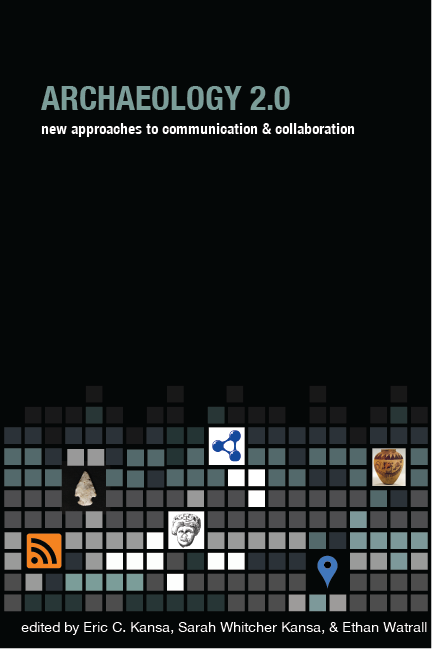
Book: Archaeology 2.0: New Approaches to Communication and Collaboration

Archaeology 2.0: New Approaches to Communication and Collaboration
Kansa, Eric C.; Kansa, Sarah Whitcher; Watrall, Ethan (eds.)
Cotsen Digital Archaeology Series


Announced 18 August at:
This book explores the social use and context of the World Wide Web within the discipline of archaeology. While the Web has radically altered journalism, commerce, media and social relationships, its sees very uneven adoption in professional scholarly contexts. Case studies discussed in this book help illuminate patterns of adoption and resistance to new forms of scholarly communication and data sharing. These case studies explore social media, digital preservation, and cultural representation concerns, as well as technical and semantic challenges and approaches toward data interoperability. Contributors to this volume debate the merits and sustainability of open access publishing and how the Web mediates interactions between professional and nonprofessional communities engaged in archaeology.


Archaeology 2.0 is the first book in the Cotsen Institute’s new Digital Archaeology Series. The editors want to thank all of the book’s contributors, and also the Cotsen Institute of Archaeology Press, especially Julie Nemer, Carol Leyba, and Willeke Wendrich. The printed version will be available for purchase shortly.

Thursday, August 18, 2011

Inscriptifact Update

The InscriptiFact Team has reported in an email to registered users that they have just uploaded approximately 5700 new images of 296 new texts from the Persepolis Fortification Archive. The majority of Aramaic texts from the archive are now available.

InscriptiFact is part of The West Semitic Research Project an academic project affiliated with the University of Southern California School of Religion and directed by Dr. Bruce Zuckerman. 


About InscriptiFact

The InscriptiFact Project is a database designed to allow access via the Internet to high-resolution images of ancient inscriptions from the Near Eastern and Mediterranean Worlds. The target inscriptions are some of the earliest written records in the world from an array of international museums and libraries and field projects where inscriptions still remain in situ. Included are, for example, Dead Sea Scrolls; cuneiform tablets from Mesopotamia and Canaan; papyri from Egypt; inscriptions on stone from Jordan, Lebanon and Cyprus; Hebrew, Aramaic, Ammonite and Edomite inscriptions on a variety of hard media (e.g., clay sherds, copper, semi-precious stones, jar handles); and Egyptian scarabs. These ancient texts represent religious and historical documents that serve as a foundation and historical point of reference for Judaism, Christianity, Islam and the cultures out of which they emerged...
Examples of screens and searches in HTML format for viewing in a web browser.
Step-by-step instructions for conducting searches and retrieving images in InscriptiFact, in PDF format.
Step-by-step instructions for using the InscriptiFact Viewer, featuring RTI (Reflectance Transformation Imaging) images, in PDF format.
One possible way to search for texts in InscriptiFact is by choosing "Text or Publication Numbers," i.e., common abbreviations used in the field of Ancient Near Eastern Studies. This PDF documents gives bibliographic information for the abbreviations or references used in InscriptiFact.
Download this document and fax it as stated to obtain access to InscriptiFact.
Click on this link to be taken to the download site for the InscriptiFact desktop client.

Wednesday, August 17, 2011

Open Access Journal: Aigis

[First posted in AWOL 29 October 2009. Updated 17 August 2011]

AIGIS: elektronisk tidsskrift for klassiske studier i Norden
ISSN 1901-685
AIGIS udkommer to gange årligt, 1. maj og 1. november og er gratis. Tidsskriftet udkommer ikke på papir, kun i elektronisk form


Læsning af formaterne
Artiklerne findes i indholdsfor-tegnelsen for de enkelte bind, hvorefter de downloades eller læses direkte. Hvis man har fast opkobling kan det være lettere at læse filerne med et Acrobat Reader plug-in. Hvis man derimod er koblet op med et modem og gerne vil spare på telefonregningen, er det mere hensigtsmæssigt at downloade (save as) og så lukke telefonen. 

Programmet
Artikler osv i AIGIS ligger i pdf (portable document format) som tillader græske bogstaver, billeder og fast lay-out med, så man kan henvise til sidenummer i artiklerne. Det er nødvendigt at man har det gratis program Acrobat Reader 6 eller nyere (8) der kan læse artiklerne, printe dem ud, søge i dem eller, hvis man vil, uddrage enkelte passager til brug i egne filer. Hent programmet på Adobe's hjemmeside. 

Abonnement
Hvis man vil være sikker på at få fremtidige færdige numre af AIGIS 'leveret' så snart det udkommer, kan man melde sig til AIGIS-postlisten via KU's Listserver. Men man kan naturligvis også komme til AIGIS uden at være fast abonnent. 

Bidrag, ris og ros
Man kan også sende e-post til redaktionen - selvfølgelig helst med ros og bidrag til kommende numre. Bidrag kan sendes per attachment i alle gængse tekstbehandlings-systemer, allerbedst i rtf (Rich Text Format). Græsk må gerne være skrevet i GreekKeys (Kadmos, Athe-nian, el. lign.), så slipper vi for at skrive det om. Allerbedst er Unicode. Disse systemer er brugbare både på Mac og PC. Undgå venligst Wingreek, Son of Wingreek og WordPerfect græsk som kun fungerer på PC. Billeder leveres indscannet i jpeg. 

Citater
Citater fra AIGIS skal være mærket med tydelig kildeangivelse.
AIGIS1.1 april 2001
AIGIS 1.2 oktober 2001
AIGIS 2.1 april 2002
AIGIS 2.2 oktober 2002
AIGIS 3.1 april 2003
AIGIS 3.2 oktober 2003
AIGIS 4.1 april 2004
AIGIS 4.2 oktober 2004
AIGIS 5.1 april 2005
AIGIS 5.2 oktober 2005
AIGIS 6.1 april 2006
AIGIS 6.2 oktober 2006
AIGIS 7.1 april 2007
AIGIS 7.2 oktober 2007
AIGIS 8.1 april 2008
AIGIS 8.2 november 2008
AIGIS 9.1 maj 2009
AIGIS 9,2 november 2009
AIGIS 10,1 maj 2010
AIGIS 10,2 november 2010
AIGIS 11,1 maj 2011  
Festskrift for Chr. Gorm Tortzen 60
TILBAGE TIL FORSIDEN


Bookmark and  Share so Your Real Friends Know that You Know