Wednesday, September 6, 2023

Les monnaies de fouille du monde grec (VIe-Ier s. a.C.): Apports, approches et méthodes

Les monnaies de fouille du monde grec (VIe-Ier s. a.C.)

Scripta Antiqua

Ce livre donne un état des récentes découvertes de monnaies de fouille en Méditerranée orientale dont celles faites en Égypte lors des fouilles sous-marines dans le delta du Nil en Égypte ou en Grèce sur les sites royaux de Macédoine. Une grande partie de ce matériel est inédite. L’ambition des auteurs est d’abord méthodologique : les monnaies de fouille sont des monnaies principalement perdues, souvent de faible valeur ou hors d’usage (décri, monnaies modifiées, fausses monnaies). L’objectif classique de leur étude est de fournir des marqueurs chronologiques aux archéologues, d’enrichir les corpus monétaires ou d’étudier la circulation. En réalité, elles offrent bien d’autres possibilités à la recherche (étude des phases de circulation et de décri, des pratiques monétaires, histoire économique, histoire des pratiques sociales, etc.), qu’elles soient trouvées en groupe ou isolées, dès lors qu’elles sont remises en contexte archéologique, de concert avec les autres artefacts, notamment céramiques.

  • Éditeur : Ausonius Éditions
  • Collection : Scripta Antiqua | 93
  • Lieu d’édition : Bordeaux
  • Année d’édition : 2016
  • Publication sur OpenEdition Books : 05 septembre 2023
  • EAN (Édition imprimée) : 9782356131706
  • EAN électronique : 9782356135964
  • Nombre de pages : 360 p.
Frédérique Duyrat et Catherine Grandjean
Avant-propos
Catherine Grandjean
Introduction
John H. Kroll
Conclusions


L'Antiquité dans la littérature de jeunesse

L'Antiquité dans la littérature de jeunesse
Scripta Receptoria

À travers 19 contributions, ce volume collectif considère quelques aspects de la représentation et de la réélaboration du matériau antique dans la littérature pour la jeunesse, spécialement dans le roman, la bande dessinée, le manga. La mythologie reçoit une grande attention, mais l’histoire, surtout romaine, est aussi l’objet d’attention, à travers par exemple des séries comme Astérix, Alix ou Thermae Romae. Quatre directions sont privilégiées : la nature et l’ampleur des adaptations opérées, leurs modalités, l’intention dans lesquelles elles ont été menées, le contenu du message véhiculé. Il est ainsi montré comment l’Antiquité, sous diverses formes, est utilisable, dans les ouvrages et corpus étudiés, comme vecteur d’enseignement, d’éducation, de médiation culturelle ou de simple recréation, comment elle se prête à diverses formes de réappropriation personnelle par les lecteurs.

  • Éditeur : Ausonius Éditions
  • Collection : Scripta Receptoria
  • Lieu d’édition : Bordeaux
  • Année d’édition : 2021
  • Publication sur OpenEdition Books : 05 septembre 2023
  • EAN (Édition imprimée) : 9782356134233
  • EAN électronique : 9782356135988
  • Nombre de pages : 253 p.

Monday, September 4, 2023

The British Institute for the Study of Iraq YouTube Channel Ur Colloquium


The British Institute for the Study of Iraq (BISI) is the UK’s only institution dedicated to advancing research and public education on Iraq in all areas of the arts, humanities and social sciences. For over 80 years, BISI has supported academic excellence and understanding of Iraq: funding projects, publishing vital research, organising conferences and public lectures, and re-training Iraq’s scholars and cultural heritage professionals. 

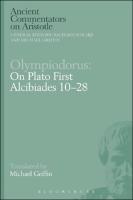
Olympiodorus: On Plato First Alcibiades 10–28

Griffin, Michael (editor)
Thumbnail

This open access book looks at Olympiodorus (AD c. 500–570), possibly the last non-Christian teacher of philosophy in Alexandria, who delivered 28 lectures as an introduction to Plato. This volume translates lectures 10–28, following from the first nine lectures and a biography of the philosopher published in translation in a companion volume, Olympiodorus: Life of Plato and On Plato First Alcibiades 1–9 (Bloomsbury, 2014). For us, these lectures can serve as an accessible introduction to late Neoplatonism. Olympiodorus locates the First Alcibiades at the start of the curriculum on Plato, because it is about self-knowledge. His pupils are beginners, able to approach the hierarchy of philosophical virtues, like the aristocratic playboy Alcibiades. Alcibiades needs to know himself, at least as an individual with particular actions, before he can reach the virtues of mere civic interaction. As Olympiodorus addresses mainly Christian students, he tells them that the different words they use are often symbols of truths shared between their faiths. The ebook editions of this book are available open access under a CC BY-NC-ND 4.0 licence on bloomsburycollections.com. Open access was funded by The University of British Columbia.

DOI
10.5040/9781474297578
ISBN
9781472584014, 9781472584007, 9781472584014, 9781472584007
Publication date and place
London, 2016
Imprint
Bloomsbury Academic
Series
Ancient Commentators on Aristotle,


The Diachronic Frequency of Latin Words: A Computational Dictionary: (B-C)

Giacomo Fenzi
Tommaso Spinelli (Hrsg.)
 The Diachronic Frequency of Latin Words:  A Computational Dictionary
Digital Classics Books

 The Diachronic Frequency of Latin Words ist eine neue Form eines Nachschlagewerkes, in dem statistische Informationen über die chronologische Entwicklung der Verwendung lateinischer Wörter in der Geschichte der Sprache vom vierten Jahrhundert v. Chr. bis zum frühen sechsten Jahrhundert n. Chr. geliefert werden. Als Grundlage dient die computergestützte Analyse der Werke von 309 lateinischen Autoren, fragmentarischen und anonymen Texten und über 520.000 Inschriften. So ist das Nachschlagewerk eine Unterstützung für Wissenschaftler:innen, den Gebrauch lateinischer Wörter in verschiedenen Zeiträumen und Sprachebenen zu untersuchen. Zusätzlich bietet es statistische Erkenntnisse zur Unterstützung philologischer, linguistischer und literarischer Analysen.

Lizenz

Dieses Werk ist unter der
Creative Commons-Lizenz 4.0
(CC BY-SA 4.0)
veröffentlicht.
Creative Commons Lizenz BY-SA 4.0

Identifikatoren
ISBN 978-3-96929-203-7 (PDF)

Veröffentlicht am 04.09.2023.

And see also: The Diachronic Frequency of Latin Words: A Computational Dictionary: (A/AB–AZYMVS)

Sunday, September 3, 2023

Administrative Hieratic from dynasties 19 and 20 : case studies on selected groups of ostraca with necropolis administration

Online publication date: 10-Oct-2022
Year of first publication: 2022
Language: english
Abstract: The publication, linked to the data in the online database AKU-PAL, discusses various aspects of ostraca with administrative hieratic script from Ramesside times. The genre of administrative writing is considered and the designation “necropolis journal” is rejected in favor of a more inclusive reference to necropolis administration. The economy of the writing process is analyzed especially in the form of economizing marks and practices of abbreviation. Palaeographic peculiarities in the composition of hieratograms are reviewed as well as text planning and hints at the cognitive writing process. Finally, the handwritings of three scribes are palaeographically reviewed. These aspects are embedded in an overall review of the workflow of scribes in Deir el-Medina during dynasties 19 and 20 and the question how they set up documents and wrote down their administration.
DDC: 490 Andere Sprachen
490 Other languages
930 Alte Geschichte
930 History of ancient world
Institution: Johannes Gutenberg-Universität Mainz
Department: FB 07 Geschichts- u. Kulturwissensch.
Place: Mainz
ROR: https://ror.org/023b0x485
DOI: http://doi.org/10.25358/openscience-7839
Version: Published version
Publication type: Monographie
License: CC BY
Information on rights of use: https://creativecommons.org/licenses/by/4.0/
Extent: 200 Seiten
Publisher: Akademie der Wissenschaften und der Literatur
Publisher place: Mainz
Issue date: 2022
Appears in collections:JGU-Publikationen
 

Girsu-Texte der Akkade-Zeit im Louvre

Online publication date: 28-Sep-2022
Year of first publication: 2022
Language: german
DDC: 490 Andere Sprachen
490 Other languages
930 Alte Geschichte
930 History of ancient world
Institution: Johannes Gutenberg-Universität Mainz
Department: FB 07 Geschichts- u. Kulturwissensch.
Place: Mainz
ROR: https://ror.org/023b0x485
DOI: http://doi.org/10.25358/openscience-7775
URN: urn:nbn:de:hebis:77-openscience-43d486fe-1e37-4dc1-a2c9-cb406bf0583b1
Version: Original work
Publication type: Dissertation
License: CC BY
Information on rights of use: https://creativecommons.org/licenses/by/4.0/
Extent: vi, 556 Seiten
Appears in collections:JGU-Publikationen