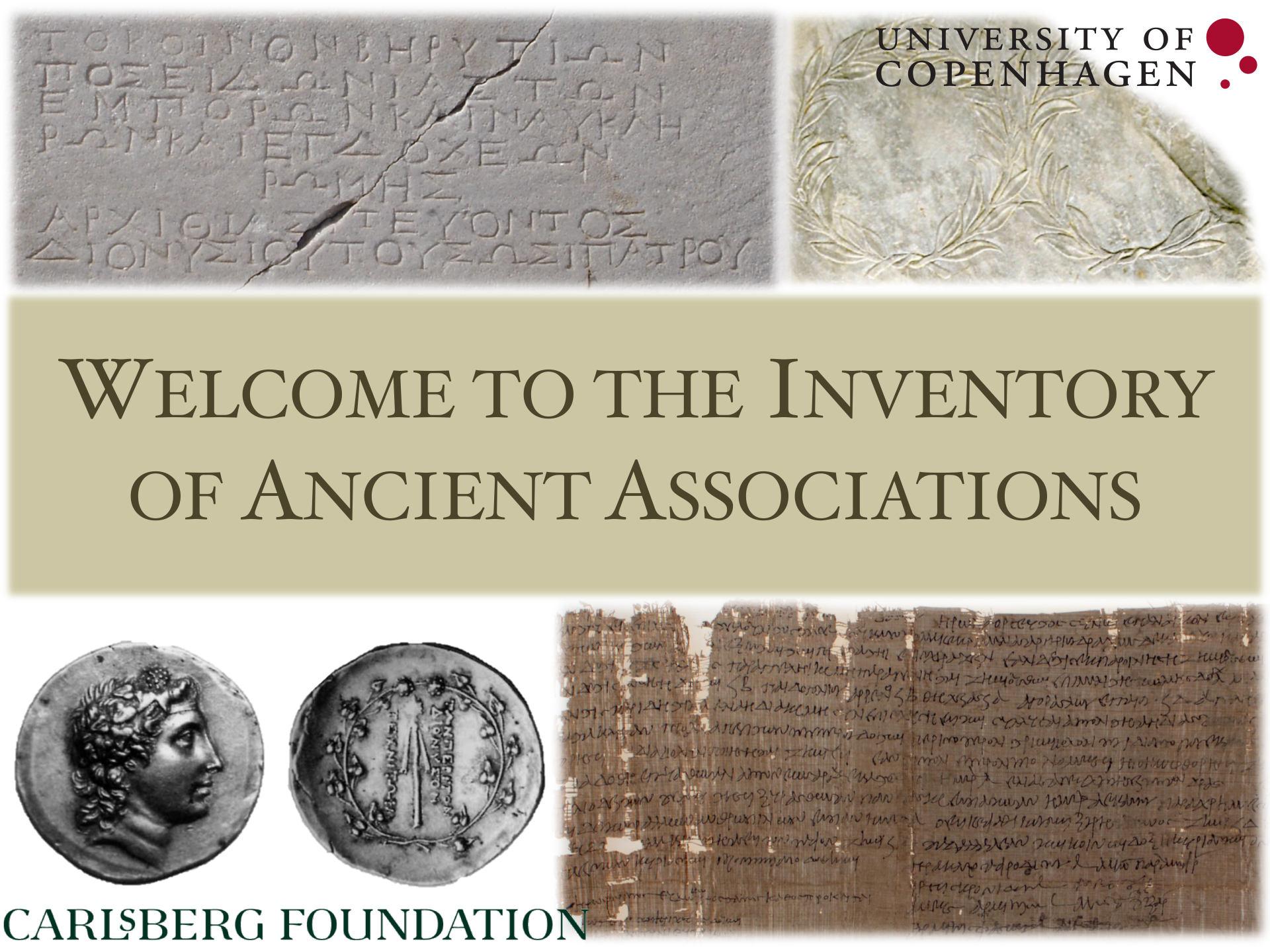
The main aim of the Inventory of Ancient Associations is to document the private associations of the Classical, Hellenistic, and Roman worlds (ca. 500 BC to ca. AD 300) in an analytical and critical manner. The purpose is to stimulate research, debate, and discussion on this fast–evolving scholarly subject, not to provide definite answers or strait jackets to it. For this reason, an online database—rather than a soon out–dated printed publication—represented the best tool for the task: updates and global searches are the main advantages of the Inventory.
The geographical area covered extends from the Central Mediterranean to the Near East (see Geography). The Inventory collects and records in a standardized manner (see Structure), following a specific set of analytical criteria, all known attestations of private associations from this area and these periods, including languages other than Greek (e.g. Demotic Egyptian and Aramaic). The Inventory is a database of private associations, not of texts.
The term 'private' is a debated one: although certainly not ideal, it seemed the best option to generally define the phenomenon of non–state groups (i.e. groups other than civic subdivisions) under investigation. A useful discussion on the subject is the Introduction by V. Gabrielsen and C. A. Thomsen to the volume Private Associations and the Public Sphere. Proceedings of a Symposium held at the Royal Danish Academy of Sciences and Letters, 9-11 September 2010, Copenhagen 2015.
The editorial board of the Inventory was formed by the main members of the Copenhagen Associations Project: Vincent Gabrielsen (Project Director), Jan-Mathieu Carbon, Annelies Cazemier, Mario C. D. Paganini, and Stella Skaltsa (see About). Several international collaborators generously contributed to the compilation of the Inventory (see Acknowledgements). Although following the relevant guidelines by the editorial board during the process of recording the relevant material, each contributor had absolute freedom in their scientific choices of the treatment of the material: the final selection remained at the judgment of each individual contributor.
The electronic database is fully accessible (see Practical Help and Terms of Use) and will continue to be regularly updated: it should be constantly considered a 'work in progress'. Despite the best efforts to the contrary and because of the collegial nature of the Inventory, some internal inconsistences will regrettably be present.
The work should be cited as: The Inventory of Ancient Associations. The suggested way of referring to the content of each entry in the database is by its unique ID alongside the name of the author, according to the following example: CAPInv. 10 (Gabrielsen).
For comments, queries, and feedback feel free to contact the Editors.
For a rich and useful online collection of texts and sources in translation relating to associations, guilds, immigrant groups, and mysteries initiates see the website Associations in the Greco–Roman World by P. Harland.
Wednesday, August 2, 2023
Inventory of Ancient Associations
Multiscapes: Eine Methodensuche zur Annäherung an hethitisches Ritualgeschehen im ‚offenen Raum‘

Die Untersuchung antiker Kultaktivitäten konzentrierte sich zumeist auf architektonisch gestaltete Heiligtümer in den Städten. Um sich Ritualgeschehen abseits von Siedlungen anzunähern, entwickelt diese Dissertation ein multisensorisches Analysemodell namens Multiscapes.
Dieses besteht aus kulturspezifischen Narrativen (Mindscape) und den menschlichen Wahrnehmungspotentialen Sehen (Visionscape), Hören (Soundscape), Riechen (Smellscape), Schmecken (Tastescape) und Fühlen (Touchscape).
Die praktische Anwendbarkeit wird bei einem beispielhaften Vergleich von konzeptionellen hethitischen Schriftquellen mit Umsetzungspotentialen an Befunden im ‚offenen Raum‘ des spätbronzezeitlichen Anatolien getestet.InhaltsverzeichnisAnhangLizenz
Dieses Werk ist unter der
Creative Commons-Lizenz 4.0
(CC BY-SA 4.0) veröffentlicht.
Identifikatoren
ISBN 978-3-96929-216-7 (PDF)ISBN 978-3-96929-217-4 (Hardcover)

Proceedings of the 12th International Congress on the Archaeology of the Ancient Near East 06-09 April 2021, Bologna. Vol. 1: Environmental Archaeology. Hammering the Material World. Cognitive Archaeology. Modeling the Past. Networked Archaeology. Endangered Cultural Heritage
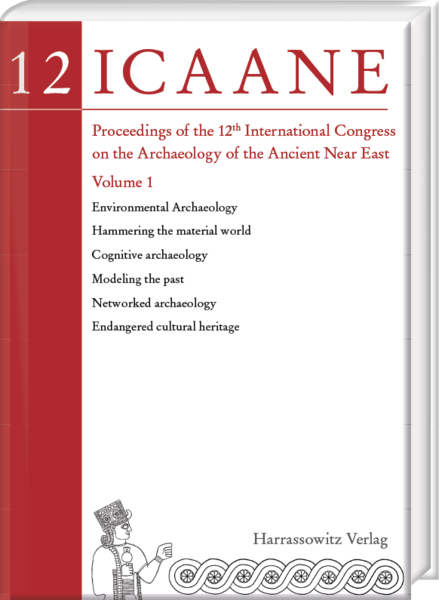
The two volumes include 142 selected lectures presented at the “12th International Congress on the Archaeology of the Ancient Near East” (ICAANE) at the University of Bologna in April 2021. This congress takes place every other year and is the platform for all archaeologists worldwide to present the current results of their research in and on the Near East. The timeframe extends from the Neolithic through the Bronze and Iron ages down to the Achaemenid, Seleuco-Parthian and up to the Islamic period. The geographical frame spans the area from the eastern Mediterranean to Central Asia, and from the Black Sea to the Arabian peninsula. Researchers coming from 43 countries have summarized their latest discoveries mostly in English: the ICAANE proceedings give a state of the art-insight into current research methods and problems of Near Eastern Archaeology.
Volume 1, edited by N. Marchetti, M. Campeggi, F. Cavaliere, C. D'Orazio, G. Giacosa, E. Mariani, comprises 73 contributions related to the conference themes of Environmental Archaeology; Hammering the material world; Cognitive archaeology; Modeling the past; Networked archaeology; Endangered cultural heritage.
pages/dimensions: XII, 1044 pages, 689 fig., 43 tables language: English binding: Book (Hardback) dimensions: 17.00 × 24.00 cm publishing date: 26.07.2023 prices: 158,00 Eur[D] / 162,50 Eur[A] ISBN: 978-3-447-11873-6 DOI: 10.13173/9783447118736 Sequence
Tuesday, August 1, 2023
'I Descended to the Depths of the Earth': A Rhetorical Poetics of the Jewish Babylonian Aramaic Incantation Bowls
This dissertation investigates the use of narrative spells in the magical context of the Jewish Babylonian Aramaic (JBA) incantation bowls. These ancient clay bowls were inscribed with incantations that were designed to protect their owners from demons. But the bowls do not just adjure or threaten demons. They also use narrative spells to achieve their goals. This dissertation collates the narrative materials in the four hundred JBA bowls published thus far. It makes various important distinctions within these materials, and uses the concepts of magic, rhetoric, and rhetorical narratology to examine how the JBA bowls harnessed the power of narrative to generate a change in the world and persuade or compel demons to do things. Persuasive appeals reveal people’s orientations and attitudes towards supernatural powers, and the rhetorical framework outlined in this work draws attention to the multiple but neglected forms of effective narrative deployed in the bowls. It demonstrates how the efficacy of these spells is built upon distinctive narrative properties such as description, narrative space, and the implicit movement of simple narratives towards resolution. It also examines how the bowls reveal the demonology of late antique Judaism, and argues that their texts show the human actors behind the bowls in the active, imaginative process of constructing and negotiating their relationships with angels, demons, and God. This book is thus not just about the use of words to change the world; it is also a story of imagination in the service of magic.
Original language English Qualification Doctor of Philosophy Awarding Institution
- University of Groningen
Supervisors/Advisors
- Popovic, Mladen, Supervisor
- von Stuckrad, Kocku, Supervisor
Award date 2-Jul-2020 Place of Publication [Groningen] Publisher Print ISBNs 978-94-034-2779-9 Electronic ISBNs 978-94-034-2780-5 Publication status Published - 2020
Access to Document
Handle.net
Henoch und der Tempel des Todes: "Henochs Vision von den zwei Häusern" (1 Hen 14,8-25) zwischen Schriftauslegung und Traditionsverarbeitung. Mit einer Einführung in die Quellenlage, Neuedition und Übersetzung von 1 Hen 14-16
The study on the Book of Watchers (1 Enoch 1–36), an ancient Jewish text of the third century B.C.E., presented here focuses on Enoch’s vision of the two houses (1 Enoch 14:8–25), which is usually interpreted as a vision of the heavenly temple and throne of God. This vision is investigated in the context of the dream account (1 Enoch 14–16) in its different versions (Aramaic, Greek and Old Ethiopic) and in particular with regard to the question of the relationship between scriptural interpretation and use of traditions. A close examination of the source material illustrates the complexity and the difficulties of the transmission process of this text and suggests in general a synoptic approach to the various textual witnesses. A detailed textual analysis of the vision and an in-depth comparison with ancient Jewish and Mesopotamian sources suggests that the two houses in 1 Enoch 14:8–25 should not be interpreted in accordance with the previous research opinion as distinct parts of a big temple complex, but rather as a contrast of the inferior earthly temple with the ideal heavenly sanctuary. Enoch’s vision of the two houses reflects in many ways ideas and traditions found in other works of its intellectual environment, but it also introduces with the evolution beyond the idea, that the earthly and heavenly sanctuary correspond, an essential temple theological innovation and articulates in this way one of the most radical temple critiques of ancient Judaism.
Original language German Qualification Doctor of Philosophy Awarding Institution
- University of Groningen
Supervisors/Advisors
- Popovic, Mladen, Supervisor
- Kratz, Reinhard, Supervisor, External person
- Steudel, A., Supervisor, External person
- Ruiten, van, Jacques, Supervisor
Award date 27-Feb-2020 Place of Publication [Groningen] Publisher Print ISBNs 978-94-034-2241-1 Electronic ISBNs 978-94-034-2240-4 Publication status Published - 2020
Access to Document
Handle.net
Silenced Voices : Hearing Biblical Women Through the Genesis Apocryphon
Langley, British Columbia : Trinity Western University, 2021.
File / Folder AccessFootnote * file Open
A Study on Judean Cultural Identity in Egypt during the Fifth Century BCE: characterizing Judean Cultural Identity using elements of Judean Matrimonial Law attested in the Aramaic Matrimonial Property Arrangements from Elephantine Island
The fifth century BCE can be characterized as a century during which the globalization of the ancient world continued to expand. The rise of the Achaemenid Empire caused individuals to settle in new areas within the empire and establish new communities. One of such communities is the Judean community on Elephantine Island. In this dissertation, I will study the effects of the settlement of the Judean community into the culturally diverse social context on Elephantine Island on the development of their cultural identity. I will do so, by approaching the question from the perspective of the legal tradition attested in the Aramaic papyri which have been discovered on Elephantine Island during the late 19th and early 20th centuries. Based on the contents of Judean matrimonial property arrangements, I will demonstrate that Judeans not only adapted themselves to the legal practices of their contractual partners, but also continued to use elements of a distinct Judean legal tradition in the context of matrimonial law. Not only will this contribute to a more profound understanding of Judean cultural identity during the fifth century BCE, but it will also demonstrate that (matrimonial) law was an integral part of Judean cultural identity on Elephantine Island, in addition to religion.
Original language English Qualification Doctor of Philosophy Awarding Institution
- University of Groningen
Supervisors/Advisors
- Popovic, Mladen, Supervisor
- van Bekkum, Wout, Supervisor
Award date 23-Jan-2023 Place of Publication [Groningen] Publisher Publication status Published - 2023 Access to Document
Handle.net





 Posts
Posts


 Stumble It!

