Friday, February 16, 2018

Open Access Journal: Annales Islamologiques

Annales Islamologiques
ISSN électronique: 2429-2850
 
Les Annales islamologiques sont une revue pluridisciplinaire annuelle, publiant en français, anglais et arabe, des études originales dans tous les domaines relatifs à l’Égypte et au monde arabo-musulman, du VIIe siècle à nos jours : histoire, histoire de l’art, archéologie, conservation et restauration, linguistique, littérature, droit, religion, histoire des sciences, ethnologie. Chaque numéro comprend un dossier thématique et des varia.

NUMÉROS EN TEXTE INTÉGRAL

Earlier volumes (open access through  volume 46) are available directly from the IFAO:
1 2 3 4 5 6 7 8 9 10 11 12 13 14 15 16 17 18 19 20 21 22 23 24 25 26 26.2 27 28 29 30 31 32 33 34 35 36 37 38 39 40 
41 42 43 44 45 46 47 48.1 48.2 49 50

Exhibition: ROMANCE AND REASON: Islamic Transformations of the Classical Past

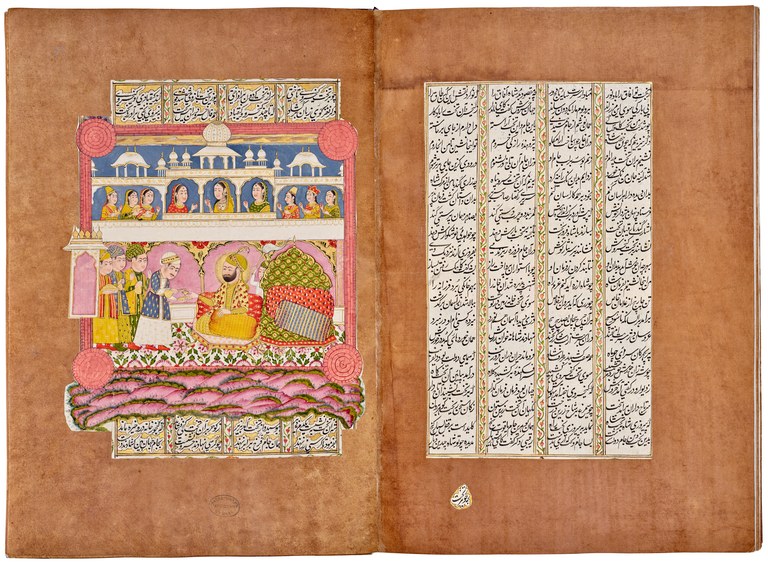
ROMANCE AND REASON: Islamic Transformations of the Classical Past
KhamsaFolios 50 verso, 51 recto: Iskandar Served Kay Khusraw’s Magical Goblet (jam-i jahan-bin)Author: Nizami Ganjavi (1141–1209); Copyist: Unknown; Language: PersianInk, opaque watercolor, and gold on paperIndia, 17th century, illustrations possibly laterFrom the collections of The National Library of Israel: Ms. Yah. Ar. 1021Image (c) National Library of Israel 
The story of antiquity reads as an endless cycle of expansion, conflict, and conquest. Yet despite the divisions that existed among peoples and nations, the exchange and appropriation of ideas, images, and heroic figures across cultures knew no boundaries, with the Classical World retaining a particular appeal across countries and beliefs.

Thursday, February 15, 2018

Open Access Journal: Cahiers de l'Ecole du Louvre

 [First posted in AWOL 13 March 2014, updated 15 February 2018]

Cahiers de l'Ecole du Louvre
ISSN: 2262-208X
Revue de recherche en ligne de l’Ecole du Louvre, cette nouvelle publication accompagne la restructuration du troisième cycle en offrant à la recherche pratiquée à l’Ecole un  nouvel outil de diffusion, plus souple et mieux adapté aux pratiques contemporaines. Alliant l’exigence scientifique garantie par la validation d’un comité de lecture à la souplesse et à la facilité d’utilisation du support numérique, les Cahiers ont pour ambition de rendre la recherche menée à l’Ecole plus visible à la communauté savante.
Avec une périodicité semestrielle, ils proposeront pour chaque numéro une série de cinq à six articles issus des  meilleurs travaux des élèves ainsi que des recherches en cours des enseignants et partenaires associés de l’Ecole. Le lecteur pourra également trouver un résumé en français, un abstract en anglais et une courte biographie des auteurs, une rubrique « Documents », destinée à accueillir le cas échéant, des articles plus courts mettant en valeur un document inédit, et une rubrique « Actualité de la recherche à l’Ecole » qui rendra compte des journées d’études, colloques, parution d’ouvrages, etc. organisés par l’Ecole.


Les Cahiers de l’Ecole du Louvre bénéficient du soutien de la Fondation Daniel et Nina Carasso.

Numéros en texte intégral


OpenARCHEM: Archaeometry for the 21st Century

 OpenARCHEM: Archaeometry for the 21st Century
We are in the process of building, please stay tuned! In the meantime, you can look at our current test data and visit our general blog here for more information. If you have suggestions or feedback, please email them to us!

Our Data

Currently our Organic Residue Analysis (ORA) data comes from the ARCHEM project but we invite potential contributors to contact us about setting up accounts to add your data. In the future we hope to expand beyond ORA data into other methods of archaeometry.
Descriptions of objects and sites are adapted from museum catalogs and publications. Whenever possible, ceramic objects will be linked to petrographic data provided either by ourselves or by complementary databases such as the Levantine Ceramics Project.
Information on the plants, compounds, and texts comes from a number of databases, most notably Dr. Duke's Phytochemical and Ethnobotanical Databases, the NIST Chemistry Webbook, and the Perseus Digital Library. We provide links out to these databases and more throughout our site and hope visitors will find them useful sources of additional information.
When we have 3D models for ORA source objects, we host them on Sketchfab and provide an embedded viewer for examining the models.

WIRE: Women in the Roman East

WIRE: Women in the Roman East
logo 
Welcome! WIRE: Women in the Roman East seeks to provide resources and digital tools for the study of women’s lives in the Roman East. Within the project database, you will encounter a wide range of evidence that bears witness to women’s experiences, from epitaphs to coins. This collection is drawn from ancient texts, excavation reports, museum catalogs, and field records. The sources can be used to study any number of aspects of women’s lives in the Roman East, from women’s names to women’s roles in imperial politics and cult. The database is accessible to a range of users, including scholars engaged in research, instructors integrating WIRE into their classroom pedagogy, and interested members of the general public.
WIRE is actively developed under the supervision of Robyn Le Blanc (UNCG) and Sean P. Burrus (U. Mich). New content and features are continuously being added, and we welcome your feedback at contact@wireproject.org.

ergaleia // digital tools for classics

ergaleia // digital tools for classics 
This is a listing of digital tools that we have found personally useful in our own research and pedagogy. There are many other digital tools out there for Classicists and archaeologists; this list is by no means exhaustive or comprehensive. Our goal is to provide a short annotated list of basic tools that fulfill basic needs in Classical scholarship or teaching. Other resources will be added as time goes on, some accompanied by a longer explanatory post on the ergaleia blog.
If you are looking for a comprehensive listing of digital tools for Classics, feel free to consult the Digital Classicist Wiki and help contribute if you find new ones that aren’t listed!

Quick links

Textual Analysis // Pedagogy // Material Culture // Mapping / Geography