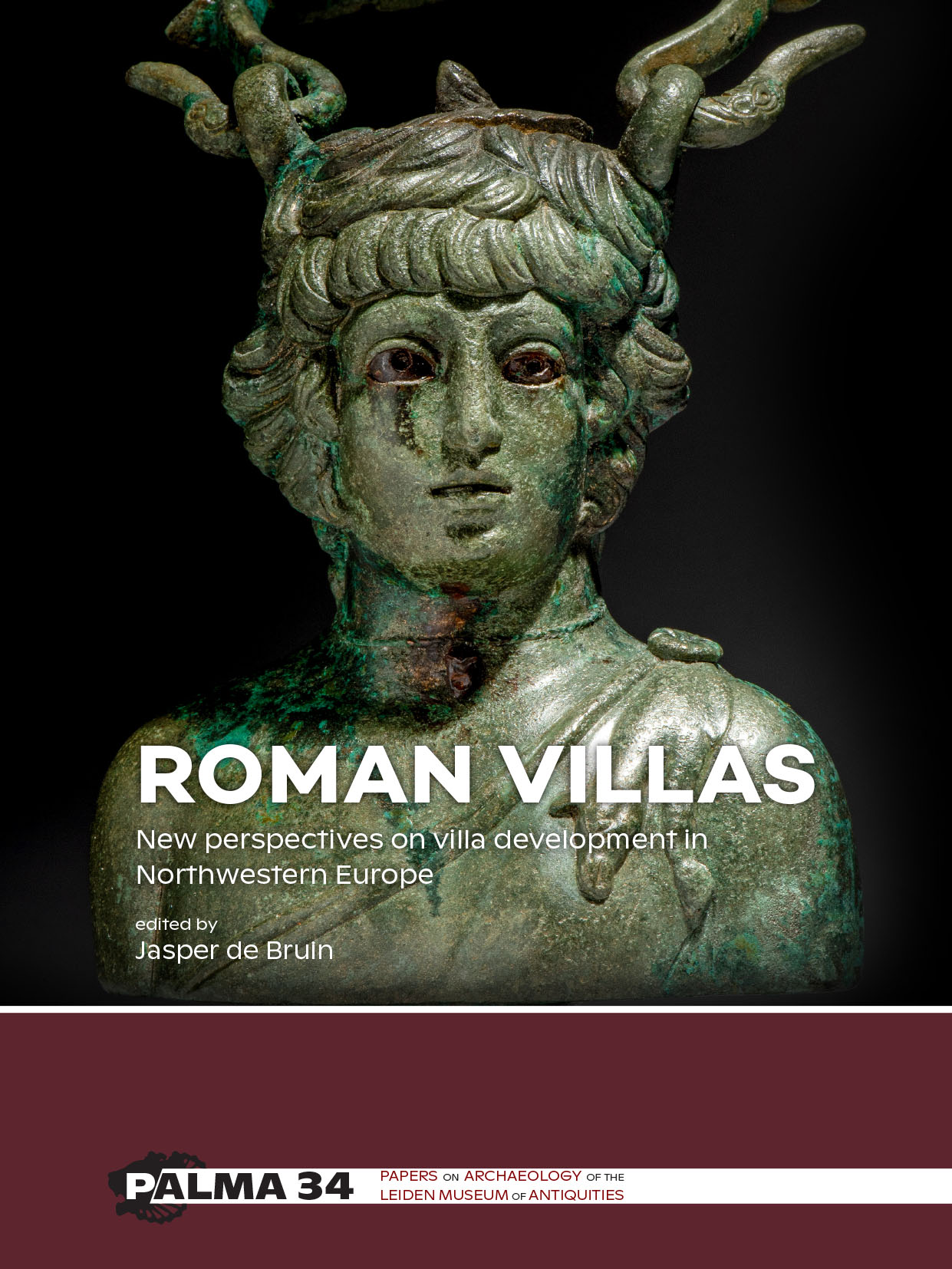
Paperback ISBN: 9789464263473 | Hardback ISBN: 9789464263480 | Imprint: Sidestone Press | Format: 210x280mm | 516 pp. | Papers on Archaeology of the Leiden Museum of Antiquities 34 | Series: PALMA | Language: English | 70 illus. (bw) | 342 illus. (fc) | Keywords: archaeology; Roman period; Roman Empire, Roman villa | download cover | DOI: 10.59641/m5p1j2k3l4 | CC-license: CC BY-NC-ND 4.0
The Dutch province of Limburg, as it exists now, once bordered the frontier zone of the Roman Empire. It was known for its fertile soils, where, especially in the south, a villa landscape developed during the first three centuries CE. Many of these Roman villas were excavated in the nineteenth and twentieth centuries, without being analysed, and publications relating to these sites did not meet contemporary standards.
The Leiden Villa Project, conducted between 2022 and 2024 by a team of researchers from the National Museum of Antiquities in Leiden, the Limburgs Museum in Venlo, The Roman Museum in Heerlen and the Cultural Heritage Agency of the Netherlands, aimed at filling in this lacuna. The project also paid attention to other aspects, such as the research history in Dutch Limburg, the burials that were associated with the Roman villa settlements, and aspects of conservation and heritage management.
This project has resulted in an up-to-date overview of more than twenty villa settlements, presented here in this volume, together with information on the more recently studied villa sites in the Netherlands, and the villa landscapes in Germany, Belgium and France. Accompanied by a study focused on the end of the Roman villas, this volume offers new and thought-provoking perspectives for anyone studying Roman villas in Northwestern Europe, or the phenomenon of the Roman villa in general.
1. Introduction
Jasper de Bruin2. Limburg in the Roman Period
Bibi Beekman3. The Rijksmuseum van Oudheden and Roman Limburg: The history of a long relationship
Leo VerhartPART I: Roman villas in Dutch Limburg
4. Buildings at villa sites in Dutch Limburg and their development.
Henk Hiddink5. Decorating villas: wall paintings and natural stone
Jasper de Bruin and Lara Laken6. Ceramic finds from the villae
Roderick GeertsPART II: Individual villa sites in Dutch Limburg
7. The Roman villas of Meerssen-Onderste Herkenberg and Cadier en Keer-Backerbosch revisited and reconsidered
Tessa de Groot and Jan-Willem de Kort8. Voerendaal-Ten Hove. A Late Iron Age enclosure, Roman villa and Late Roman-Early Medieval settlement with burials
Henk Hiddink and Diederick Habermehl9. The Maasbracht villa
Wouter Vos and Jasper de Bruin10. The Kerkrade-Holzkuil Villa
Gerard TichelmanPART III: Burials in Dutch Limburg
11. Burials in the Limburg villa region
Jasper de Bruin, with contributions by Lourens van der Feijst, Tessa de Groot and Annelies Koster12. The Simpelveld Sarcophagus: The History of a Discovery
Leo Verhart13. The Conservation of the Simpelveld Sarcophagus
Renske Dooijes and Nikè HaverkampPART IV: Villa landscapes in Northwestern Europe
14. The Roman villa landscape of South Limburg: a prime example of local agency in a native-Roman farming society
Karen Jeneson15. Roman villas in modern-day Belgium
Sadi Maréchal16. Villae rusticae in the German Rhineland
Tünde Kaszab-Olschewski17. The state of research on Roman villas in Gaul. Problems and perspectives
Michel ReddéPART V: The ‘End’ of the villa?
18. Exploring the end of the Roman villa in Northwest Europe: Current directions and approaches
James Dodd19. (Un)protected opulence. National heritage management and Roman villas in Limburg, 1961-2023
Tessa de Groot & Jos Bazelmans20. Villa development in Dutch Limburg and beyond: new perspectives
Jasper de Bruin





 Posts
Posts


 Stumble It!


No comments:
Post a Comment