Thursday, July 31, 2025

Open Access Journal: Bulletin archéologique des Écoles françaises à l’étranger

 [First posted in AWOL 20 January 2024, updated 31 July 2025]
 
ISSN électroniqu:e 2732-687X
Bulletin archéologique des Écoles françaises à l’étranger

Créé en 2020, le Bulletin archéologique des Écoles françaises à l’étranger propose les contributions de l’École française d’Athènes, de l’École française de Rome, de l’Institut français d’archéologie orientale, de l’École française d’Extrême-Orient et de la Casa de Velázquez, réunis au sein du Réseau des Écoles françaises à l’étranger. C’est ainsi toute l’actualité des recherches archéologiques menées par ces institutions, sur tout le pourtour méditerranéen mais aussi dans les Balkans, en Inde et en Asie qui est proposée dans ce Bulletin exclusivement électronique, multilingue et à la publication continue.

Latest texts

See AWOL's full List of Open Access Journals in Ancient Studies


Bicentenaire Champollion : l'Egypte et Montpellier

Aufrère S.H., Lavabre-Bertrand Th., Nique Ch., Sénac J.P., BOSSON Nathalie, DHOMBRES J., CARREZ-MARATRAY J.Y., MATHIEU B., MENEGHETTI Livia, SERVAJEAN F., GOLVIN J.C., PERRAUD Milena, LHOYER Bénédicte, Lopez E.

Résumé :

Colloque tenu à Montpellier les 13 et 14 mai 2022 Ayant débarqué à Toulon après l’Expédition franco-Toscane (1828-1829), JeanFrançois Champollion, revenant vers Paris, effectue un détour dans le Sud de la France. Après une quarantaine au lazaret de Toulon, ce périple méridional le mène à Marseille,Aix-en-Provence, Avignon, Nîmes, Montpellier, Narbonne et Toulouse avant de prendre la route de Paris. À Montpellier, il rend visite à une connaissance rencontrée en 1825 à Florence : le baron François-Xavier Fabre. Cette rencontre emblématique entre l’Égyptologie naissante et les Beaux-Arts préfigure la naissance de l’égyptologie à Montpellier.

Consulter ou télécharger les actes du colloque :

📄 Lire le colloque en ligne 📤 Télécharger le colloque

Vidéo(s) du colloque :


Beyond Egyptomania: Objects, Style and Agency

Miguel John Versluys (ed.)
 
Published by De Gruyter
Book 21 in the Studien aus dem Warburg-Haus series

The material and intellectual presence of Egypt is at the heart of Western culture, religion and art from Antiquity to the present. This volume aims to provide a long term and interdisciplinary perspective on Egypt and its mnemohistory, taking theories on objects and their agency as its main point of departure. The central questions the book addresses are why, from the first millennium BC onwards, things and concepts Egyptian are to be found in such a great variety of places throughout European history and how we can account for their enduring impact over time. By taking a radically object-oriented perspective on this question, this book is also a major contribution to current debates on the agency of artefacts across archaeology, anthropology and art histor 

Peer Review Information

This work has been peer reviewed.

Language

  • English

Date published

ISBNs

  • PDF
    9783110565843
  • Hardback
    9783110564259


Open Access Journal: Iraq: Journal of the British Institute for the Study of Iraq (Gertrude Bell Memorial)

ISSN: 0021-0889 (Print) 
ISSN: 2053-4744 (Online)

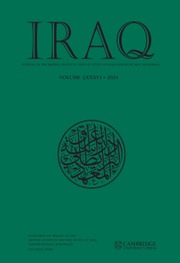
IRAQ

Iraq is an academic periodical founded in 1934 and appearing annually. It publishes articles on the history, art, archaeology, religion, economic and social life of Iraq and, to a lesser degree, of the neighbouring countries where they relate to it, from the earliest times to about AD 1750. Iraq has been a vehicle especially for the art and archaeology of Mesopotamia and for Assyriology.The British Institute for the Study of Iraq has wider interests than its predecessor, the British School of Archaeology in Iraq. Consequently the editorial board is keen to solicit articles from a greater range of academic fields. We welcome contributions on, for example, aspects of early Islamic, medieval and early Ottoman Iraq. 

We are delighted to announce that all articles accepted for publication in Iraq from 13 December 2024 will be ‘open access’; published with a Creative Commons licence and freely available to read online (see the journal’s Open Access Options page for available licence options). We have an OA option for every author: the costs of open access publication will be covered through agreements between the publisher and the author’s institution, payment of APCs from grant or other funds, or else waived entirely, ensuring every author can publish and enjoy the benefits of OA.  

Please see the journal's Open Access Options page for instructions on how to request an APC waiver.

See this FAQ for more information.

Volume 86 - December 2024

Latest volume of IRAQ

Editorial

Obituary

APPROACHES TO CUNEIFORM LITERATURE CONFERENCE

Research Article

Addendum

Research Article

Abstracts in Arabic

Front Cover (OFC, IFC) and matter

Back Cover (IBC, OBC) and matter

See AWOL's full List of Open Access Journals in Ancient Studies