Friday, December 5, 2025

Open Access Journal: Eugesta [Journal on Gender Studies in Antiquity]

[First posted in AWOL 18 December 2011. Updated 6 Decewmber 2025]

Eugesta [Journal on Gender Studies in Antiquity]
ISSN: 2265-8777
Le recours aux concepts de sexe et de genre développés dans les Gender Studies a considérablement transformé les recherches dans le domaine de l’Antiquité en ouvrant un nouveau champ extrêmement fructueux sur le plan culturel et social. Dans la mesure où elle est à l’origine de conceptions et valeurs auxquelles se réfèrent les constructions d’identités dans les cultures occidentales, l’Antiquité est un lieu d’application de ces théories tout à fait particulier. Les travaux menés sur les relations entre hommes, entre hommes et femmes, entre femmes, et sur les façons de construire le féminin et le masculin, ont jeté sur le fonctionnement des sociétés et cultures antiques, un éclairage nouveau, qui est aussi d’un intérêt capital pour l’étude de la réception de l’Antiquité dans les cultures occidentales.
Lire la suite…
The increased attention accorded to concepts of sex and gender developed by work in gender studies has powerfully transformed research in to the ancient Mediterranean past, opening up a new extremely fruitful field of cultural and social analysis. Inasmuch as many ideas and values responsible for shaping the construction of identities in later western societies originate in antiquity, applying gendered theoretical perspectives to the texts and artifacts surviving from the ancient world antiquity offers particular benefits. Inquiries conducted into the relations among men, between men and women, among women, and on modes of constructing what qualifies as “feminine” and “masculine” have brought a new illumination to the distinctive ways that ancient societies and cultures functioned, an illumination also of major relevance for research on the reception of antiquity in western cultures.
More


All issues


Der Königspalast von Qaṭna. Teil 3: Architektur, Stratigraphie, Funde und Keramik der westlichen, nördlichen und östlich-zentralen Raumeinheiten. Teilband 1: Die Nutzungsphasen G 12 bis G 9b Die Nutzungsphasen G 12-G 9a. Teilband 2: Die Nutzungsphase G 9a. Teilband 3: Die Nutzungsphasen G 8 bis G 5/6 Free Open Access Download - Appendix

Der Königspalast von Qaṭna. Teil 3: Architektur, Stratigraphie, Funde und Keramik der westlichen, nördlichen und östlich-zentralen Raumeinheiten. Teilband 1: Die Nutzungsphasen G 12 bis G 9b Die Nutzungsphasen G 12-G 9a. Teilband 2: Die Nutzungsphase G 9a. Teilband 3: Die Nutzungsphasen G 8 bis G 5/6 Free Open Access Download - Appendix
Geith, Eva / Lange-Weber, Sarah / Pfälzner, Peter / Wissing, Anne  
 

 In dem aus drei Teilbänden bestehenden Werk werden die archäologischen Befunde und die damit jeweils kontextuell verbundenen Funde und Keramikkollektionen aus den westlichen, nördlichen und östlich-zentralen Raumeinheiten des Königspalastes von Qaṭna (Al-Mišrife, Syrien) vorgelegt. Die Darstellung umfasst die folgenden Raumeinheiten des Palastes: den Eingangstrakt, den Westtrakt, den mittleren Teil des zentralen Repräsentationstraktes, die Nordosteinheit, die Nordeinheit, die Brunneneinheit, den Nordwestflügel und die Nordterrasse. Die Befunde, Funde und die Keramik werden in chronologischer Reihenfolge von der Frühen Bronzezeit bis zur Eisenzeit präsentiert.

In Teilband 1 werden die vorpalastzeitlichen Befunde aus der Frühen Bronzezeit (Phasen G 12 und G 11) und aus der Mittleren Bronzezeit I (Phase G 10) im Bereich des späteren Palastes sowie der aus der Mittleren Bronzezeit IIA stammende Urplan des Palastes (Phase G 9b) behandelt.
Der zweite Teilband behandelt den Ausführungsplan des Palastes (Phase G 9a). Dieser datiert in die Mittlere Bronzezeit IIA und folgte dem Urplan (Phase G 9b) zeitlich unmittelbar nach. In dieser Zeit wurde der Palastplan in der Form errichtet, in der das Gebäude bis in die Späte Bronzezeit weiterbenutzt wurde.
Der dritte Teilband ist den späteren Nutzungsphasen des Palastes und der nachfolgenden Bebauung aus der Eisenzeit gewidmet. Hier wird zunächst die Nutzungsphase G 8 des Gebäudes, die aus der Mittelbronzezeit IIA–IIB stammt, behandelt und danach die Nutzungsphase G 7, die der Späten Bronzezeit I bis IIA zuzuweisen ist. Anschließend werden die Befunde und Funde der eisenzeitlichen Bebauung des Areals (Phase G 5/6) nach der Zerstörung des Palastes vorgestellt.

series:
volume: 11
parts: 3
language: Deutsch
binding: Buch (Hardcover)
dimensions: 23,50 × 30,50 cm
publishing date: 17.12.2025
prices: ca. 368,00 Eur[D] / 378,40 Eur[A]
ISBN: 978-3-447-12295-5


Open Access Journal: Religions

ISSN: 2077-1444 
Religions 
Religions is an international, interdisciplinary, peer-reviewed, open access journal on religions and theology, published monthly online by MDPI.

All Issues

Volume 16, Issue 11
Current:  Vol. 16, Iss 11
November2025
Volume 16, Issue 10
Vol. 16, Iss 10
October2025
Volume 16, Issue 9
Vol. 16, Iss 9
September2025
Volume 16, Issue 8
Vol. 16, Iss 8
August2025
Volume 16, Issue 7
Vol. 16, Iss 7
July2025
Volume 16, Issue 6
Vol. 16, Iss 6
June2025
Volume 16, Issue 5
Vol. 16, Iss 5
May2025
Volume 16, Issue 4
Vol. 16, Iss 4
April2025
Volume 16, Issue 3
Vol. 16, Iss 3
March2025
Volume 16, Issue 2
Vol. 16, Iss 2
February2025
Volume 16, Issue 1
Vol. 16, Iss 1
January2025
Volume 15, Issue 12
Vol. 15, Iss 12
December2024
Volume 15, Issue 11
Vol. 15, Iss 11
November2024
Volume 15, Issue 10
Vol. 15, Iss 10
October2024
Volume 15, Issue 9
Vol. 15, Iss 9
September2024
Volume 15, Issue 8
Vol. 15, Iss 8
August2024
Volume 15, Issue 7
Vol. 15, Iss 7
July2024
Volume 15, Issue 6
Vol. 15, Iss 6
June2024
Volume 15, Issue 5
Vol. 15, Iss 5
May2024
Volume 15, Issue 4
Vol. 15, Iss 4
April2024
Volume 15, Issue 3
Vol. 15, Iss 3
March2024
Volume 15, Issue 2
Vol. 15, Iss 2
February2024
Volume 15, Issue 1
Vol. 15, Iss 1
January2024
Volume 14, Issue 12
Vol. 14, Iss 12
December2023
Volume 14, Issue 11
Vol. 14, Iss 11
November2023
Volume 14, Issue 10
Vol. 14, Iss 10
October2023
Volume 14, Issue 9
Vol. 14, Iss 9
September2023
Volume 14, Issue 8
Vol. 14, Iss 8
August2023
Volume 14, Issue 7
Vol. 14, Iss 7
July2023
Volume 14, Issue 6
Vol. 14, Iss 6
June2023
Volume 14, Issue 5
Vol. 14, Iss 5
May2023
Volume 14, Issue 4
Vol. 14, Iss 4
April2023
Volume 14, Issue 3
Vol. 14, Iss 3
March2023
Volume 14, Issue 2
Vol. 14, Iss 2
February2023
Volume 14, Issue 1
Vol. 14, Iss 1
January2023

of 4


See AWOL's full List of Open Access Journals in Ancient Studies


World’s first film in ancient Sumerian released by Trinity filmmakers

Posted on: 04 December 2025

World’s first film in ancient Sumerian released by Trinity filmmakers

The world’s first film shot entirely in the ancient Sumerian language is now available to audiences worldwide to view on YouTube.

Dumuzi's Dream and Dumuzi's Demons, performed by Trinity students entirely in the dead language of Sumerian, tells the story of how Dumuzi, a Sumerian shepherd god, repeatedly escapes from underworld demons, until they finally catch him for good.  

The short film is a dramatization of the 4,000-year-old mythological poem known today as Dumuzi’s Dream. The script of the film follows, word for word, the text of this poem, which is preserved on cuneiform clay tablets excavated in modern-day Iraq and housed in Museums all over the world.

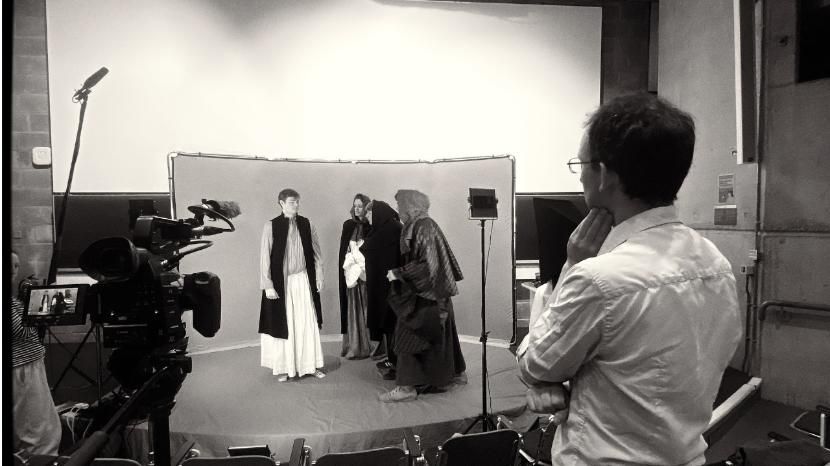
The 20-minute film stars Trinity students Olivia Romao (4th year Music) and Gwenhwyfar Ferch Rhys (4th year English/Classics) and was directed and produced by Professor Martin Worthington (School of Languages, Literatures and Cultural Studies).

The film is now freely available on YouTube with subtitles in 27 languages, including Irish, Arabic, Mandarin and Hungarian.

The film is available now on YouTube with subtitles in 27 languages 

“Sumerian was spoken in the south of ancient Iraq. It is probably the world’s first written language and died out around 2000 BCE. However, the ancient Babylonians kept it alive as a learned and liturgical language, just as today many people do with Latin,” explains Professor Worthington.

Eighteen students participated in the production, some as part of their formal studies, and others just for fun–which involved speaking a language from 4000 years ago, donning exciting costumes, and a lot of running around in Dublin’s Phoenix Park.

Gwenhwyfar Ferch Rhys, who played Dumuzi, said: “Viewers don’t need to feel too sorry for Dumuzi being led to the underworld. There is another Sumerian story where he gets to escape for part of every year—we might do that one next time!  And people interested in the history of religion may be interested to learn that Sumerian culture included a god who died and came back to life.”

Olivia Romao, who as well as studying Music in Trinity is also a professional actress, said: “Playing Dumuzi’s sister Ĝeštinana had me reflect on feminine power in ancient Sumer. Her key role in the Dumuzi story is an invitation to see feminine leadership historically as a soft and transformative form of power–a theme all the more important at a time when women’s rights worldwide are increasingly under threat.”

RTÉ interviews students and staff and films some of the Library's Sumerian clay tablets

Prof. Worthington, who acted as narrator, added: “To be able to access, via ancient Sumerian, some of the oldest recorded stories in the world is a huge opportunity to reflect on a different world but also on ourselves. Many viewers will find the Dumuzi story gripping and relatable. In making it widely accessible in film form we are both giving a voice to a long-forgotten people, and fostering human curiosity.”

The film was funded by Trinity College Dublin, the Philological Society, the CAENO Foundation, the Thriplow Charitable Trust, and the European Research Council (in connection with the project ‘Mesopotamian Orality and the Anthropology of Writing’, of which Dr Worthington is the principal investigator). Filming was done by Cinetext films. Video Editing and VFX Artistry was provided by Taichuan Tang. Costumes were supplied by the Abbey Theatre and the Samuel Beckett Theatre.

Filming in action in Trinity's Arts Building. Image: Shauna Rachael McGeoghan. 

Translation of the subtitles are thanks to collaboration with a wide network of individuals and institutions, including Tbilisi State University, the Council for British Research in the Levant (Amman Branch), and Seminari Theoloji Malaysia and Trinity’s Irish Department. Original score was composed by Rose Sherezade and Olivia Romao.

Watch the film on YouTube.


Thursday, December 4, 2025

Connected Philology: Interdisciplinary Perspectives on Transcultural Encounters

  • Edited by: Korinna Gonschorek , Marco Pouget , Luis Schäfer and Nikola Wenner
  • In collaboration with: Emanuele Ciarrocchi , Simon Haffner , Enbo Hu , Matthias Knallinger , Jonas Müller , Ophelia Norris , Elisabeth Seidel   and   Bastian Jürgen Wagner 
  • book: Connected Philology
  • Even though the similarities of philological methods and traditions across various cultures have been the subject of scholarly research, the reasons for these occurrences usually remain obscure. The present volume addresses this obscurity through introducing the concept of 'Connected Philology' from an interdisciplinary perspective. 'Connected Philology' explores underlying causes for similarities in philological practices: in the process of re-textualisation, written and oral traditions are translated, reformulated, and combined; the contact with foreign cultures leads to the expression of unfamiliar concepts in other languages, and the reconceptualisation of word meanings. In addition, such practices are understood in the context of an interplay between politics, society, and individual actors. The contributions focus on transcultural encounters, the subsequent movement of texts, processes of cultural transfer, as well as the history and politics of connected and connecting philology.
    Connected Philology transcends both national and disciplinary boundaries within philology and establishes connections with history, cultural studies, and linguistics.  

    of cultural transfer, as well as the history and politics of connected and connecting philology.
    Connected Philology transcends both national and disciplinary boundaries within philology and establishes connections with history, cultural studies, and linguistics.


    eBook ISBN: 9783111432861
    Hardcover ISBN: 9783111366753
    Audience(s) for this book
    Scholars and students of all philologies, cultural studies, linguistics, history
    Creative Commons
    BY-NC-ND 4.0
    Safety & product resources

    Open Access

    I

    Open Access

    V

    Open Access

    VII

    Open Access

    X

    Marco Pouget and Luis Schäfer
    Open Access

    1
    Single Words in Cultural Transfer Processes


    Philological Practices in Reading Orazio della Penna’s (1680–1745) Tibetan-Italian-Tibetan Dictionary
    Federica Venturi
    Open Access

    19

    Buddhist Sūtras and Cultural Translation in Rašīd al-Dīn’s Ǧāmiʿ al-tawārīḫ
    Chia-Wei Lin
    Open Access

    49

    An Analysis of Gal 3:28 through the Lens of Cultural Transfer
    Jonas Müller
    Open Access

    79
    Textual Networks and Transcultural Encounters


    Andrea Acri
    Open Access

    99

    Max Deeg
    Open Access

    133

    Korinna Gonschorek
    Open Access

    151
    History and Politics of Connected and Connecting Philology


    Nikola Wenner
    Open Access

    185

    Natalia Kamovnikova
    Open Access

    215

    Mert Moralı
    Open Access

    233

    Christian Høgel
    Open Access

    253

    Licensed


    Licensed