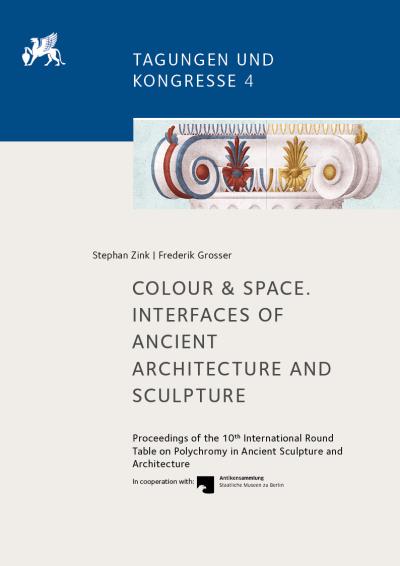
This volume presents a compilation of papers focused on the phenomenology of colour in both architecture and sculpture. It specifically highlights interactions of polychromy within spatial settings, as well as architecture and sculpture’s shared technological and artistic knowledge base. Research on ancient polychromy has evolved significantly since the first scientific pigment analyses in the 1830s, and the «International Round Table on Polychromy in Ancient Architecture and Sculpture», established in 2009, serves as a testament to this progress. The present volume features a selection of papers from the 10th Meeting of the International Round Table, jointly hosted by the German Archaeological Institute in Berlin (DAI) and the Antikensammlung Berlin in 2020. The case studies and comprehensive analyses presented range chronologically from the Greek Archaic to the Medieval periods, and cover a geographic range that includes the Mediterranean Basin and Great Britain. Papers explore various themes, such as the potential of spatial re-contextualisations to offer new insights into colour choices and materials, the dynamics of colour as a medium influencing form and synaesthetics, as well as symbolisms and meanings, particularly in the use of specific colours such as purple, black, gold, and blue. Additionally, a final section on ongoing museum research showcases ground-breaking polychromy studies and experimental visualisation strategies. This volume reflects a collaborative effort to move beyond the traditional academic separation of architecture and sculpture. It advocates for viewing colour (and surface treatments in general) as enduring interfaces between architecture and sculpture, emphasising conceptual and technological connections that challenge conventional taxonomies.
Copyright (c) 2025 Deutsches Archäologisches InstitutDetails about the available publication format: Buy Print Edition
Buy Print EditionISBN-13 (15)
978-3-7520-0860-9Physical Dimensions
Details about the available publication format: PDF
ISBN-13 (15)
978-3-7520-0860-9Stephan Zink; Frederik Grosser, Antikensammlung – Staatliche Museen zu Berlin; Susanna Bracci, ISPC-CNR; Paola Marraffa, Parco Archeologico di Ercolano; Marie Svoboda, J. Paul Getty Museum, Los Angeles; Kenneth Lapatin, J. Paul Getty Museum, Los Angeles; Francesco Sirano, Parco Archeologico di Ercolano; Elisabetta Canna, Parco Archeologico di Ercolano; Lucrezia Ungaro, Sovrintendenza Capitolina Beni Culturali di Roma; Ina Reiche, CNRS Délégation Paris B; Jana Hainbach, TU München; Yannick Vandenberghe, Centre de recherche et de restauration des musées de France (C2RMF), Paris; Miguel F. Pérez Blasco, Museo Arqueológico y de Historia de Elche; Maria Perla Colombini, Università di Pisa; Monica Ceci, Sovrintendenza Capitolina ai Beni Culturali; Aurélie Mounier, Archéosciences Bordeaux (UMR 6034, CNRS – Université Bordeaux Montaigne – Université de Bordeaux) (ex-IRAMAT-CRP2A: UMR 5060); Katharine Raff, The Art Institute of Chicago; Jens Pflug; Brigitte Bourgeois, Centre de recherche et de restauration des musées de France (C2RMF), Paris; Ilaria Degano, Università di Pisa; Caroline Roberts, Kelsey Museum of Archaeology, University of Michigan; Adriana Rizzo, The Metropolitan Museum of Art; Roberta Iannaccone, Università degli Studi di Sassari; Silvia Pedone, Accademia Nazionale dei Lincei; Giovanni Verri, The Art Institute of Chicago; Marco Leona, The Metropolitan Museum of Art; Paola Antonella Andreuccetti, Istituto Storico Lucchese; Jan Stubbe Østergaard, Ny Carlsberg Glyptotek; Clara Granzotto, The Art Institute of Chicago; Rachele Manganelli Del Fà, ISPC-CNR; Federico Carò, The Metropolitan Museum of Art; Markus Schlicht, Ausonius (UMR 5607, CNRS – Université Bordeaux Montaigne); Sara Lenzi; Josefina Pérez-Arantegui, Universidad de Zaragoza; Giovanni Bartolozzi, IFAC-CNR; Donata Magrini, ISPC-CNR; Maud Mulliez, ArScAn (UMR 7041, CNRS – Université Paris-Nanterre), Archéosciences Bordeaux (UMR 6034, CNRS – Université Bordeaux Montaigne – Université de Bordeaux) (ex-Archeovision: UMS 3657); Elena Walter-Karydi, University of Saarbrücken; Paolo Liverani, Università degli Studi di Firenze; Elena Basso, The Metropolitan Museum of Art; Matthias Alfeld, Delft University of Technology; Dorothy H. Abramitis, The Metropolitan Museum of Art; Nobuko Shibayama, The Metropolitan Museum of Art; Violaine Jeammet, Musée du Louvre; Philippe Jockey, Paris-Nanterre University; Sarah Lepinski, The Metropolitan Museum of Art; Teresa Chapa Brunet, Universidad Complutense de Madrid; Seán Hemingway, The Metropolitan Museum of Art; Lothar Haselberger, University of Pennsylvania; Rachel Sabino, The Art Institute of Chicago; Federica Pozzi, Centro per la Conservazione ed il Restauro dei Beni Culturali "La Venaria Reale"; María Belén Deamos, Universidad de Sevilla
No comments:
Post a Comment